

GCSE Arabic Foundation Tier: Easier or Different?
GCSE Arabic Foundation tier easier? Compare demand, content, grade limits and exam skills, then decide which tier best fits your current performance.
The word Foundation can sound reassuring. It suggests a gentler paper, familiar vocabulary and fewer moments when the question feels beyond reach. But if you are asking whether GCSE Arabic Foundation tier is easier, the honest answer is: yes, its questions are designed to be less demanding than Higher tier questions, but it is not an easy version of the qualification.
Foundation still tests listening, speaking, reading and writing. It still requires vocabulary recall, accurate communication and sensible timing. The more useful question is not simply, “Which paper is easier?” It is, “Which tier gives me the best chance of showing what I can reliably do?”
The short answer
For Pearson Edexcel GCSE Arabic, Foundation tier:
- targets grades 111 to 555;
- uses less demanding vocabulary and grammatical structures than Higher;
- has shorter assessment times in several components;
- still assesses listening, speaking, reading and writing;
- places the same broad skills at the centre of the qualification;
- cannot award a grade above 555.
Higher tier targets grades 444 to 999, although a grade 333 may sometimes be awarded when a result falls a small number of marks below the grade 444 boundary. Higher students are expected to handle Foundation material as well as additional grammar, broader expression and more demanding language.
So Foundation is genuinely less demanding in its level of language. Yet it can feel merely different because its challenge is often accuracy on accessible material rather than coping with the most complex material.
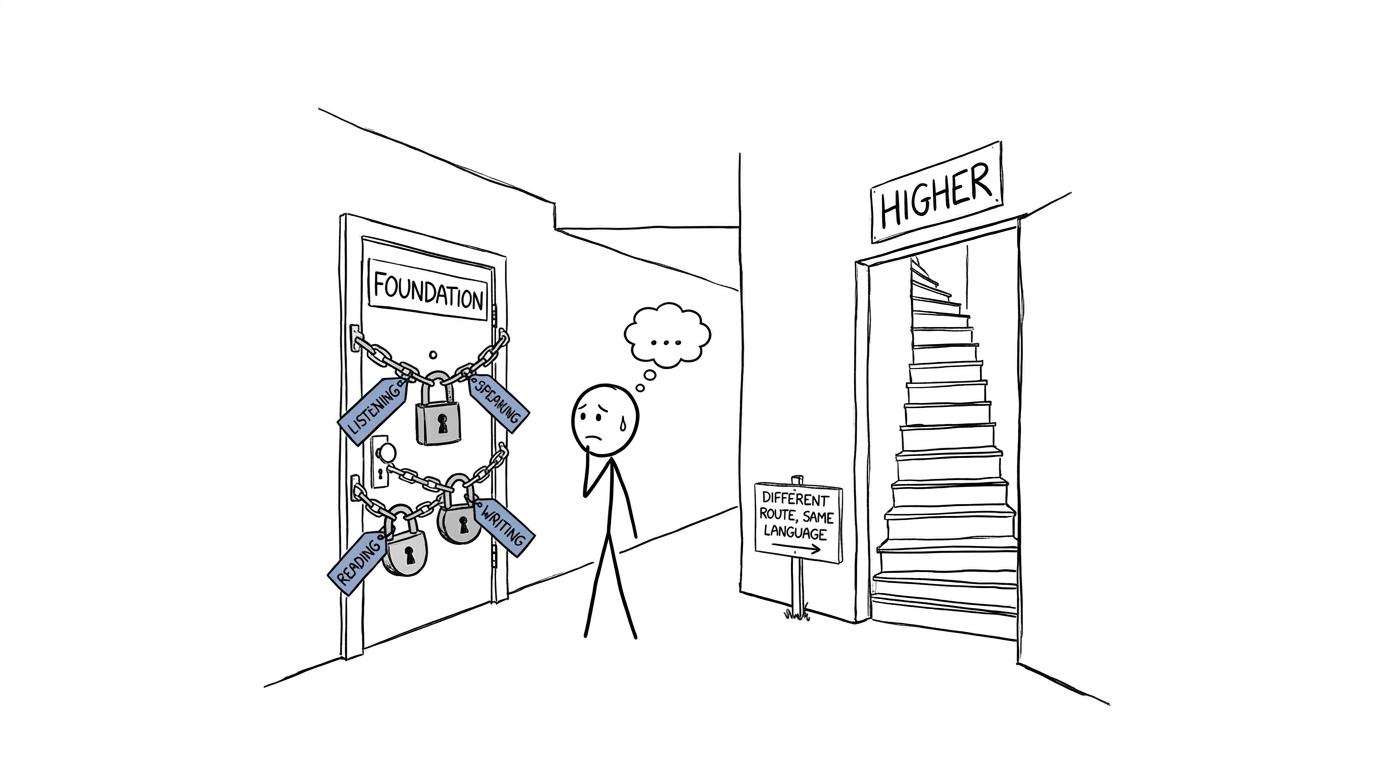 A student choosing between Foundation and Higher routes
What Foundation tier actually assesses
Current GCSE modern foreign language rules require an overlapping tier model. Foundation questions and tasks are targeted at the level needed for grades 111 to 555, while Higher assessments target grades 444 to 999.
Under the current Pearson Edexcel GCSE Arabic specification, students take four papers:
- listening and understanding in Arabic;
- speaking in Arabic;
- reading and understanding in Arabic;
- writing in Arabic.
Each skill contributes 25%25\%25% of the qualification. This balance matters. Being a confident speaker does not remove the need to read accurately, and knowing a long vocabulary list will not compensate completely for weak writing.
All four papers must be entered at the same tier. You cannot, for example, take Foundation listening and Higher writing. Your tier is a decision about the whole qualification.
Listening and reading are not passive skills
Foundation listening uses language at an appropriate level for grades 111 to 555, but recordings still move forward whether or not you understood the previous phrase. You must identify relevant details, distinguish between plausible answers and follow meaning rather than wait for one familiar word.
Reading includes different text types and a translation from Arabic into English. Some questions and instructions use English, while others use Arabic. The challenge is therefore not just recognising individual words. You need to understand what the text is doing and answer the question actually asked.
Speaking still requires interaction
The Foundation speaking assessment lasts between 777 and 999 minutes, with formal preparation time. It includes a role play, a picture-based task and a conversation.
That is shorter than the Higher assessment, but shorter does not automatically mean comfortable. Speaking places recall, pronunciation, comprehension and response speed into the same few minutes. A student who knows the vocabulary on paper may still need deliberate speaking practice to retrieve it aloud.
Writing rewards clear communication
Foundation writing tasks are more accessible than Higher tasks, but successful answers still need relevant content, understandable language and suitable grammar. Memorising an impressive paragraph can be risky if it does not fit the prompt.
A simpler sentence that answers the question is usually more useful than an ambitious sentence whose meaning collapses. Foundation is designed around accessible demand, not around awarding marks for vague or incomplete communication.
Why GCSE Arabic Foundation is genuinely easier
There are three important ways in which Foundation has lower demand.
The grade target changes the question design
Foundation assessments are specifically targeted at grades 111 to 555. Higher assessments must distinguish between students working across grades 444 to 999, so they need material capable of testing deeper understanding, greater range and stronger control.
This is similar to tier choice in GCSE maths, although the subjects assess very different knowledge. MathsGenie’s GCSE maths topics by exam board and tier guide explains the same central principle: Foundation is not simply Higher with the final questions removed. Tier affects the level and balance of demand across the paper.
Higher includes additional grammar
Government subject content separates grammar requirements by tier. Higher candidates are expected to apply Foundation grammar and additional Higher structures. That creates a real difference in expected range and complexity.
Foundation students still need grammatical control. They are simply not required to demonstrate the full Higher range.
Some assessments are shorter
For example, the current Foundation speaking assessment lasts 777 to 999 minutes, compared with 101010 to 121212 minutes at Higher. Foundation listening is also shorter under the current framework.
Less time does not necessarily make every minute easier, but it reflects a reduced volume and level of demand.
Why Foundation can still feel just different
The strange thing about tiered exams is that reducing complexity does not remove pressure. It moves the pressure.
On Higher, a student may meet language they genuinely do not know. On Foundation, more of the paper may look familiar, so dropped marks can come from incomplete details, misunderstood instructions or preventable inaccuracies. The task feels accessible, but the grade 555 boundary still demands a strong performance.
The grade ceiling changes the decision too. If your realistic target is above grade 555, Foundation cannot deliver it, however high your raw mark may be. Conversely, entering Higher solely because grade 666 or above exists is unhelpful if current evidence shows that the Higher papers are consistently inaccessible.
This is why tier choice should be based on marked evidence, not status. The MathsGenie guide to finding weak topics describes a useful process for maths that transfers well to languages: complete an appropriate assessment, mark it carefully, classify each lost mark and then repair the underlying weakness.
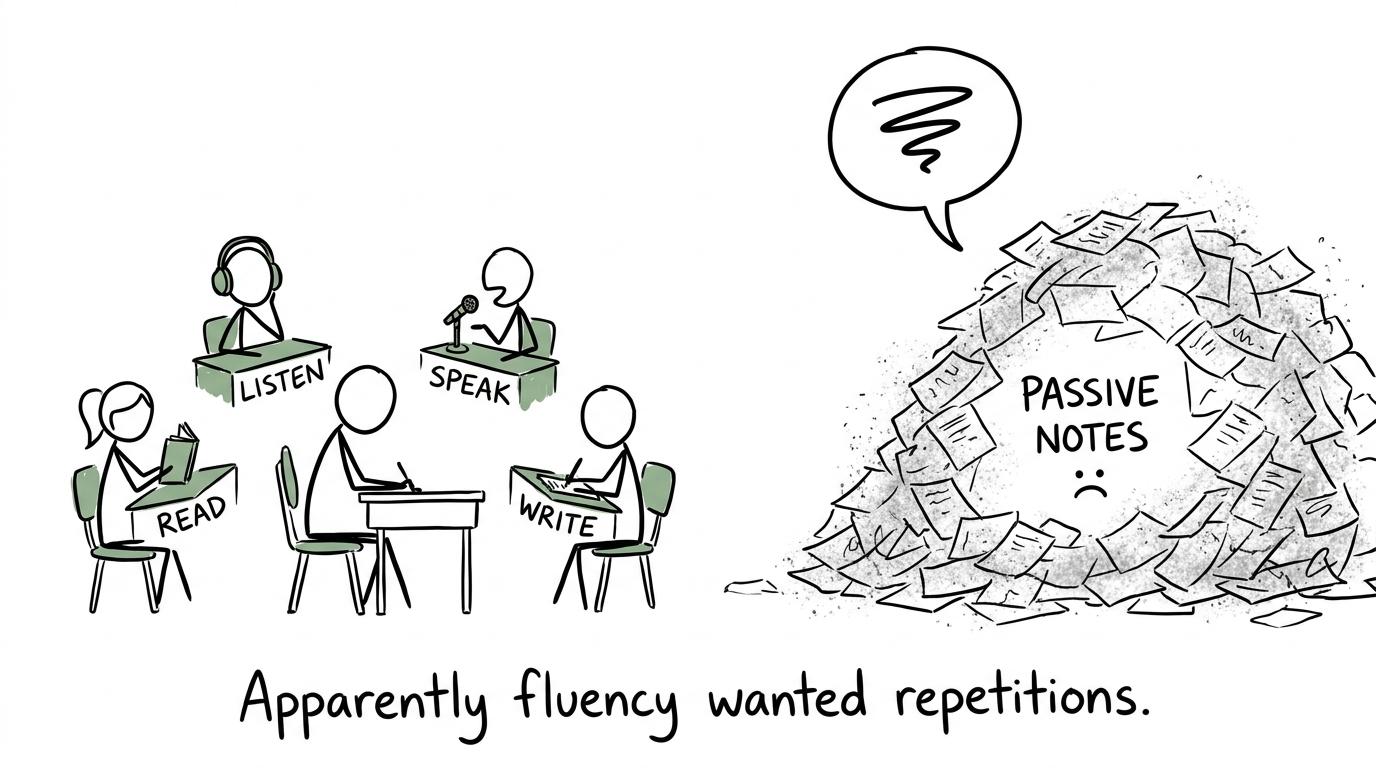 A four-skill revision workout replacing passive notes
How to decide which tier suits you
Your teacher or examinations officer handles the formal entry, so discuss the decision with them. Before that conversation, gather useful evidence.
Compare performance across all four skills
Do not base the decision on your favourite component. Record separate results for listening, speaking, reading and writing. Because each contributes 25%25\%25%, a serious weakness in one area matters.
Ask:
- Can I understand the main message and supporting details?
- Can I answer unfamiliar but tier-appropriate questions without constant prompting?
- Can I speak spontaneously instead of only reciting memorised material?
- Can I write relevant answers accurately within the available time?
- Are my results stable across more than one assessment?
One unusually good mock is encouraging, but a pattern is more informative.
Look at accessibility, not just the total mark
A total mark can hide the nature of your performance. On a Higher paper, were you close to the target because you attempted most questions, or because isolated answers happened to score? On Foundation, are you securely reaching your goal, or repeatedly losing straightforward marks?
Maths students can apply the same reasoning when choosing a tier. Start from the GCSE Maths revision hub, select the correct board and compare your performance using revision lessons, practice questions and papers. The subjects differ, but evidence-based tier decisions work in both.
Remember that boundaries change
Grade boundaries are set for individual examination series, so do not treat a previous boundary as a permanent target. MathsGenie’s Edexcel GCSE Arabic grade boundaries page lets you compare published historical outcomes, but these figures are context, not a prediction of the next boundary.
Use raw marks to monitor progress while keeping the official grade range in mind: Foundation offers grades 111 to 555.
Revise for the demands of Foundation
Foundation revision should make accessible language dependable. That requires active practice across each skill.
For listening, use short recordings and listen more than once with a different purpose: first for the overall message, then for details, negatives, opinions and time references. For speaking, rehearse responses aloud and practise recovering when you do not immediately understand a prompt.
For reading, underline the part of the text that supports each answer. For writing, check that every sentence contributes directly to the task before checking verbs, agreements, spelling and clarity.
A useful cycle is:
- retrieve vocabulary without notes;
- apply it in one of the four skills;
- mark or review the response;
- name the exact error;
- repeat the skill later with fresh material.
This mirrors the approach in MathsGenie’s efficient GCSE maths revision guide: learn, practise, mark and fix. For maths preparation, you can then use Edexcel GCSE maths mini tests for short checks and Edexcel predicted papers for fresh exam-style practice.
Common mistakes when judging Foundation tier
Assuming Foundation means little revision is needed
The vocabulary and structures are more accessible, but success still depends on reliable recall and communication across four equally weighted skills.
Choosing Higher for prestige
Tier is not a judgement about intelligence. It is an assessment route. Choose the route supported by current performance and your required grade, in discussion with your school.
Choosing Foundation after one difficult Higher paper
A single paper may expose an unusually weak topic or poor day. Compare several assessments and identify whether the difficulty is consistent.
Ignoring the grade 555 ceiling
A student needing grade 666 or above must take Higher. Foundation cannot award that grade, regardless of how strong the performance is.
Revising Arabic only by rereading notes
Recognition feels fluent because the page supplies the answer. Exams require retrieval. Listening, speaking, reading and writing must all be practised actively.
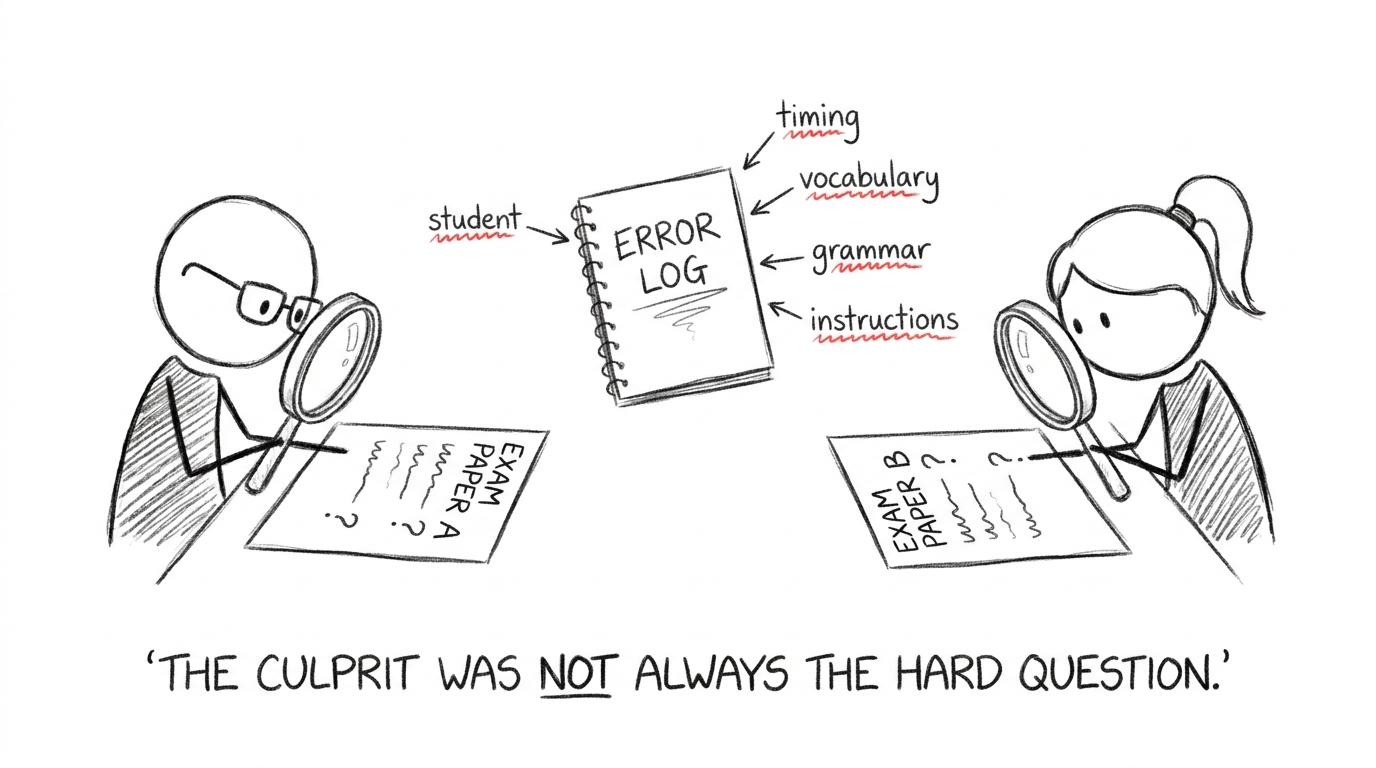 Students investigate the real causes of lost marks
The better question to ask
Is GCSE Arabic Foundation tier easier? In assessment terms, yes. It is targeted at a lower grade range, uses tier-appropriate grammar and includes shorter or less demanding tasks. But “easier” can mislead if it suggests effortless. Foundation covers the same four language skills, and a secure grade 555 still requires consistent performance.
The best tier is the one that matches your evidence and your goal. Talk to your teacher, compare several marked assessments and revise the precise skills that cost you marks.
For your maths exams, make MathsGenie your free revision base. Begin with the GCSE Maths revision hub, repair gaps with revision lessons and practice questions, then build confidence through mini tests, past papers, predicted papers, mark schemes and video solutions. A tier label tells you where the assessment is aimed. Careful practice determines what you can do when it arrives.










