

GCSE Arabic Flashcards Quizlet: Best Decks
GCSE Arabic flashcards Quizlet guide: find reliable Edexcel decks, check vocabulary, avoid weak sets and build your own fast for smarter revision.
Finding a flashcard deck is easy. Finding one you can trust is harder. Search for gcse arabic flashcards quizlet and you will see broad vocabulary collections, topic sets, speaking answers and decks mixing Modern Standard Arabic with regional dialects. They may all look useful at first glance.
The short answer is this: start with decks clearly organised around the Pearson Edexcel GCSE Arabic specification, check every unfamiliar term against Pearson’s official vocabulary list or your teacher’s materials, and use smaller topic decks for active recall. Treat public Quizlet sets as editable starting points, not unofficial mark schemes.
Flashcards can build vocabulary quickly, but they cannot replace listening, speaking, reading and writing practice. The best revision system combines both.
Your GCSE Arabic flashcard checklist
Before using or copying a deck, ask:
- Does it name Pearson Edexcel GCSE Arabic or qualification code 1AA0?
- Is the vocabulary grouped by the five specification themes?
- Does it use Modern Standard Arabic rather than unexplained dialect?
- Are spelling, translations and gender forms accurate?
- Does it include useful verbs, connectors and time phrases?
- Can you answer from English to Arabic, not merely recognise English meanings?
- Is the deck small enough to review without guessing or rushing?
- Have you checked difficult entries against an authoritative source?
A deck that passes most of these checks is worth testing. A deck with no exam board, theme or source should be treated cautiously.
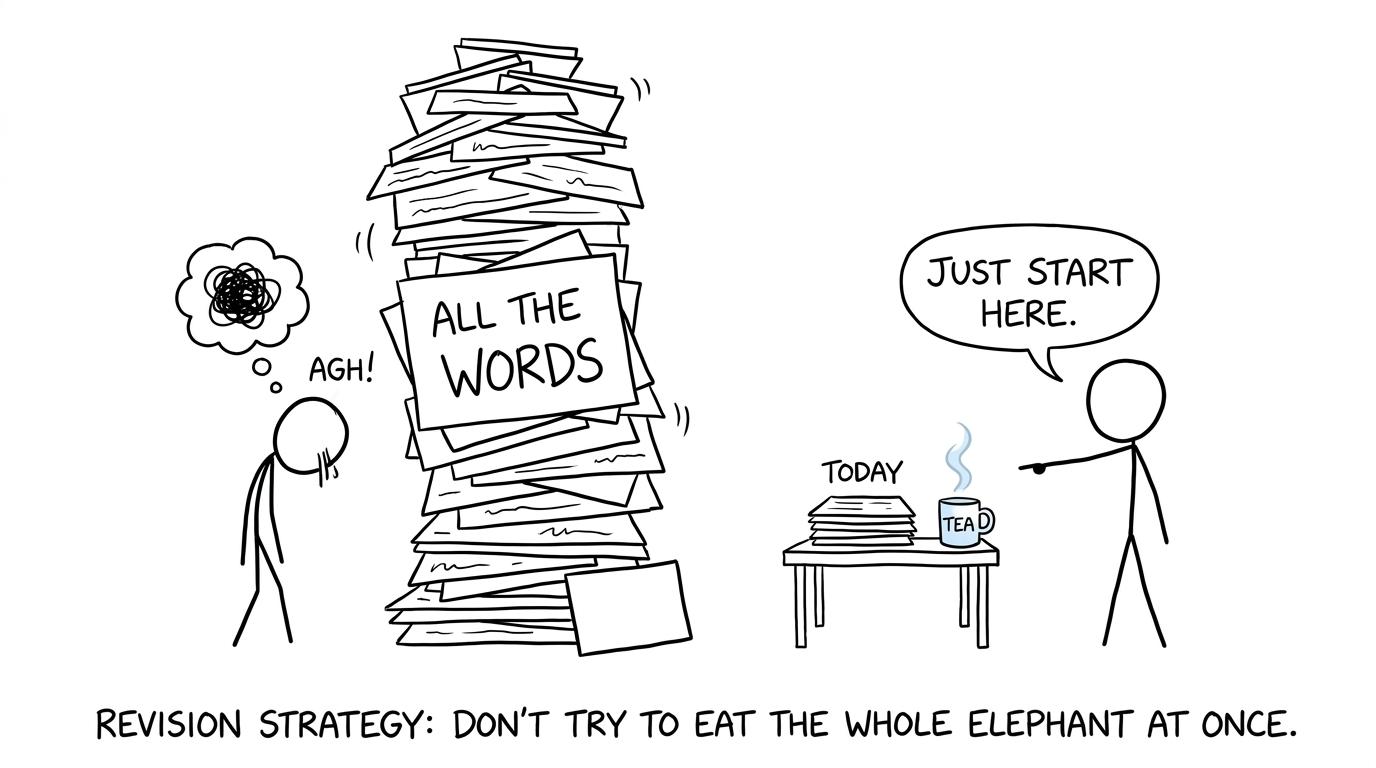 A student choosing a manageable flashcard stack instead of every word at once
Which GCSE Arabic Quizlet decks are worth using?
There is no single public Quizlet deck that should be accepted as a perfect copy of the specification. User-created sets can be changed, contain transcription errors or follow a different course. The safest answer is to choose decks by purpose.
The Pearson Edexcel vocabulary list should be your master deck
Pearson’s official GCSE Arabic vocabulary spreadsheet is the strongest starting source. It separates high-frequency language from topic-specific vocabulary, including common verbs, adjectives, adverbs, prepositions, conjunctions, numbers and words linked to each theme.
It is not itself a Quizlet set, but it gives you the material from which a reliable set can be made. If a public deck claims to contain the complete course vocabulary, compare its headings and entries with this list before investing hours in it.
A large deck based on the official list is useful for checking coverage. It is usually less effective as your everyday revision queue. Copy the words you need into smaller sets rather than trying to master hundreds of unrelated cards in one sitting.
“GCSE Arabic vocabulary” is a useful broad starting set
The public Quizlet set titled GCSE Arabic vocabulary can be useful as an initial bank of words. Its advantage is breadth: it offers a quicker starting point than entering every common word manually.
However, a broad title does not prove full specification alignment. Check whether the set covers all five Edexcel themes, whether Arabic spelling is consistent and whether words are given in a form you can actually use in a sentence. Use it as a bank to audit and customise, not as your only revision resource.
Topic decks are best for daily recall
The Edexcel specification organises content into five themes:
- Identity and culture
- Local area, holiday and travel
- School
- Future aspirations, study and work
- International and global dimension
Search Quizlet using the exact theme plus “GCSE Arabic”. A focused set such as Ali GCSE Arabic: Theme 3: School (Speaking and Writing Sample Q&As) is more useful when you are preparing language for one topic than a random general Arabic deck.
Question-and-answer decks can help you notice useful sentence structures. Do not memorise complete model answers blindly. An examiner’s question may change, and an answer that sounds impressive but does not address it will not help. Extract reusable phrases, verbs and opinions, then adapt them to your own meaning.
Linking-word decks are useful but require careful checking
The set titled Arabic: Useful linking words contains vocabulary for extending writing, including equivalents of “because”, “although”, “also” and “first of all”. This category is valuable because connectors help you move beyond disconnected statements.
Yet short language decks can still contain spelling mistakes, inconsistent forms or awkward translations. Verify each connector before learning it. Ten accurate phrases you can deploy naturally are worth more than fifty uncertain ones.
Avoid dialect and beginner-course decks unless your teacher recommends them
Search results often include Egyptian Arabic, Darija, Levantine phrases, alphabet courses and vocabulary from unrelated textbooks. These may be good resources for learning Arabic generally, but that is not the same as preparing for GCSE Arabic.
Pearson assesses understanding and production of standard Arabic across the qualification. A dialect deck is therefore not a substitute for specification vocabulary. Keep it only if your teacher has explained why a particular expression is appropriate.
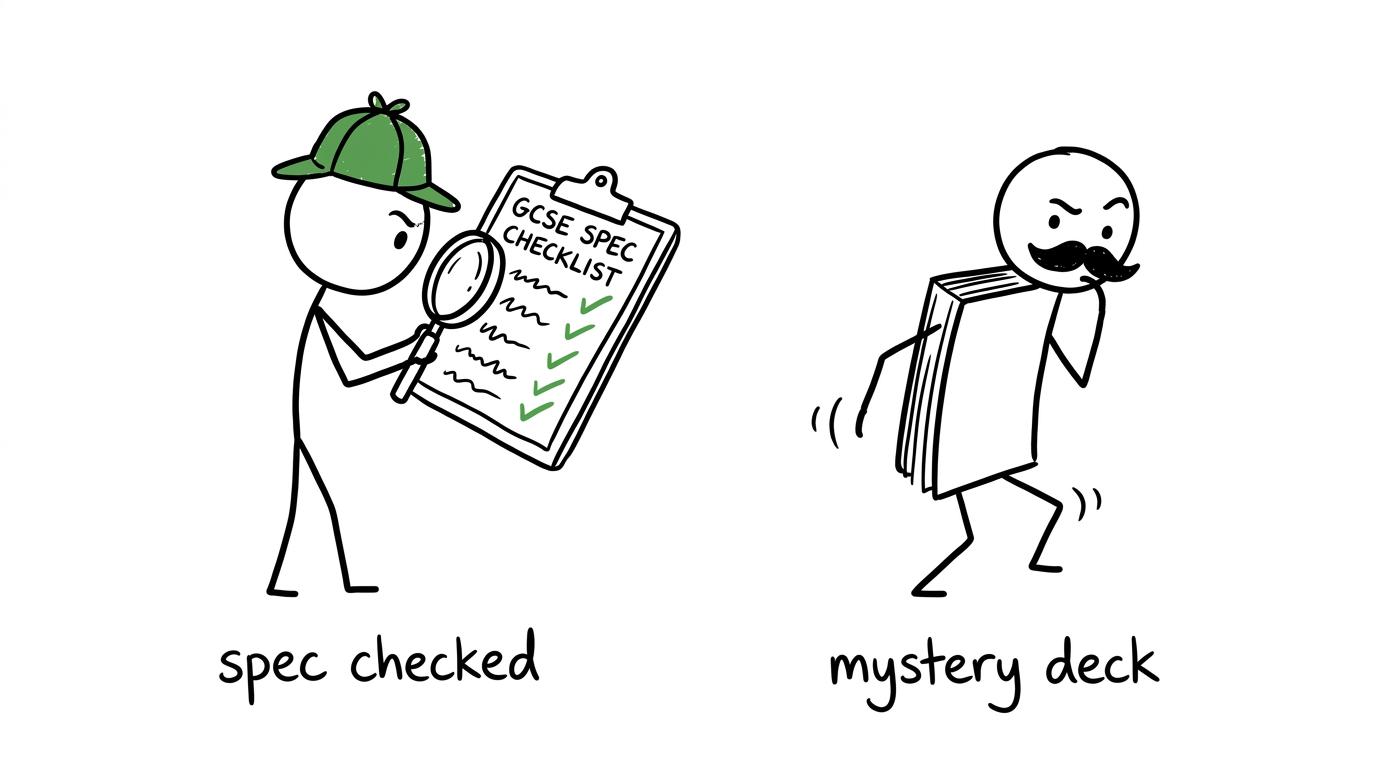 A specification detective checking a reliable deck while a mystery deck escapes
How to judge a Quizlet set in five minutes
Open the set and inspect a sample from its beginning, middle and end. Look for these signals.
Strong signals
- The title names Edexcel, GCSE Arabic or a specification theme.
- Arabic script is used consistently and displays correctly.
- Terms match vocabulary from your course materials.
- Cards include enough context to distinguish similar meanings.
- The creator separates vocabulary from longer speaking answers.
- The deck has a manageable, clearly defined purpose.
Warning signals
- The set mixes transliteration, dialect and Modern Standard Arabic without labels.
- English meanings are vague or grammatically different from the Arabic term.
- Several cards contain obvious typing errors.
- One card holds an entire paragraph.
- The deck claims to guarantee a particular grade.
- There is no clue which exam board or course it follows.
Popularity is not verification. A widely copied error remains an error. Your specification, teacher and official vocabulary materials outrank likes, saves or search position.
How to build your own GCSE Arabic flashcards fast
Making your own set sounds slower, but selective creation often saves time. You decide what belongs in the deck, and the act of checking each term gives you a first encounter with it.
Start with one theme, not the whole course
Choose the topic you are currently revising. Copy only the vocabulary you do not recall securely. A practical first set might contain around 202020 a few 404040 cards rather than several hundred.
Name it precisely, such as “Edexcel GCSE Arabic: School: Weak Vocabulary”. A clear title makes later review easier.
Import terms in two columns
Prepare one column for the prompt and one for the answer. Quizlet can separate terms and definitions when pasted in a consistent format. Check the imported Arabic carefully, particularly joined letters, punctuation and text direction.
Keep one testable idea on each card. If a card contains a noun, a verb, three example sentences and a grammar note, you will not know what a correct answer means.
Build more than simple word pairs
A strong collection should include several card types:
- English prompt to Arabic answer
- Arabic prompt to English meaning
- Verb to a required form or tense
- Question to a short adaptable response
- Connector to its function
- Common error to corrected spelling
- Audio prompt where accurate pronunciation is available
For nouns, include grammatical information when it matters. For verbs, record enough information to use the word rather than merely recognise it. Ask your teacher how much detail is appropriate for your class and tier.
Tag every card by source and theme
Add a short note such as “Pearson vocabulary list”, “teacher booklet” or “corrected after mock”. This makes uncertain cards easy to audit. It also stops one public Quizlet typo from quietly spreading across your entire revision system.
Create a mistakes deck
After a vocabulary test, listening task or writing exercise, move every genuine gap into one small deck. This becomes more valuable than a generic collection because it reflects your weaknesses.
The same principle works in maths. MathsGenie’s guide to finding your weakest GCSE topics explains why evidence from mistakes should direct the next revision session. Revision improves when it responds to what you cannot yet do.
How to use flashcards so the words actually stick
Looking at a card and thinking “that seems familiar” is recognition, not reliable recall. Retrieval practice requires you to produce the answer before revealing it. Research on learning consistently supports combining retrieval with revisiting material across separate sessions.
Use this routine:
- Read the prompt and pause.
- Say or write the complete answer from memory.
- Reveal the card and compare carefully.
- Mark it wrong if spelling or meaning would cause confusion.
- Correct the answer immediately.
- Return to the card on another day.
Practise in both directions. Arabic-to-English retrieval supports reading and listening recognition; English-to-Arabic retrieval is more demanding and supports writing and speaking.
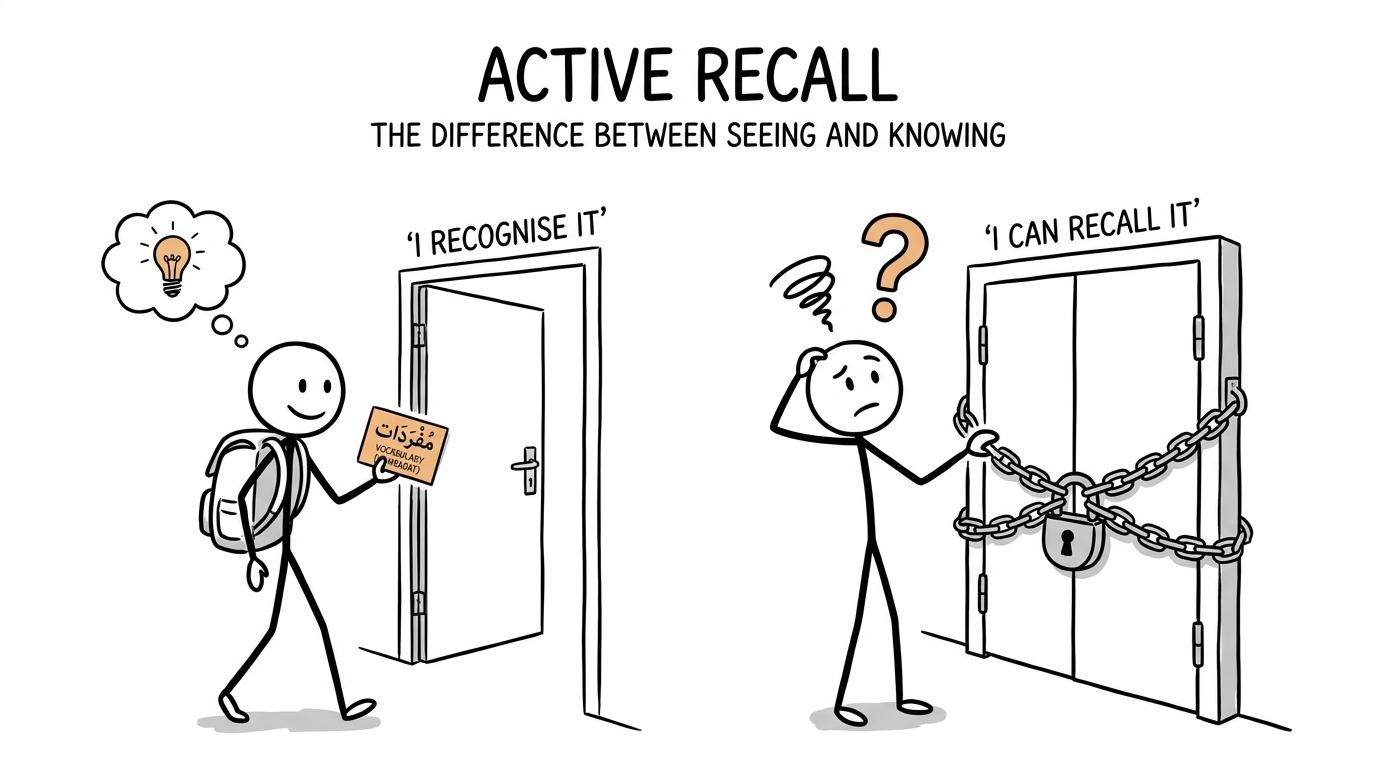 A student discovering that recall is harder than recognition
Quizlet offers flashcard, Learn and Test-style activities, although available features can depend on the account and current product version. Whatever mode you choose, do not let multiple-choice success become your only evidence. Finish by producing words without visible options.
A simple spaced pattern is to revisit new cards the next day, then several days later, then after a week. Adjust the interval when a card remains weak. Maths students can use the same approach alongside MathsGenie’s guide to stopping GCSE content from being forgotten.
Flashcards are only one part of GCSE Arabic revision
Pearson Edexcel GCSE Arabic assesses listening, speaking, reading and writing in four compulsory papers, with each skill carrying 25%25\%25% of the qualification. Vocabulary supports all four, but flashcards alone do not recreate any complete paper.
Turn recalled words into something active:
- listen for them in short audio tasks;
- say them inside an original response;
- identify them in a reading passage;
- use them in timed writing;
- practise translation in both directions.
This matters when you are balancing Arabic with GCSE maths. Keep one revision plan rather than separate piles of good intentions. The GCSE maths revision timetable guide can help you organise short retrieval sessions alongside deeper practice.
For maths, move from free GCSE maths revision lessons into GCSE mini tests and 45-minute maths tests. That progression mirrors effective language revision: learn the content, retrieve it, then use it under realistic conditions.
Common mistakes with GCSE Arabic flashcards
Trusting the title instead of checking the content
“GCSE Arabic” in a title does not guarantee Edexcel alignment or accurate Arabic. Compare the cards with official vocabulary and teacher-approved materials.
Learning only from Arabic to English
Recognition feels quick, which makes it reassuring. But speaking and writing require production. Reverse the cards regularly and write the Arabic before checking.
Keeping decks that are too large
A huge deck hides weak vocabulary among words you already know. Split it by theme, confidence or source, then prioritise the cards that cause errors.
Memorising paragraphs as single cards
Long model answers encourage imitation without flexibility. Break them into adaptable opinions, reasons, tense phrases and connectors.
Ignoring spelling and pronunciation
A meaning that is “nearly right” may conceal an important distinction. Check every doubtful form and use accurate audio or teacher feedback for pronunciation.
Replacing exam practice with app activity
A long Quizlet streak is not the same as completing an assessment task. In maths, use Edexcel GCSE maths past papers and mark schemes; in Arabic, use official specimen or past assessment material supplied by Pearson and your school. Marked practice reveals whether recalled knowledge survives an exam question.
Build a smaller system you can trust
The best GCSE Arabic flashcards are not necessarily the longest or most popular. They are the ones that match the specification, contain accurate Modern Standard Arabic, expose your weak vocabulary and make you retrieve answers without hints.
Begin with Pearson’s vocabulary list, audit broad public sets, use theme decks selectively and create a personal mistakes deck. Then move beyond the cards into listening, speaking, reading and writing.
For the maths side of your GCSE revision, let MathsGenie remove the search and decision-making. Use the free revision lessons and practice questions, diagnose gaps with mini tests, and build exam confidence through past papers, predicted papers, mark schemes and video solutions. A good resource matters. A repeatable routine matters more.










