GCSE Arabic Exam Time of Day: Does It Matter?
GCSE Arabic exam time of day can affect alertness, but it need not decide your grade. Learn the timetable rules and prepare for morning or afternoon.
There is a particular kind of worry that appears once the revision is mostly done. It is no longer about vocabulary, listening practice or writing accurately. It is about the timetable.
Will you think clearly in a morning exam? Will an afternoon paper arrive just as your energy dips? The short answer is that GCSE Arabic exam time of day can affect how alert you feel, but it is unlikely to determine your result by itself. Sleep, preparation, food, anxiety, exam technique and familiarity with the paper are all more controllable influences.
You normally cannot choose the session for a written GCSE examination. What you can do is prepare your routine for the time printed on your school’s candidate timetable.
The quick answer and exam-day checklist
Keep these points in mind:
- Check whether each Arabic paper is in the morning or afternoon.
- Use your school’s candidate timetable, not an old timetable found online.
- Expect published UK session times of 9.00 am9.00\text{ am}9.00 am and 1.30 pm1.30\text{ pm}1.30 pm, although schools can start within permitted windows.
- Practise some timed work during the same part of the day as the real paper.
- Protect your sleep rather than extending revision late into the night.
- For an afternoon exam, plan a familiar lunch and avoid a morning revision marathon.
- Confirm the separate arrangements for your speaking assessment with your school.
- Arrive at the time specified by your exams officer.
The timetable is fixed. Your preparation for it does not have to be.
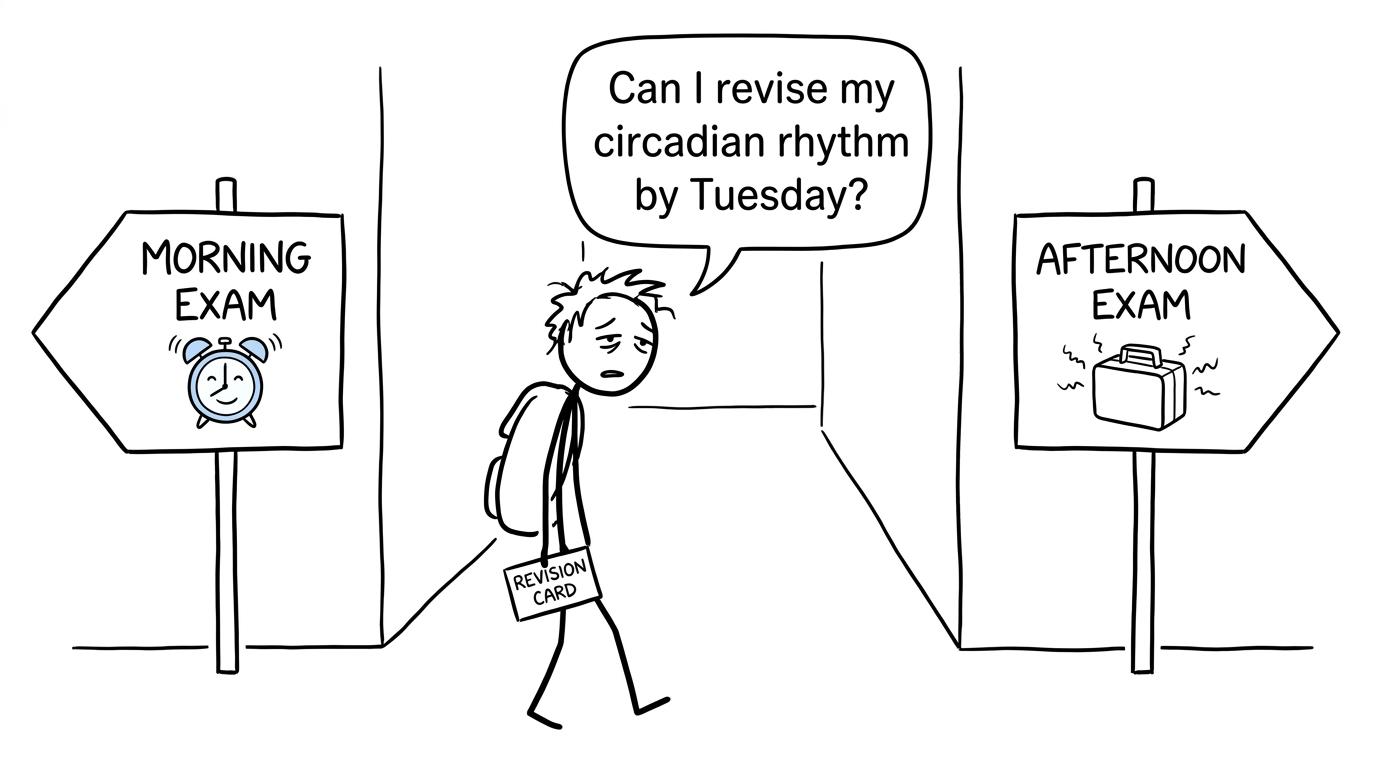 A sleepy student choosing between morning and afternoon exams
What time are GCSE Arabic exams held?
GCSE Arabic candidates should check the timetable for their exact exam series and qualification. The current Pearson Edexcel GCSE Arabic qualification includes listening, speaking, reading and writing assessments at Foundation and Higher tier.
The written papers are assigned nationally to morning or afternoon sessions. As a recent example, Pearson’s final summer 2026 timetable placed the listening and reading papers in the morning on 22 May, while the writing paper was in the afternoon on 2 June. Future dates and sessions can change, so these should not be treated as a timetable for another year.
The speaking assessment works differently. It is conducted by the school during a window set by Pearson, so your individual appointment may be in the morning or afternoon. Ask your Arabic teacher or exams officer for your confirmed time.
Under the Joint Council for Qualifications instructions for the 2025/26 academic year, the published starting time was 9.00 am9.00\text{ am}9.00 am for morning examinations and 1.30 pm1.30\text{ pm}1.30 pm for afternoon examinations. UK centres could normally begin up to 303030 minutes earlier or later. CCEA used a published morning time of 9.15 am9.15\text{ am}9.15 am.
That flexibility belongs to the centre, not the candidate. If your timetable says to arrive at 8.30 am8.30\text{ am}8.30 am, do not assume that the paper will simply begin at 9.00 am9.00\text{ am}9.00 am. Follow the instructions from your school.
Does morning versus afternoon affect performance?
Potentially, yes, but not in a simple way that allows us to say afternoon is always better.
Research into adolescents, chronotype and assessment performance suggests that some students perform differently across the day. A Dutch study examining thousands of secondary-school examination grades found that early chronotypes performed better than later chronotypes during morning examinations, while this difference disappeared in the early afternoon. A later review of adolescent research found evidence that performance can improve when testing time matches a person’s circadian preference, although results vary across tasks and circumstances.
This matters because teenagers commonly experience a shift towards later sleeping and waking patterns. A student who struggles to feel alert early in the morning may find an early listening examination uncomfortable. Equally, another student may feel sharp before lunch but sluggish after eating.
However, this research does not prove that every GCSE Arabic candidate will score more highly in the afternoon. Much of the evidence comes from different countries, age groups, subjects or assessment settings. There is no good basis for predicting a particular change in your Arabic grade merely from the label “morning” or “afternoon”.
The most useful conclusion is narrower: alertness can vary, individual patterns differ, and a routine that reduces avoidable tiredness is worthwhile.
Why the paper itself also matters
Listening, reading and writing place different demands on attention.
A listening paper requires immediate concentration. If your mind drifts during a recording, you cannot treat the missed information like a paragraph and simply read it again whenever you wish. A morning candidate therefore needs to be mentally awake before entering the room, not five questions into the paper.
Writing requires sustained recall, organisation and checking. An afternoon slot can provide more time to settle before the exam, but it also creates more hours in which to worry, over-revise or become tired.
Neither session is automatically easier. Each creates a different preparation problem.
How to prepare for a morning Arabic exam
A successful morning begins the previous evening. Teenagers are generally advised to get around 888 to 101010 hours of sleep, although individual needs vary. Sacrificing several hours of sleep for one more vocabulary list may leave you less able to retrieve what you already know.
Use this routine:
- Stop demanding revision at a fixed time.
- Pack your permitted equipment and check your room and seat details.
- Set an alarm with enough time to wake, eat and travel without rushing.
- Eat a familiar breakfast if you normally do so.
- Complete only a brief recall warm-up in the morning.
- Arrive by the time stated by your school.
Do not turn breakfast into a last-minute mock exam. A short review of familiar words or writing structures may help you switch into Arabic, but discovering an entire untouched topic at 7.45 am7.45\text{ am}7.45 am is more likely to create panic than mastery.
This principle transfers directly to maths. MathsGenie’s GCSE maths night-before plan uses short, focused practice rather than an exhausting late session. The subject changes, but the logic remains the same: reduce decisions and protect the attention you will need tomorrow.
How to prepare for an afternoon Arabic exam
An afternoon paper can look generous because you have the whole morning. That generosity is deceptive. Unstructured time easily becomes four hours of anxious revision.
Set boundaries instead:
- Wake at roughly your normal school-day time.
- Complete one light revision block early in the morning.
- Review familiar material rather than learning large new sections.
- Eat a normal, familiar lunch with enough time before leaving.
- Drink water normally without overdoing it immediately before the exam.
- Put your notes away before entering the examination area.
The aim is to arrive alert, not intellectually exhausted. If you have another examination in the morning, follow your school’s instructions about supervision, clashes and breaks. Do not assume you will be free to leave the site or use your phone between papers.
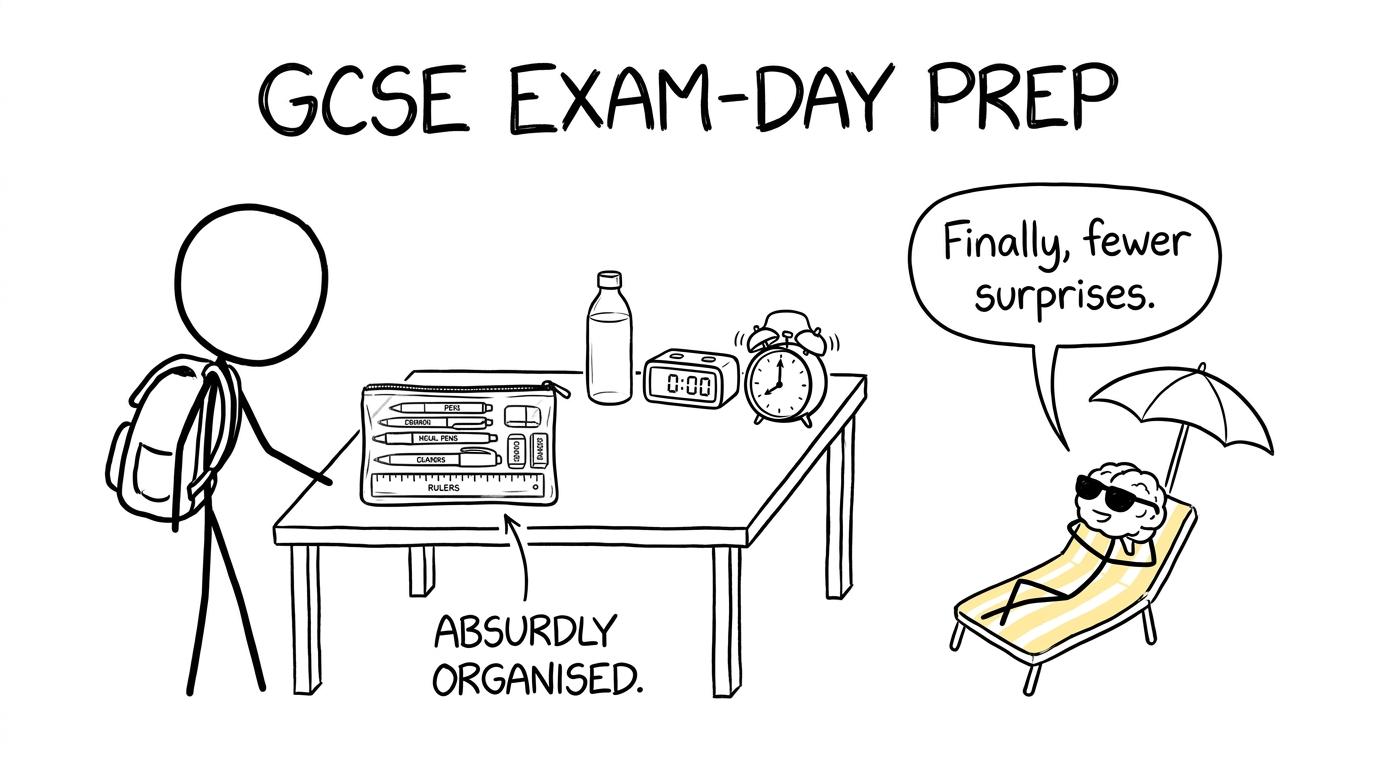 An organised candidate whose brain enjoys fewer surprises
Practise for the session you will actually sit
Once you know the timetable, complete a small number of timed practices at the relevant time of day. This is not because practising at 1.30 pm1.30\text{ pm}1.30 pm guarantees a biological transformation. It is because rehearsal reveals practical problems.
A morning practice might show that you need longer to wake fully. An afternoon practice might reveal that heavy revision before lunch leaves you flat. You can then adjust your routine before the real paper.
Maths students can use the same approach. Complete an Edexcel GCSE Maths mini test or part of a paper during the session in which the real maths examination will occur. Mark it afterwards, then separate content errors from tiredness, rushing and poor timing.
For longer practice, the GCSE maths revision hub lets you select resources for Edexcel, AQA, OCR, Eduqas and other boards. Edexcel candidates can use GCSE maths past papers with mark schemes, while Edexcel predicted papers provide further specification-matched practice.
The useful pattern is simple:
- Sit a timed task in realistic conditions.
- Mark it honestly.
- Identify why each mark was lost.
- Repair the weakest skill.
- Repeat on another day.
The MathsGenie guide to finding weak GCSE topics explains how to turn errors into focused revision rather than merely collecting paper scores.
Your chronotype is information, not a verdict
Students often describe themselves as a “morning person” or “night owl”. That can be useful information, but it should not become an excuse.
If mornings are difficult, you can practise getting up at the required time during the days before the exam. If your energy falls after lunch, you can test a calmer morning schedule and a familiar meal. You may not be able to redesign your internal clock instantly, but you can remove some of the surprises surrounding the session.
Avoid making dramatic changes on exam day. An unfamiliar energy drink, unusually early bedtime or extreme breakfast can introduce new problems. Consistency is usually more helpful than experimentation.
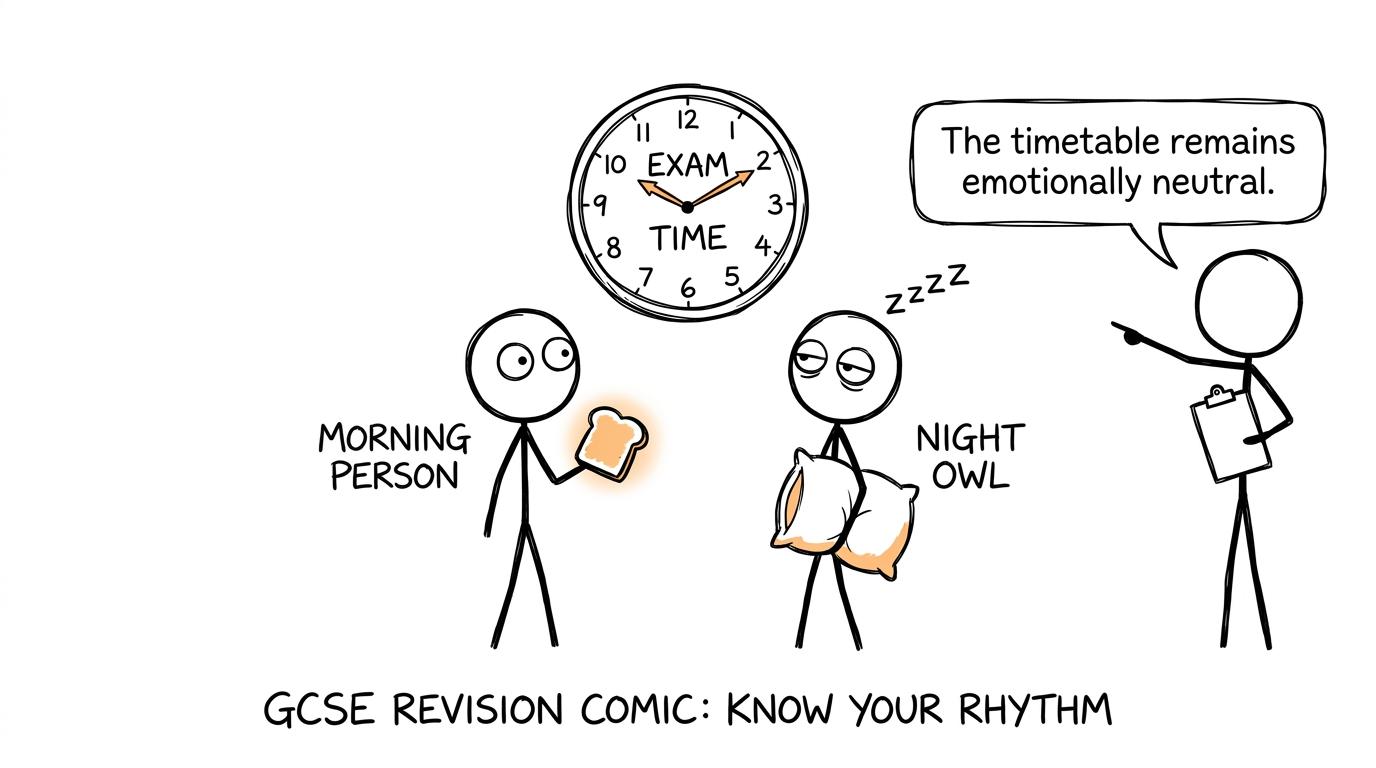 Morning person and night owl facing an emotionally neutral timetable
Common mistakes when preparing for the exam time
Looking at the wrong year’s timetable
Search results can continue displaying old dates. Check the exam series, qualification code, tier and paper number against your school’s candidate timetable.
Assuming “morning” means exactly the published time
The national published time and your required arrival time are not necessarily identical. Your centre may start within the permitted window, so follow its written instructions.
Treating the speaking exam like a nationally fixed written paper
Speaking assessments are arranged within a specified window. Your school must tell you your individual appointment and preparation arrangements.
Revising all morning for an afternoon paper
More time does not always mean more useful revision. A short recall session followed by rest and a normal routine is usually more sensible than hours of frantic work.
Changing sleep only on the night before
One unusually early night does not guarantee instant sleep. Keep your waking and sleeping routine reasonably consistent during the run-up to the examination.
Believing the session decides the grade
Time of day may influence alertness, but it does not erase preparation or make a result inevitable. Focus on the factors you can change: sleep, routine, practice, arrival and exam technique.
Make the timetable part of your preparation
The clock matters, but usually less than the story anxiety tells about it. A morning paper is not doomed because you prefer evenings. An afternoon paper is not automatically easier because you have longer to prepare.
Confirm the session, rehearse a sensible routine and protect your attention. Then return to the work that genuinely builds performance.
For your maths papers, begin with the free MathsGenie GCSE maths revision hub. Use revision lessons and practice questions to strengthen individual topics, mini tests to check recall, and past papers or predicted papers to practise timing. Mark everything carefully using the mark schemes and video solutions.
You cannot choose every exam time. You can choose how ready you are when it arrives.