

GCSE Arabic Exam Start Time: What to Expect
GCSE Arabic exam start time explained: check session times, arrival, school variations and exactly when you will be allowed to begin your paper.

The phrase morning exam sounds precise until you realise that it may describe several different moments: when you arrive, when you enter the hall, when the invigilator begins the instructions and when you finally open the paper.
Here is the direct answer to the GCSE Arabic exam start time question. For UK centres following JCQ arrangements, the published start is normally 9.00 am9.00\text{ am}9.00 am for a morning examination and 1.30 pm1.30\text{ pm}1.30 pm for an afternoon examination. However, centres may start up to 303030 minutes earlier or later under the standard rules. Your school’s personal timetable is therefore the final instruction you must follow.
You should normally plan to arrive at least 202020 to 303030 minutes before the time given by your school. You start working only when the invigilator tells you to open the paper and the examination timing begins.
The short exam-day checklist
Before looking at the detailed walkthrough, confirm these essentials:
- Check the date, session and exact reporting time on your personal timetable.
- Confirm whether you are entered for Foundation or Higher tier.
- Identify the component: listening, speaking, reading or writing.
- Follow your school’s arrival instructions rather than assuming every morning paper begins locally at exactly 9.00 am9.00\text{ am}9.00 am.
- Arrive early enough to find your room, seat and candidate details calmly.
- Remove or hand in your phone, smartwatch, earbuds and other unauthorised devices.
- Tell the school immediately if a delay may make you late.
That is the practical answer. The rest explains why the time on an exam-board timetable may not be the exact minute when your pen touches the page.
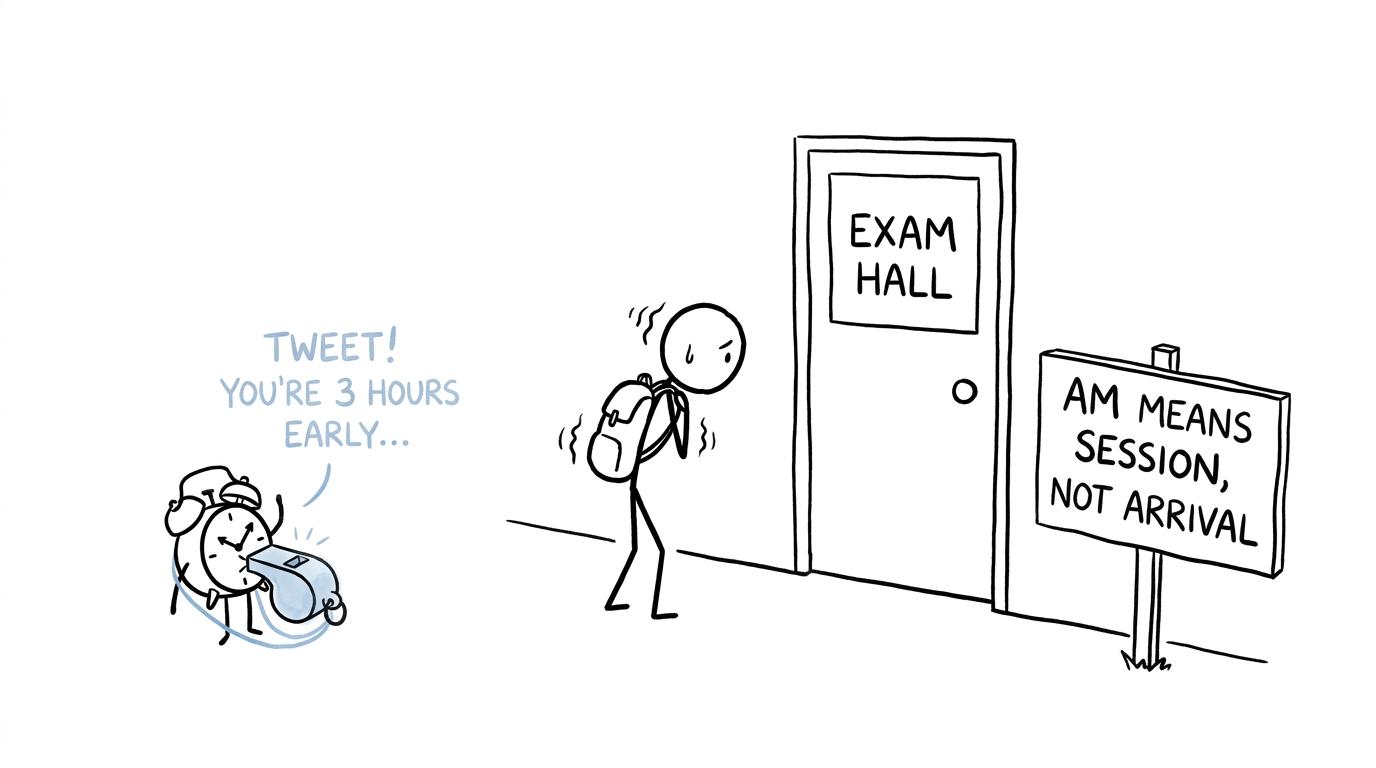 A student discovering that an exam session is not an arrival time
What the published GCSE Arabic time means
Pearson Edexcel GCSE Arabic is made up of listening, speaking, reading and writing assessments. The nationally timetabled written components are assigned to either a morning or afternoon session. Speaking is different because your centre arranges an individual appointment within the permitted assessment period.
For the summer 2026 series, Pearson’s final timetable placed the listening and reading papers in the morning session on Friday 22 May. The writing paper was in the afternoon session on Tuesday 2 June. Those dates now provide a useful example of how the timetable works, but students in another series must check the timetable issued for their own year.
The JCQ published session times for the 2025/26 academic year were:
| Published session | Standard UK start time | Normal permitted centre window |
|---|---|---|
| Morning | 9.00 am9.00\text{ am}9.00 am | 8.30 am8.30\text{ am}8.30 am to 9.30 am9.30\text{ am}9.30 am |
| Afternoon | 1.30 pm1.30\text{ pm}1.30 pm | 1.00 pm1.00\text{ pm}1.00 pm to 2.00 pm2.00\text{ pm}2.00 pm |
This flexibility explains why one school may tell students to report for an afternoon paper at 12.40 pm12.40\text{ pm}12.40 pm and begin at 1.00 pm1.00\text{ pm}1.00 pm, while another may begin at 1.30 pm1.30\text{ pm}1.30 pm. Both can be operating correctly.
Do not copy a time from another student, school or social-media post. Your centre may have adjusted its local start, and timetable clashes or access arrangements may affect an individual candidate’s schedule.
A realistic walkthrough from arrival to writing
Around 303030 minutes before the paper
You arrive at the location specified by your school. This may be the main school site, a separate exam hall or another approved venue. If your timetable says to report at 8.30 am8.30\text{ am}8.30 am, treat that as an instruction, not a suggestion.
Use the toilet before joining the line. Check that you have permitted equipment and any identification your centre requires. For a language paper, follow the instructions you have been given about writing equipment and dictionaries. Do not assume that a resource is allowed simply because it was useful during lessons.
Your phone should be switched off and stored exactly as your school directs. The same caution applies to smartwatches, headphones and earbuds.
Around 151515 minutes before the paper
Staff begin seating candidates. You may be asked to enter in a particular order or locate a seat using your candidate number.
Formal examination conditions apply from the moment you enter the exam room. That means no talking, signalling or communicating with another candidate. The paper may be visible on your desk, but you must not open it.
This waiting period can feel longer than it is. The useful response is simple: check the details placed in front of you, listen carefully and avoid letting another student’s nervousness become your own.
During the invigilator’s instructions
The invigilator confirms the paper, tier, duration and permitted materials. You may need to write your name, centre number and candidate number when instructed. Any problem, including the wrong tier, a damaged paper or missing equipment, should be raised immediately.
The clock has not necessarily started merely because you are seated. The examination begins when the invigilator formally starts it. Candidates must receive the full published working time, although supervised preparation or reading time may be included within a component’s stated duration.
When you actually start writing
You begin only after the invigilator tells the room to open the paper or start work. If the centre is running to its advertised schedule, this will be close to the local start time on your personal timetable. Seating checks and announcements happen beforehand so that they do not normally consume your examination time.
The listening paper has a specific structure. Under the current Edexcel specification, its duration includes 555 minutes of reading time:
- Foundation listening: 353535 minutes in total
- Higher listening: 454545 minutes in total
Follow the recorded and invigilator instructions rather than inventing your own start point. You may annotate or answer only as the paper’s instructions permit.
Reading and writing are conventional written papers. Their current published durations are:
| Component | Foundation tier | Higher tier |
|---|---|---|
| Reading | 505050 minutes | 111 hour 555 minutes |
| Writing | 111 hour 202020 minutes | 111 hour 252525 minutes |
If listening and reading take place consecutively in the same session, your centre will explain the order and whether there is a supervised break. Do not assume that the second component begins at the headline morning-session time.
Why the speaking exam has no universal start time
The speaking assessment is internally conducted and externally assessed. Your school or exam centre gives you an individual appointment, so there is no single national GCSE Arabic speaking start time.
Under the current specification, candidates receive 121212 minutes of supervised preparation. The assessed speaking time is then:
- Foundation tier: 777 to 999 minutes
- Higher tier: 101010 to 121212 minutes
Arrive for the reporting time your centre provides, which may be earlier than the individual assessment appointment. Supervised preparation is part of a controlled process, so you must follow the centre’s rules about contact with other candidates and permitted notes.
What to do if you are running late
If disruption makes you late, telephone the school immediately. Go to reception or the designated exams office when you arrive; do not walk into the exam hall unescorted.
Under JCQ rules, a centre may admit a candidate after an examination has started, and an admitted late candidate must be allowed the full examination time. Admission is still at the centre’s discretion. A candidate can be classified as very late after the relevant threshold, and the awarding body may decide not to accept the script.
For an examination lasting at least one hour, arrival more than one hour after the published session start is considered very late. For a paper lasting less than one hour, the threshold is the examination’s published finishing time. This matters particularly for the shorter listening component.
The lesson is not to calculate how late you can safely be. There is no safe lateness. Contact the centre, travel directly there and follow staff instructions.
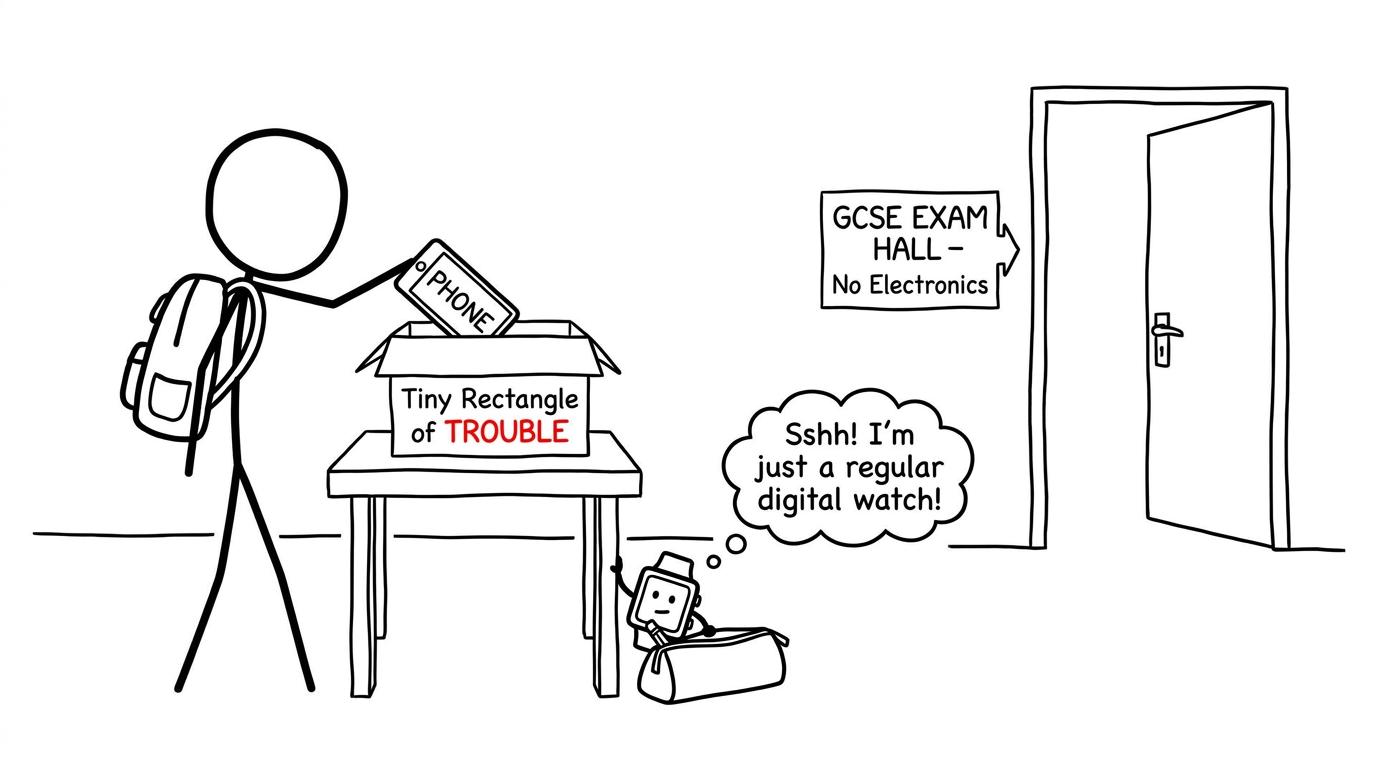 A phone and smartwatch attempting to sneak into an exam
What Arabic timing teaches you about GCSE maths
The administrative rules are largely the same when you return to your maths papers. A session label is not an arrival time, and a published start is not permission to walk through the school gate at that minute.
Use the same discipline during revision. Complete a paper under its full time limit, without pausing for hints, then mark it honestly. The GCSE Maths revision hub lets you choose resources for Edexcel, AQA, OCR and Eduqas, while the Edexcel GCSE Maths revision area brings together lessons and practice questions for Foundation and Higher tier.
When you need exam realism, use Edexcel GCSE Maths past papers with their mark schemes. Shorter Edexcel GCSE Maths mini tests are useful when you want to practise maintaining focus without completing a full paper.
Nearer your examination, GCSE predicted papers can add unseen practice. They should complement, rather than replace, specification coverage and genuine past papers.
The deeper point is that timing confidence is built before exam day. MathsGenie’s twenty-minute maths revision routine helps on busy days, while the one-week GCSE maths revision plan provides structure when the examination is close. On the final evening, use the GCSE maths night-before plan instead of attempting an exhausting last-minute rescue.
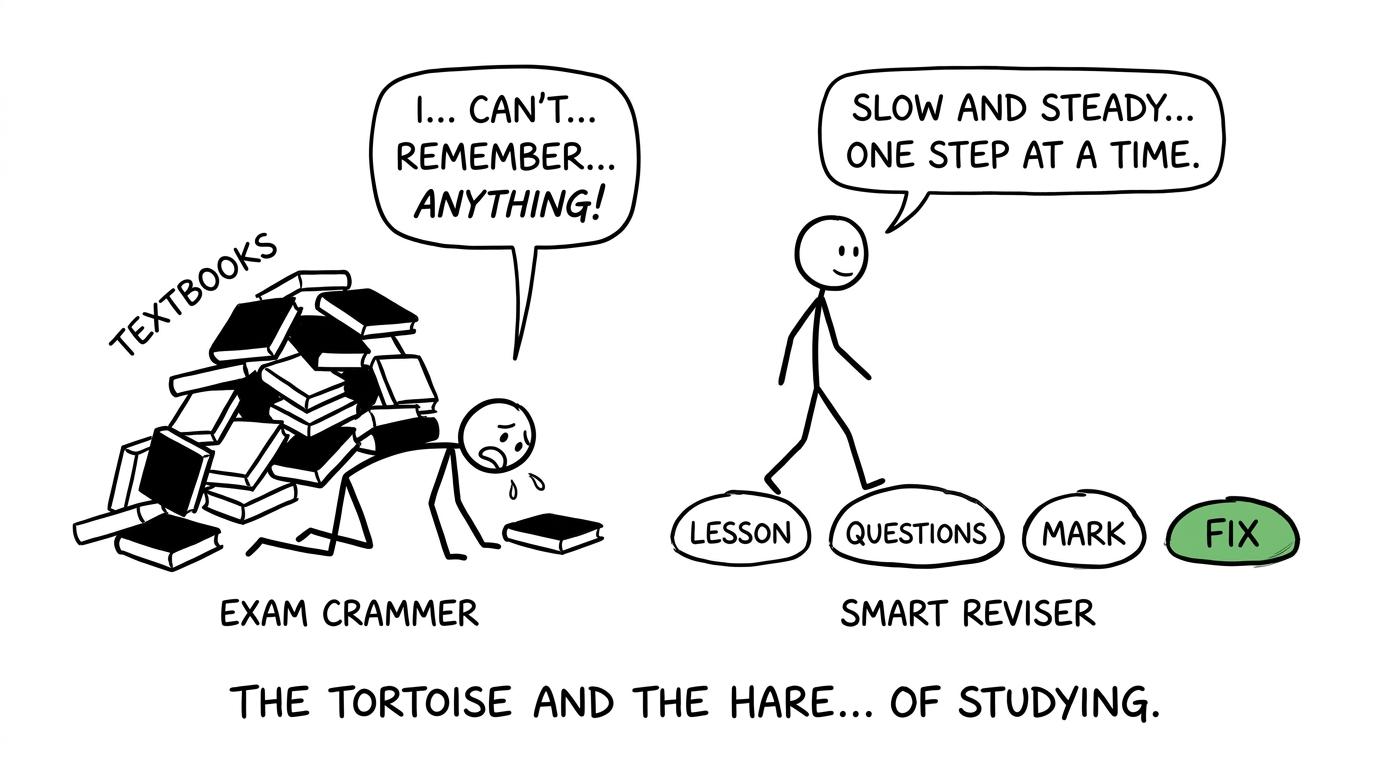 Two revision strategies racing towards the examination
Common mistakes with GCSE Arabic exam timing
Treating “morning” as an exact local time
The published morning start is normally 9.00 am9.00\text{ am}9.00 am, but centres have limited flexibility. Read your personal timetable and centre guidance.
Arriving at the stated start time
The start time is when the examination should begin, not when you should reach reception. Follow your school’s reporting time and aim to have a sensible travel buffer.
Confusing speaking with the written papers
Speaking appointments are arranged by centres. Your friend’s appointment does not determine yours, even if you attend the same school.
Opening the paper before permission
Being seated early does not allow you to read ahead. Wait for the invigilator’s instruction.
Forgetting that listening includes reading time
The stated listening duration includes the initial 555 minutes of reading time. It is not an extra period added afterwards.
Relying on an old timetable
Dates and sessions can change between exam series. Check the current exam-board timetable and, most importantly, the personalised timetable issued by your centre.
Start calm by removing uncertainty
Exam mornings often feel difficult because several small uncertainties arrive together. Which room? Which seat? Which paper? What time does it really begin? Most of these can be removed the evening before.
Check your timetable, pack permitted equipment, set your alarms and plan to arrive early. Once inside the hall, wait for the invigilator. That is the moment at which responsibility becomes simple: listen, open the correct paper when told and use the full time available.
For your maths preparation, make MathsGenie your free revision base. Learn methods through revision lessons, practise with topic questions and mini tests, then build exam stamina using past papers, predicted papers, mark schemes and video solutions. Good examination timing is not about rushing. It is about arriving prepared enough that the clock no longer feels like a surprise.










