GCSE Arabic Exam Paper Guide: Every Paper Explained
GCSE Arabic exam paper guide covering Edexcel listening, speaking, reading and writing papers, with timings, marks, tiers and revision advice.
The hardest part of an exam is sometimes not the content. It is the uncertainty: how long will the paper last, which language will the questions use, and what happens after you turn the page?
This GCSE Arabic exam paper guide removes that uncertainty. For the current Pearson Edexcel GCSE Arabic qualification, code 1AA01AA01AA0, you complete four papers: Listening, Speaking, Reading and Writing. Each skill contributes 25%25\%25% of the qualification, and you must take the same tier Foundation or Higher across all four papers.
The details below reflect the current Pearson Edexcel specification and assessment guidance. They do not describe International GCSE Arabic, which has a different structure. Always confirm your specification, tier and examination arrangements with your school.
GCSE Arabic papers at a glance
| Paper | Skill | Foundation | Higher | Raw marks | Qualification weighting |
|---|---|---|---|---|---|
| Paper 111 | Listening | 353535 minutes, including 555 minutes’ reading time | 454545 minutes, including 555 minutes’ reading time | 505050 | 25%25\%25% |
| Paper 222 | Speaking | 777 to 999 minutes, plus 121212 minutes’ preparation | 101010 to 121212 minutes, plus 121212 minutes’ preparation | 707070 | 25%25\%25% |
| Paper 333 | Reading | 505050 minutes | 111 hour 555 minutes | 505050 | 25%25\%25% |
| Paper 444 | Writing | 111 hour 151515 minutes | 111 hour 252525 minutes | 606060 | 25%25\%25% |
Your essential checklist is straightforward:
- Check that your entry is Pearson Edexcel GCSE Arabic 1AA01AA01AA0.
- Confirm whether you are taking Foundation or Higher tier.
- Learn the order and demands of all four papers.
- Practise without a dictionary because dictionaries are not permitted.
- Use timed papers rather than relying only on vocabulary revision.
- Mark every attempt and turn errors into specific revision tasks.
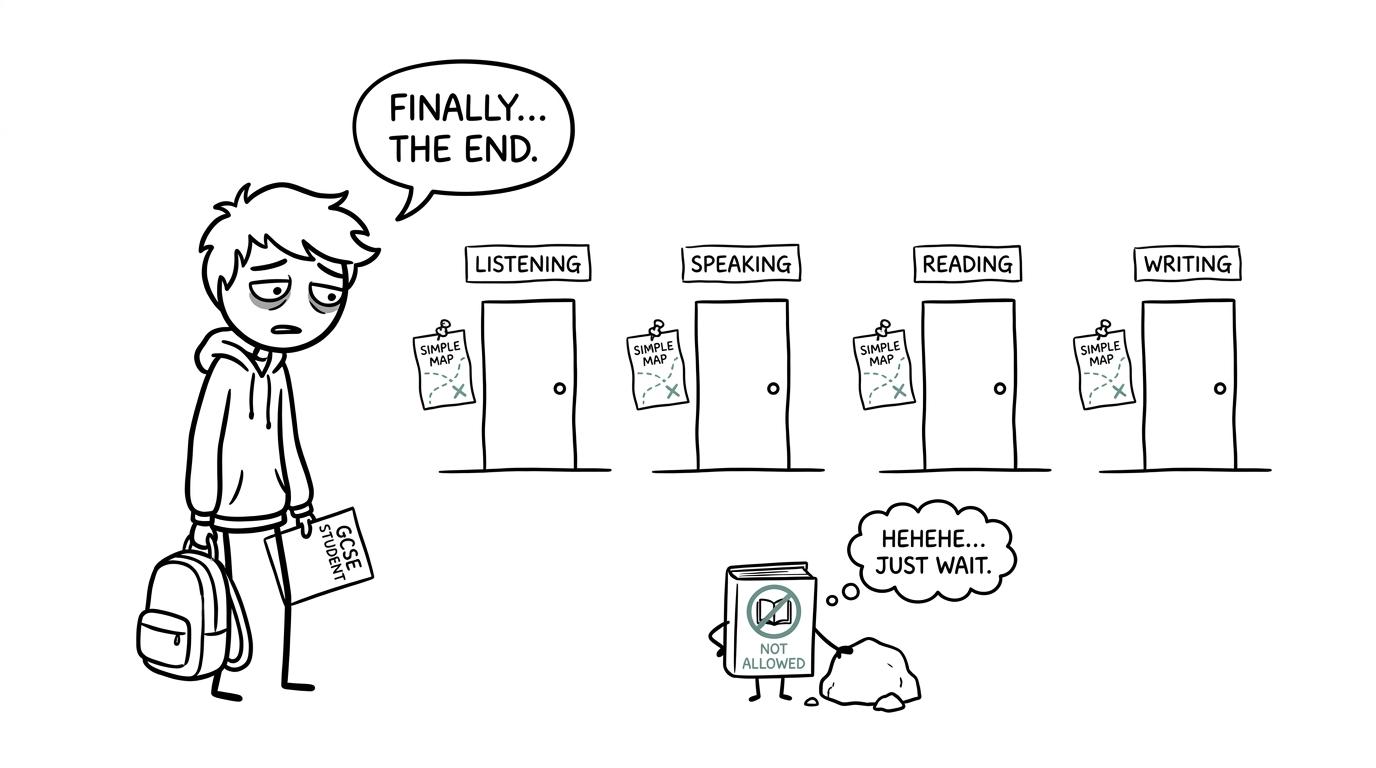 A student discovering that the four GCSE exam papers are less mysterious when each has a map
Paper 1: Listening and understanding in Arabic
Paper 111 assesses how well you understand standard spoken Arabic in public and social situations. Recordings may feature male and female speakers, and the questions include multiple-response tasks and short open responses. Every extract is played twice, with pauses for writing and reading the next question.
You do not have to produce written answers in Arabic. However, some questions and answer options are presented in Arabic, so reading accurately still matters.
How the sections change by tier
At Foundation tier:
- Section A is set in English.
- Section B is set in Arabic.
- The complete paper lasts 353535 minutes, including 555 minutes’ reading time.
At Higher tier:
- Section A is set in Arabic.
- Section B is set in English.
- The complete paper lasts 454545 minutes, including 555 minutes’ reading time.
Both tiers are worth 505050 raw marks.
How to approach the listening paper
Treat the initial 555 minutes as part of the assessment, not as waiting time. Read ahead, identify what each question requests and predict the type of information you may hear: a person, opinion, reason, place or time.
On the first playing, establish the overall meaning. On the second, confirm details and watch for corrections, contrasts and negative expressions. If a speaker changes their mind, the final statement may contain the answer.
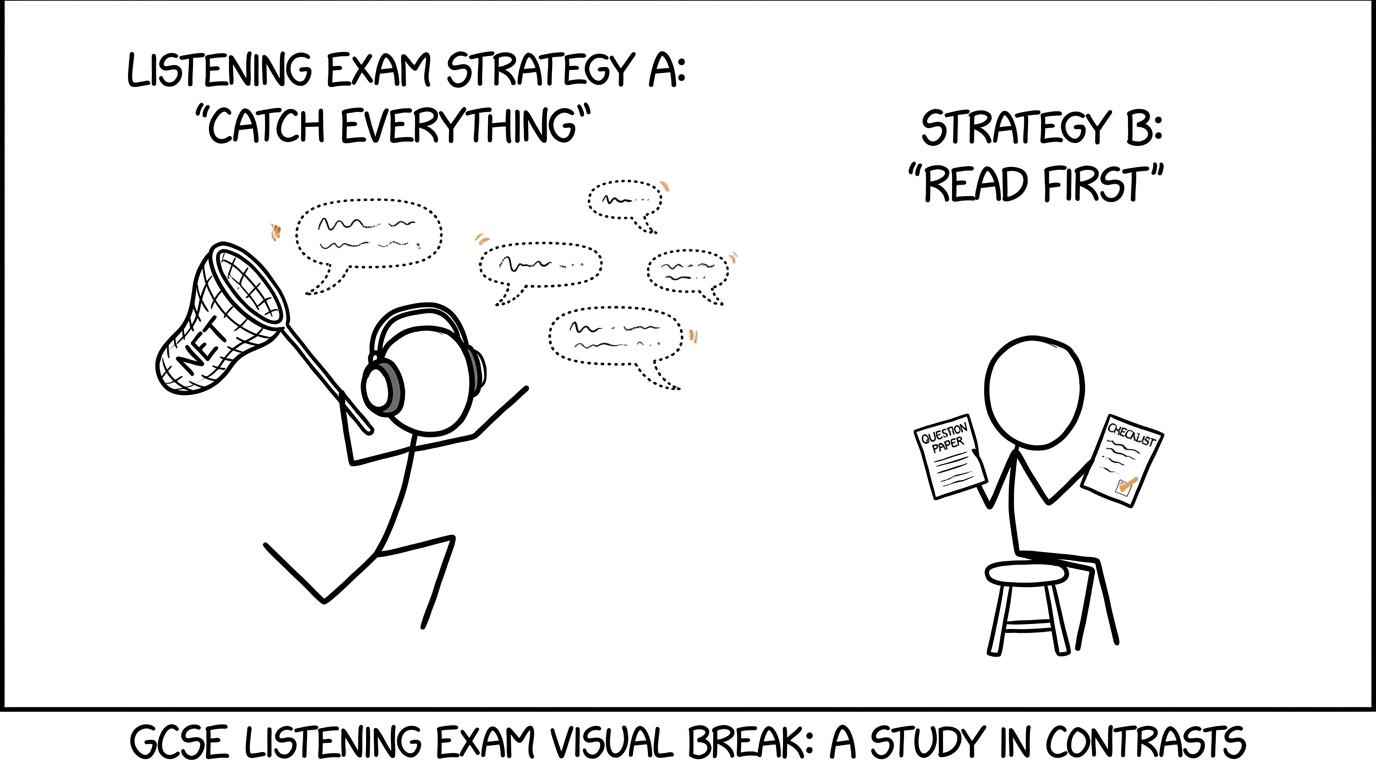 A student calmly reading questions while another tries to catch listening answers in a net
Paper 2: Speaking in Arabic
The speaking assessment is conducted by a teacher at your centre and marked externally by Pearson. It consists of three consecutive tasks completed in a fixed order:
- a role play based on a topic allocated by Pearson;
- a picture-based task on an allocated topic;
- a conversation covering two themes.
For the conversation, the first theme comes from a topic you choose before the assessment. Pearson allocates the second theme.
Speaking timings
| Task | Foundation | Higher |
|---|---|---|
| Preparation | 121212 minutes | 121212 minutes |
| Role play | About 111 to 1.51.51.5 minutes | About 222 to 2.52.52.5 minutes |
| Picture-based task | About 2.52.52.5 to 333 minutes | About 333 to 3.53.53.5 minutes |
| Conversation | About 3.53.53.5 to 4.54.54.5 minutes | About 555 to 666 minutes |
| Overall assessment | 777 to 999 minutes | 101010 to 121212 minutes |
The paper is worth 707070 raw marks but still contributes 25%25\%25% of the qualification. Dictionaries are not allowed, including during the 121212 minutes of preparation.
What the examiner is assessing
The speaking paper rewards communication and interaction, not a memorised monologue detached from the question. You need to respond appropriately, convey information, express and justify opinions, ask a question where required and use language with reasonable accuracy.
Use preparation time to organise prompts rather than attempting to script every sentence. Listen carefully to the exact question and answer it before adding detail. If you make a small error, continue. A correction followed by clear communication is usually more useful than stopping completely.
 A nervous speaking answer growing into a confident conversation while the stopwatch waits
Paper 3: Reading and understanding in Arabic
Paper 333 assesses your understanding of written Arabic across materials such as advertisements, emails, letters, articles and adapted literary texts. Questions include multiple-response and short open-response tasks.
Both tiers contain three sections:
- Section A has questions and instructions in English.
- Section B has questions and instructions in Arabic.
- Section C requires translation from Arabic into English.
You must answer every question in all three sections. Foundation lasts 505050 minutes and Higher lasts 111 hour 555 minutes. Both are worth 505050 raw marks.
A sensible reading-paper strategy
Read the question before reading the whole passage closely. This gives your reading a purpose and prevents one unfamiliar word from taking control of your attention.
For English responses, communicate the meaning precisely rather than translating more than the question requires. In the translation section, preserve the meaning, tense and relationships between ideas. Natural English matters, but it must remain faithful to the Arabic text.
A useful final check is to compare each answer with its question. Correct information can still miss the mark if it answers something slightly different.
Paper 4: Writing in Arabic
Paper 444 tests your ability to communicate for different purposes and audiences. Instructions are in Arabic, specified word counts are approximate, and every question must be attempted. The paper includes open-response writing and translation from English into Arabic.
Foundation writing structure
Foundation tier lasts 111 hour 151515 minutes and contains:
- three open-response writing tasks;
- one translation into Arabic;
- 606060 raw marks in total.
The writing develops from a short response of approximately 202020 to 303030 words to longer tasks of approximately 404040 to 505050 words and 808080 to 909090 words. Read every bullet point carefully because each one establishes content you are expected to address.
Higher writing structure
Higher tier lasts 111 hour 252525 minutes and contains:
- two open-response writing tasks;
- one translation into Arabic;
- 606060 raw marks in total.
The open responses are approximately 808080 to 909090 words and 130130130 to 150150150 words. Longer writing requires developed ideas, opinions and justification, alongside a suitable range of vocabulary and structures.
How to protect your writing marks
Plan briefly before writing. Assign an idea to every bullet point, note the time frame required and decide where you will include an opinion or justification. Then leave time to check agreement, verb formation, spelling, register and whether any bullet point has been missed.
The approximate word count is guidance, not an invitation to produce the longest possible answer. Extra writing only helps when it remains relevant and controlled.
Foundation or Higher: what changes?
Foundation offers shorter assessments and more accessible language, while Higher expects greater complexity, independence and range. The grade ranges also differ: Foundation targets grades 111 to 555, while Higher targets grades 444 to 999, with an allowed grade 333 in limited circumstances under awarding rules.
Your school decides the appropriate entry with you. Because mixed-tier entry is not permitted, you cannot take Foundation Listening and Higher Writing, for example. One tier applies across the qualification.
Do not choose a tier from pride or fear. Choose the paper on which you can demonstrate your knowledge consistently.
How to revise for all four Arabic papers
Vocabulary matters, but knowing vocabulary is not the same as performing under examination conditions. Revision should reproduce the decisions demanded by each paper.
Use this weekly cycle:
- Listening: complete a timed extract, then identify missed words, distractors and changes of opinion.
- Speaking: practise short, unscripted responses and record yourself answering unpredictable follow-up questions.
- Reading: alternate between comprehension and translation, working in both question languages.
- Writing: complete one timed response, check it against the task and rewrite weak sections accurately.
Past papers work best when they change what you do next. MathsGenie’s guide to when to start GCSE past papers explains how to move from short sections to complete timed papers. Its GCSE revision timetable guide can also help you balance Arabic with maths and your other subjects.
For maths revision alongside Arabic, use the GCSE Maths revision hub for free lessons and practice questions. Short GCSE mini tests are useful when your timetable is crowded, while Edexcel GCSE Maths past papers build full-paper stamina. Nearer the examination, add GCSE predicted papers as extra practice rather than replacing official past papers.
Common mistakes that cost marks
Revising all four skills in the same way
Reading vocabulary lists may support recognition, but it does not rehearse speaking spontaneously or following a recording at examination speed. Give each paper its own practice method.
Forgetting the language of the question
Listening and Reading contain sections presented in different languages. Practise reading Arabic rubrics so that the instruction itself never becomes the obstacle.
Missing a writing bullet point
A polished response can still lose marks when it ignores part of the task. Tick each bullet point after covering it and check that required time frames are clear.
Treating speaking as a memory test
Over-rehearsed answers can collapse when the question changes. Prepare flexible language and practise listening before responding.
Using a dictionary during practice
Dictionaries are not permitted in any of the four assessments, including speaking preparation. Regular dictionary-free practice exposes the vocabulary you genuinely need to learn.
Marking without correcting
A score tells you what happened; a correction changes what happens next. After every paper, record the exact cause of each lost mark and revisit it. The same principle drives effective maths revision through MathsGenie’s one-month GCSE revision plan: attempt, mark, fix and retest.
 A student trapping repeated mistakes in a box labelled fix next time
Make the format feel ordinary
An unfamiliar paper consumes attention. A familiar one gives that attention back.
Now you know the route: Listening, Speaking, Reading and Writing; equal weighting; one consistent tier; no dictionary; and a distinct strategy for every skill. Confirm your entry details with your school, obtain the correct Pearson materials and begin practising in the real format.
For the rest of your GCSE preparation, make MathsGenie your free maths revision base. Use revision lessons to rebuild weak topics, practice questions and mini tests to develop fluency, and past papers, predicted papers, mark schemes and video solutions to make examination conditions familiar. The aim is not to remove every difficult question. It is to make sure the paper itself no longer surprises you.