GCSE Arabic Exam Length: Your Real Time in the Hall
GCSE Arabic exam length explained by paper and tier, including same-day sessions, speaking preparation and a practical energy plan for exam day.
The hardest part of a long exam is not always the final question. Sometimes it is the moment halfway through when your concentration quietly begins to fade.
The GCSE Arabic exam length depends on your tier and the skill being assessed. For Pearson Edexcel GCSE Arabic, Foundation students have 222 hours 454545 minutes of written exams in total, while Higher students have 333 hours 151515 minutes. Speaking is assessed separately and includes 121212 minutes of supervised preparation. Crucially, listening and reading are normally held consecutively in the same timetable session, so that exam day feels longer than either paper suggests on its own.
This guide covers Pearson Edexcel GCSE (9-1)(9\text{-}1)(9-1) Arabic, specification code 1AA01\text{AA}01AA0. Always check your personalised school timetable because dates, room arrangements and start times can change between exam series.
GCSE Arabic exam length at a glance
Here is the current Pearson Edexcel paper structure and timing.
| Assessment | Foundation tier | Higher tier | Weighting |
|---|---|---|---|
| Paper 111: Listening | 353535 minutes, including 555 minutes' reading time | 454545 minutes, including 555 minutes' reading time | 25%25\%25% |
| Paper 222: Speaking | 777 to 999 minutes, plus 121212 minutes' preparation | 101010 to 121212 minutes, plus 121212 minutes' preparation | 25%25\%25% |
| Paper 333: Reading | 505050 minutes | 111 hour 555 minutes | 25%25\%25% |
| Paper 444: Writing | 111 hour 202020 minutes | 111 hour 252525 minutes | 25%25\%25% |
The immediate checklist is simple:
- Confirm that your qualification code is 1AA01\text{AA}01AA0.
- Check whether you are entered for Foundation or Higher tier.
- Expect listening and reading to take place in the same session.
- Treat speaking as preparation time plus assessment time.
- Allow for registration, instructions, paper collection and any supervised transition.
- Use your school's timetable rather than relying on a date found online.
This matters because the time printed beside a paper is not necessarily the time for which you will be in the exam room.
How long are you actually sitting on the main exam day?
For summer 202620262026, Pearson's final timetable placed GCSE Arabic listening and reading in the same morning session. Both papers were scheduled for Friday 222222 May, while writing was scheduled separately on Tuesday 222 June. Future dates may differ, but the same-session structure is the important planning point.
Foundation listening and reading session
The formal assessment time is:
35 minutes+50 minutes=85 minutes35\text{ minutes} + 50\text{ minutes} = 85\text{ minutes}35 minutes+50 minutes=85 minutesThat is 111 hour 252525 minutes of paper time.
However, your real commitment may also include attendance checks, invigilator instructions, distributing and collecting papers, and a supervised transition or break between the two assessments. The exact procedure is controlled by your centre, so do not assume that you will walk out exactly 858585 minutes after entering.
Higher listening and reading session
The formal assessment time is:
45 minutes+65 minutes=110 minutes45\text{ minutes} + 65\text{ minutes} = 110\text{ minutes}45 minutes+65 minutes=110 minutesThat is 111 hour 505050 minutes of paper time before administrative time or any supervised break is considered.
For a Higher student, this is closer to a long-distance effort than two unrelated short papers. You must remain attentive to audio early in the session, then shift into careful reading and translation without treating the gap as the end of the exam.
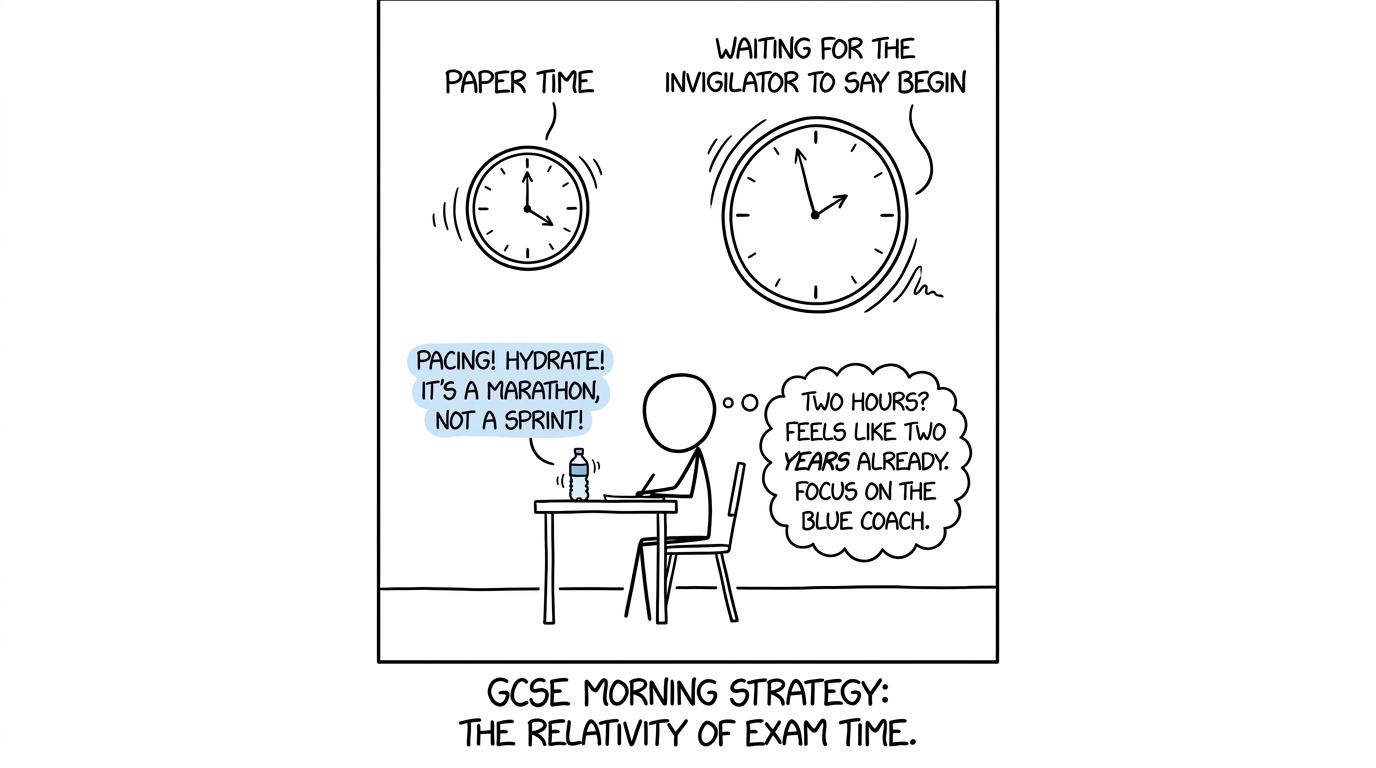 A student waiting for an exam to begin while two clocks appear to move at very different speeds
What each GCSE Arabic paper feels like in real time
A minute is always a minute on the clock. It does not always feel the same to your brain.
Listening includes reading time
The Foundation listening paper lasts 353535 minutes and the Higher paper lasts 454545 minutes. In both cases, this includes 555 minutes of reading time.
Those first 555 minutes are part of the assessment, not bonus time before it. Use them to scan the layout, identify what each question requires and notice where answers must be given in English or Arabic. The recording is pre-paused and should not be stopped once it has begun.
Listening demands immediate recovery. If one phrase escapes you, carrying that frustration into the next recording can cost more than the original missed detail. Mark the uncertain response, reset and listen for the next piece of evidence.
Reading follows listening
Reading lasts 505050 minutes at Foundation and 656565 minutes at Higher. It includes different text types, short and multiple-response questions, and translation into English.
Because it may follow listening in the same session, the first few minutes matter. Begin with the paper in front of you, not with a mental replay of the recording you have just heard. Listening is over. Reading is a fresh source of marks.
This is a useful skill across subjects. During maths revision, Edexcel GCSE Maths mini tests can help you practise starting a new task cleanly after completing another timed set.
Writing is the longest individual paper
The writing examination lasts 808080 minutes at Foundation and 858585 minutes at Higher. Foundation candidates answer three open-response questions and complete a translation into Arabic. Higher candidates answer two open-response questions and complete a translation into Arabic.
Do not confuse fewer questions with less work. Higher responses demand greater development and control. Plan enough to keep your response relevant, but not so much that planning consumes the writing time you need.
Speaking has a hidden time commitment
The assessed conversation is short compared with the written papers, but the complete commitment includes 121212 minutes of supervised preparation:
- Foundation: 191919 to 212121 minutes including preparation
- Higher: 222222 to 242424 minutes including preparation
The assessment contains a role play, a picture-based task and a conversation. It is conducted by your centre during the speaking assessment period rather than as part of the main written timetable.
You may also spend time waiting before preparation begins. Your school controls that schedule, so ask when to arrive and whether you must remain under supervision before or after your slot.
Total GCSE Arabic assessment time
Adding every scheduled assessment gives a clearer picture of the qualification as a whole.
| Tier | Written paper time | Speaking with preparation | Overall scheduled assessment time |
|---|---|---|---|
| Foundation | 222 hours 454545 minutes | 191919 to 212121 minutes | 333 hours 444 to 666 minutes |
| Higher | 333 hours 151515 minutes | 222222 to 242424 minutes | 333 hours 373737 to 393939 minutes |
These totals do not mean that you complete everything in one sitting. They also exclude registration, waiting, instructions and supervised transitions. Think of them as the qualification's formal assessment commitment rather than a prediction of exactly how long you will be inside school.
Each skill contributes 25%25\%25% of the final qualification. The longest paper is therefore not automatically the most heavily weighted. A short speaking assessment matters just as much as writing.
Plan your energy, not just your minutes
A timetable tells you when an exam begins. It cannot tell you how alert you will feel near the end.
Before listening and reading
Eat and drink in a familiar way rather than experimenting on exam morning. Arrive early enough to avoid rushing, but follow your school's stated arrival time. Bring the permitted equipment and remember that dictionaries are not allowed in these assessments, including during speaking preparation.
Avoid an intense last-minute vocabulary session outside the exam room. It can create the feeling that everything you do not know is suddenly important. A short review of familiar structures is calmer and more useful.
During the same-session papers
Treat listening and reading as separate stages of one performance:
- In listening, stay with the recording and recover quickly from uncertainty.
- During the transition, relax your shoulders and take a calm breath.
- In reading, begin again rather than analysing the previous paper.
- Keep enough time to check that each response is written in the required language.
If your centre gives a supervised break, follow the invigilator's instructions. It may not work like an ordinary school break.
Before the writing paper
Writing is held on a separate day, so it requires a fresh plan. Do not let the completed listening and reading papers dictate your mood. You cannot accurately mark them from memory, and trying to do so spends energy without changing a mark.
The same principle helps with maths. After completing a paper from the GCSE maths revision hub, use the mark scheme, identify the error and move towards the next action. Do not repeatedly replay the mistake.
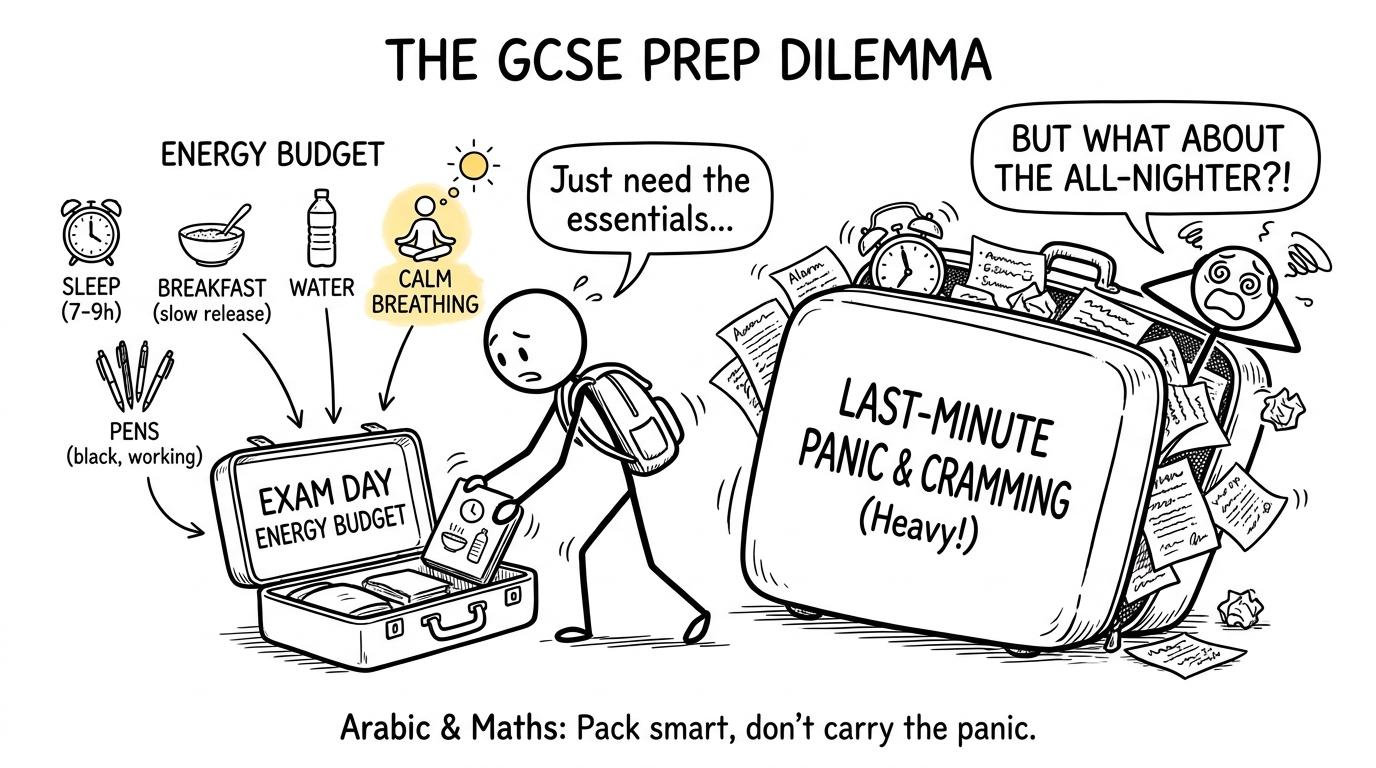 A student choosing an exam-day energy suitcase while leaving last-minute panic behind
Build stamina across Arabic and maths revision
Arabic and maths test different knowledge, but concentration behaves in similar ways. It improves when you practise under realistic conditions.
Begin with shorter sessions. The MathsGenie 202020-minute revision routine is useful when school days are crowded. Then progress to Edexcel GCSE Maths past papers or an Arabic paper completed with the correct timer and permitted materials.
A reliable practice cycle is:
- complete a timed task without interruptions;
- mark it carefully;
- record whether the problem was knowledge, accuracy or timing;
- repair one specific weakness;
- repeat under timed conditions.
MathsGenie's guide to using past papers properly explains how to turn a completed paper into targeted revision. Nearer the exam, GCSE predicted papers provide further timed maths practice, while official past papers should remain your main guide to each subject's established format.
Access arrangements and adjusted timings
The published durations are standard timings. If you have approved access arrangements, your personal finish time may be different.
For example, approved extra time is calculated from the standard duration according to your arrangement. Supervised rest breaks are different: during a rest break, you do not have access to the question paper, and the break is not additional thinking time.
Do not calculate your own leaving time and assume it applies. Ask your school's SENCo or exams officer how your arrangements work for listening, speaking and consecutive papers. Listening assessments can require particular administration because the recording controls the pace.
Common mistakes when planning GCSE Arabic exam day
Looking at only the longest paper
Writing is the longest individual assessment, but the listening-and-reading session may keep you working or under supervision for longer overall.
Forgetting that listening time includes reading time
The 555 minutes at the start are included within the published listening duration. They are not added afterwards.
Treating listening and reading as separate trips
They are timetabled in the same session. Unless your centre tells you otherwise, plan your food, water and concentration for both.
Using an old specification or unofficial timetable
Paper durations can be revised. For summer 202620262026, the official timetable lists Foundation writing as 111 hour 202020 minutes. Check the current specification, final timetable and your candidate statement rather than relying on an old guide.
Confusing GCSE with International GCSE
An International GCSE Arabic qualification can have a different structure. Check the awarding organisation and specification code before using these timings.
Practising knowledge but never practising duration
Knowing vocabulary is not the same as maintaining accuracy for an entire session. Build gradually towards the full timing, just as you would with the GCSE maths exam-week checklist.
Go into the room knowing what the clock means
The GCSE Arabic exam is not one enormous sitting. It is a sequence: speaking with preparation, a substantial combined listening-and-reading session, and a separate writing paper.
Once you understand that sequence, the clock becomes less mysterious. You can prepare for the first hour, the transition and the final stretch rather than hoping concentration will appear when needed.
Keep that same discipline across your maths exams. Start with MathsGenie's free GCSE maths revision resources, strengthen weak topics through revision lessons and practice questions, then build endurance with mini tests, past papers, predicted papers, mark schemes and video solutions. Good exam preparation is rarely one heroic session. It is the quieter habit of making the real day feel familiar before it arrives.