GCSE Arabic Exam Board Differences: Do They Matter?
GCSE Arabic exam board differences explained: discover which qualifications exist, whether one is easier and how to choose the right revision materials.
A student can spend hours comparing exam boards, looking for the one with kinder questions or lower grade boundaries. It feels sensible. If two routes lead to the same qualification, surely one must be easier.
But the most important fact about GCSE Arabic exam board differences is surprisingly simple: for the reformed GCSE accredited for teaching in England, the official government list places Arabic with Pearson Edexcel, not AQA, OCR or Eduqas. In most English schools, therefore, there is no meaningful choice between several domestic GCSE Arabic boards.
There are International GCSE Arabic qualifications with different structures. That is where comparisons become useful, and where students must be careful not to revise for the wrong assessment.
The short answer
Use this checklist before downloading a single paper:
- Confirm whether your qualification is GCSE Arabic or International GCSE Arabic.
- Find the exact awarding organisation and specification code.
- Check whether you are entered for foundation or higher tier, where applicable.
- Revise the skills, topics and task formats stated in that specification.
- Use past papers produced for your exact qualification.
- Do not assume that a different specification is easier because its papers look more familiar.
For Pearson Edexcel GCSE Arabic, the specification code is 1AA0. It assesses listening, speaking, reading and writing, with each skill contributing 25%25\%25% of the qualification. Students take one tier across all four papers.
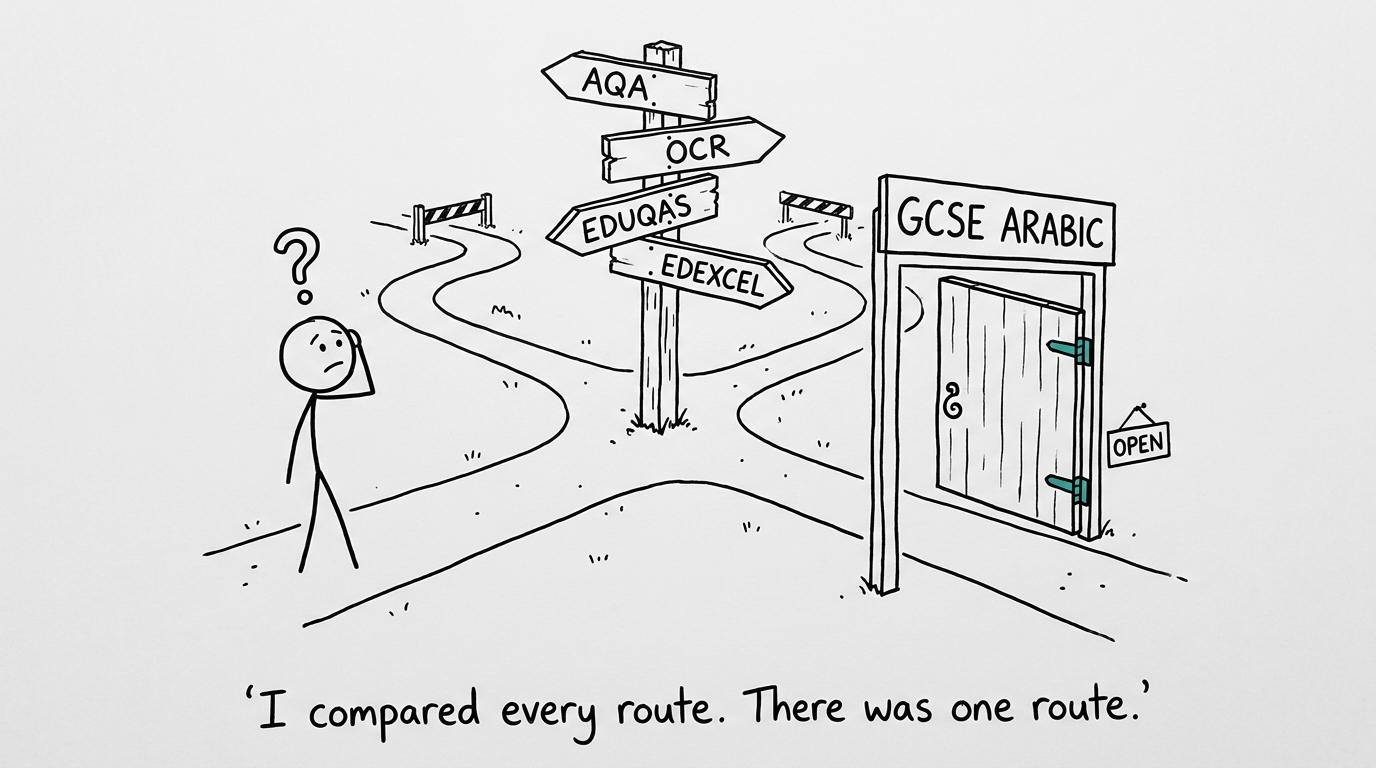 A student discovers that GCSE Arabic has one main domestic exam-board route
Which exam boards offer GCSE Arabic?
Students often search for AQA GCSE Arabic, OCR GCSE Arabic or Eduqas GCSE Arabic because those names appear on their maths, science and English papers. That does not mean every board offers every subject.
For the regulated reformed GCSE in England, Arabic appears under Pearson Edexcel. AQA, OCR and Eduqas offer many GCSE languages, but Arabic is not included in their current domestic GCSE ranges. This means a school entering students for the standard GCSE Arabic qualification will ordinarily use Pearson Edexcel.
That is different from the international market. Depending on where and through which centre you enter, you may encounter qualifications such as:
- Pearson Edexcel International GCSE Arabic (First Language)
- Cambridge IGCSE First Language Arabic
- OxfordAQA International GCSE Arabic (First Language), with first examinations scheduled from 202820282028
These are not simply alternative versions of the same domestic GCSE paper. Their intended learners, assessed skills and paper structures can differ substantially. Some first-language qualifications concentrate on sophisticated reading, grammar and extended writing rather than testing listening and speaking.
The words GCSE, International GCSE, Arabic and First Language therefore matter. Your specification code matters even more.
What does Pearson Edexcel GCSE Arabic assess?
Pearson Edexcel GCSE Arabic 1AA0 follows the four-skill structure required for the qualification:
| Skill | Weighting | What it measures |
|---|---|---|
| Listening | 25%25\%25% | Understanding and responding to spoken Arabic |
| Speaking | 25%25\%25% | Communicating and interacting effectively in Arabic |
| Reading | 25%25\%25% | Understanding different forms of written Arabic |
| Writing | 25%25\%25% | Communicating accurately and appropriately in writing |
The reading assessment includes translation from Arabic into English, while writing includes translation into Arabic. Speaking involves structured tasks, including role play, a picture-based task and conversation. Dictionaries are not permitted in the assessments, including speaking preparation time.
Foundation and higher papers assess the same broad skills but at different levels of demand. Foundation targets grades 111 to 555, while higher targets grades 444 to 999, with a possible grade 333 awarded below the grade 444 boundary. A student must be entered for the same tier across listening, speaking, reading and writing.
That tier decision is likely to affect your experience far more than an imagined comparison with another domestic board.
Is one GCSE Arabic exam board harder than another?
For students taking the regulated GCSE in England, the direct answer is no meaningful board comparison exists, because Pearson Edexcel is the established domestic GCSE Arabic route.
If you are comparing GCSE Arabic with an International GCSE, however, one qualification may feel harder for you. That does not automatically make it easier or harder in an objective sense.
A student who speaks Arabic confidently but has less experience of formal grammar may prefer an assessment containing speaking and listening. Another student with strong literary reading and extended writing may feel more comfortable with a first-language International GCSE. The paper is interacting with the student’s skill profile.
Difficulty depends on several things:
- whether listening and speaking are assessed;
- the expected level of reading comprehension;
- the length and purpose of writing tasks;
- how directly grammar is tested;
- whether the qualification is designed for language learners or first-language users;
- the tier and grade range available;
- how closely revision has matched the specification.
A paper can look easier because its topic is familiar, yet demand much more precise language. Another can look intimidating but contain structured questions that allow marks to be accumulated steadily.
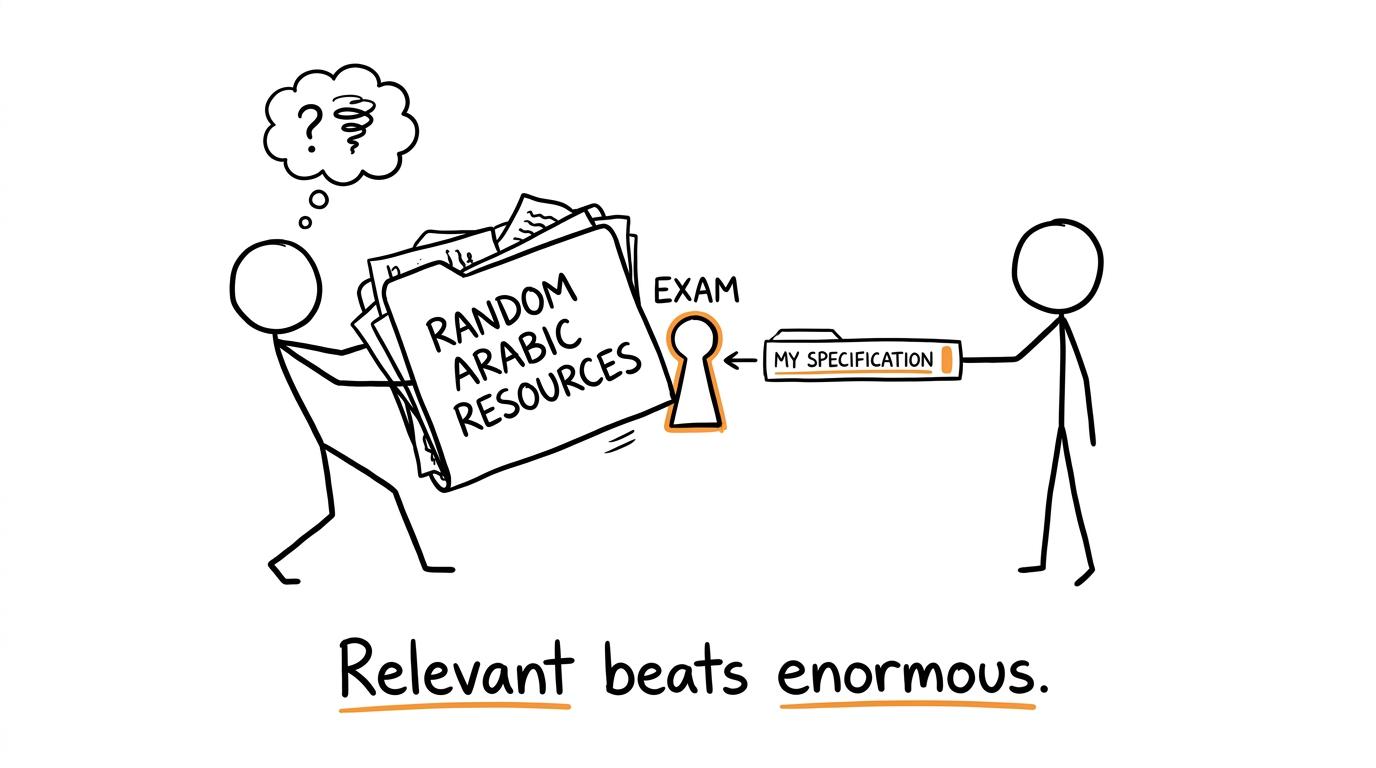 A huge pile of random resources fails to fit the specification-shaped keyhole
Why grade boundaries do not prove that one board is easier
Grade boundaries are often treated like league tables. A lower boundary is taken to mean an easier route. Usually, that conclusion has the logic backwards.
Boundaries are set after the demand of the assessment and the available evidence are considered. If a paper is more demanding in a particular series, its boundaries may be lower. If it is more accessible, they may be higher. Raw marks from different qualifications are not directly interchangeable because the papers, total marks, cohorts and assessment objectives may differ.
You can inspect the published Edexcel GCSE Arabic grade boundaries, but use them for context rather than prediction. Boundaries change between exam series, so last year’s figure is not a guaranteed target for your examination.
A better target is a secure performance across all four skills. Because each contributes 25%25\%25%, avoiding a serious weakness in one component matters. Strong reading cannot completely erase neglected speaking preparation.
How to confirm which Arabic qualification you take
Do not rely on the colour of a textbook or what a friend at another school is sitting. Ask your teacher or examinations officer for four details:
- the full qualification title;
- the awarding organisation;
- the specification or syllabus code;
- your tier, if the qualification is tiered.
Then compare those details with the front of an official sample assessment or past paper. For domestic Edexcel GCSE Arabic, look for 1AA0. Pearson International GCSE Arabic (First Language) uses 4AA1, so the similar branding should not disguise the different assessment.
This is a useful habit across every subject. In maths, for example, MathsGenie’s GCSE maths revision hub separates resources by boards including Edexcel, AQA, OCR and Eduqas. The underlying principle is identical: practise the course you will actually sit.
A revision method that works regardless of the label
Once your qualification is confirmed, stop comparing labels and start collecting evidence from your own work.
Build a specification checklist
List every assessed skill and task type. For Edexcel GCSE Arabic, your plan must cover listening, speaking, reading and writing rather than concentrating only on the skills you enjoy.
Beside each area, record one of three judgements:
- secure;
- inconsistent;
- needs teaching.
This turns a large subject into a set of visible decisions.
Use exact past papers
Complete papers from your own qualification under the correct conditions. Use the permitted preparation time, avoid a dictionary when one is prohibited and practise responding in the language requested by each question.
The method mirrors effective maths preparation. MathsGenie’s guide to starting GCSE past papers explains why timed work should be followed by careful diagnosis, not merely a total mark. Its past-paper platform also shows the value of keeping papers, mark schemes and worked support close together.
Turn every lost mark into an action
After marking, classify each weakness:
- vocabulary gap;
- misunderstood instruction;
- grammar or accuracy error;
- incomplete development;
- weak listening discrimination;
- hesitation or lack of detail in speaking;
- poor time management.
Then choose a specific repair task. “Revise writing” is too vague. “Practise giving and justifying opinions in more than one time frame” is actionable.
For students balancing Arabic with maths, a structured GCSE maths revision timetable can help protect time for both subjects. Short, repeated sessions are easier to sustain than letting one subject consume an entire weekend.
Re-test instead of rereading
Revision feels productive when notes become neater. Progress is clearer when performance changes.
Return to a similar task after a short gap. If the same error appears, the topic is not yet secure. This learn, practise, mark, fix and re-test loop is also central to MathsGenie’s advice on finding your weakest GCSE topics.
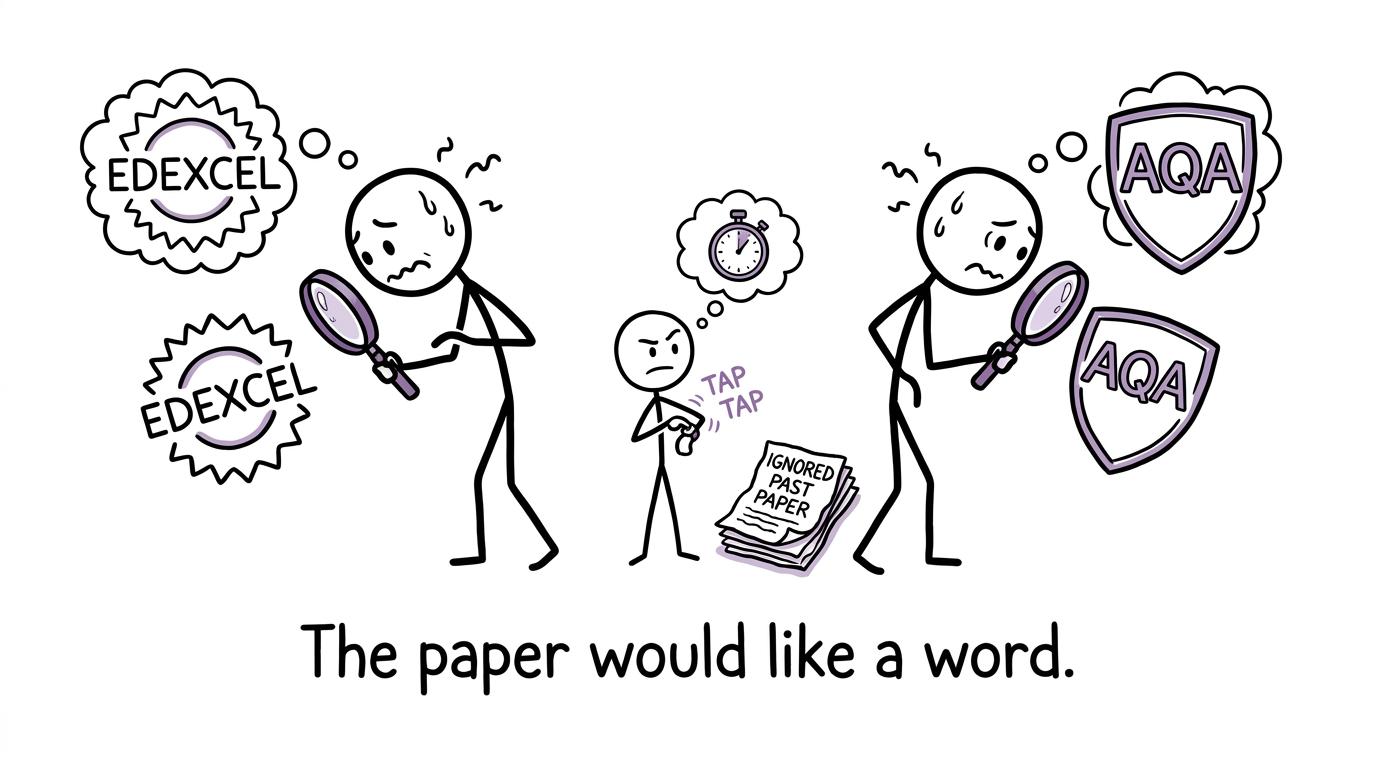 Students investigate exam-board logos while an ignored past paper waits
Common mistakes when comparing GCSE Arabic courses
Revising for an International GCSE by accident
A first-language paper may contain useful Arabic practice, but it cannot replace material matched to GCSE Arabic 1AA0. Check the code before committing time.
Assuming familiar content means an easier exam
Recognising a theme is not the same as meeting the mark scheme. Accuracy, detail, comprehension and task fulfilment still decide marks.
Using grade boundaries as a revision target
Previous boundaries describe a past series. They do not tell you precisely what will be required this year.
Neglecting one quarter of the qualification
With four equally weighted skills, ignoring speaking or listening creates a substantial weakness. Allocate revision according to evidence, not preference.
Practising without exam conditions
Unlimited pauses, dictionaries and heavily prepared answers can create false confidence. Supported practice has a place, but it must lead towards independent performance under the real rules.
Comparing boards instead of improving technique
Board comparison can become sophisticated procrastination. The more useful question is: which task currently costs you marks, and what will you do about it this week?
The board matters less than matching your preparation
The exam board matters because it determines the specification, paper structure and mark scheme. It does not offer a hidden shortcut to an easier grade.
For most students taking regulated GCSE Arabic in England, Pearson Edexcel is the relevant board, so the practical challenge is not choosing among AQA, OCR, Eduqas and Edexcel. It is confirming the correct qualification, tier and specification code, then practising its exact demands.
Apply the same discipline across your timetable. Use MathsGenie’s free GCSE revision resources to keep maths moving with revision lessons, practice questions and mini tests. Build exam confidence with Edexcel GCSE maths past papers, mark schemes and video solutions, then add predicted papers when the examinations approach.
The board name belongs at the top of the paper. Your attention belongs on the work that changes the marks.