

Can You Sit GCSE Arabic at a Different Exam Centre?
GCSE Arabic different exam centre guide: find an approved centre, arrange your speaking assessment, confirm fees, deadlines and access arrangements.
The difficult part is sometimes not learning the subject. It is finding a desk where you are allowed to sit the exam.
If your school does not offer Arabic, you can normally arrange to sit GCSE Arabic at a different exam centre as a private candidate. The centre must be approved by the relevant exam board, accept external candidates for the correct specification and be able to conduct every required assessment, including speaking.
That is the short answer to the GCSE Arabic different exam centre question. The longer answer matters because an informal agreement is not an exam entry. You need confirmation of the board, specification, tier, assessments, fees and deadlines before you can consider the arrangement secure.
Your GCSE Arabic exam-centre checklist
Before paying or changing your revision plans, confirm all of the following in writing:
- Your current school cannot enter you for GCSE Arabic.
- The alternative centre accepts private candidates.
- It offers the exact qualification and specification you are preparing for.
- It can conduct the Arabic speaking assessment, not only the written papers.
- It has confirmed your foundation or higher tier entry.
- You know the centre's internal deadline and total fee.
- Any access arrangements have been discussed early.
- You will receive a statement of entry to check.
- Your school knows that you are being entered elsewhere, preventing confusion or duplicate entries.
- You know where and when every assessment will take place.
Once these details are settled, the administrative problem becomes smaller. You can return your attention to Arabic and to the rest of your GCSE timetable, including maths.
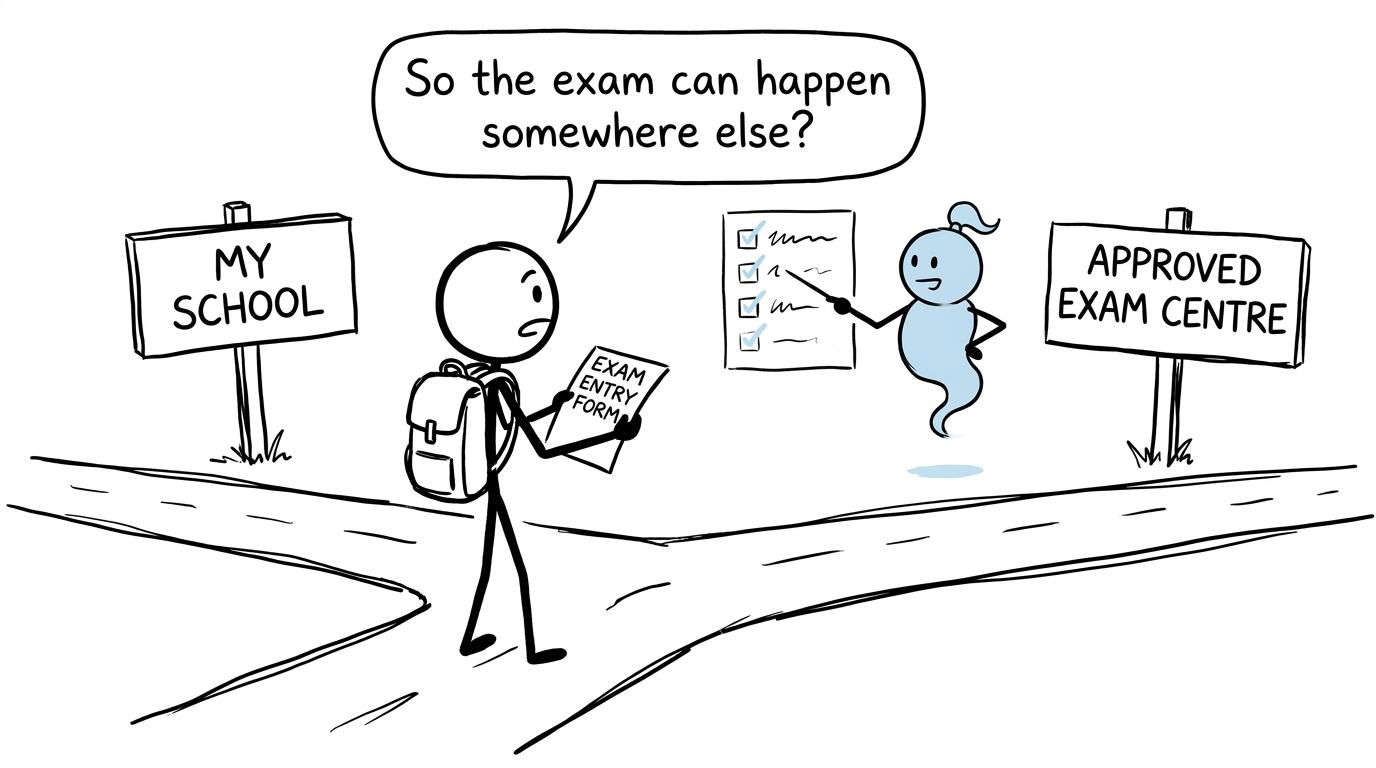 A student discovers that an approved exam centre can be different from their school
Can you take GCSE Arabic somewhere other than your school?
Yes. A student can take an examination at an approved school, college or other exam centre without being enrolled there as a pupil. At that centre, the student is usually treated as a private candidate, sometimes called an external candidate.
The alternative centre makes the entry with the awarding organisation. You cannot enter yourself directly with an exam board, and the Joint Council for Qualifications, or JCQ, is not itself an exam centre.
Your first conversation should still be with your school's exams officer. A school that does not teach Arabic might nevertheless be willing to arrange an entry, although it may decline if it cannot provide the necessary staff, facilities or speaking assessment. Ask clearly rather than assuming.
If the school cannot help, request written confirmation and ask whether it knows of a nearby centre that has previously offered language entries. You can then use the JCQ private-candidate search tool and contact approved centres directly. Listings are a starting point, not a guarantee: availability, subjects, capacity, fees and internal deadlines must be checked with each centre.
Check the exact GCSE Arabic qualification
The live Pearson Edexcel GCSE Arabic qualification is specification code 1AA0. It assesses listening, speaking, reading and writing. Each component is available at foundation and higher tier, and a candidate must take the same tier across all four papers.
This distinction matters. “Arabic GCSE” is not precise enough when contacting a centre. GCSE and International GCSE qualifications can have different codes, assessment structures and speaking requirements. Preparing for one specification while being entered for another can leave you revising the wrong content or format.
Ask the exams officer to confirm:
- the awarding organisation;
- the qualification title;
- the specification and entry code;
- whether the entry is foundation or higher tier;
- the examination series;
- how and where the speaking assessment will be conducted.
Pearson's current GCSE Arabic specification requires the speaking assessment to be conducted in person during the prescribed window. It is conducted by a suitable teacher-examiner at the centre, recorded and sent to Pearson for external assessment. This is why a centre that accepts private candidates generally may still be unable to accept GCSE Arabic specifically.
How to arrange a different exam centre
Speak to your school first
Contact the exams officer, head of languages or GCSE co-ordinator. Explain that you want to take GCSE Arabic and ask whether the school can make the entry despite not teaching the course.
If the answer is no, establish whether the objection concerns the subject entry itself, the speaking assessment or both. That information may help when approaching another centre. Keep your school informed, particularly if GCSE Arabic affects your timetable, predicted grades or post-16 applications.
Search for approved private-candidate centres
Use the JCQ private-candidate centre search and filter by qualification and awarding organisation. You can also contact local secondary schools, further education colleges and dedicated examination centres.
Approach several centres rather than waiting for one reply at a time. Not every centre accepts private candidates, and a centre offering Pearson qualifications does not automatically offer Arabic. Language assessments require additional organisation, so capacity may be limited.
Send a precise enquiry
A useful enquiry gives the exams officer enough information to make a decision. Include:
- the candidate's full name and date of birth;
- the intended exam series;
- Pearson Edexcel GCSE Arabic, code 1AA0, if that is your chosen specification;
- the intended tier;
- confirmation that you require all four components;
- any access arrangements or modified-paper needs;
- your Unique Candidate Identifier, if you already have one;
- a request for the full fee and internal deadline.
Do not send sensitive identity documents until the centre explains its secure registration process.
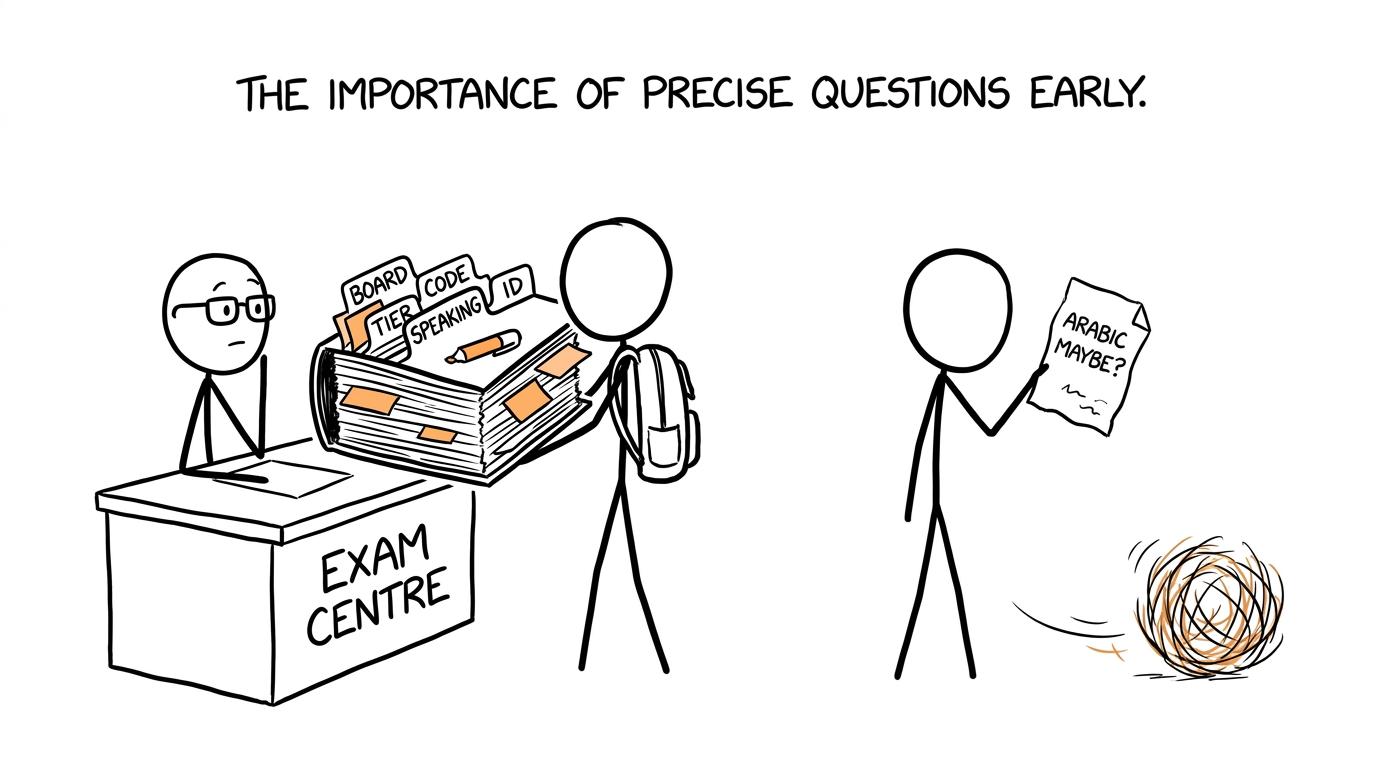 An organised candidate asks an exam centre precise questions while another arrives with a vague note
Confirm the speaking assessment
This is the question that should never be left until the end: Will the centre provide a suitable teacher-examiner and conduct the GCSE Arabic speaking assessment?
The centre is responsible for following the exam board's instructions, maintaining secure materials, recording the assessment and submitting the required files. A relative or informal tutor cannot simply conduct the assessment independently. JCQ rules govern who may act as the teacher-examiner and how potential conflicts of interest are handled.
Ask whether the speaking assessment will happen at the same address as the written papers. It may take place weeks before the main written examination dates, so include it in your travel and revision plans.
Register, pay and check your statement of entry
Once a centre accepts you, it will explain its identification, registration and payment requirements. Private candidates are normally responsible for the awarding-body charge together with any administration, invigilation, assessment or facility fees set by the centre.
There is no single national price. Request an itemised total and ask what happens if you withdraw, change tier or apply after the centre's standard deadline. Centres can set internal deadlines earlier than the awarding organisation's final entry deadline, and late entries may cost more or be refused.
After registration, obtain your statement of entry. Check your name, date of birth, subject, code, tier and components immediately. A payment receipt alone does not prove that every detail of the entry is correct.
Access arrangements and exam support
If you normally receive extra time, supervised rest breaks, a reader, a scribe, a separate room or modified papers, tell the proposed centre during your first enquiry.
The new centre must consider the evidence, follow JCQ requirements and make the relevant application. An arrangement used at your school does not transfer automatically merely because a teacher knows about it. The centre may need documents or an assessment, and deadlines can fall well before the examinations.
Ask your school or SENCO what evidence already exists and whether it can be shared securely with the new centre. Starting early gives the centre time to decide what can be supported. Never assume the matter can be repaired on the morning of the exam.
Protect your maths revision while arranging Arabic
Exam administration expands to fill whatever attention you give it. One unanswered email becomes five tabs, three phone calls and an evening in which no revision happens.
Contain the task. Keep a simple record of centres contacted, dates, replies, fees and next actions. Set aside one short weekly administration block, ideally with a parent or carer, rather than checking for replies throughout every revision session.
Then give each subject a defined place. The GCSE maths revision hub lets you select your exam board and move between revision lessons, practice questions, mini tests and papers. If you need a workable weekly structure, adapt the GCSE maths revision timetable rather than building a complicated plan from scratch.
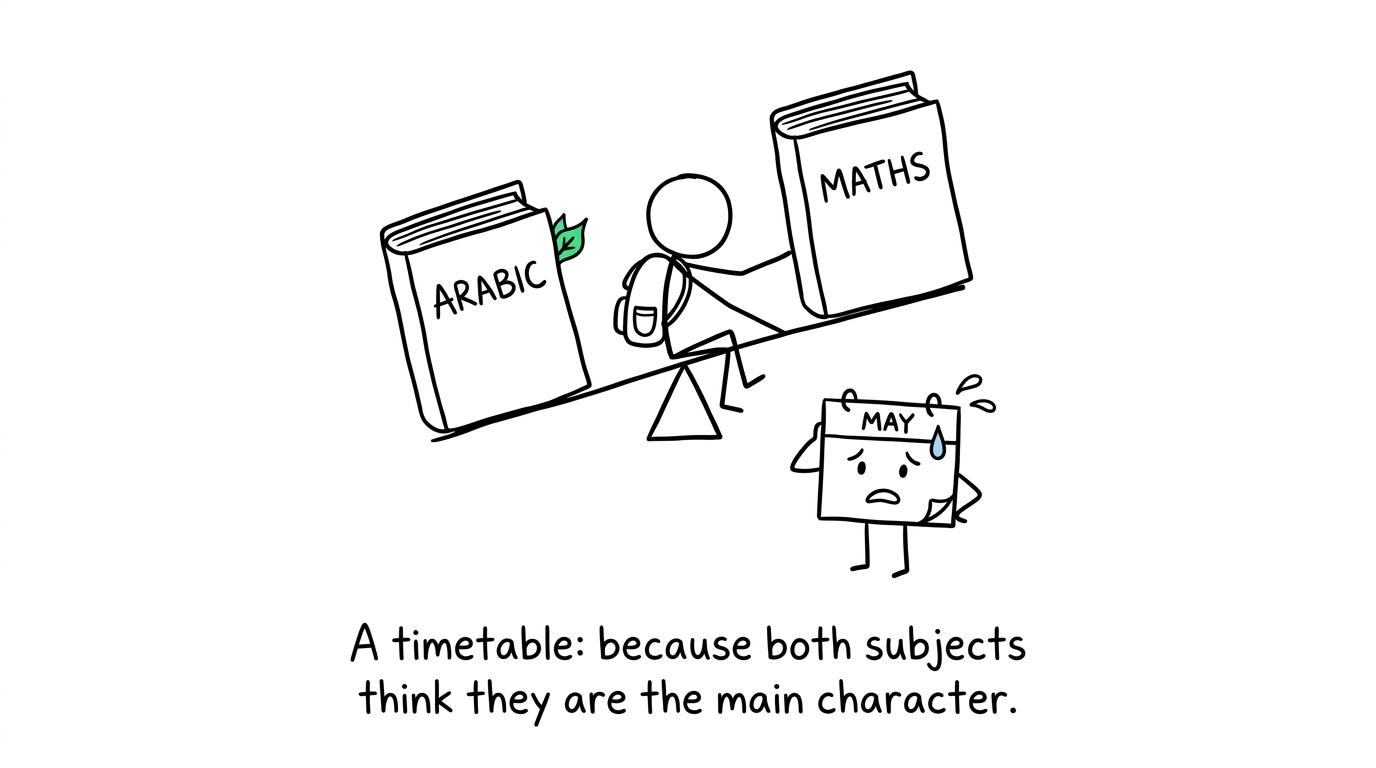 Arabic and maths both attempt to become the main character in a student's revision timetable
Short sessions are useful when phone calls and paperwork interrupt the week. The 20-minute GCSE maths revision routine provides a repeatable learn, practise and mark cycle. For a longer run-up, use the one-month GCSE maths revision plan.
Keep your maths practice matched to the correct board and tier. MathsGenie provides dedicated resources for Edexcel GCSE Maths, OCR GCSE Maths and other UK exam boards. Once your topic knowledge is secure, use Edexcel GCSE Maths past papers or AQA GCSE Maths past papers with their mark schemes and available solutions.
The principle is the same in both subjects: confirm the specification first, then practise the assessment you will actually sit.
Common mistakes when booking GCSE Arabic elsewhere
Assuming any exam centre can offer Arabic
Approval for one exam board or subject does not guarantee that the centre can deliver GCSE Arabic. Confirm the exact specification and every component.
Confusing GCSE with International GCSE
These are separate qualifications. Check the full title and code before agreeing to an entry or buying resources.
Asking only about the written papers
Listening, reading and writing are not the entire qualification. The centre must also be able to conduct and submit the speaking assessment correctly.
Waiting for the exam board's final deadline
A centre's own deadline may be earlier, especially where it must organise a suitable teacher-examiner. Begin enquiries during the autumn before the intended summer series where possible.
Choosing a tier informally
For Pearson Edexcel GCSE Arabic, the same tier must be used across all four components. Obtain written confirmation of foundation or higher entry before the speaking assessment.
Forgetting access arrangements
Discuss support during the first enquiry. Evidence, approval and practical arrangements take time.
Treating a verbal yes as confirmation
Secure the full details in writing, pay through the centre's official process and check the statement of entry. Precise paperwork now prevents unpleasant surprises later.
Turn the arrangement into a confirmed plan
You can sit GCSE Arabic at a different exam centre when your school does not offer it. The key is to become specific early: identify the qualification, find an approved centre accepting private candidates, confirm all four assessments, agree the tier and fees, arrange support, and check the final entry.
Once the centre is confirmed, let the administration become boring. That is a success. Your attention can move back to the work that earns marks.
For maths, begin with the MathsGenie GCSE revision hub. Use free revision lessons to rebuild weak topics, practice questions and mini tests to develop accuracy, then past papers, predicted papers, mark schemes and video solutions to prepare for exam conditions. One secure Arabic entry and one clear revision plan can remove a surprising amount of uncertainty from the year.










