

GCSE Arabic and GCSE Modern Hebrew Together?
GCSE Arabic and GCSE Modern Hebrew together is possible. Compare exam rules, language overlap, workload and how to protect your GCSE maths revision time.
Choosing GCSE subjects can feel like arranging a suitcase that is already full. Every new qualification may be valuable, but it still needs time, preparation and space beside compulsory subjects such as maths.
The direct answer is that taking GCSE Arabic and GCSE Modern Hebrew together is generally possible. They are separate language qualifications, and there is no general rule preventing a student from entering both. The real questions are whether your school or exam centre can provide both entries, whether the final timetable is manageable, and whether you are sufficiently fluent and literate in each language.
There is useful linguistic overlap, but much less exam-saving overlap than students sometimes expect. Arabic and Modern Hebrew are related languages, yet each has its own script, vocabulary, grammar, pronunciation and assessment preparation.
The quick decision checklist
Before committing to both GCSEs, establish the following:
- Your school or examination centre is willing and able to enter you for both qualifications.
- A suitable teacher or examiner can conduct each speaking assessment correctly.
- You can read, write, listen and speak confidently in both languages.
- You understand which tier you will take in each subject.
- Your centre has checked the current specifications and final examination timetable.
- The extra preparation will not weaken your GCSE maths, English or science revision.
- You have seen authentic past or sample assessment materials for both languages.
A promising answer to most of these questions makes the combination realistic. Uncertainty about several of them means you need a conversation with your examinations officer before building a revision plan.
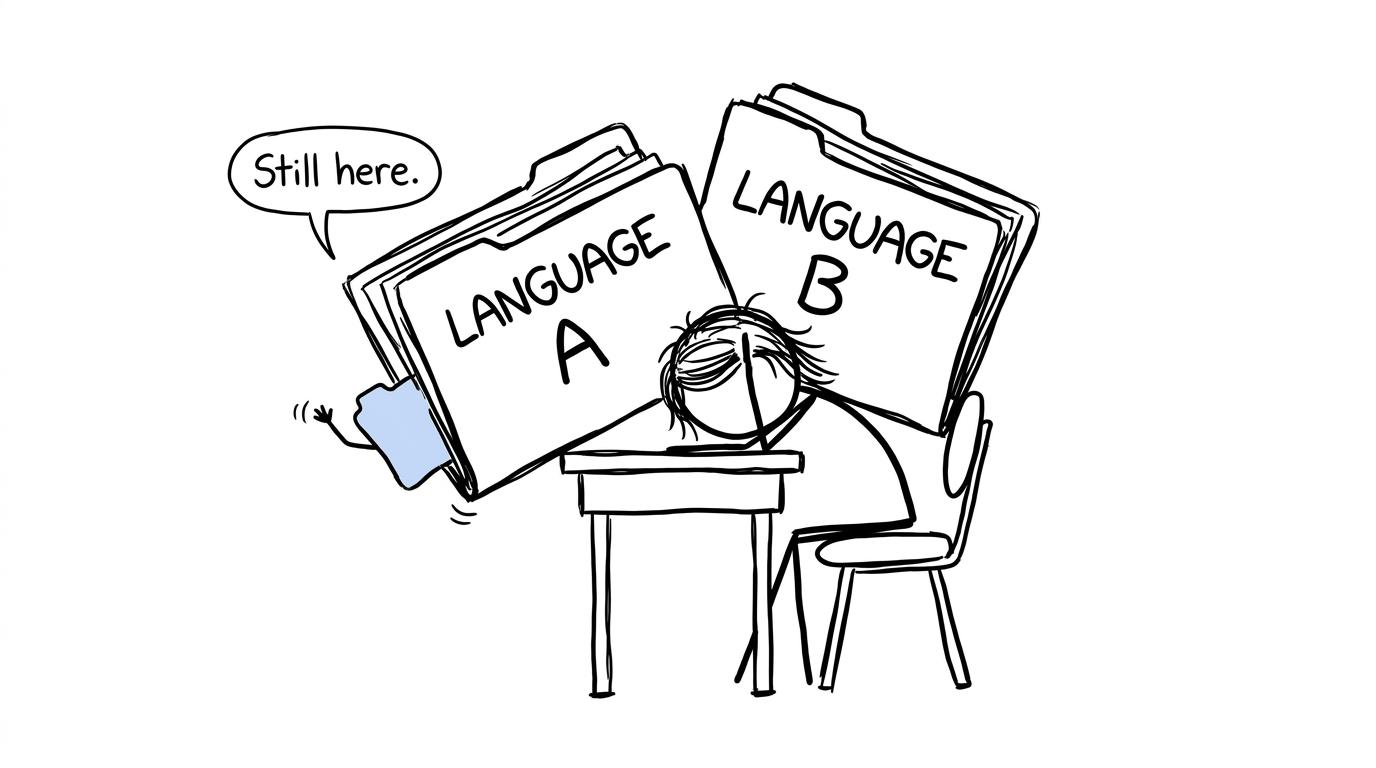 A GCSE student balancing two language folders while maths waits underneath
Are you allowed to take both qualifications?
Yes, in principle. GCSE Arabic and GCSE Modern Hebrew are different subjects rather than duplicate entries for the same subject. At the time of writing, GCSE Arabic is offered by Pearson Edexcel under specification code 1AA0, while GCSE Modern Hebrew is offered by AQA under specification code 8678.
Both are linear GCSEs. This means the assessments contributing to the final qualification are completed in the relevant examination series rather than being collected as separate modular awards over several years.
However, being permitted to take both does not mean every school must offer both. A centre needs to handle entries, speaking assessments, secure materials and examination administration. A school may therefore decline an entry because it lacks an appropriate teacher, cannot conduct the speaking component or has an internal policy on additional languages.
Ask your examinations officer three precise questions:
- Can the centre enter me for both current specifications?
- Who will conduct and authenticate the speaking assessments?
- When will the centre confirm possible timetable clashes?
Do this early. Administrative feasibility is different from academic ability, and neither can replace the other.
Foundation and higher tier decisions
Both qualifications have foundation and higher tiers. Within each individual GCSE, all four language skills must be entered at the same tier. You cannot mix foundation listening with higher writing in one qualification.
Because Arabic and Modern Hebrew are separate GCSEs, the tier decision is made separately for each. A student could potentially take higher tier in one language and foundation tier in the other if the centre considers that appropriate.
The usual grade ranges apply: foundation tier covers grades 1-5, while higher tier covers grades 4-9. Tier selection should reflect performance across all four skills, not just conversational confidence.
What each GCSE actually assesses
The broad assessment structure is remarkably similar. Both qualifications test:
- listening;
- speaking;
- reading; and
- writing.
Each skill contributes one quarter of the qualification. Both courses include communication across familiar personal, social, educational and wider-world contexts. They also assess the ability to understand detail, express opinions and use language across different time frames.
That shared shape helps with exam habits. Techniques such as identifying command words, developing spoken answers, checking whether every writing bullet point has been covered and practising under timed conditions can transfer between the two subjects.
But the marks remain language-specific. Knowing how to structure an extended answer does not supply the vocabulary, spelling or grammatical accuracy needed to write it in the other language.
It is also important not to confuse Modern Hebrew with Biblical Hebrew. They are distinct GCSE subjects with different content and assessment structures. Confirm that your entry is specifically for AQA GCSE Modern Hebrew if that is the qualification you intend to take.
How much Arabic and Modern Hebrew overlap is there?
Arabic and Hebrew belong to the Semitic language family. This shared history creates genuine connections. Both are written from right to left, both use consonant-centred writing systems, and both make extensive use of roots and patterns when forming related words. Students may also notice related vocabulary and some familiar grammatical ideas, including grammatical gender.
This can make the second language feel less conceptually strange. Recognising that words may be organised around consonantal roots, for example, is a transferable insight.
Yet related does not mean interchangeable.
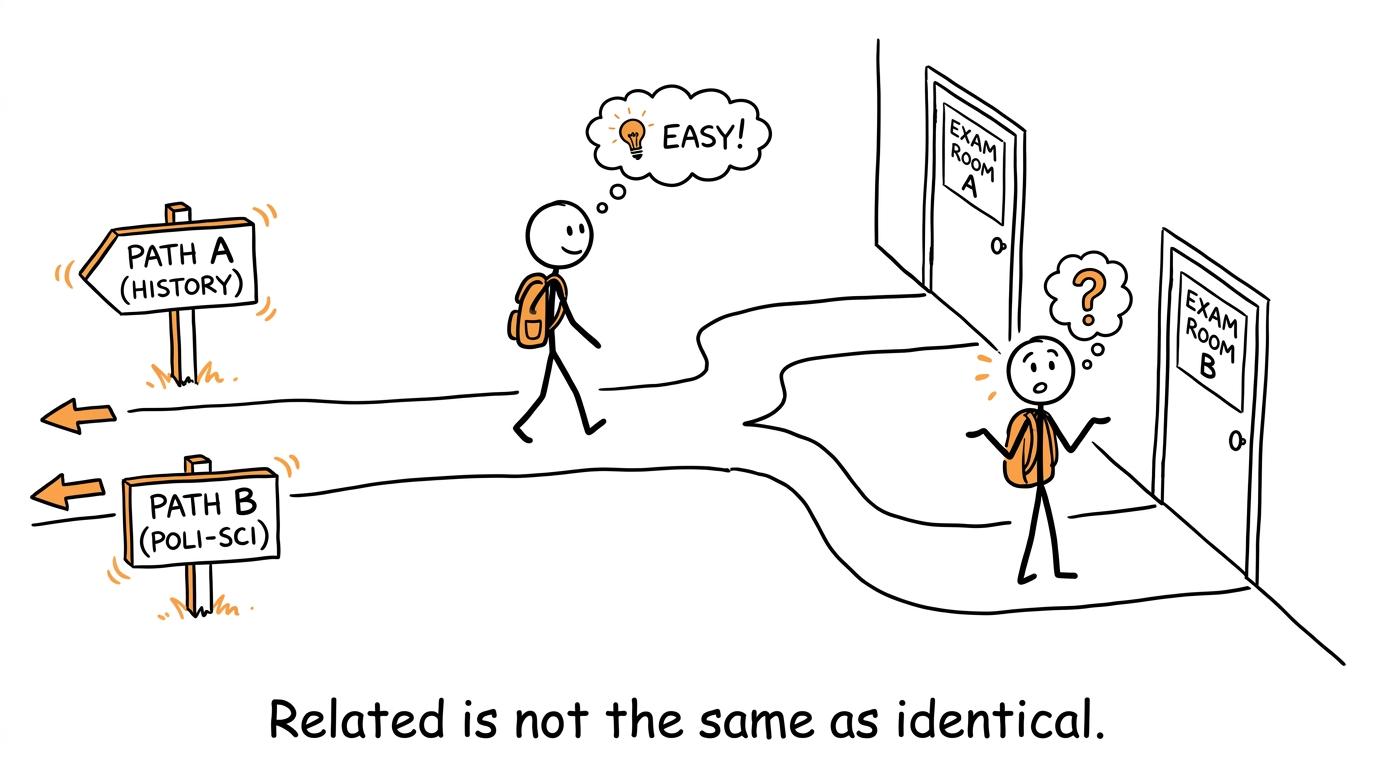 Two related language paths leading to separate examination rooms
Where the overlap stops
The two languages use different scripts. Letter forms, spelling conventions and the practical process of reading fluently must be learnt separately. Their pronunciation systems, everyday vocabulary and detailed verb patterns also differ.
Arabic brings another practical consideration: students may speak a regional variety at home while the GCSE assesses standard Arabic appropriate to the specification. Home fluency is a major advantage, but it does not automatically guarantee confidence with formal reading and writing.
Modern Hebrew similarly requires accurate written language and exam-ready grammar, not merely the ability to follow family conversation.
The most realistic description is therefore:
- Strong overlap in broad linguistic ideas;
- some overlap in learning strategies and occasional vocabulary relationships;
- limited direct overlap in the material that must be recalled accurately in each examination.
You are preparing two qualifications, not one enlarged language course.
Is taking both realistic?
It depends more on your starting point than on the relationship between the languages.
Taking both may be realistic if you already speak, read and write both with confidence, have access to appropriate teaching, and perform securely on assessment materials. It may also work if one language is already strong and you have been learning the other systematically for several years.
It becomes much harder when you can speak both but write neither accurately, when you are beginning one language late, or when both qualifications must be prepared independently outside school. Listening and conversation can create an impression of fluency that disappears when faced with translation, formal spelling and extended writing.
A sensible diagnostic is to inspect each skill separately:
- Can you understand unfamiliar recorded speech without visual clues?
- Can you respond spontaneously in a speaking task?
- Can you read formal and informal texts accurately?
- Can you produce extended writing using more than one time frame?
If one skill is far behind in either language, count the time needed to repair it. Do not base the decision solely on the number of GCSEs you could collect.
Protecting your GCSE maths revision
An additional language qualification has an opportunity cost. An evening spent preparing a speaking answer cannot also be used to fix algebra or complete a calculator paper. That does not make the language a poor choice; it simply makes planning essential.
Start by using the GCSE maths revision hub to identify your board, tier and weakest topics. Students following AQA can use the AQA GCSE maths revision resources, while Eduqas students have a dedicated Eduqas GCSE maths revision hub.
Build a weekly plan around distinct kinds of work:
- short Arabic vocabulary, listening or speaking sessions;
- short Modern Hebrew vocabulary, listening or speaking sessions;
- protected maths topic practice;
- one longer timed assessment block;
- catch-up time and proper rest.
The GCSE maths revision timetable guide can help you create a routine that revisits weak skills rather than rewarding whichever subject feels easiest that evening. If exams are approaching, the one-month GCSE maths revision plan offers a more concentrated structure.
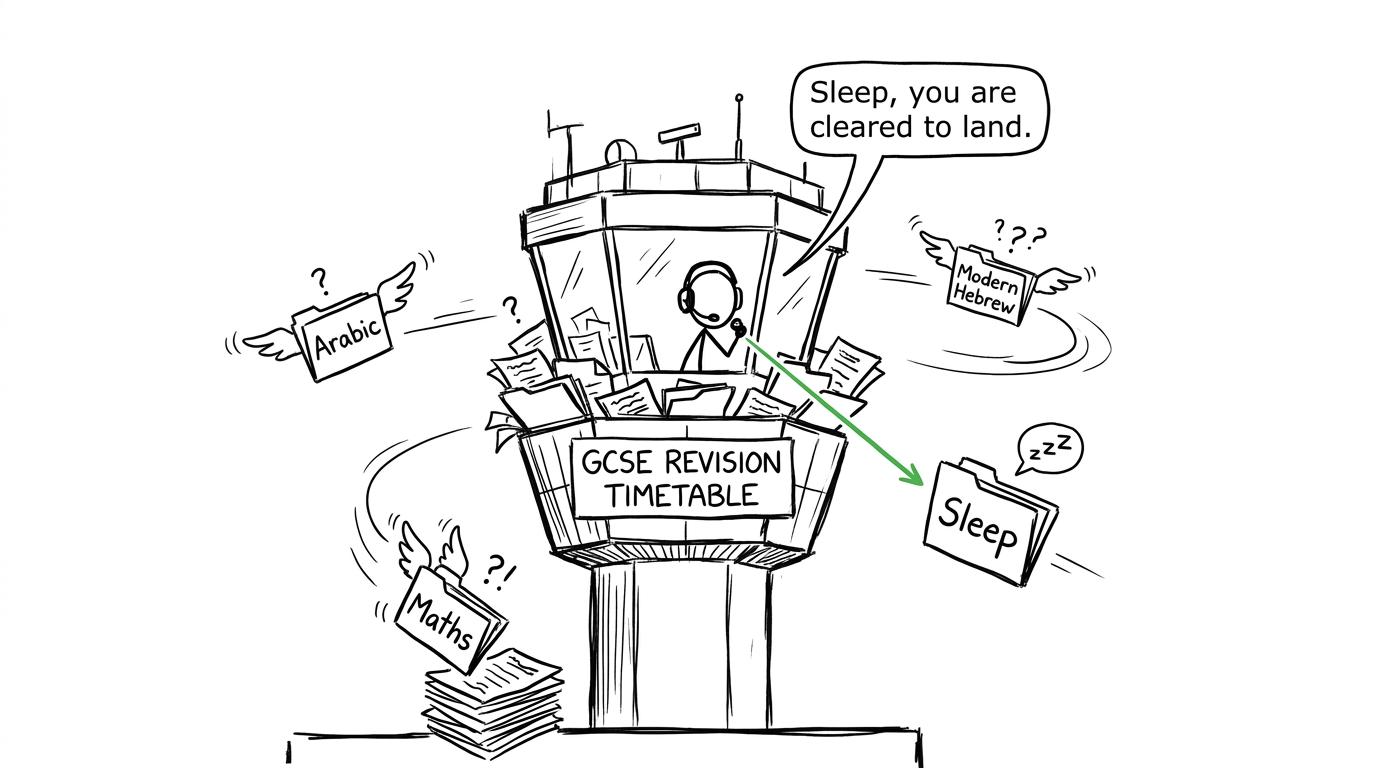 A revision control tower finding space for languages, maths and sleep
Managing papers and timetable clashes
Your centre should check the final timetable for the correct examination series. Speaking assessments take place within prescribed windows, while listening, reading and writing papers are scheduled nationally by the relevant awarding organisation.
If two written examinations fall in the same session, JCQ procedures allow centres to manage many genuine timetable clashes under supervised conditions. The exact arrangement depends on the combined duration and circumstances. Do not attempt to solve the clash yourself or assume one paper can simply be taken on another convenient day.
Ask the examinations officer to confirm the arrangement in writing once entries and timetables are final.
Use the same disciplined approach with maths papers. Complete board-appropriate material, mark it and turn lost marks into named topics. The guide to using GCSE past papers properly explains how to make each paper produce a useful revision action. Edexcel students can go directly to the Edexcel GCSE maths past papers, including mark schemes and worked solutions where available.
Common mistakes when choosing both languages
Assuming related languages mean half the work
Shared roots and right-to-left writing provide a head start, not a shortcut through two specifications. Separate vocabulary, scripts and exam practice are still required.
Confusing speaking ability with GCSE readiness
A fluent conversation may not reveal weaknesses in spelling, translation, formal register or extended writing. Diagnose all four skills.
Leaving the entry arrangements too late
A centre needs time to organise entries and speaking assessments. Confirm availability with the examinations officer rather than relying on an informal promise.
Ignoring the exact qualification title
Modern Hebrew and Biblical Hebrew are not the same GCSE. Check the exam board, specification code and assessment structure.
Sacrificing maths whenever revision becomes crowded
Maths improvement depends on repeated practice. Use the guide to finding your weakest GCSE maths topics so limited time goes towards the errors actually costing you marks.
Make the decision from evidence
Taking GCSE Arabic and GCSE Modern Hebrew together can be an excellent choice for a student who is genuinely prepared in both languages. The combination is allowed in principle, and the shared Semitic background creates some helpful connections. But the overlap does not remove the need to master two scripts, two bodies of vocabulary and two sets of language-specific assessment demands.
Before committing, ask your centre to confirm the entries, speaking arrangements, tiers and timetable. Then test your real level across listening, speaking, reading and writing. The best subject choice is not the one that looks most impressive on paper. It is the one you can prepare for without quietly weakening everything around it.
Keep maths stable while you decide. Use MathsGenie’s free revision lessons and practice questions to repair individual topics, mini tests to check recall, and past papers, predicted papers, mark schemes and video solutions to build exam confidence. A clear plan protects your time, and turns an ambitious GCSE programme into a manageable one.










