GCSE Arabic 6 to 8: A Practical Revision Guide
GCSE Arabic 6 to 8: discover the changes in speaking, listening, reading and writing that can turn secure answers into grade 8 performance now.
A grade 666 can feel frustratingly close to a grade 888. You already understand Arabic. You can communicate, follow texts and produce sensible answers. Yet the highest marks remain slightly out of reach.
The route from GCSE Arabic 6 to 8 is not simply learning hundreds of extra words. It is about gaining greater control: understanding implied meaning, developing answers, manipulating grammar accurately and responding when the language becomes less predictable.
For the current Pearson Edexcel GCSE Arabic qualification, listening, speaking, reading and writing each contribute 25%25\%25% of the final result. That balance matters. A brilliant prepared conversation cannot completely compensate for weak listening or rushed writing. To reach grade 888, your performance needs to become more consistent across all four skills.
The grade 6 to grade 8 checklist
Focus on these changes:
- move from identifying information to interpreting opinions and conclusions
- replace short statements with developed ideas, reasons and examples
- use different time frames accurately rather than occasionally
- respond naturally to unpredictable speaking questions
- widen vocabulary by theme, context and word family
- improve grammatical control without avoiding ambitious language
- practise translation in both directions
- use timed papers to diagnose specific weaknesses
- review mistakes and retest them instead of merely completing more work
The principle is familiar to successful maths students: marks improve when practice becomes specific. MathsGenie’s guide to finding your weakest GCSE topics explains that diagnostic approach clearly. In Arabic, your categories might be inference, verb agreement, pronunciation, translation or understanding fast speech rather than algebra and geometry.
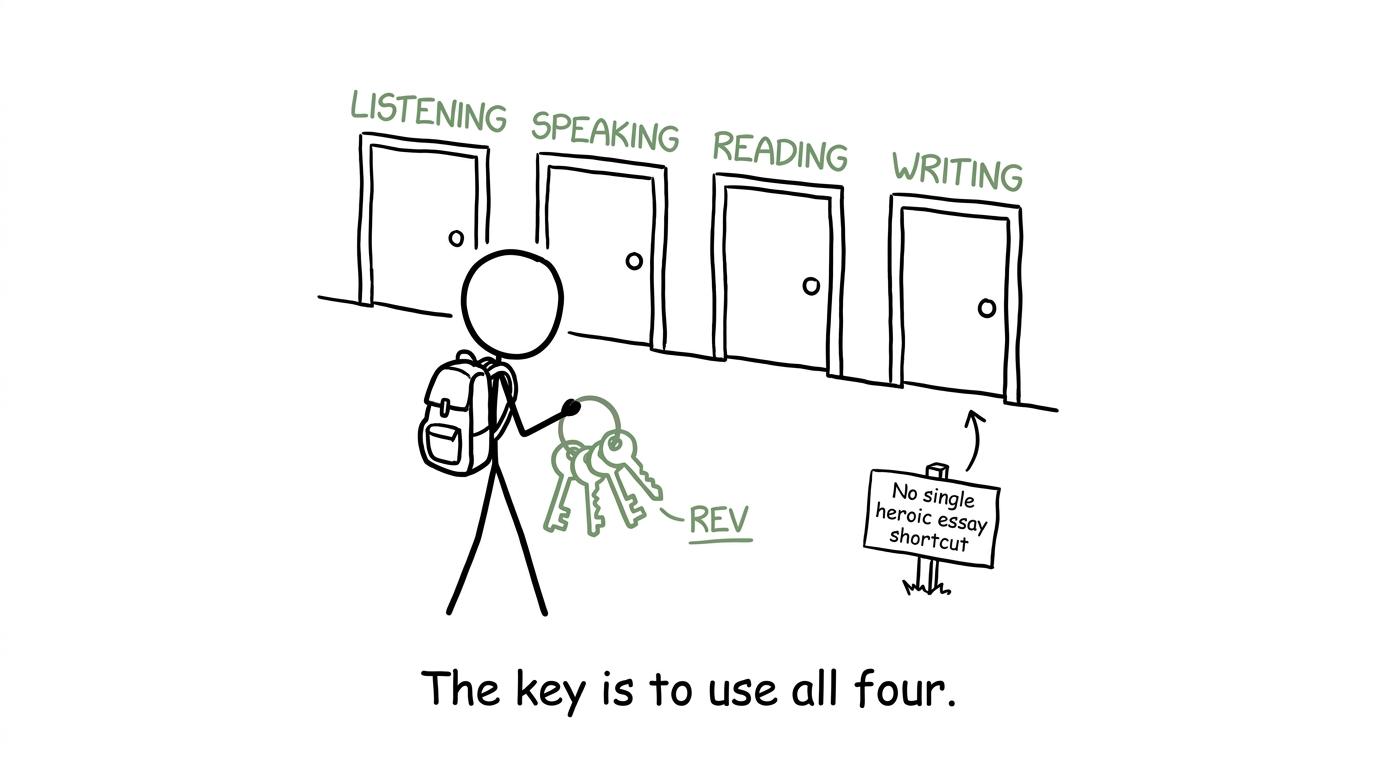 A student facing the four doors of GCSE Arabic assessment
What separates a grade 6 from a grade 8 in GCSE Arabic?
A grade is awarded from your total mark, and grade boundaries are set for each examination series. There is no permanent raw mark that always guarantees a grade 888. The more useful distinction comes from the official grade descriptor.
At grade 888, students are expected to handle more complex and extended spoken and written passages. They can identify opinions, draw conclusions and infer meaning. In speaking and writing, they explain ideas, justify opinions and manipulate vocabulary and grammar, including some complex language, mostly accurately.
That last phrase is important: mostly accurately. Grade 888 does not require perfection. It requires enough control that ambitious language strengthens communication rather than making the answer difficult to understand.
| Secure grade 6 performance | Grade 8 direction |
|---|---|
| Understands main points and many details | Handles extended material and draws conclusions |
| Gives relevant opinions | Explains and justifies opinions convincingly |
| Uses familiar structures successfully | Manipulates familiar and more complex structures |
| Produces prepared speaking answers | Sustains conversation through unexpected questions |
| Uses several time frames | Moves between time frames with reliable control |
| Understands direct meaning | Recognises viewpoints and implied meaning |
| Communicates despite noticeable errors | Remains mostly accurate while attempting greater complexity |
The difference is not decorative vocabulary. It is depth, flexibility and accuracy working together.
Build equal strength across the four papers
Pearson Edexcel GCSE Arabic uses four compulsory papers: listening, speaking, reading and writing. Students enter one tier across the qualification. A student targeting grades 666 to 888 will normally be preparing for Higher tier, but your school makes the entry decision.
Higher-tier listening lasts 454545 minutes, including 555 minutes of reading time. Higher-tier speaking lasts approximately 101010 to 121212 minutes after preparation time. Reading lasts 111 hour 555 minutes, while writing lasts 111 hour 252525 minutes. Check your current specification and examination instructions with your teacher, as administrative arrangements can change.
Because each skill carries the same weighting, organise revision by evidence rather than preference. Record a recent score or teacher judgement for each skill, then give additional time to the weakest one. The MathsGenie revision planner can help you protect regular revision blocks alongside maths and your other GCSE subjects.
Upgrade GCSE Arabic listening
Grade 666 listeners often recognise the topic, speaker and obvious details. Grade 888 listening asks for more: shifts of opinion, reasons, contrasts and conclusions across longer passages.
Listen for structure, not isolated words
Train yourself to notice:
- negative forms and exceptions
- changes between past, present and future
- contrast words that reverse an earlier idea
- whether an opinion belongs to the speaker or somebody else
- intensifiers, uncertainty and qualified opinions
- the final sentence, where a conclusion may appear
Do not stop listening mentally when you hear an unfamiliar word. Meaning is often recoverable from the words around it. Inference is a grade 888 skill precisely because complete word-for-word recognition is not always necessary.
Use short audio sections actively. First listen without pausing. On the second attempt, note the main idea, details and attitude separately. Then check the transcript or answer guidance if available. Your correction should name the cause: unknown vocabulary, missed negative, unfamiliar pronunciation, lost concentration or wrong inference.
Make speaking detailed but adaptable
The speaking assessment includes a role play, questions based on a picture stimulus and a conversation. A memorised paragraph may sound fluent until the teacher asks an unexpected follow-up question. Grade 888 performance is more flexible: the student sustains a detailed conversation and responds effectively when the route changes.
Build answers from reusable components:
- a direct response
- an opinion
- a reason
- a supporting detail
- a contrast or alternative
- a reference to another time frame
Practise these components across themes rather than memorising one rigid speech. Record yourself answering unseen questions and check whether you actually answered what was asked. Listen for pronunciation, agreement, hesitation and repeated vocabulary.
Your goal is not to remove every pause. Natural communication includes thinking time. Your goal is to avoid collapsing into one-word answers when the question is unfamiliar.
Turn writing from correct to convincing
A grade 666 response may communicate all the required information but rely on predictable sentences. A grade 888 response develops its content, justifies ideas and uses grammar with greater range and control.
Before writing, identify every bullet point and decide which time frame, opinion and supporting detail will address it. This prevents an elegant answer from missing part of the task.
After writing, check in layers:
- coverage: has every requirement been answered?
- communication: are ideas clear and sufficiently developed?
- verbs: are tense, person and agreement controlled?
- connections: do ideas flow through reasons and contrasts?
- accuracy: are spelling, gender, number and sentence structure secure?
- range: have you used varied vocabulary without forcing unsuitable phrases?
Translation into Arabic also deserves regular practice. It exposes small gaps that free writing can hide because you cannot simply avoid an awkward structure.
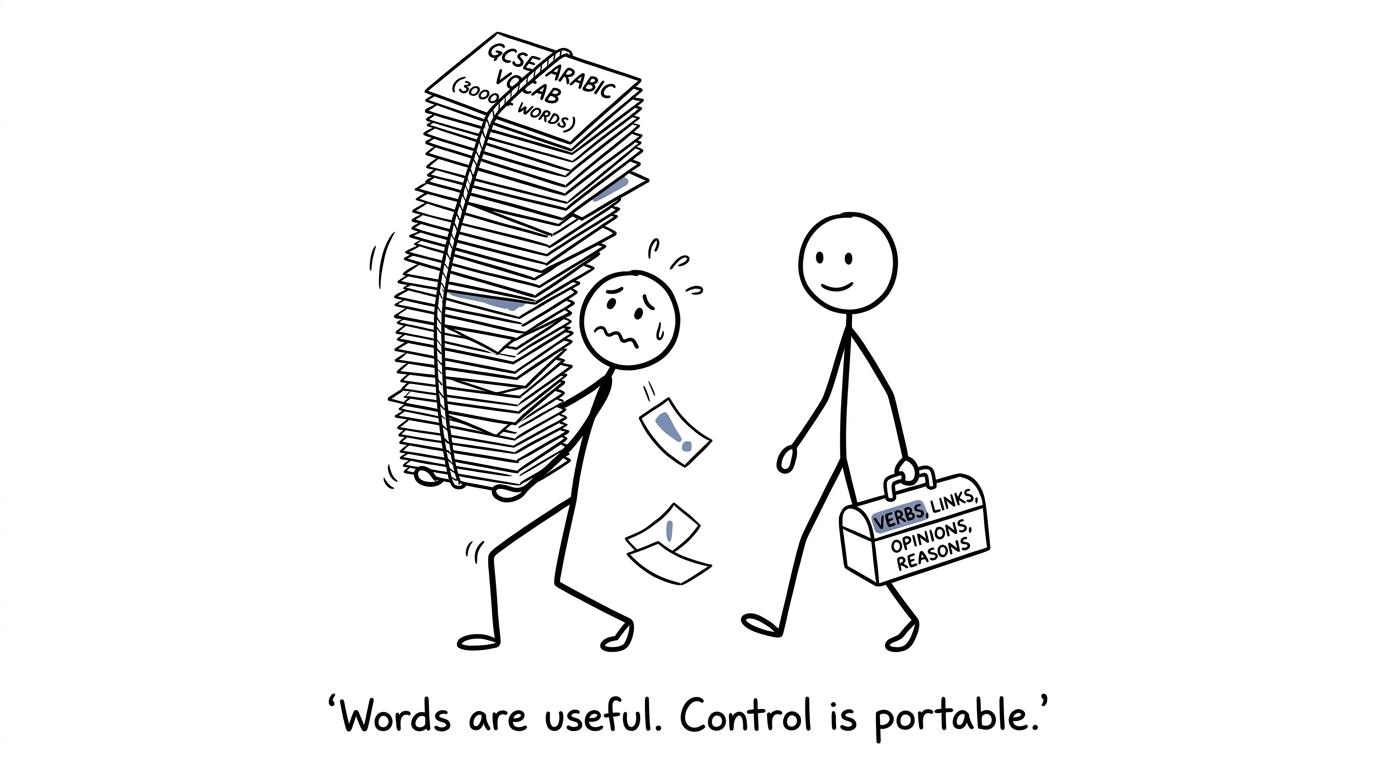 A huge vocabulary pile beside a small grammar toolbox
Read for viewpoint and implied meaning
Higher-tier reading includes varied texts and translation from Arabic into English. Moving towards grade 888 means reading beyond factual retrieval.
Ask three questions after each paragraph:
- What happened or what is being discussed?
- What does the writer think about it?
- Which word or phrase proves that interpretation?
That final question prevents vague guessing. It also trains you to distinguish a fact from an attitude.
When translating into English, preserve meaning before style. Check negatives, pronoun references, time markers and who performed each action. A polished English sentence that changes the original meaning will not earn full credit.
Vocabulary revision should also become contextual. Learn words with a phrase, common partner, opposite or related verb. A long disconnected list creates recognition; connected language creates usable control.
Use an error log to make the grade jump measurable
The most important change may be how you review work. Completing a paper tells you your current level. Correcting and retesting it is what changes that level.
Use a simple error log with five fields:
- paper and question
- skill or theme
- reason the mark was lost
- corrected rule, word or interpretation
- date for a fresh attempt
Sort errors into categories such as vocabulary, grammar, inference, task coverage, timing and careless reading. If the same category appears repeatedly, it becomes your next revision target.
This mirrors the method in MathsGenie’s guide to using GCSE past papers properly: attempt, mark, fix and retest. You can use GCSE mini tests to apply the same short-feedback rhythm to your maths revision while protecting separate Arabic practice sessions.
A weekly GCSE Arabic 6 to 8 routine
A balanced week could contain:
- one listening session focused on inference and opinions
- one speaking recording with unseen follow-up questions
- one reading passage plus careful translation review
- one timed writing task or detailed plan
- one grammar and vocabulary repair session based on your error log
- one short retest of mistakes from the previous week
Keep sessions narrow. “Revise Arabic” is too vague; “practise identifying changes of opinion in two listening extracts” gives you a measurable task.
As examinations approach, add complete timed papers. The same progression works in maths: topic practice first, then mixed questions, then exam conditions. MathsGenie’s advice on when to start GCSE past papers and its GCSE Maths revision hub can help you coordinate both subjects without turning every evening into an unplanned marathon.
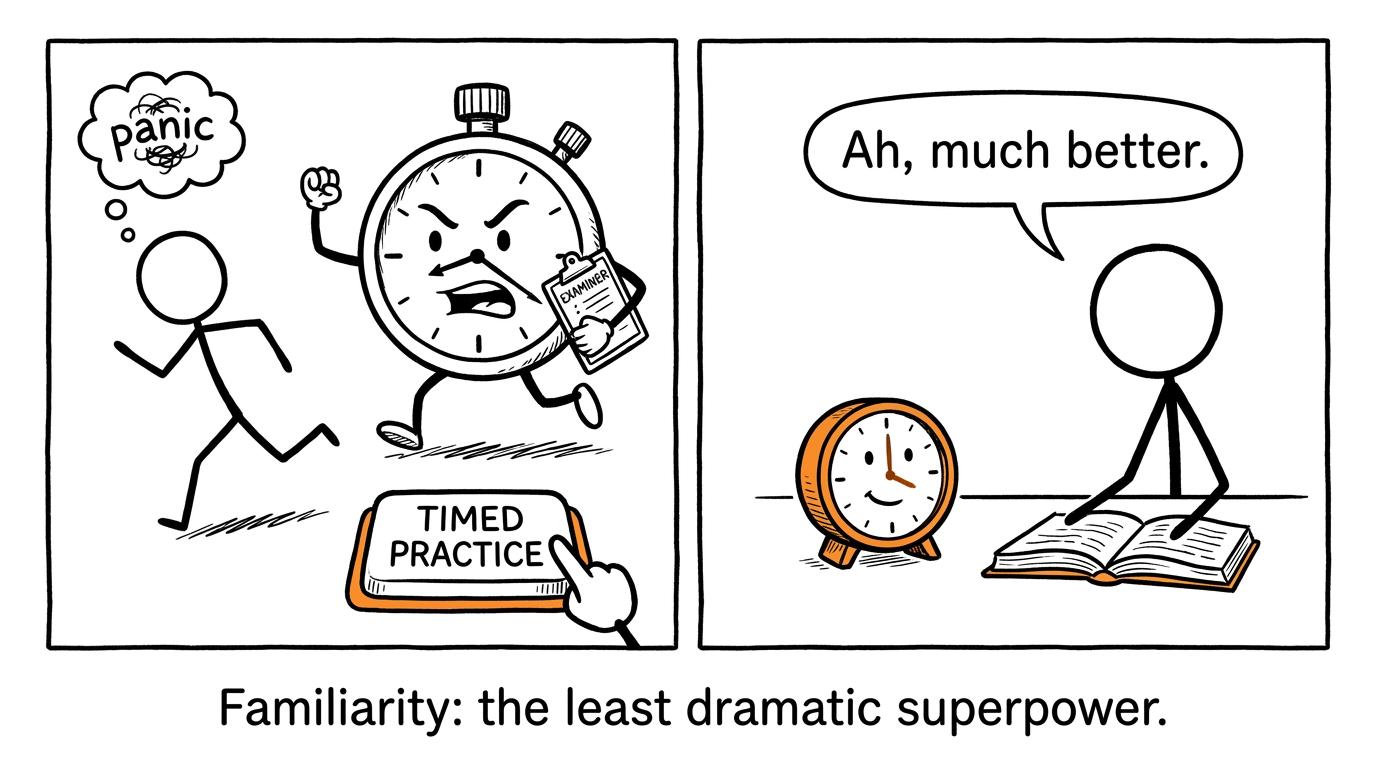 Timed practice transforming a chasing stopwatch into a friendly clock
Common mistakes that keep students at grade 6
Memorising answers without training flexibility
Prepared material is useful, but an examiner can ask unpredictable questions. Practise changing tense, viewpoint and detail so that your language remains usable outside one script.
Chasing rare vocabulary while basic grammar remains unstable
Sophisticated words cannot compensate for unclear verb forms or agreement. Secure high-frequency structures first, then add complexity selectively.
Treating every skill as a vocabulary test
Listening and reading also assess interpretation. Speaking and writing assess development, interaction, purpose and grammatical control. Vocabulary supports these skills; it does not replace them.
Ignoring the exact task
A fluent response that misses a bullet point or answers a different question sacrifices avoidable marks. Underline instructions and check coverage before finishing.
Completing papers without reviewing them
Volume can create the feeling of progress while the same errors survive. Use the paper-review cycle described in MathsGenie’s guide to finding weak topics quickly, adapted for Arabic skills.
Assuming a grade boundary is permanent
Grade boundaries vary between examination series. Use official boundaries only to interpret a particular paper, not as a fixed prediction of the mark needed in a future year.
Make control your competitive advantage
The jump from grade 666 to grade 888 is rarely one dramatic breakthrough. It is usually a collection of quieter changes: one better reason in speaking, one correctly inferred opinion in reading, one controlled time-frame shift in writing and one negative heard accurately in listening.
Begin with evidence. Complete a task in each skill, review it honestly and identify the two patterns costing you the most marks. Then build a weekly routine that repairs those patterns and tests them again.
MathsGenie does not replace your school’s GCSE Arabic specification materials, but it can organise the rest of your revision. Use the free GCSE Maths resources for revision lessons, practice questions, past papers, predicted papers, mini tests, mark schemes and video solutions. Apply the same disciplined cycle to Arabic: learn, practise, mark, fix and retest. That is how a target grade stops being a hope and becomes a plan.