

GCSE Arabic 3 to 5: A Practical Grade Guide
GCSE Arabic 3 to 5: learn what separates the grades and build a focused plan for stronger listening, speaking, reading, writing and exam skills.
A Grade 3 result can feel frustrating because it proves that you understand some Arabic, but not yet consistently enough to earn the grade you want. The encouraging part is that the GCSE Arabic 3 to 5 journey usually does not require obscure vocabulary or flawless grammar. It requires clearer communication, stronger control of familiar language and fewer marks lost through incomplete answers.
For the current Pearson Edexcel GCSE Arabic specification, listening, speaking, reading and writing each contribute 25%25\%25% of the qualification. A Grade 5 student therefore cannot rely entirely on one comfortable skill. The practical goal is to make all four skills dependable while turning your strongest areas into reliable sources of marks.
This guide focuses specifically on GCSE Arabic. MathsGenie does not provide Arabic lessons or Arabic past papers, but the revision system used across its free GCSE maths revision resources, diagnose, practise, mark, fix and retest, transfers effectively to language revision.
The GCSE Arabic 3 to 5 checklist
Use this as your starting point:
- Confirm that you are taking Pearson Edexcel GCSE Arabic, specification
1AA0, and check your tier with your teacher. - Collect evidence from each of the four skills rather than judging yourself by one mock grade.
- Learn high-frequency vocabulary by theme and use it in complete sentences.
- Practise identifying details, opinions, negatives and changes of timeframe.
- Extend speaking answers with an opinion, reason and relevant detail.
- Plan writing around every bullet point in the task.
- Improve control of familiar grammar before attempting unnecessarily elaborate language.
- Mark practice using official mark schemes and examiner criteria.
- Keep an error log and retest weaknesses after a short gap.
The Foundation tier offers grades 1 to 5. Higher tier normally offers grades 4 to 9, although a Grade 3 may be awarded when a result falls narrowly below the grade 4 boundary. Tier entry applies across the papers, so discuss it with your teacher rather than choosing from one isolated practice result.
What separates a Grade 3 from a Grade 5 in GCSE Arabic?
A Grade 3 student can usually retrieve straightforward information from short, familiar material and communicate basic ideas. Problems emerge when a passage becomes longer, a question is unpredictable or an answer needs development.
At Grade 5, the official modern foreign language descriptor expects students to handle some extended spoken and written passages, identifying overall messages, key points, details and opinions. In speaking, students should develop conversations with reasonable accuracy and respond appropriately to unpredictable questions. In writing, they should express ideas and opinions clearly while manipulating familiar vocabulary and grammar with reasonable accuracy.
That difference can be summarised as control under variation. Grade 3 performance often works when the language and question are highly familiar. Grade 5 performance remains understandable when the wording, timeframe or context changes.
| Around Grade 3 | Moving towards Grade 5 |
|---|---|
| Recognises key points in short passages | Follows overall meaning, details and opinions in longer material |
| Gives brief or heavily rehearsed answers | Develops answers and reacts to follow-up questions |
| Uses isolated or repetitive sentences | Links ideas into a coherent response |
| Gives an opinion without development | Supports an opinion with a reason or detail |
| Refers mainly to one timeframe | Uses the timeframes required by the task with greater control |
| Makes errors that regularly obscure meaning | Makes errors, but familiar language remains mostly clear |
Grade boundaries change between exam series because papers vary in difficulty. Do not build your plan around a fixed raw-mark rumour. Build it around the published assessment criteria and your pattern of lost marks.
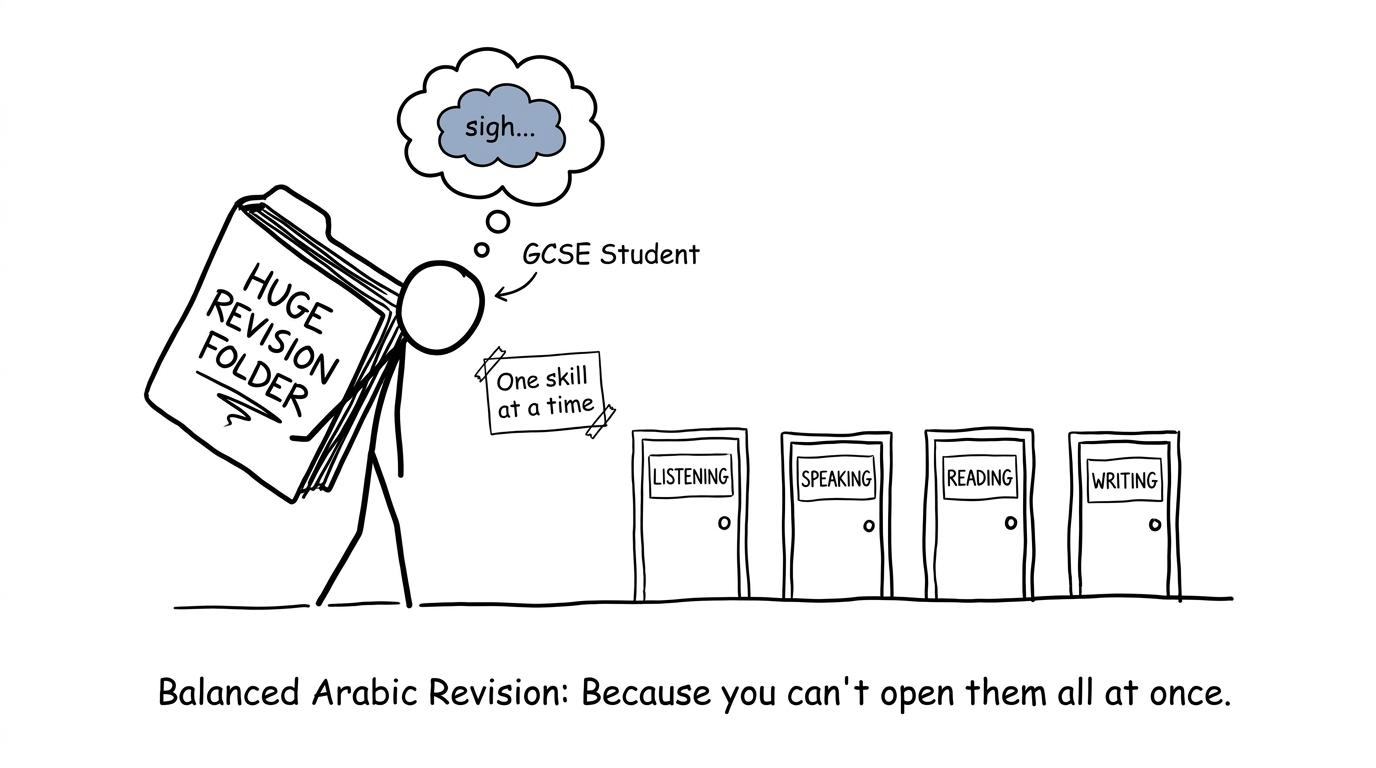 A student approaching four revision doors one skill at a time
Strengthen all four GCSE Arabic skills
Listening: listen for decisions, not individual words
Students often hear one unfamiliar word and mentally abandon the rest of the recording. Grade 5 listening depends more on tracking meaning than translating every word.
Before the audio begins, read the question carefully and predict what kind of information is required: a place, opinion, reason, activity or time reference. During the recording, listen for negatives, contrasts and changes of mind. A speaker may mention one option before rejecting it, so the first familiar word is not automatically the answer.
Use short audio practice actively. Answer the questions, check the transcript if one is provided, identify the phrase you missed and listen again without reading. Record the cause of each error: unknown vocabulary, speed, pronunciation, a negative or a misunderstood instruction.
Speaking: replace scripts with flexible building blocks
Memorising a perfect paragraph can create confidence, but it can also make an unexpected question feel catastrophic. The speaking assessment includes interaction, so adaptable language is more valuable than one rigid script.
Prepare reusable building blocks for each specification theme:
- a clear opinion;
- a reason;
- a past reference;
- a present description;
- a future intention;
- a comparison or contrast;
- a repair phrase for when you need time to think.
Record yourself answering unseen questions. Listen for long pauses, unclear pronunciation and answers that end before they develop. Your aim is not to sound like a newsreader. It is to communicate intelligibly, respond to the question and keep the exchange moving.
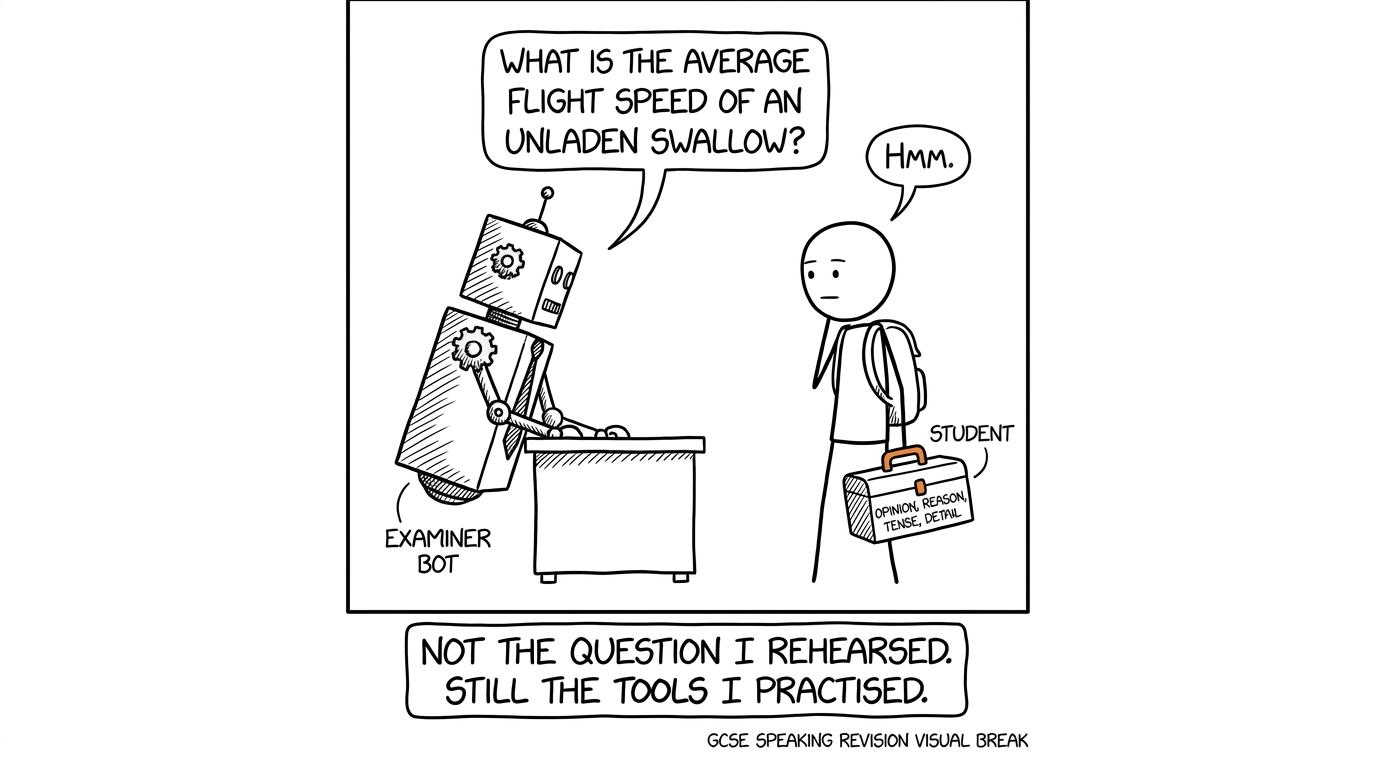 A calm student using a speaking toolbox for an unexpected question
Reading: prove every answer from the text
Grade 3 readers may understand the broad topic but lose marks through imprecise answers. To move upwards, separate the overall message from the exact detail requested.
Underline the command or focus of the question. Then locate evidence in the passage before answering. Pay particular attention to pronouns, connectives, negatives and words that signal an opinion. In translation tasks, preserve the complete meaning rather than producing a loose summary.
When reviewing a mistake, do not write only “reading”. Name the actual weakness: confused two people, missed a negative, selected the wrong timeframe or omitted part of a translation. Specific diagnoses lead to useful practice.
Writing: fulfil the task before showing range
Pearson's writing criteria reward communication and content alongside linguistic knowledge and accuracy. A sophisticated sentence cannot rescue an answer that ignores a required bullet point.
Plan briefly before writing. Check that every part of the prompt will be covered and that the response includes the required timeframes. Develop ideas through relevant opinions, reasons and details. Use linking language to create a connected response rather than a list of unrelated sentences.
Accuracy matters most when it protects meaning. Prioritise dependable control of common verbs, pronouns, agreement, spelling and sentence structure. Once those are stable, add greater variety gradually. A shorter, relevant and understandable response is usually more useful than an ambitious answer whose meaning repeatedly breaks down.
Build vocabulary that you can actually use
Recognition is not the same as recall. Looking through a vocabulary list can feel productive because every word seems familiar. The exam asks whether you can retrieve meaning under pressure and, in speaking or writing, produce the language yourself.
Organise vocabulary around the specification's broad themes, including identity and culture, local area and travel, school, future aspirations and the international dimension. For every useful item, practise three stages:
- recognise it in Arabic;
- recall its meaning without looking;
- use it in a relevant sentence or spoken response.
Return to difficult vocabulary after a gap rather than repeating it many times in one sitting. The active-recall and spaced-practice principles in MathsGenie's guide to stopping forgotten GCSE content work across subjects because they make retrieval, not rereading, the centre of revision.
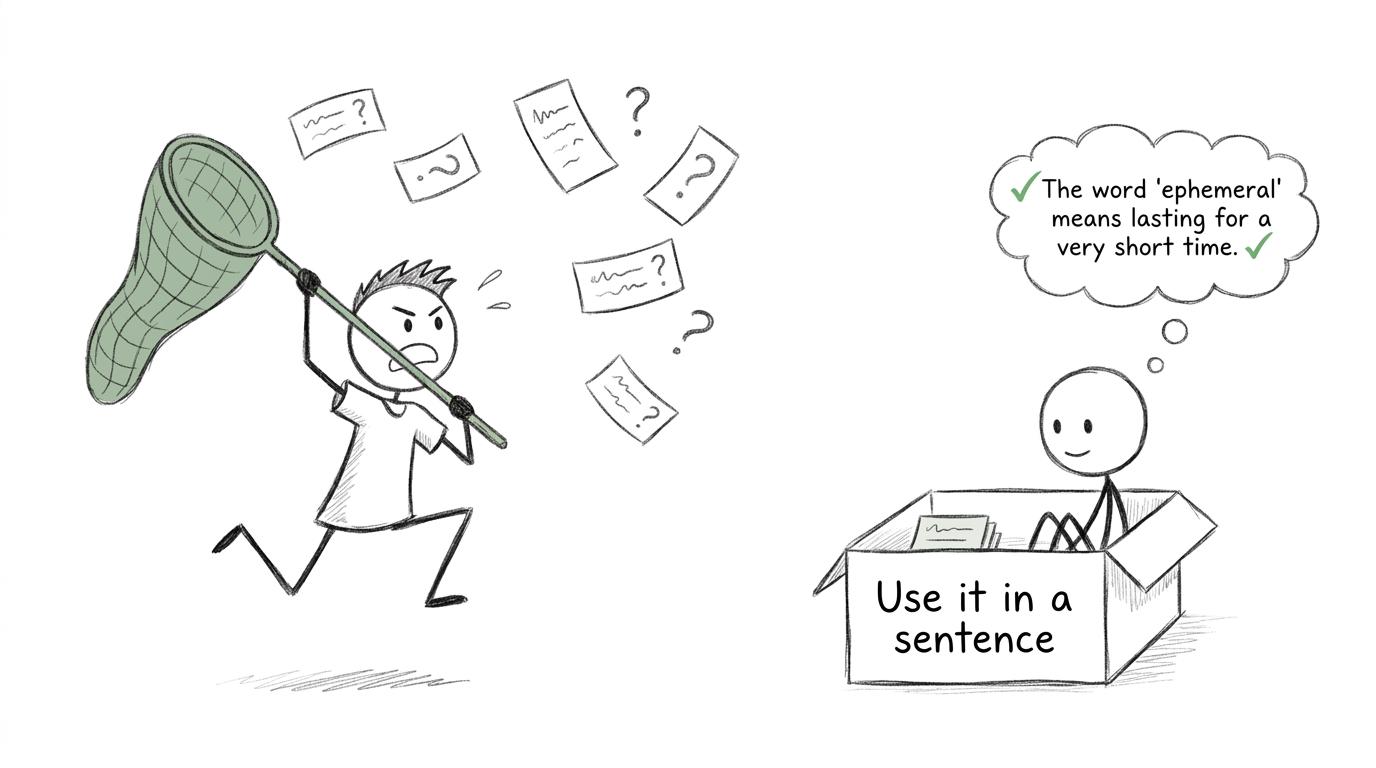 A student catching vocabulary cards while one useful card waits in a sentence box
Use an error log to find the missing marks
A mock result tells you where you finished. An error log tells you what to do next.
Divide a page into listening, speaking, reading and writing. For every lost mark or weak response, record:
- the task and theme;
- what went wrong;
- the missing knowledge or exam habit;
- the action needed;
- the date you will retest it.
This is the same diagnostic principle used in MathsGenie's guide to finding your weakest GCSE topics. “Revise Arabic” is too large to act on. “Practise recognising past-tense time markers in travel listening questions” is small enough to improve.
Use official Arabic past papers supplied by your teacher or Pearson, and follow the process explained in how to use GCSE past papers properly: complete, mark, diagnose, repair and retest. A completed paper without correction is measurement, not improvement.
A weekly revision routine for moving towards Grade 5
Consistency matters more than a heroic session followed by several silent days. Adapt this schedule around school and other GCSE subjects.
| Session | Focus |
|---|---|
| Monday, 202020 minutes | Vocabulary retrieval and one short listening task |
| Tuesday, 252525 minutes | Unseen speaking questions recorded and reviewed |
| Wednesday, 252525 minutes | Reading or translation practice with corrections |
| Thursday, 303030 minutes | Timed writing plan and response |
| Weekend, 454545 minutes | Mixed paper section, marking and error-log update |
Revisit one previous weakness during every session. That prevents improvement in one topic from being followed by quiet forgetting elsewhere.
If you are balancing Arabic with maths, build both into a realistic GCSE revision timetable. For maths, use GCSE mini tests for short checks and Edexcel GCSE maths past papers for full-paper practice. Keeping resources organised reduces the time lost deciding what to revise.
Common mistakes that keep students at Grade 3
Revising only the strongest skill
Being fluent in conversation does not guarantee equally strong reading or writing, particularly if most everyday Arabic exposure is dialectal rather than the standard Arabic assessed. Diagnose all four components separately.
Memorising answers without practising questions
A memorised response may collapse when the wording changes. Practise adapting familiar language to unseen prompts and follow-up questions.
Ignoring task instructions
Missed bullet points, the wrong response language or incomplete translations can lose avoidable marks. Read the instruction twice and use a final checklist.
Chasing complexity before accuracy
Grade 5 does not require perfect Arabic, but meaning must remain clear. Secure common structures and relevant content before forcing advanced expressions into every answer.
Marking without making a correction
Reading a mark scheme is not the same as changing future performance. Rewrite the faulty section, repeat the listening extract or answer the speaking question again.
Treating predicted material as a forecast
Predicted papers are practice tools, not promises about exact exam content. MathsGenie's GCSE predicted papers serve this purpose in maths: they support timing and mixed practice, while the full specification still needs revision. Apply the same caution to any predicted Arabic topics.
Make Grade 5 a collection of smaller changes
The distance from Grade 3 to Grade 5 can look like one large leap. In practice, it is usually a collection of smaller changes: hearing the negative, answering every bullet point, adding a reason, controlling a second or third timeframe, and correcting the same grammar error before it returns.
Start with one timed task from each Arabic skill. Mark it against the official criteria, identify your three most repeated weaknesses and schedule the first retest. Ask your teacher to review your tier and speaking or writing evidence if you are uncertain about your current level.
For the maths part of your GCSE revision, make MathsGenie your free home base. Use its revision lessons and practice questions to rebuild weak topics, mini tests to check recall, past papers and mark schemes to measure progress, video solutions to understand mistakes, and predicted papers for final exam practice. The subjects differ, but the dependable rhythm remains the same: learn, practise, mark, fix and prove that the fix has lasted.










