Foundation or Higher GCSE Italian: How to Choose
Foundation or higher GCSE Italian? Compare grade ranges, current performance and skill evidence to choose the tier offering your best realistic outcome.
Choosing an exam tier can feel strangely personal. Higher sounds ambitious; Foundation can sound cautious. Yet neither label tells you which entry will produce your best result.
When deciding between foundation or higher GCSE Italian, start with where you are performing now. Foundation is usually the sensible choice if your realistic target is grade 444 or 555 and Higher papers leave substantial gaps across several skills. Higher is appropriate if you need grade 666 or above and timed evidence shows that you can cope consistently with its vocabulary, grammar and longer tasks.
The decision should come from marked work, not pride, panic or one unusually good lesson. Your teacher and school make the formal entry, but understanding the evidence allows you to have a much better conversation with them.
Your tier decision checklist
Before asking to change tier, check the following:
- Confirm whether you take AQA or Pearson Edexcel GCSE Italian and read the correct specification.
- Identify the grade you realistically need, especially for sixth form or future language courses.
- Compare several recent timed assessments rather than one mock result.
- Review listening, speaking, reading and writing separately.
- Try material from both tiers under controlled conditions.
- Ask whether Higher difficulty is improving your Italian or simply preventing you from demonstrating what you know.
- Discuss the evidence and entry deadline with your Italian teacher.
This is similar to choosing a tier in maths. MathsGenie's guide to moving from Foundation to Higher GCSE Maths emphasises the same principle: a tier change should be supported by secure core knowledge and repeatable performance.
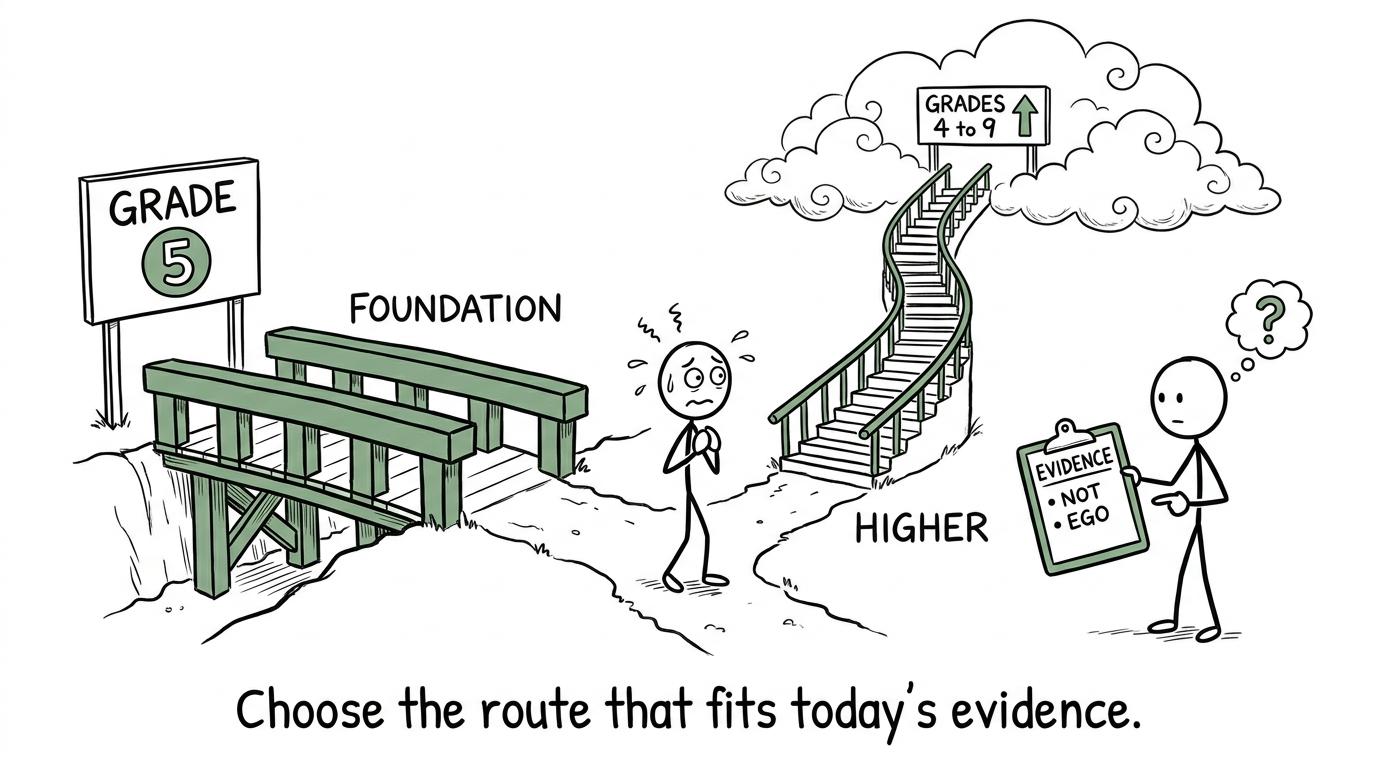 A student choosing between Foundation and Higher using evidence rather than ego
What Foundation and Higher GCSE Italian mean
Current AQA and Pearson Edexcel GCSE Italian qualifications assess four skills: listening, speaking, reading and writing. Each skill contributes 25%25\%25% of the qualification. You must be entered at one tier across all four assessments; you cannot take Foundation listening and Higher writing, for example.
| Tier | Normal grades available | Best suited to |
|---|---|---|
| Foundation | 111 to 555 | Students aiming for a secure grade 444 or 555 who perform more consistently on accessible tasks |
| Higher | 444 to 999 | Students requiring grade 666 or above who can handle greater linguistic demand across all four skills |
Higher tier also has a limited grade 333 safety net when a candidate falls only a small number of marks below the relevant boundary. It should not be treated as a dependable route to grade 333. A student who is substantially below the required standard can be unclassified.
Foundation is capped at grade 555. That cap matters if you are regularly working above grade 555 or intend to continue to A Level Italian. However, taking Higher does not automatically improve your grade. It provides access to higher grades while presenting more demanding material.
Check your exact exam-board documents because task formats, timings and mark totals differ between AQA and Edexcel. Do not assume that advice written for French, Spanish or another board precisely describes your Italian papers.
How to decide based on where you are sitting now
The best question is not, “Which tier am I capable of on my best day?” It is, “Which tier reflects the standard I can reproduce under exam conditions?”
Look at a pattern of results
Use at least three substantial pieces of recent evidence, ideally including a timed mock or past assessment. Record:
- your total mark and teacher-estimated grade;
- performance in each of the four skills;
- questions left blank;
- marks lost through missing vocabulary;
- marks lost through grammar, accuracy or misunderstanding instructions;
- whether timing affected the result.
Grade boundaries change between exam series, so an old raw mark is not a permanent promise of a particular grade. Use the boundary and mark scheme associated with that assessment, then place more weight on trends than on a single number.
The same diagnostic habit improves maths revision. MathsGenie's guide to finding your weakest GCSE topics explains how to turn lost marks into specific next actions rather than vague labels such as “bad at algebra”. For Italian, replace topics with vocabulary, listening detail, pronunciation, translation, tense control and extended writing.
Compare your realistic target with the grade ceiling
Foundation deserves serious consideration when:
- your likely outcome currently sits around grades 333 to 555;
- Foundation tasks allow you to demonstrate knowledge consistently;
- several Higher sections remain inaccessible despite targeted revision;
- your immediate priority is securing grade 444 or 555.
Higher deserves serious consideration when:
- you need grade 666 or above;
- your Foundation performance is consistently near the top of the tier;
- you can access a meaningful proportion of Higher questions in every skill;
- your grammar and vocabulary remain usable under time pressure;
- your teacher's assessments support the move.
A grade 555 is available through either tier. This overlap is where the decision becomes most delicate. A student near grade 555 should compare which paper produces the more stable outcome, while also considering whether access to grade 666 is realistic rather than merely desirable.
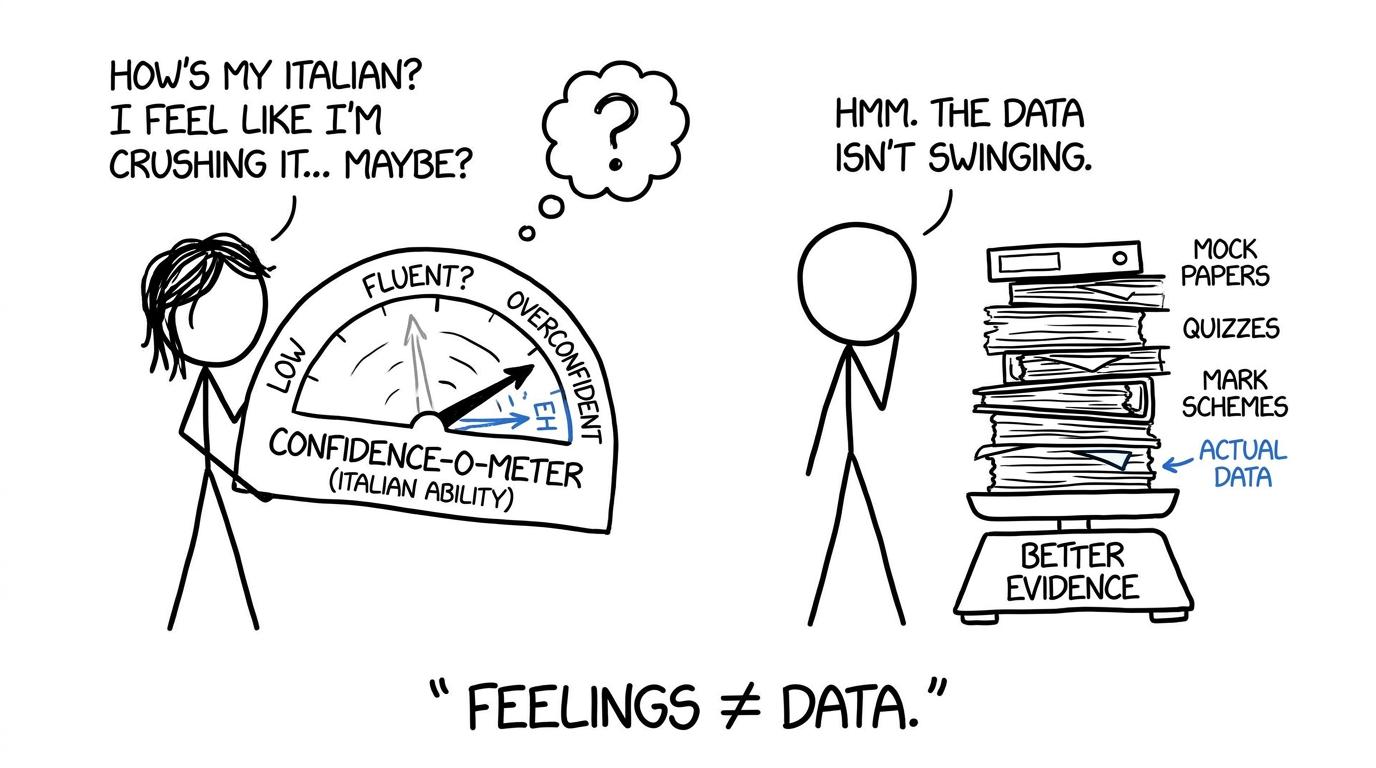 Confidence competes with mock papers and mark schemes as evidence
Judge all four Italian skills separately
An overall mark can hide the real problem. You might be comfortable in reading and writing but lose heavily in listening, or speak fluently while making grammatical errors in extended writing.
Listening and reading
Higher material generally demands stronger recognition of vocabulary, detail and inference. Ask whether you can follow passages after an unfamiliar word appears. If one missed phrase causes you to lose the rest of an extract, that is a revision priority and possible warning sign.
Look beyond the percentage. Notice whether you misunderstand the language or the question. Those are different problems: one calls for vocabulary and listening practice; the other calls for closer attention to instructions and response language.
Speaking
Higher speaking lasts longer than Foundation under the regulated assessment model. You therefore need enough language to sustain communication, respond spontaneously and recover when you do not understand immediately.
Do not base your decision on whether speaking feels frightening. Speaking can feel uncomfortable even when performance is strong. Use teacher feedback on communication, pronunciation, range, interaction and accuracy.
Writing
Higher writing requires greater range and control. Look for evidence that you can communicate across time frames, develop ideas and select accurate structures without relying on memorised paragraphs that only fit one question.
A polished answer produced at home with unlimited time is not tier evidence. A timed answer completed without prompts is.
Run a fair Foundation-versus-Higher test
Ask your teacher for comparable material from both tiers. Complete it under the correct conditions, without pausing to check vocabulary or notes. Then use the appropriate mark schemes and teacher feedback.
Judge more than the final mark:
- How much could you attempt?
- Did you finish?
- Were errors concentrated in one repairable area?
- Could you understand the Higher tasks even when your answers were imperfect?
- Did Foundation reveal reliable knowledge, or did you still make frequent basic errors?
One attempt is a snapshot. Repeat the process after targeted revision. Maths students can see this feedback cycle through Edexcel GCSE Maths past papers, while the guidance on using GCSE past papers properly shows why marking and repairing mistakes matter more than simply completing another paper.
Turn uncertainty into a short improvement plan
If the decision is close, give yourself a defined period agreed with your teacher. For two or three weeks:
- revise one specific weakness in each session;
- complete short timed tasks from both tiers;
- mark or review them promptly;
- record what caused each lost mark;
- repeat a similar task several days later;
- compare the new evidence with your starting point.
This is not about proving that you “belong” in Higher. It is about discovering whether your current difficulties respond quickly enough to focused practice.
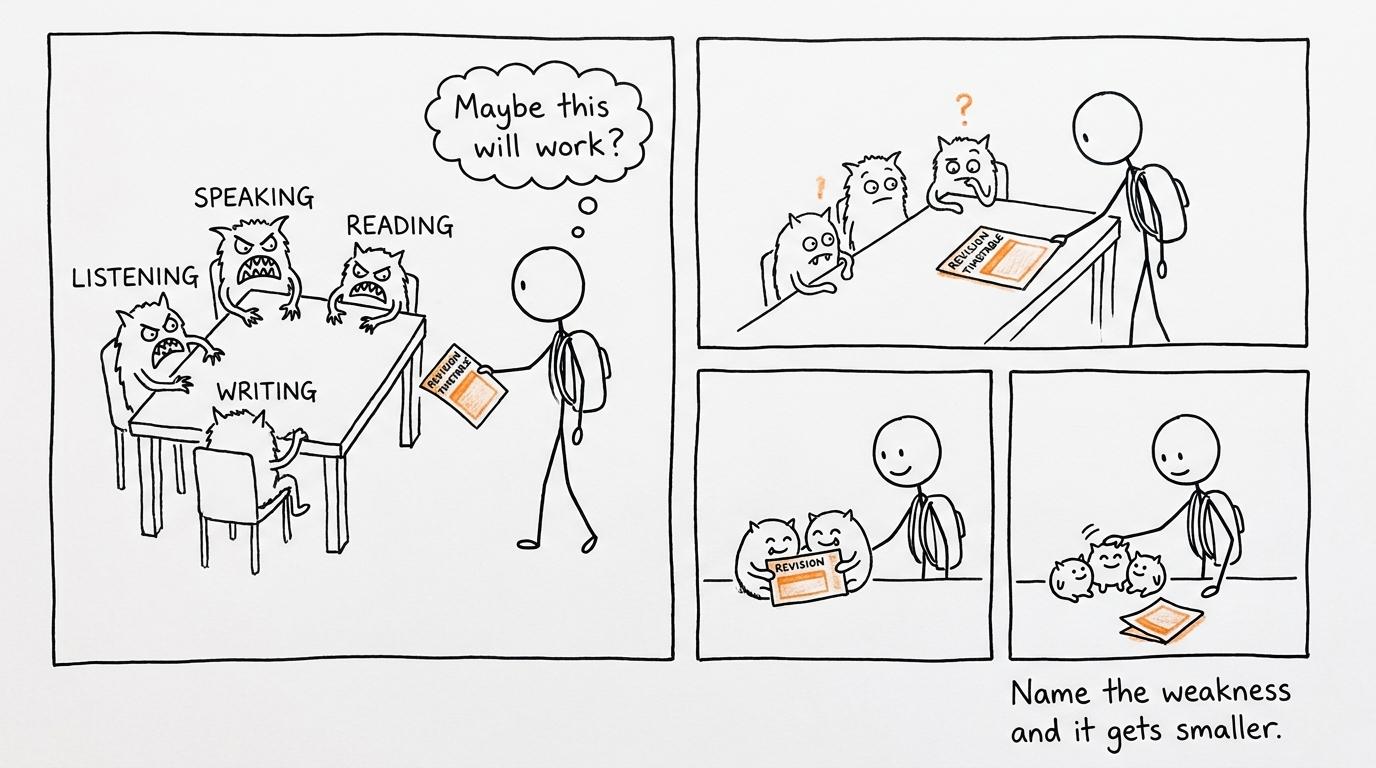 Four exam-skill monsters becoming manageable after receiving a revision timetable
MathsGenie's efficient GCSE revision guide uses a learn, practise, mark and fix cycle. The subject may change, but the principle survives: improvement comes from feedback that changes the next attempt.
Common mistakes when choosing a GCSE Italian tier
Treating Foundation as failure
Foundation can produce grades up to 555. If it gives you the clearest route to the grade you need, it is a strategic entry rather than a judgement about your intelligence.
Choosing Higher because friends are taking it
Your friends' vocabulary, speaking confidence and target grades do not determine your result. Tier choice is individual.
Focusing only on the strongest skill
Strong speaking cannot completely compensate for inaccessible listening, reading and writing assessments. Consider the whole qualification.
Using one mock as the entire decision
Illness, nerves, unfamiliar vocabulary or poor timing can distort one result. Equally, one excellent paper may not represent your usual standard. Look for repeated evidence.
Assuming Higher gives easier access to grade 555
Both tiers offer grade 555, but their questions target different ranges of demand. Compare actual performance rather than relying on a general rule.
Waiting too long to speak to your teacher
Schools must make tier entries according to awarding-body deadlines, and Pearson states that Italian tier entry must be decided before the speaking assessment. Ask your school about its internal deadline well in advance.
Make the choice calmly, then revise for it
The right tier is the one that turns your present knowledge into the strongest realistic result while leaving room for justified ambition. Choose Foundation if it makes a secure grade 444 or 555 more attainable. Choose Higher when consistent evidence shows that you can access the paper and need the opportunity to earn grade 666 or above.
Then stop revisiting the label and start improving the skills.
MathsGenie does not currently provide GCSE Italian lessons, so use your school's Italian specification, approved materials and exam-board assessments for subject practice. For maths, MathsGenie remains your free revision base: begin with the Edexcel GCSE Maths revision hub, diagnose your level with revision lessons and practice questions, then use GCSE predicted papers, past papers, mark schemes, video solutions and mini tests to turn the same evidence-led approach into marks.