

A February Half-Term IGCSE Maths Revision Plan
A February half-term IGCSE Maths revision plan with a practical seven-day timetable for Edexcel or Cambridge students, including rest and past papers.
February half-term can create an uncomfortable feeling. The exams are close enough to matter, yet the syllabus still seems too large to hold in your head. You may open a past paper, find three unfamiliar questions and wonder whether one week can make any meaningful difference.
It can, provided you do not try to revise everything.
A February half-term IGCSE Maths revision plan should have three aims: identify your weakest areas, repair a small number of important gaps and finish with evidence that you have improved. The practical plan below works for students taking Pearson Edexcel International GCSE Maths or Cambridge IGCSE Maths. Adapt the topics and paper style to your own specification, tier or route.
For broader planning beyond half-term, begin with the GCSE Maths revision timetable pillar guide. Although IGCSE specifications differ, its principles of realistic scheduling, active practice and regular review still apply.
Your half-term checklist
Before the week begins, collect:
- your current Edexcel or Cambridge specification topic list
- one recent school assessment or completed past paper
- the correct calculator and mathematical equipment
- practice questions for your weakest topics
- mark schemes for checking your work
- one notebook or document for recording errors
- seven short revision slots, including at least one rest day
Confirm your exact course before selecting questions. Edexcel International GCSE Mathematics A uses Foundation and Higher tiers. Cambridge IGCSE Mathematics uses Core and Extended routes. Similar-looking courses can contain different content and assessment arrangements, so your school’s specification should decide what enters your timetable.
Start with a diagnosis, not a guess
Imagine a student called Sam planning the week on Sunday evening. Sam’s first instinct is to write “algebra” on Monday and “geometry” on Tuesday. It looks organised, but those labels are too broad to guide useful revision.
Instead, Sam takes a recent assessment and sorts each lost mark into one of three groups:
- Knowledge gap: the method was unknown or forgotten.
- Application gap: the method was known, but the question was not recognised.
- Accuracy gap: the approach was correct, but arithmetic, notation or rounding caused the error.
This distinction matters. Rewatching an entire lesson may help a knowledge gap, but it will not necessarily fix careless substitution. Equally, completing twenty routine questions may not prepare you for a multi-step application problem.
Choose four priority topics from this diagnosis. A sensible selection might include two substantial weaknesses, one topic where accuracy is costing marks and one previously revised topic that needs retrieval practice. Keep a fifth topic in reserve if you progress faster than expected.
MathsGenie’s free maths revision resources provide topic videos and worksheets that can help you move from reviewing a method to answering questions independently.
A seven-day IGCSE revision timetable
This plan assumes two focused sessions on most days. Each session should last roughly 404040-606060 minutes, with a proper break between them. Shorten the sessions if you have other subjects or family plans. Consistency is more valuable than an unrealistic ten-hour timetable abandoned by Tuesday.
| Day | First session | Second session |
|---|---|---|
| Saturday | Complete a diagnostic set or review a recent assessment | Choose four priorities and organise resources |
| Sunday | Learn or relearn priority topic one | Complete practice questions without notes |
| Monday | Review priority topic two | Mark the work and correct every error |
| Tuesday | Practise priority topic three | Complete a mixed set using topics one to three |
| Wednesday | Rest or use a short catch-up slot | No scheduled maths revision |
| Thursday | Review priority topic four | Complete timed exam-style questions |
| Friday | Attempt a timed section from the correct IGCSE paper | Mark it and update the error log |
| Saturday | Retry questions previously answered incorrectly | Plan the next two school weeks |
You now have the structure; if setting every session up by hand feels like another task, build your half-term schedule in the Revision Planner.
The rest day is deliberate. A timetable should survive real life, not merely look impressive on paper. Wednesday can absorb an unfinished session, illness or another subject’s deadline without causing the entire plan to collapse.
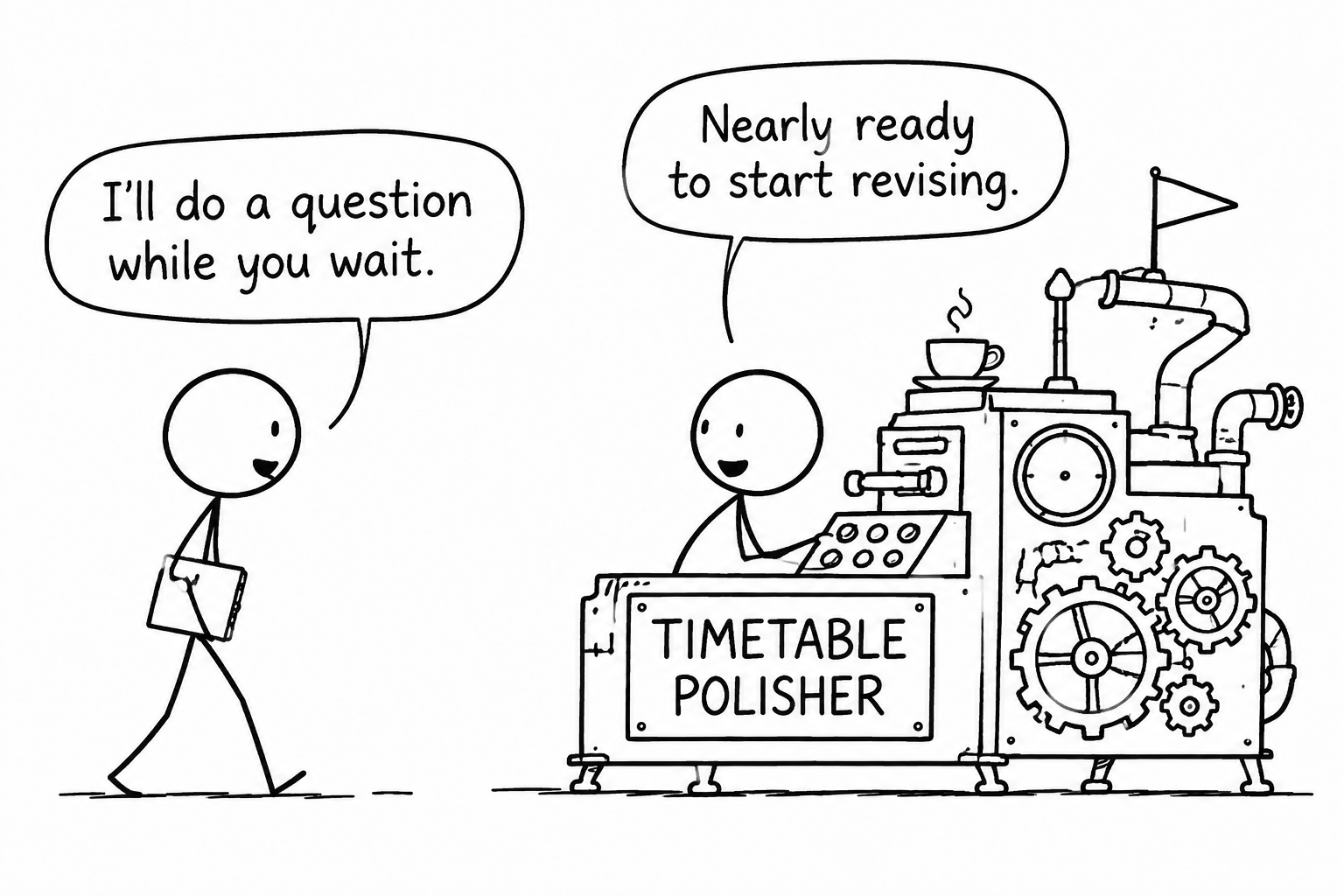 A student starts revising while an enormous timetable-polishing machine is still being prepared
What to do inside each revision session
A topic name is not a revision method. Give every session a simple structure so that you spend more time thinking and less time deciding what to do next.
Recall the method
Spend the first few minutes writing down what you remember without notes. This might include a formula, a sequence of steps or the meaning of important vocabulary. Then check your notes or watch the relevant revision lesson.
The purpose is not to produce beautiful notes. It is to expose what you cannot yet retrieve.
Practise independently
Move quickly to questions. Begin with several focused examples, then include unfamiliar or mixed questions. If you need to copy every step from a video, you are still learning rather than testing yourself. Close the explanation and attempt another question unaided.
For busy days, the structure in the 20-minute maths revision routine can be adapted to IGCSE topics from your own specification.
Mark and correct
Use the mark scheme after completing a useful block of work, not after every line. Record the reason for each lost mark and write a correct solution. If possible, retry the same question later without looking at your correction.
A helpful error log has four columns: topic, mistake, correct method and retry date. It turns “I am bad at maths” into a specific statement such as “I need to practise forming equations from written information”. Specific problems are easier to solve.
Use past papers without wasting them
A full past paper can be useful, but it is not automatically the best starting point for February half-term. If several topics are still insecure, repeatedly sitting whole papers may simply confirm weaknesses you already know about.
Use one timed section or a carefully selected group of exam questions near the end of the week. Work under realistic conditions, mark it strictly and investigate each lost mark. Save other complete papers for later rounds of IGCSE maths revision, when they can provide a clearer measure of exam readiness.
Do not mix boards casually. Edexcel and Cambridge questions can both develop mathematical understanding, but their specifications, terminology and paper structures are not interchangeable. Prioritise materials produced for the course you are actually taking.
After half-term, the one-month maths revision plan offers a useful model for extending topic work into mixed practice, mini tests and past papers. You can also use the MathsGenie revision planning collection to explore related timetable advice.
Common mistakes when planning half-term revision
Filling every hour
An overloaded IGCSE revision timetable creates guilt rather than progress. Leave room for meals, sleep, exercise, other subjects and unexpected changes.
Revising only comfortable topics
Familiar questions feel productive because answers arrive quickly. Begin with weaknesses, then use stronger topics for mixed retrieval and confidence.
Watching without practising
A clear video can make a method feel obvious. The real test is whether you can use it after the explanation has disappeared. Follow each lesson with independent questions.
Ignoring corrections
A mark scheme is not just a score generator. It shows where your reasoning, notation or accuracy failed. Correcting work is part of the session, not optional administration at the end.
Using the wrong course materials
Check whether you take Edexcel Foundation or Higher, or Cambridge Core or Extended. Also confirm your syllabus code and current specification with your school before downloading papers.
Turn one good week into a routine
By the end of half-term, Sam does not need to have completed the whole syllabus. A better outcome is four clearer topics, a useful error log and a realistic picture of what should happen next. Knowing the plan is only the first step; following it once school restarts is the harder part.
Your exams have fixed dates, so each unplanned week reduces the time available for targeted practice. Build your February half-term schedule in the Revision Planner.















