Explain GCSE History to a Parent: Does It Help?
Explain GCSE History to a parent as a powerful revision check. Learn why teaching exposes gaps, how to run it, and how the method transfers to GCSE maths.
Revision can feel convincing right up to the moment someone asks a simple question: “Why?” Your notes looked familiar. The timeline made sense on the page. Yet the explanation will not quite form.
Choosing to explain GCSE History to a parent who has never studied the topic can be a surprisingly effective revision check. It forces you to retrieve knowledge, organise it and make connections clear enough for a beginner to follow. If you cannot explain a cause, consequence or turning point without hiding behind your notes, you have probably found something worth revisiting.
The same principle matters for GCSE maths. Explaining why a method works can expose uncertainty that completing familiar-looking questions sometimes conceals.
This is not a replacement for exam questions, mark schemes or timed papers. It is a diagnostic tool: a way to discover what you genuinely understand before the exam discovers it for you.
The quick answer
Explaining History to someone with no background knowledge is useful when you:
- choose one narrow topic rather than an entire unit;
- begin without notes, so recall has to do some work;
- explain causes, events and consequences rather than reciting dates;
- invite genuine questions from your listener;
- check your explanation against reliable notes afterwards;
- turn every gap into a specific revision task;
- follow the conversation with an exam-style question.
The last two steps are crucial. An explanation shows where the weakness is. Practice and feedback are what help you repair it.
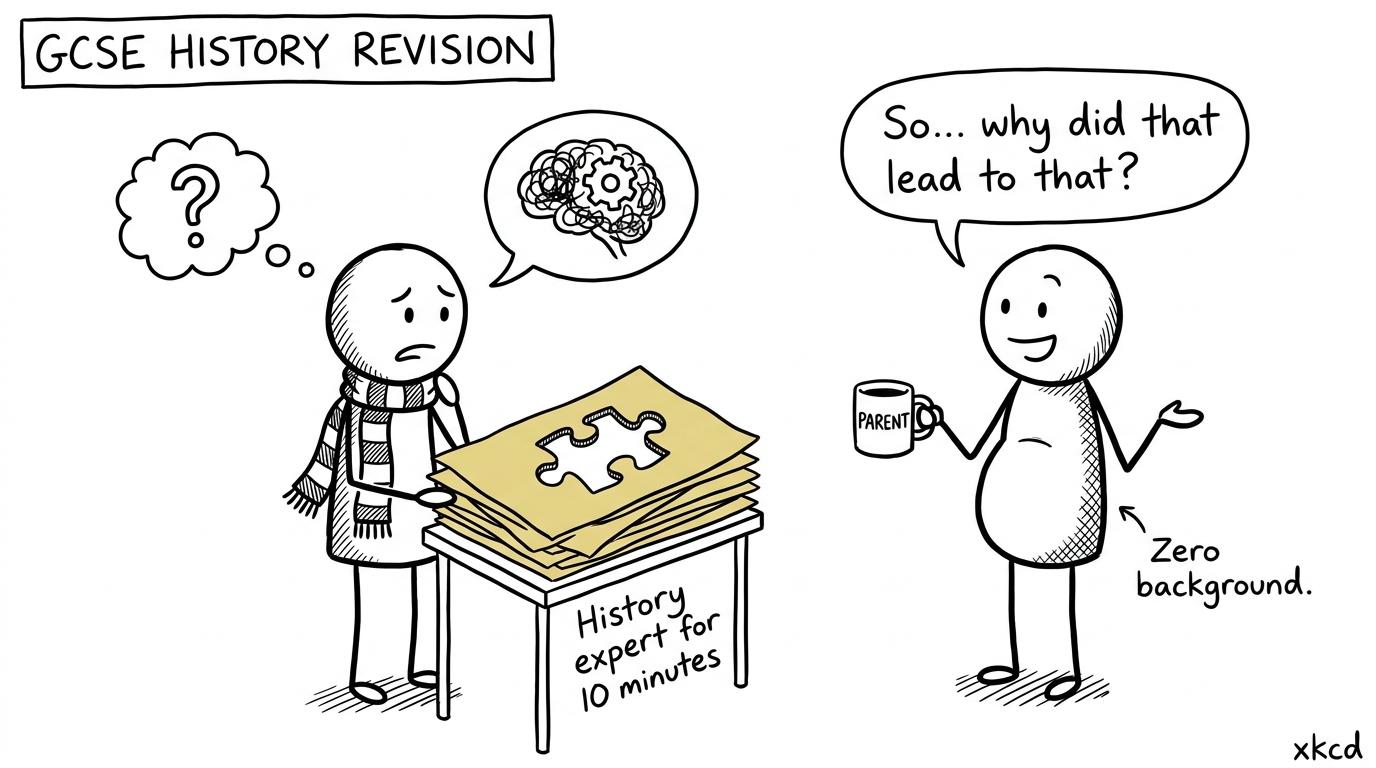 A parent’s simple question reveals a missing piece in a student’s History knowledge
Why explaining GCSE History can reveal hidden gaps
Rereading is comfortable because the page supplies the information. Recognition can then feel like recall: you see a name, date or event and think, “Yes, I know that.” But the exam will not place your revision guide beside the question.
Explaining from memory changes the task. You must select relevant knowledge, arrange it coherently and retrieve the language needed to connect one idea to another. Research into learning by teaching suggests that retrieval, explanation and interaction can all contribute to learning, although the evidence does not support treating teaching as a magical technique that always outperforms every alternative.
The safest conclusion is practical rather than dramatic: explaining can be a strong check of understanding, especially when it includes effortful recall and corrective feedback.
A beginner cannot silently fill in your gaps
A classmate studying the same unit may understand what you intended to say. A parent with no background cannot. If you jump from one event to another without explaining the link, they are more likely to stop you.
Questions such as these are valuable:
- Why did that make a difference?
- Was that the only cause?
- What changed afterwards?
- Why did people respond in that way?
- Which factor mattered most?
- How do you know that source is useful?
These are not interruptions. They are a stress test for the structure of your knowledge.
It checks more than factual recall
Across GCSE History specifications, the assessment objectives set by Ofqual include knowledge and understanding, explanation and analysis using second-order concepts, evaluation of contemporary sources, and judgements about interpretations. Those second-order concepts include cause, consequence, change, continuity, significance, similarity and difference.
That means knowing isolated facts is only part of the job. Explaining a topic aloud can reveal whether you understand how those facts relate. However, spoken revision cannot fully reproduce source evaluation, interpretation questions or extended writing. You still need board-specific practice for Edexcel, AQA, OCR or Eduqas.
How to explain GCSE History to a parent effectively
A useful session can take around ten to fifteen minutes. It should feel focused, not like delivering an entire documentary series over dinner.
Choose a precise question
Do not announce, “I am going to explain the Cold War.” Choose something manageable, such as the causes of one crisis, the consequences of one policy or why a particular development became significant.
A narrow question makes omissions easier to detect. This is the same reason successful maths revision targets an exact skill rather than vaguely choosing “algebra”. The guide to finding your weakest GCSE topics uses the same principle: diagnose a specific gap, then work on that gap.
Give your parent a simple listening job
Your parent does not need to mark the historical accuracy. Ask them to listen for clarity and stop you when:
- you use a term without defining it;
- the order of events becomes confusing;
- you claim that something caused an event without explaining how;
- you contradict an earlier statement;
- your conclusion does not follow from your evidence.
Their lack of subject knowledge is an advantage here. They cannot rescue an unclear explanation using information they already possess.
Start with the notes closed
Explain what you can from memory first. If the notes remain open, the task can become reading aloud with extra enthusiasm.
Educational guidance on retrieval practice stresses that the attempt to remember matters. The task should be challenging enough to reveal uncertainty, but not so broad that failure is inevitable. Retrieval also needs feedback because confidently repeating an error can reinforce it.
After your first attempt, open your textbook, class materials or specification-aligned revision notes. Check dates, terminology, missing evidence and causal links. Mark each gap rather than quietly correcting it in your head.
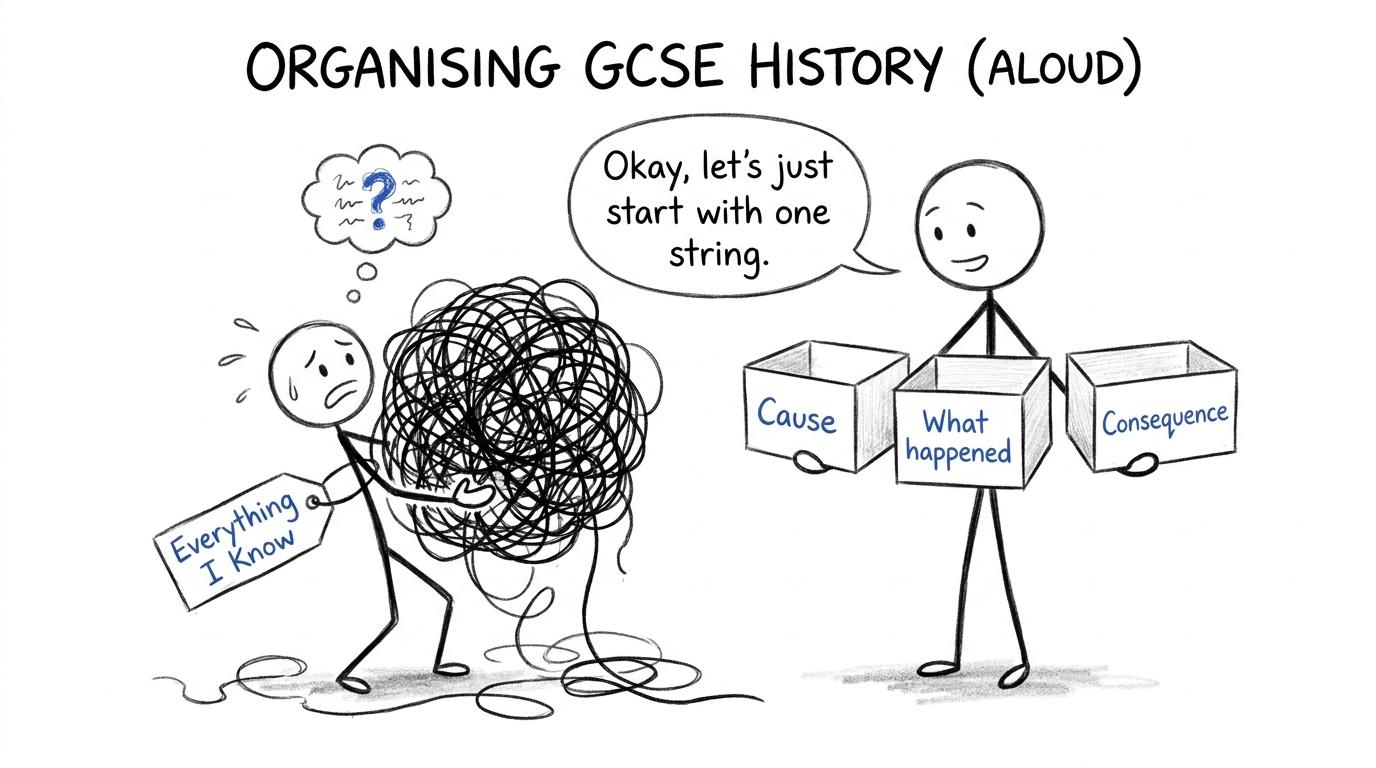 A tangled explanation is sorted into cause, event and consequence
Organise the explanation around relationships
A chronological account can still be weak if it merely lists events. Give your explanation a structure:
- establish the situation before the event;
- identify the main factor or development;
- explain how it affected decisions or conditions;
- connect it to the outcome;
- consider whether another factor limits or strengthens the argument.
The exact structure should match the question and your exam board. The important habit is making relationships explicit instead of assuming that one event naturally explains the next.
Finish with an exam task
Speaking clearly is not the same as writing a high-mark answer under time pressure. Once the conversation ends, answer a relevant exam-style question and compare it with the mark scheme.
This creates a stronger revision loop:
- retrieve aloud;
- identify the gap;
- correct the knowledge;
- apply it in the required written format;
- review the response using assessment criteria.
The idea resembles effective maths revision. On MathsGenie, students can learn through focused revision lessons, attempt practice questions and then use mark schemes or video solutions to correct their methods. The GCSE twenty-minute maths revision routine provides a compact structure for turning recall into written practice.
What this teaches you about GCSE maths revision
History and maths assess different knowledge and skills, so the technique should not be transferred carelessly. A fluent explanation of a mathematical method does not prove that you can apply it accurately to unfamiliar questions. Equally, obtaining a correct answer once does not prove that you understand the method.
The useful transfer is this: explain, test, check and repair.
Explain the decision, not just the procedure
When revising maths, try stating:
- what information the question gives you;
- what the question is asking you to find;
- why the chosen method is appropriate;
- which result would be unreasonable;
- where marks could be lost through notation, units or rounding.
You do not need a parent who remembers GCSE maths. A beginner’s question can expose a memorised rule that you cannot justify. But the explanation must be followed by independent questions, including unfamiliar and mixed problems.
Start from the free MathsGenie GCSE and A Level revision hub to choose the right qualification and topic. If you study Edexcel GCSE Maths, the Edexcel mini tests provide focused checks before you move to full papers.
Use the mark scheme as feedback
Your listener judges clarity; the mark scheme judges whether your written response earns marks. Both perspectives matter.
After verbal revision, complete questions without help and inspect every lost mark. The GCSE maths topics by exam board and tier guide can help you organise revision for Edexcel, AQA, OCR or Eduqas and distinguish foundation from higher-tier priorities.
Later, use Edexcel GCSE Maths past papers or the appropriate board collection under timed conditions. Full papers check selection, accuracy and stamina in a way that conversation cannot.
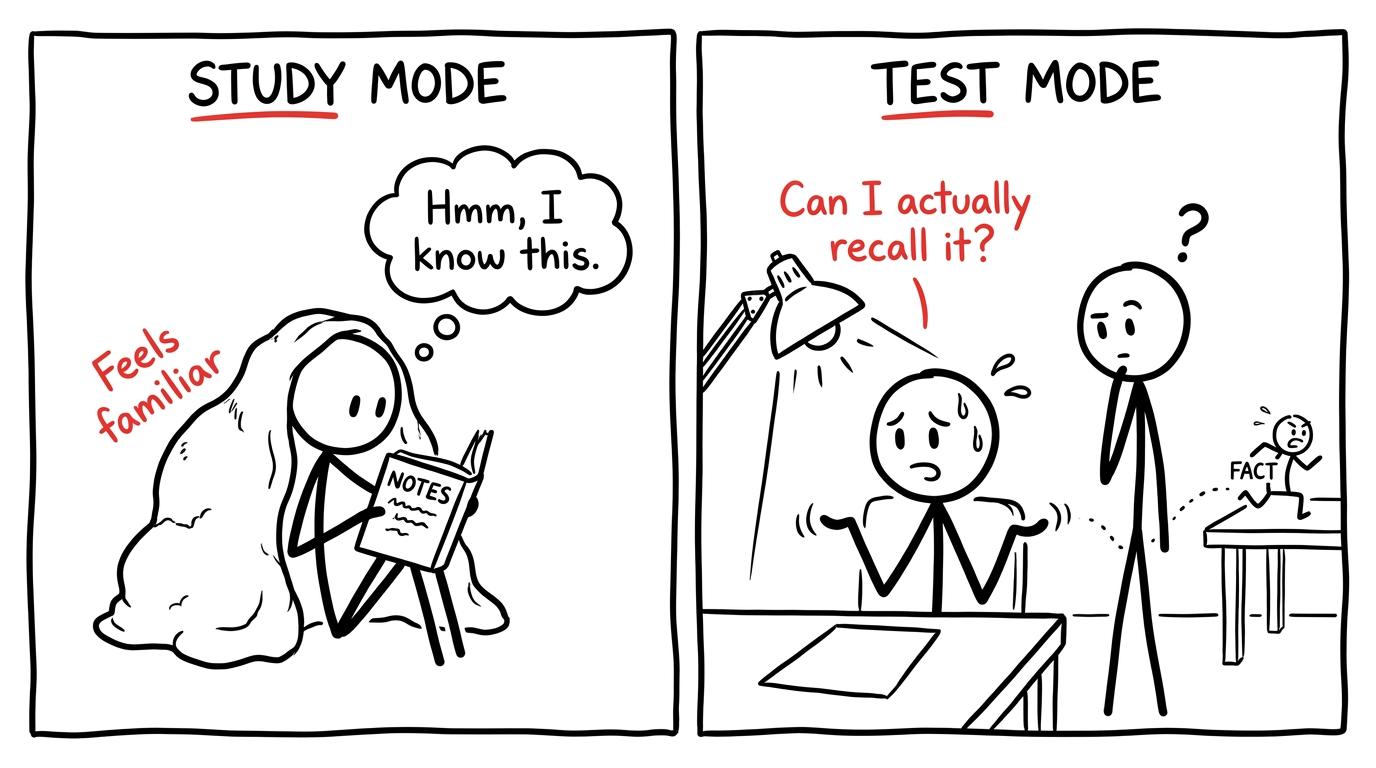 The difference between familiar notes and genuine recall
Common mistakes when learning by explaining
Turning the session into a performance
The aim is not to sound impressive. If you conceal uncertainty or avoid your parent’s questions, the activity stops being diagnostic. Say when you are unsure and write the gap down.
Looking at notes too soon
A quick glance can remove the effortful recall that makes the check useful. Attempt the explanation first, then verify it.
Choosing far too much content
Explaining a whole specification encourages a shallow summary. One causal chain, interpretation issue or period of change gives you better evidence about what you understand.
Accepting a clear but inaccurate explanation
Clarity does not guarantee truth. Your parent can judge whether the account makes sense, but not necessarily whether the dates, evidence and terminology are correct. Always check afterwards against trusted course materials.
Mistaking fluency for exam readiness
Speaking without hesitation can create confidence, but GCSE marks are awarded for responses to particular questions. Complete timed written work and use the correct board’s mark schemes.
Using explanation instead of practice
For maths especially, explaining must not consume the time needed for problem solving. Use it briefly, then answer questions. The one-month GCSE maths revision plan shows how retrieval, topic practice, mini tests and papers can fit into a balanced schedule.
Make explanation part of a wider revision system
The best revision methods rarely work alone. Explanation helps you notice the gap. Spaced revisiting helps you remember the correction. Questions test whether you can apply it. Mark schemes show what the examiner rewards. Timed papers reveal whether the knowledge survives pressure.
For History, combine short teaching sessions with timelines, source and interpretation work, essay planning and exam-board questions. For maths, combine verbal reasoning with written methods, mixed practice and full papers.
MathsGenie makes that second cycle straightforward. Use free revision lessons to rebuild a weak method, practice questions and mini tests to check it, then past papers and predicted papers to test it under realistic conditions. Mark schemes and video solutions help turn each error into a precise next step, while a revision planner can keep those steps manageable.
Explaining something to a complete beginner is powerful because it removes the places where vague understanding likes to hide. Ask a parent to listen. Welcome the obvious questions. Then open the relevant MathsGenie resources and prove that your explanation can survive the page as well as the conversation.