Explain GCSE English Language to a Parent: Does It Help?
Explain GCSE English Language to a parent as a revision test. Learn why teaching from memory reveals gaps, sharpens analysis and improves exam readiness.
Revision can create a convincing illusion. You read an annotation, recognise the technique and think, Yes, I know that. Then someone asks what the writer is actually doing, and the answer suddenly becomes difficult.
That is why trying to explain GCSE English Language to a parent who has never studied it can help. It turns recognition into retrieval. You must recall the idea, organise it and express it clearly enough for a beginner to follow. Their questions can expose vague thinking that rereading leaves hidden.
It is not a complete revision method, and it does not replace timed exam practice. But as a short revision check, it can reveal whether your understanding is usable, in English Language and, importantly for MathsGenie students, in GCSE maths.
The quick answer and checklist
Explaining the subject to a complete beginner is useful when you:
- close your notes before beginning;
- explain one precise skill rather than the entire course;
- distinguish what a question asks from what a strong response must do;
- ask your parent to interrupt whenever something is unclear;
- check your explanation against your specification or teacher guidance afterwards;
- turn every weak explanation into a specific revision task;
- follow the conversation with exam-style practice.
The method works best as a diagnosis. It tells you what to revise next; it does not prove that you can perform under timed examination conditions.
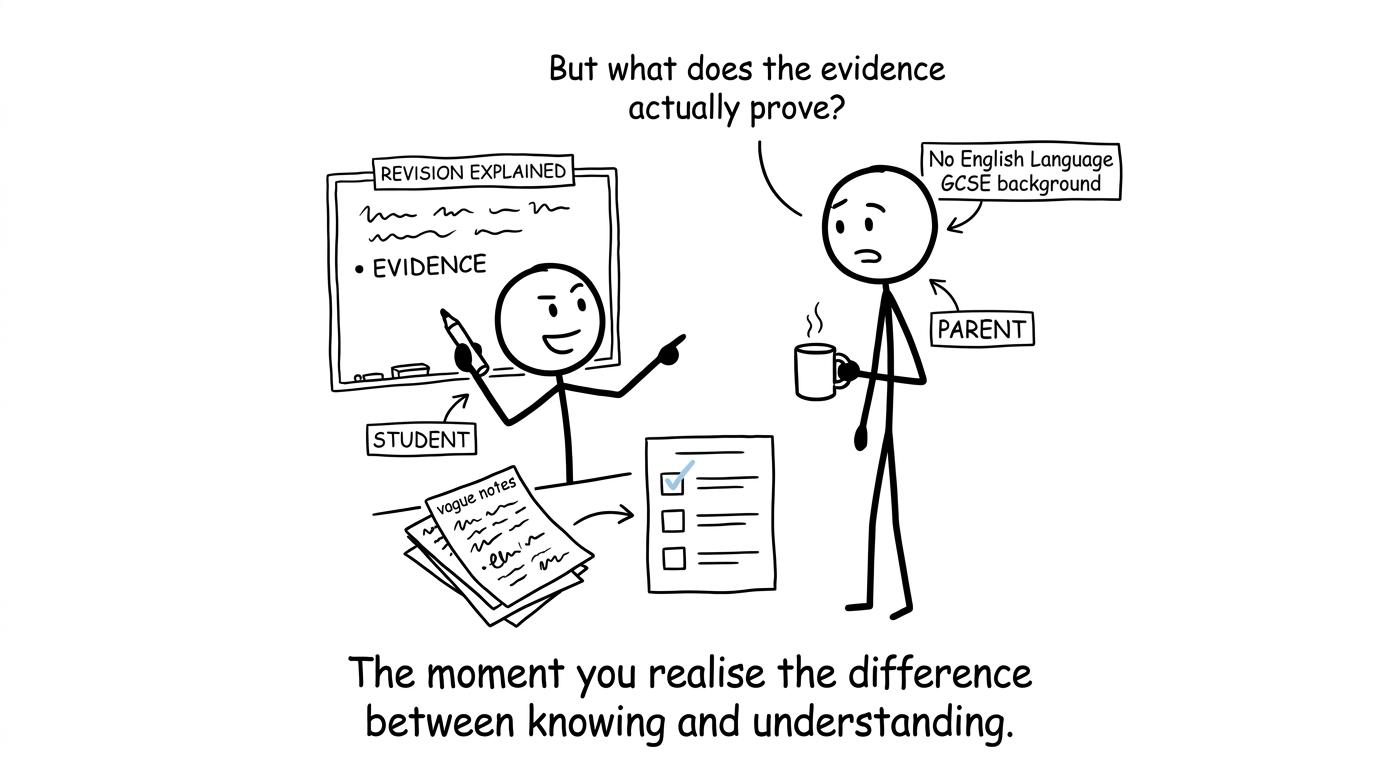 A student explaining English Language while a parent's question turns vague notes into a checklist
Why teaching a beginner can strengthen revision
Research into learning by teaching suggests that explaining material to another person can support learning, particularly when the explanation requires retrieval from memory. The evidence is more nuanced than the slogan “the best way to learn is to teach”. Some studies find that teaching and retrieval practice produce similar benefits, while the additional advantage of explaining varies with the task and conditions.
The practical lesson is simpler: do not read from a polished script. If your notes supply every sentence, the notes are doing the remembering.
It forces retrieval rather than recognition
A page of familiar terminology can feel reassuring. Yet familiarity is not the same as being able to produce an answer independently.
When you explain language analysis with the book closed, you have to retrieve:
- what the technique means;
- why a writer may have chosen it;
- how evidence supports an interpretation;
- how the effect connects to the reader or purpose;
- what the examination question is assessing.
This is the same distinction that matters in maths. Watching a video solution may make a method look obvious, but an exam asks you to select and use it independently. MathsGenie’s guide to turning GCSE maths notes into active recall applies the same principle: attempt retrieval before looking back at the method.
A beginner cannot fill in your missing steps
A classmate may understand your shorthand because they have attended the same lessons. A parent with no background cannot quietly repair the gaps for you.
If you say that a phrase is “effective”, they may reasonably ask, “Effective in doing what?” If you claim that structure creates tension, they may ask how the order or pace produces that response. Those are useful questions because they push you from labels towards reasoning.
In maths, the equivalent gap appears when a student says, “Then you rearrange it,” without identifying the operation or preserving equality. A beginner’s confusion often reveals the exact step an experienced learner has compressed too far.
It develops metacognitive accuracy
Metacognition means monitoring your own thinking. In revision, that includes judging what you know and noticing what remains uncertain.
Students are often least accurate when the material is sitting open in front of them. Explanation removes some of that support. A pause, circular definition or dependence on memorised wording becomes evidence about your understanding.
Treat that evidence calmly. A difficult explanation is not a verdict on your ability. It is an early warning delivered while there is still time to act. The MathsGenie guide to finding weak GCSE topics uses the same philosophy: diagnose the weakness, practise its smallest useful unit and then retest it.
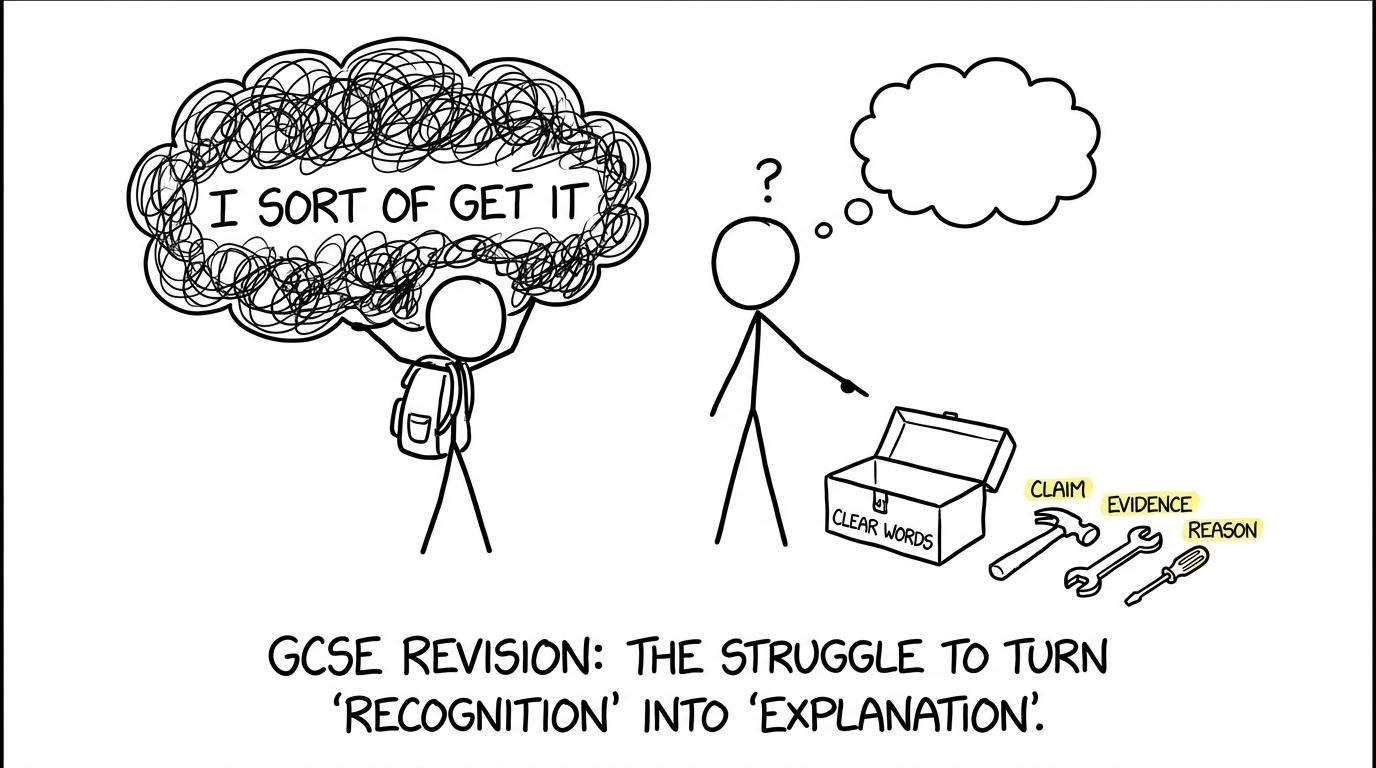 A student exchanging an unhelpful cloud of understanding for clear explanatory tools
What should you explain about GCSE English Language?
The official GCSE English Language assessment objectives in England divide the examined qualification equally between reading and writing. Reading covers identifying and interpreting information, analysing language and structure, comparing perspectives and evaluating texts. Writing covers communication and organisation alongside vocabulary, sentence structures, spelling and punctuation. Technical accuracy accounts for 20%20\%20% of the qualification as a whole.
Spoken Language is assessed separately and does not contribute to the final GCSE grade. Exact papers, timings and question formats vary between AQA, Pearson Edexcel, OCR and Eduqas, so check your own specification rather than relying on another student’s question numbers.
Good explanation topics include:
- the difference between identifying a device and analysing its effect;
- how explicit information differs from an inference;
- why evidence must support the precise interpretation being made;
- how language and structure are different but can work together;
- what it means to compare writers’ ideas and perspectives;
- how purpose, audience, form and register shape writing;
- why technical accuracy matters alongside imaginative ideas.
Choose one item. “I will explain the whole English Language GCSE” is too broad to generate useful feedback.
A simple parent-explanation revision routine
Prepare a narrow question
Start with a prompt such as, “What does language analysis require?” or, “How is evaluation different from spotting a quotation?” A focused prompt makes it possible to notice whether your explanation has answered the question.
Tell your parent they do not need to teach or mark you. Their role is to listen and ask natural questions. They should not pretend to understand unfamiliar terminology.
Explain from memory
Speak for roughly 333 to 555 minutes without notes. You may use a blank sheet to organise headings, but avoid copying prepared sentences.
Aim to explain:
- the meaning of the skill;
- what a candidate must actually do;
- why that earns marks;
- how to recognise an incomplete response;
- how the skill connects to the relevant assessment objective.
This is not a performance. Pauses are useful because they identify fragile knowledge.
Invite beginner questions
Ask your parent to use questions such as:
- “What does that word mean?”
- “How do you know?”
- “Why would that affect a reader?”
- “What would a weaker answer miss?”
- “Is that always true?”
A question does not automatically mean your explanation is wrong. It may mean that you have omitted a link in the reasoning or used terminology before defining it.
Check and convert gaps into actions
Afterwards, open your course materials. Check terminology and exam-board requirements rather than asking your parent to judge technical accuracy.
Record no more than three next actions. For instance, one might concern an unclear concept, another a forgotten assessment objective and another an exam-timing issue. Then complete an appropriate question and compare your response with trusted teacher guidance or an official mark scheme.
For maths, the parallel routine is already built into the GCSE maths revision hub: learn through a revision lesson, explain the method without support, complete practice questions and check the solution.
How this helps students preparing for maths exams
English and maths assess different knowledge, but clear explanation exposes similar weaknesses.
A secure maths explanation should make clear:
- what information is given;
- what must be found or proved;
- why a method is suitable;
- what each line of working changes;
- whether the result is reasonable;
- how the work would communicate method to an examiner.
Try teaching a parent the purpose of a topic, not rehearsing a full worked solution. Explain how you recognise when a particular method is relevant, what assumptions it uses and which mistakes could invalidate the result. This respects an important boundary: explanation supports understanding, but only questions test whether you can execute the method accurately.
After explaining, use an Edexcel GCSE maths mini test for a short check. For longer exam practice, select the correct tier from the Edexcel GCSE maths past papers, AQA GCSE maths past papers or OCR GCSE maths past papers.
The sequence matters:
- explanation reveals whether the idea makes sense;
- practice reveals whether you can apply it;
- a mark scheme reveals what the examiner rewards;
- a later retest reveals whether the improvement lasted.
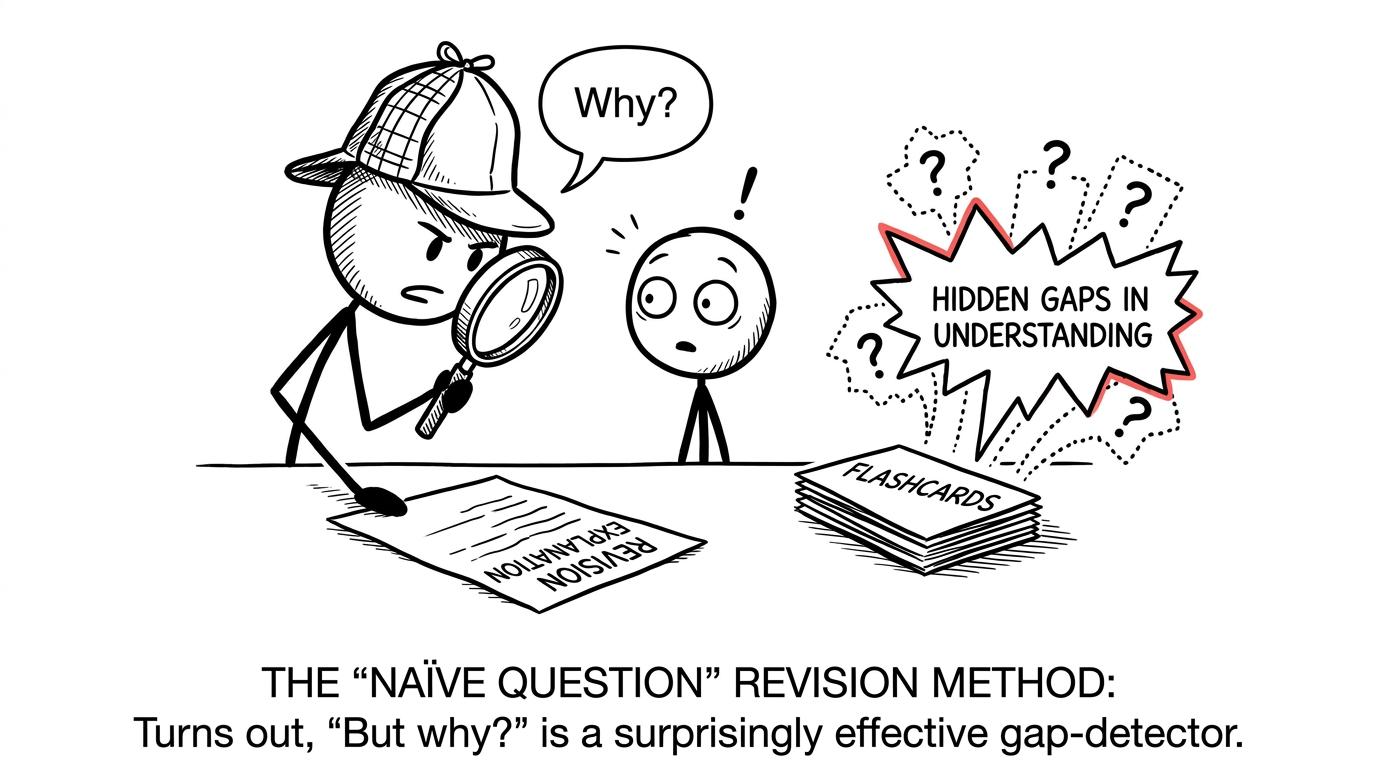 A parent detective finding hidden gaps behind a student's revision cards
When the method is less useful
Explaining is not automatically productive. It becomes less useful when you read aloud from notes, practise inaccurate material without checking it or spend so long preparing a “lesson” that little retrieval occurs.
It is also limited as evidence of exam readiness. A calm conversation does not test whether you can read an unseen extract, plan an extended response or maintain accuracy under time pressure. In maths, verbal confidence cannot replace calculations, diagrams, algebraic working or decisions made across a mixed paper.
Use explanation as one part of a broader plan. The GCSE one-month maths revision plan combines retrieval with topic practice, marking and timed papers. That balance is more reliable than depending on any single revision technique.
Common mistakes when explaining to a parent
Turning the session into a memory recital
Repeating memorised sentence starters may sound fluent without showing flexible understanding. Ask the parent to interrupt or change the wording of the question.
Using unexplained subject terminology
Words such as inference, register and juxtaposition are useful only if you can define their role. Terminology should sharpen reasoning, not hide it.
Asking the parent to act as the examiner
A beginner can identify unclear logic, but they cannot reliably confirm exam-board accuracy. Use your specification, teacher materials and mark schemes for that.
Explaining without doing questions afterwards
Knowing why a method works and executing it are related but distinct. Follow explanation with independent practice, then mark it promptly.
Treating confusion as failure
The purpose is to uncover gaps before the examination. If everything feels effortless because your notes are open, the check is probably too gentle.
Revising the wrong board or tier
English paper structures differ by exam board, while GCSE maths resources must also match foundation or higher tier. Confirm whether you take Edexcel, AQA, OCR or Eduqas and use the correct specification. MathsGenie organises free GCSE maths revision resources by exam board, reducing the risk of practising the wrong format.
Turn explanation into evidence
Explaining GCSE English Language to a parent with no background can be surprisingly effective because the listener cannot rely on classroom shorthand. They make you define, connect and justify. Most importantly, explaining from memory reveals the distance between “this looks familiar” and “I can use this independently”.
Keep the method modest: explain one skill, welcome questions, check the facts and complete exam practice. Then carry the same habit into maths. Say why a method applies, attempt the questions without help and use feedback to repair the exact gap.
Start with the MathsGenie GCSE maths revision hub. Choose your exam board and tier, use the free revision lessons and practice questions, then build towards mini tests, past papers and predicted papers. Mark your work with the available mark schemes and video solutions. A clear explanation begins the check; accurate independent work completes it.