Explain GCSE English Language and Literature to a Parent
Explain GCSE English Language and Literature to a parent to expose knowledge gaps, strengthen recall and build a practical revision routine before exams.
Revision can feel convincing when the book is open. Your notes make sense, quotations look familiar and every technique seems obvious. Then someone asks, “But why did the writer do that?” and the certainty disappears.
That is why choosing to explain GCSE English Language and Literature to a parent who has never studied the courses can be genuinely useful. It forces you to retrieve ideas, replace vague jargon with clear reasoning and notice gaps that silent rereading can hide. It is not a replacement for writing exam answers, but it is an effective revision check before you return to questions and mark schemes.
The same principle matters if your main concern is GCSE maths. Explaining a method clearly tests whether you understand it, rather than merely recognise it. MathsGenie’s guide to turning GCSE notes into active recall applies that idea directly to maths revision.
The quick answer
Explaining English to a complete beginner works best when you:
- choose one narrow topic or text;
- close your notes before speaking;
- explain the idea in ordinary language;
- include what the examiner rewards;
- invite simple questions such as “why?” and “how do you know?”;
- check your explanation against your specification, notes or mark scheme;
- finish by writing an exam response.
The important part is retrieval. If you simply read a prepared script aloud, your notes are doing most of the thinking.
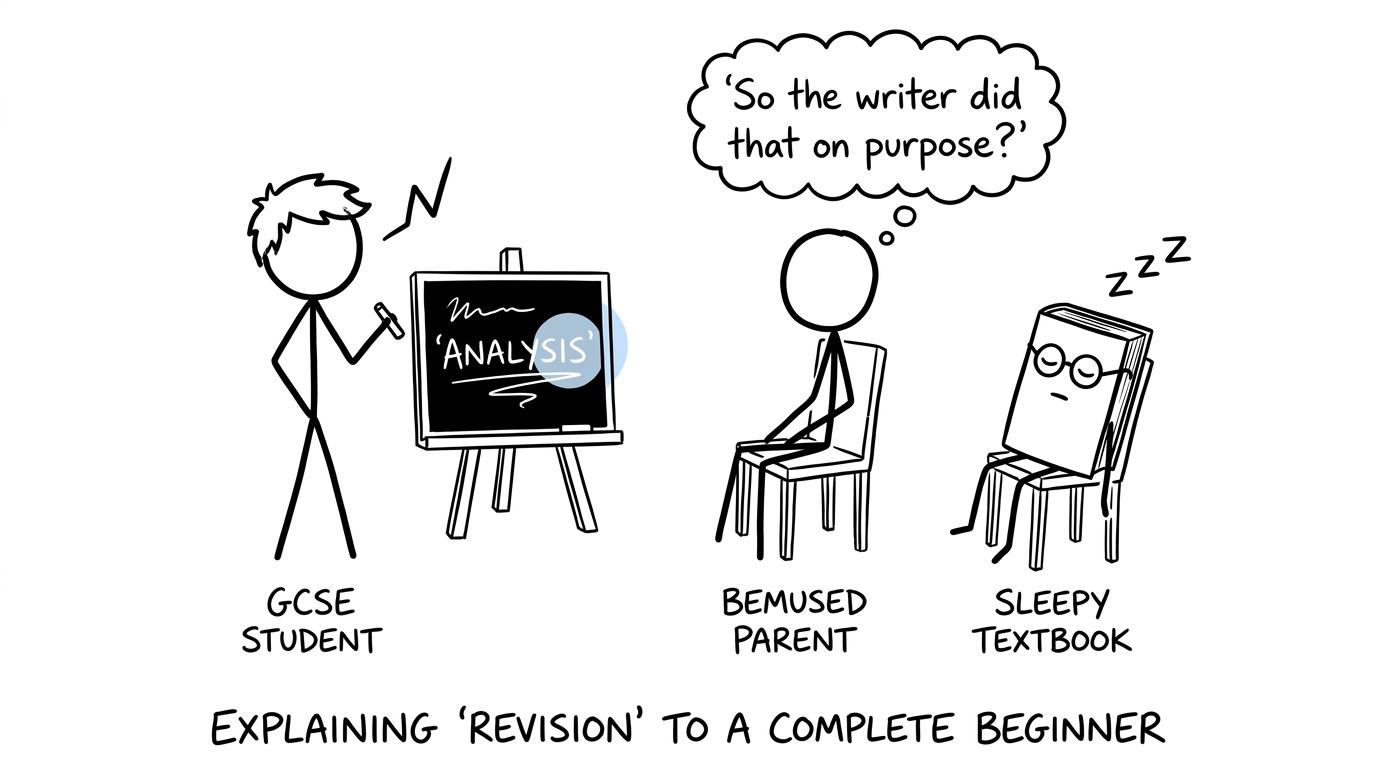 A student teaching a bemused parent while a textbook watches
Why teaching a beginner can expose weak understanding
Familiarity is comfortable. Unfortunately, it is not the same as recall.
Research into learning by teaching suggests that explaining material can support learning through several connected processes. You must retrieve information, organise it into a sensible sequence and monitor whether your explanation is coherent. Evidence is strongest when the explanation happens without heavy reliance on notes. Research also suggests that interaction can help because questions prompt clarification and elaboration.
A parent with no background in GCSE English is especially useful because they cannot quietly fill in your missing steps. Another student may understand what you intended when you say, “It creates an effect.” A beginner is more likely to ask what effect, how it is created and why it matters.
Those questions reveal the difference between a label and an explanation.
Knowing that a phrase contains a metaphor is identification. Explaining what comparison the metaphor creates, what it suggests and how it shapes the reader’s response is analysis. Your parent does not need to know the official terminology to hear whether that chain of reasoning makes sense.
What you should explain about GCSE English Language
GCSE English Language is not primarily a memory test about set stories. Across qualifications in England, the nationally defined assessment objectives divide the written qualification equally between reading and writing. Spoken Language is reported separately and does not contribute to the final numerical grade.
Exact papers, timings and question formats differ between AQA, Edexcel, OCR and Eduqas, so your explanation should match your own exam board’s current specification.
Explain the reading skills
Try describing how a strong reader:
- distinguishes explicit information from implied meaning;
- selects relevant evidence;
- analyses language and structure;
- compares ideas and perspectives where required;
- evaluates a text while supporting judgements with references.
Do not stop at a list of assessment objectives. Tell your parent what each skill looks like in an answer. If you cannot distinguish analysis from evaluation without repeating memorised phrases, that is a useful gap to find now.
Explain the writing skills
Your parent should also understand that English Language writing rewards choices made for a form, purpose and audience. You might explain how tone changes between a speech, article, letter or narrative, depending on your board’s tasks.
The national assessment objectives reward clear, effective communication, organisation, vocabulary, sentence control, spelling and punctuation. Technical accuracy is therefore not an optional final check. It is part of what is being assessed.
Ask your listener to interrupt whenever your language becomes vague. Words such as “effective”, “powerful” and “interesting” need reasons attached to them.
What you should explain about GCSE English Literature
Literature requires knowledge of studied texts as well as the ability to construct an interpretation. National subject content includes Shakespeare, a nineteenth-century novel, poetry and British fiction or drama from 1914 onwards, alongside unseen material. Schools and exam boards select particular texts within those requirements.
A useful explanation should cover four broad demands:
- responding thoughtfully to a text and supporting ideas with references;
- analysing language, form and structure;
- connecting texts with relevant contexts;
- writing clearly and accurately.
Context deserves particular care. It should illuminate the text rather than become a detached history paragraph. If you explain a contextual idea to your parent, ask yourself whether you can connect it directly to a character, theme, quotation or writer’s choice.
Quotations should work in the same way. Reciting ten quotations proves that you remember ten quotations. Explaining how two or three support a coherent interpretation proves something more valuable.
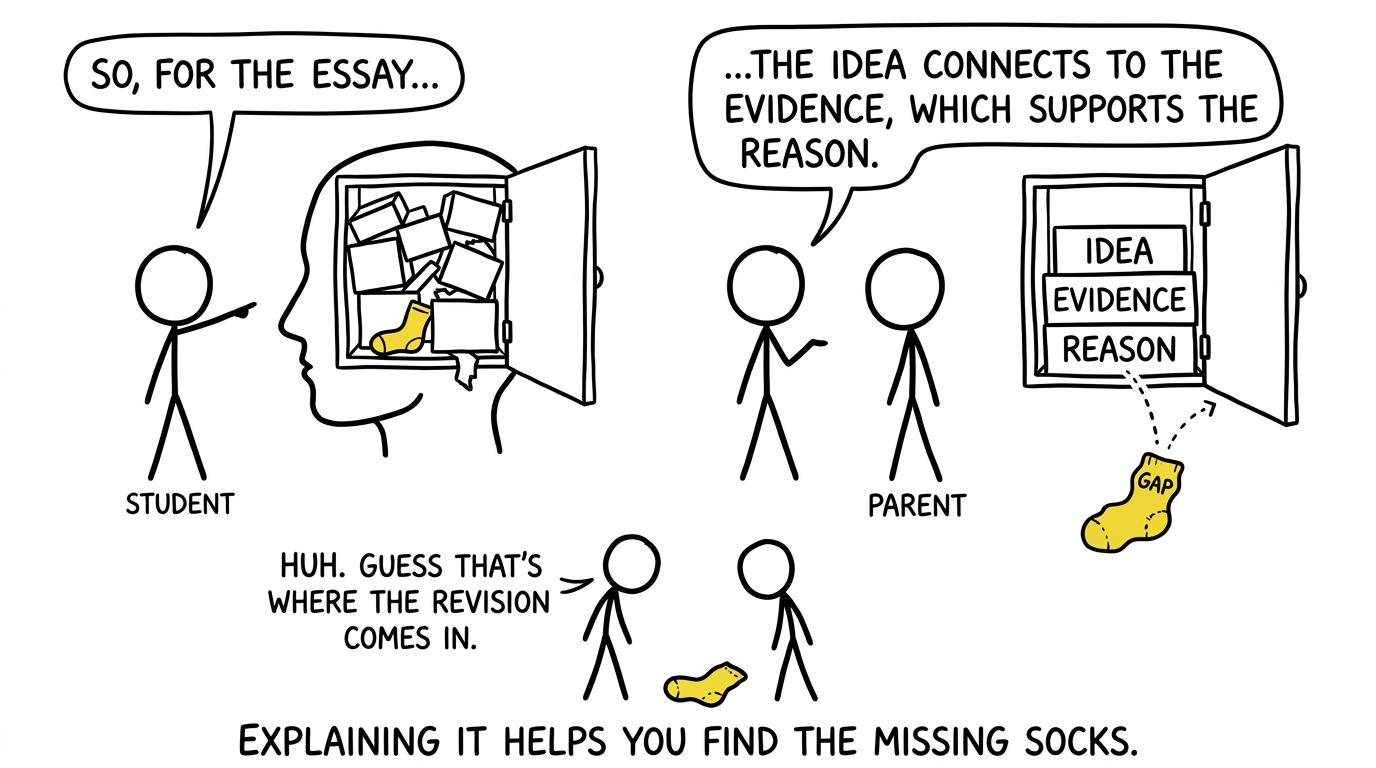 A cluttered brain cupboard becoming organised through explanation
A practical parent-teaching revision routine
Keep the activity short enough to repeat. A focused session is more revealing than an unfocused lecture on the entire course.
Choose one precise goal
Good topics include one character, one theme, one poem, one reading assessment objective or one type of writing task. “Teach all of English Literature” is too large to diagnose anything clearly.
This resembles effective maths revision. The MathsGenie GCSE Maths Revision hub separates learning into manageable topics, questions and papers rather than treating “maths” as one enormous task.
Retrieve before checking
Close your book and explain from memory for around 555 minutes. You may use a blank sheet to organise ideas, but avoid copying prepared paragraphs.
When you finish, open your materials and compare. Record:
- an idea you forgot;
- an idea you could name but not explain;
- evidence you used inaccurately;
- a question your parent asked that you could not answer.
That list is more valuable than a general feeling that revision went well. Maths students can use the same diagnostic mindset with the guide to finding weak GCSE topics.
Let the parent ask beginner questions
Useful prompts include:
- “What does that term mean?”
- “How do you know?”
- “Why does that matter?”
- “Could someone interpret it differently?”
- “What would the examiner see on the page?”
Your parent is not marking your interpretation. Their role is to test clarity. You must later verify subject-specific details using your teacher’s guidance, specification and authorised materials.
Convert speaking into exam performance
Oral explanation is preparation, not the final product. GCSE English is assessed substantially through written examinations, so finish by planning or writing a relevant response under suitable conditions.
Then use the mark scheme to check whether your answer actually demonstrates the assessment objectives. A polished conversation cannot earn marks if you cannot turn it into controlled writing.
Why this method also helps GCSE maths students
The transferable habit is simple: state the method, justify each decision and identify the evidence that confirms the result.
In maths, a student may recognise a topic when watching a video but struggle to begin independently. Explaining the method without notes exposes the missing first step. A parent can ask why an operation is valid, what information matters and how the answer could be checked.
You still need to solve questions. Explanation cannot replace written working, accuracy or timed practice. Use the MathsGenie scheme of learning to choose an appropriate topic, explain the method from memory and then complete practice questions.
When your topic knowledge is secure, move to Edexcel GCSE Maths past papers, or select the correct board through the main revision hub. Mark schemes show where credit is awarded, while video solutions help you locate the precise step your explanation missed.
This matters on both foundation and higher tier. The content differs in difficulty and breadth, but neither tier rewards passive recognition. If you are unsure what belongs in your programme, the GCSE maths topics by exam board and tier guide provides a clearer map.
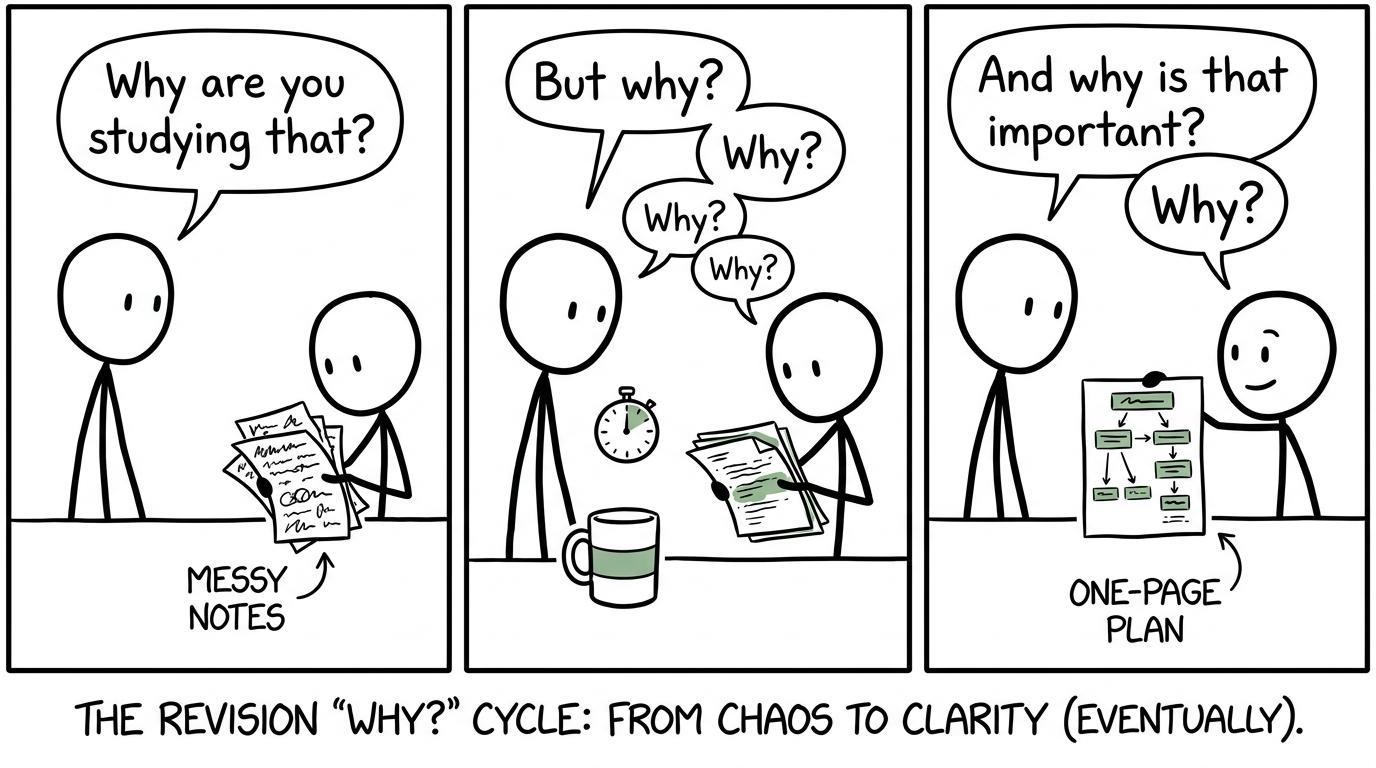 A parent asking why while a student turns messy notes into a plan
Common mistakes when explaining GCSE English to a parent
Reading from a script
Reading creates fluency without necessarily creating retrieval. Begin with closed notes, then check accuracy afterwards.
Teaching too much at once
A tour of every text and assessment objective becomes shallow. One narrow idea gives your parent enough space to question your reasoning.
Treating the parent as an examiner
A parent without GCSE English experience cannot reliably award marks. Use them to test clarity, not to replace teachers, specifications or mark schemes.
Using terminology without meaning
Naming alliteration, juxtaposition or dramatic irony is not analysis by itself. Explain the choice, evidence, meaning and significance.
Remembering content but ignoring the question
A confident speech about a character may still be irrelevant to the actual task. Always connect your explanation to a possible exam question and its command word.
Stopping before written practice
Speaking can organise thought, but examination performance requires writing. End with a paragraph, plan or timed response.
Applying the method only once
One explanation reveals today’s gaps. Returning later shows whether those gaps have closed. Space the sessions and change the question so that recall remains flexible.
Make explanation part of a balanced revision plan
Explaining English to a complete beginner is valuable because it removes the shelter of familiar notes. It makes unclear thinking audible. Used carefully, it strengthens retrieval, reveals misconceptions and prepares ideas for writing.
But the sequence matters: learn, explain, check, practise and revisit.
Use the same loop for maths. Start with MathsGenie’s free revision lessons, explain a method in your own words, complete practice questions, and check the mark scheme or video solution. Then test your decisions under pressure with mini tests, properly used GCSE maths past papers and predicted papers.
A parent does not need to know the course. Sometimes their lack of knowledge is precisely what makes the conversation useful. If your explanation survives a sincere “why?”, it is becoming something sturdier than familiarity. It is becoming understanding.