Exam Anxiety GCSE Astronomy: A Practical Plan
Exam anxiety GCSE Astronomy advice: build a calmer revision plan, practise calculations and observations, and use a clear strategy for both papers on the day.
The difficult thing about GCSE Astronomy is not always the size of the universe. Sometimes it is the size of the revision list. Or the moment a familiar calculation suddenly looks strange because it is surrounded by unfamiliar data.
If exam anxiety GCSE Astronomy is making revision feel unmanageable, the most useful response is not to revise everything for longer. It is to make the examination more familiar. Break the specification into smaller areas, practise astronomical calculations in context, rehearse observational questions and build a routine for moments when your mind goes blank.
Anxiety often grows in uncertainty. A clear process gives it less room.
Your calm GCSE Astronomy checklist
Use this as a practical starting point:
- Know the structure and requirements of your actual qualification.
- Separate naked-eye, telescopic, mathematical and observational revision.
- Practise short sets before attempting complete papers.
- Keep an error log based on lost marks, not vague topic labels.
- Rehearse calculator use, graph reading and formula-sheet navigation.
- Simulate the first five minutes of each examination.
- Prepare a strategy for difficult questions before you meet one.
- Tell a trusted adult if anxiety is disrupting sleep, revision or everyday life.
The aim is not to remove every nervous feeling. It is to know what to do next even when those feelings appear.
Know what the GCSE Astronomy exam actually demands
GCSE Astronomy is currently offered by Pearson Edexcel and is untiered. Unlike GCSE Maths, there is no foundation or higher paper. The qualification has two externally examined papers: Paper 1, Naked-eye Astronomy, and Paper 2, Telescopic Astronomy. Each lasts one hour and forty-five minutes, carries 100100100 marks and contributes 50%50\%50% of the qualification.
Across the qualification, at least 20%20\%20% of the marks reward mathematical skills. At least 15%15\%15% assess knowledge and application of observational work. Students are also required to undertake at least one unaided and one aided observation during the course, although the final grade comes from the written examinations.
That structure matters for anxiety. You are not preparing for an endless collection of space facts. You are preparing for a predictable mixture of knowledge, calculations, graphs, data interpretation, observational decisions and evaluation.
Check the latest Pearson specification and instructions provided by your school. Requirements and administrative details should always be confirmed with your teacher rather than assumed from an old revision guide.
Turn a huge subject into four revision lanes
Trying to revise “astronomy” is too broad to produce a clear next action. Divide your work into four lanes instead.
Naked-eye knowledge
This includes areas such as celestial cycles, the Earth-Moon-Sun system, timekeeping, planetary motion and observing the night sky. Retrieval cards, labelled diagrams and short written explanations are useful here.
Do not simply reread a chapter. Close the book and retrieve what you know. Then check it. The gap between your answer and the source is your next revision target.
Telescopic knowledge
Organise stars, stellar evolution, galaxies, cosmology, telescopes and space exploration into connected ideas. Anxiety often makes isolated facts feel more numerous than they are. Connections make them easier to retrieve.
For instance, telescope design, wavelength and observing conditions should not live in three unrelated folders in your mind. They all help answer the same practical question: what can be observed, and how reliably?
Mathematical skills
Astronomy calculations can involve standard form, ratios, percentages, inverse-square relationships, angles, graphs, significant figures and calculator use. The mathematics is commonly assessed inside an astronomical context rather than as an isolated exercise.
That context can make a familiar skill look harder. Reduce this effect by alternating between ordinary maths practice and astronomy questions. MathsGenie’s free GCSE maths revision hub provides revision lessons, practice questions, mini tests and papers for strengthening the underlying skills.
If standard form, graph work or trigonometry is causing uncertainty, use the GCSE topics by exam board and tier guide to identify the relevant maths area. Although GCSE Astronomy is untiered, the mathematical technique can still be practised through GCSE Maths resources at an appropriate level.
Observational thinking
Do not treat your practical observations as experiences that are finished and forgotten. Written papers can ask you to plan, analyse and evaluate observational work.
For each observation, be ready to discuss:
- the purpose and method;
- the equipment selected;
- safety and suitable observing conditions;
- variables or measurements recorded;
- accuracy, reliability and limitations;
- improvements to the procedure;
- whether the evidence supports a conclusion.
This is particularly effective anxiety preparation because it replaces abstract revision with something you have actually considered or done.
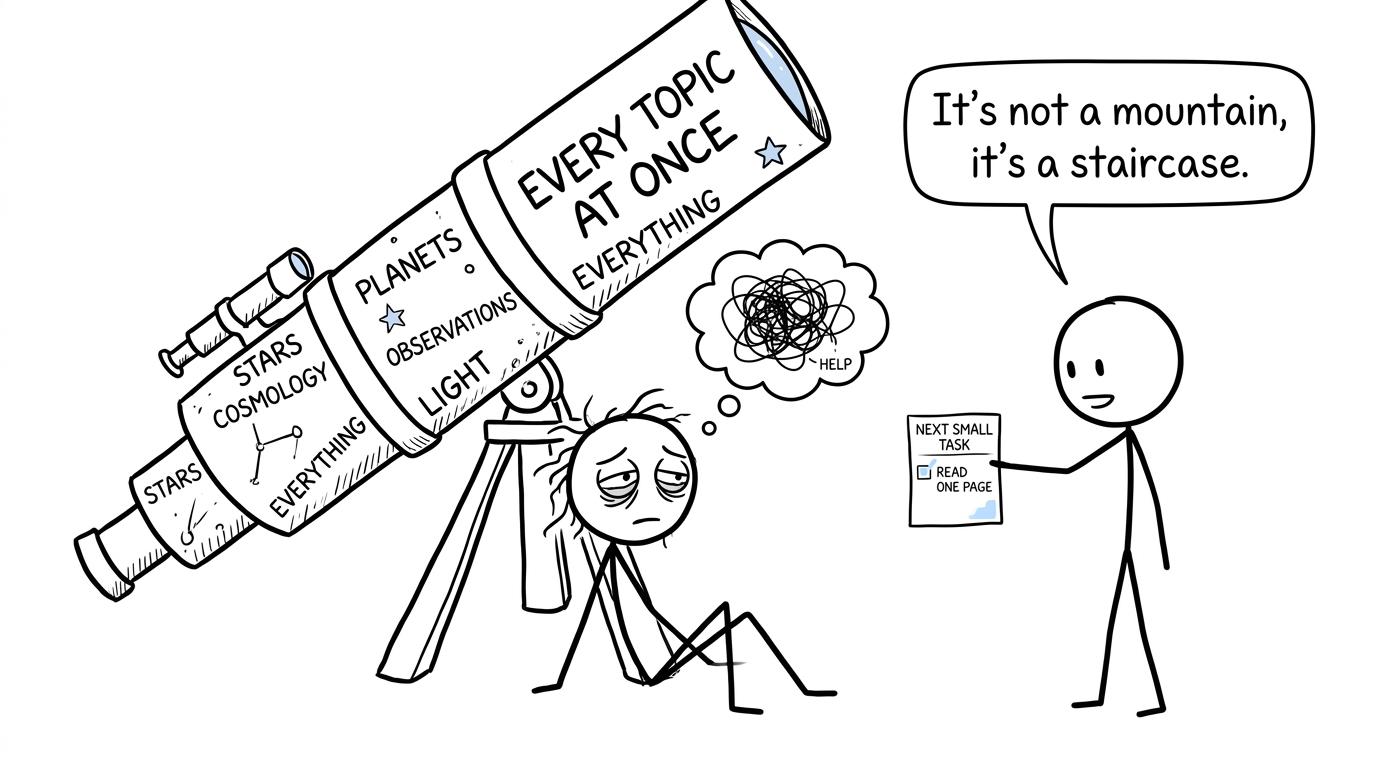 A student swaps an enormous telescope of every topic for one manageable revision checklist
Use practice to reduce uncertainty, not measure your worth
A past paper can feel threatening when it is treated as a prediction of your final grade. It becomes more useful when treated as a diagnostic instrument.
Begin with short, untimed question groups. Separate calculation questions from observational and extended-response questions. Once the format feels familiar, introduce a timer. Build towards full papers rather than demanding full examination performance immediately.
After each session, record the cause of every lost mark:
- knowledge not recalled;
- command word misread;
- formula chosen incorrectly;
- calculator input error;
- units omitted;
- rounding too early;
- observation not evaluated precisely;
- answer lacked enough developed detail.
“Bad at astronomy” is not a useful diagnosis. “I round before the final line” is. One describes an identity; the other identifies a repair.
MathsGenie’s one-month GCSE revision plan can be adapted for the mathematical side of Astronomy. Use its learn, practise, mark and retest rhythm rather than copying every maths topic. For data handling and interpretation, the free Edexcel GCSE Statistics revision resources can also strengthen graph and data confidence.
Build an Astronomy-specific weekly routine
A calm plan should be repeatable, including on an ordinary day when motivation is low.
Try this pattern:
- Session one: retrieve one Naked-eye Astronomy area, then answer short questions.
- Session two: practise one mathematical skill, followed by astronomy questions using it.
- Session three: revisit an aided or unaided observation and evaluate its method.
- Session four: revise one Telescopic Astronomy area and interpret related data.
- Weekend: complete a timed paper section, mark it and choose three repairs.
Keep tasks specific. “Revise stellar evolution” is less helpful than “draw the stages, explain the role of initial mass and answer two comparison questions”. Specific targets tell your brain when the task is complete.
Avoid building your plan around guessed questions. Predictions can help organise practice, but they cannot replace specification coverage. The same principle explained in MathsGenie’s guide to using predicted topics without guessing applies here: prioritise recurring skills without assuming that omitted areas are safe to ignore.
Rehearse what to do when anxiety rises
Calming techniques work better when practised before the examination. If slow breathing is unfamiliar, waiting until panic arrives is like learning to use a telescope after the object has disappeared below the horizon.
The NHS and government exam-pressure guidance recommend manageable revision targets, regular breaks, preparation, slow breathing and speaking to someone you trust. You can turn that advice into an Astronomy routine:
- Put both feet on the floor and release your shoulders.
- Breathe in gently, then breathe out slowly for a little longer.
- Identify the question type: knowledge, calculation, data or observation.
- Underline the command word and relevant data.
- Write the first valid step rather than waiting for the whole answer.
For a calculation, that first step may be selecting information, writing a supplied equation or identifying units. For an observational question, it may be naming the variable being measured or the limitation being evaluated.
This is not a promise that breathing will make every question easy. Its purpose is to interrupt the rush and return your attention to the task in front of you.
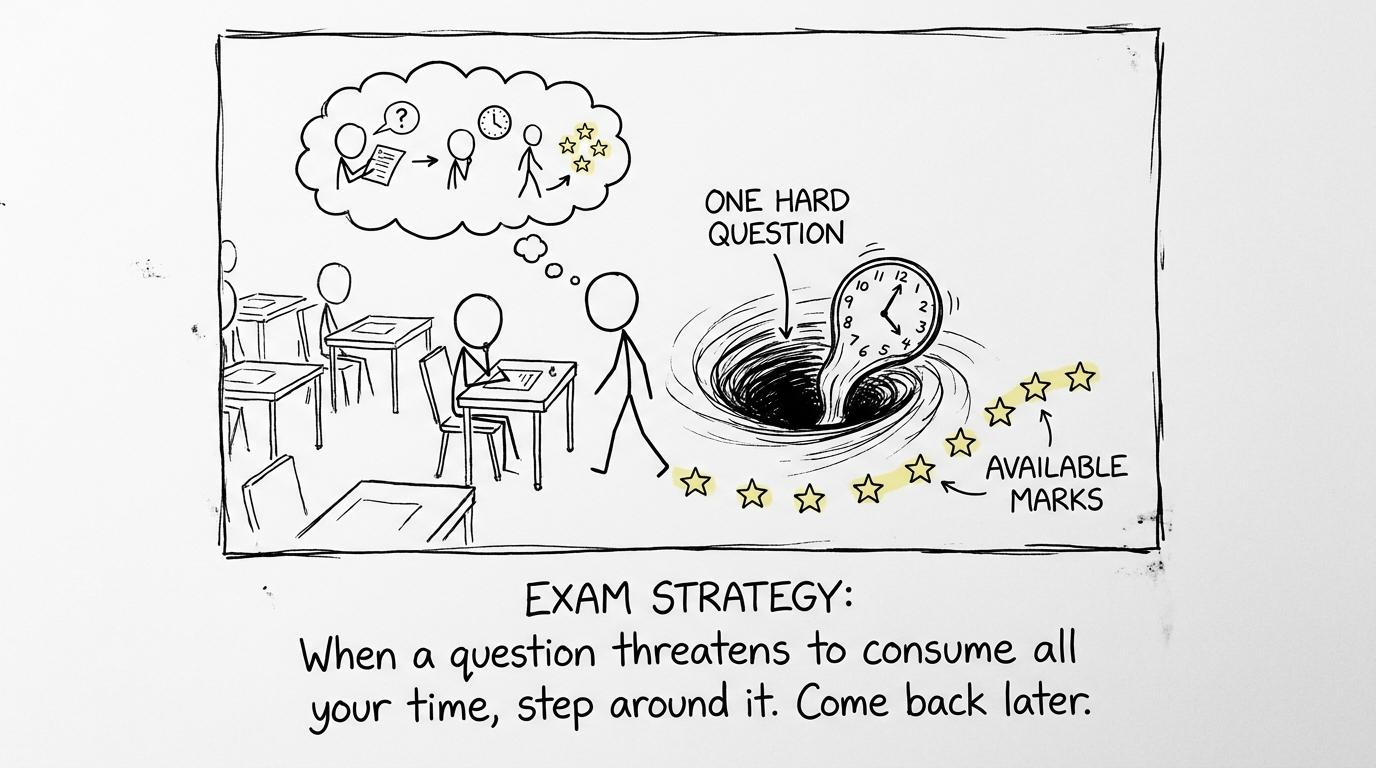 A student calmly walks around the black hole of one hard question towards available marks
Use a two-paper exam strategy
At the beginning of each Astronomy paper, check the instructions and scan the pages calmly. Notice where calculations, graphs and longer responses appear. You do not need to solve them during the scan; you are removing surprise.
If a question stops you:
- mark it clearly;
- write any relevant fact, relationship or planning point;
- move to a question where marks are accessible;
- return with the remaining time.
One hard question is not the whole paper. Protecting time for later questions is a mathematical decision as much as an emotional one.
For extended responses, pause to identify exactly what is being requested. “Describe”, “explain”, “compare” and “evaluate” require different answers. In observational evaluation, generic statements such as “use better equipment” are weak. State what should change and how that would improve accuracy, reliability or validity.
For calculations, keep enough working visible to make your reasoning clear. Check units, powers of ten and whether the final value is sensible in the astronomical context. Use the Formula and Data Sheet provided for the qualification during practice so that finding information becomes routine.
The final evening and exam morning
The night before is for reducing decisions, not expanding the syllabus.
Choose one short recall task, check a few recurring errors and stop at a planned time. Pack permitted equipment, including pens, pencils, a ruler and an approved calculator. Follow your school’s instructions about what may enter the exam room.
MathsGenie’s GCSE night-before plan offers a useful structure for checking mathematical skills without starting a last-minute marathon.
On the morning, avoid answer-comparison conversations if they increase your anxiety. Arrive in good time. If you are uncertain about an examination instruction, ask an invigilator rather than carrying the uncertainty into the paper.
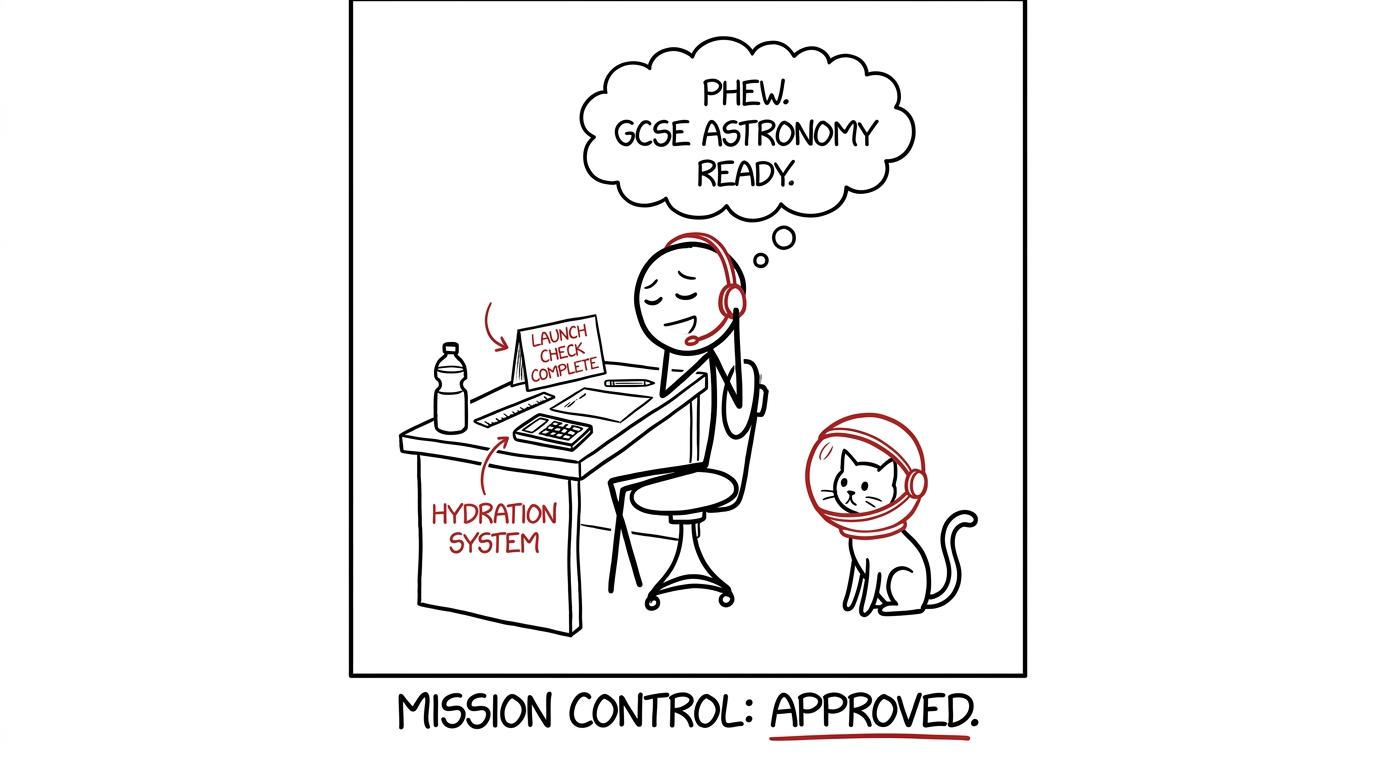 An Astronomy student's desk becomes calm mission control while a cat wears an astronaut helmet
Common mistakes when managing GCSE Astronomy anxiety
Avoiding the questions that create anxiety
Avoidance brings short-term relief but preserves uncertainty. Begin with a small dose: one graph, one calculation or one observational evaluation. Increase the difficulty gradually.
Revising facts but neglecting application
Knowing a definition does not guarantee that you can use it in an unfamiliar context. Include data, calculation and observational questions every week.
Completing papers without analysing errors
A mark is a measurement, not a revision plan. Use mark schemes to find the precise difference between your response and a creditworthy answer, then retest that skill.
Treating a blank moment as proof that knowledge is gone
Anxiety can temporarily disrupt retrieval. Move to another question, settle your breathing and return later. A delayed memory is not necessarily a missing memory.
Hiding severe or persistent anxiety
Exam nerves are common, but you should not manage serious distress alone. If anxiety is persistent, disrupts sleep or daily life, or prevents you from attending or completing assessments, speak to a parent, carer, teacher, pastoral lead or GP. Ask your school early about appropriate support and any access arrangements for which you may be eligible.
Make the examination feel less unknown
The night sky looks complicated until patterns become familiar. Examination preparation works similarly. You learn the paper structure, separate the types of demand, practise the underlying mathematics and decide how you will respond when a difficult question appears.
Start at the MathsGenie home page or open the GCSE revision hub. Use free revision lessons to rebuild weak mathematical methods, practice questions and mini tests to make them reliable, then past papers, predicted papers, mark schemes and video solutions to improve timing and accuracy in your GCSE Maths preparation.
For Astronomy, combine that mathematical confidence with your Pearson specification, observational notes and official past-paper practice. Choose one small task today. Calm preparation is rarely dramatic, but it steadily turns uncertainty into something you know how to handle.