

Exact Trig Values GCSE Maths Mock Revision
Exact trig values GCSE maths revision made clear. Learn the table, avoid common mock mistakes and practise two exam-style questions before December.
The December mock is close enough to feel real. You open a trigonometry question, recognise the angle, then pause. Was sin30∘\sin 30^\circsin30∘ equal to 12\frac{1}{2}21 or 32\frac{\sqrt{3}}{2}23?
For exact trig values GCSE maths revision, you need to know a small table of sine, cosine and tangent values, then use those values without turning them into decimals. The quickest route is simple: learn the patterns, understand where they come from and practise retrieving them inside exam-style questions.
This is not a large topic. But it rewards certainty, and certainty is often built from a few short sessions rather than one long evening.
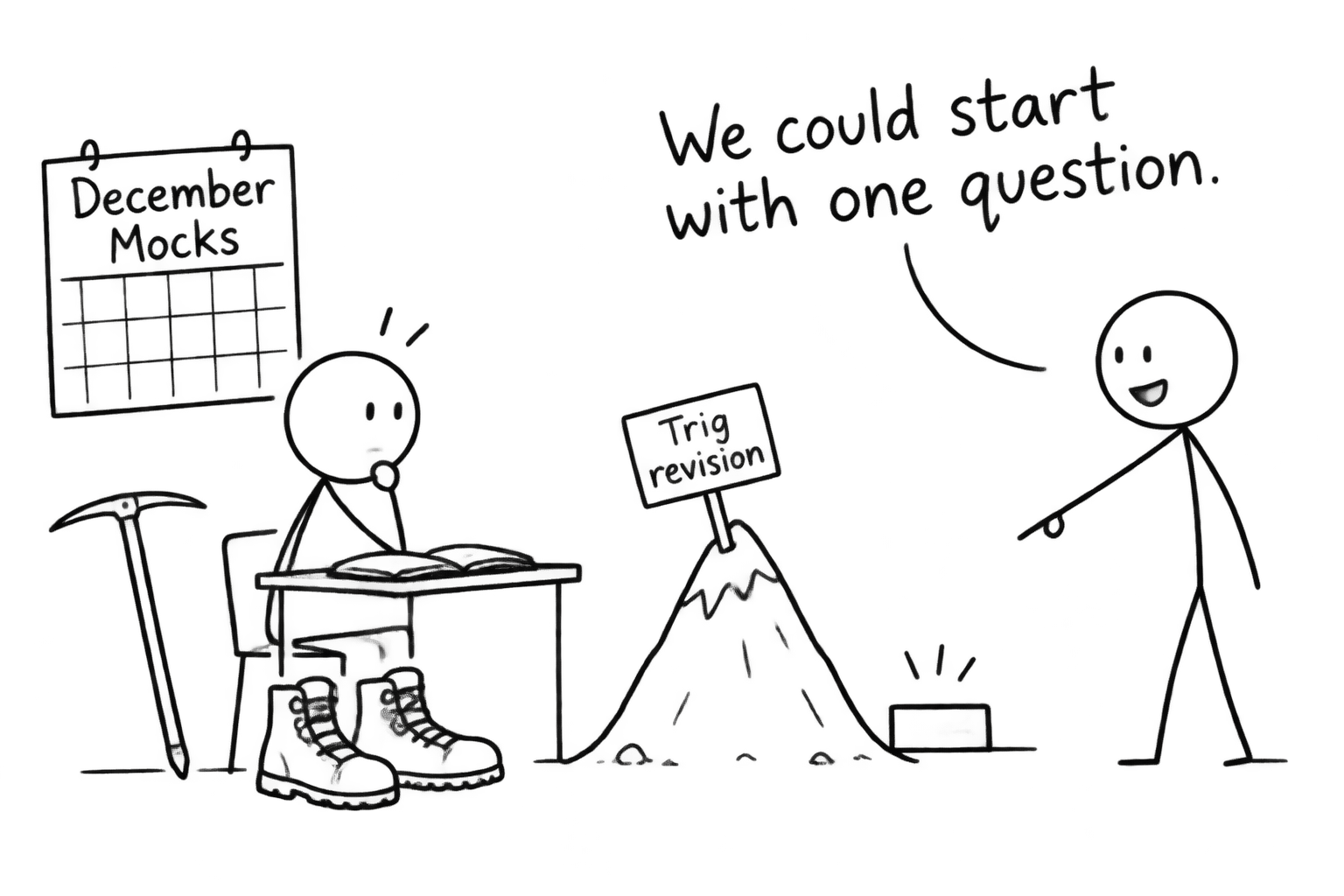 A Year 11 student prepares to climb a tiny trig revision mountain
Your exact trig values mock revision checklist
Before the mock, aim to be able to:
- recall the exact sine and cosine values for 0∘0^\circ0∘, 30∘30^\circ30∘, 45∘45^\circ45∘, 60∘60^\circ60∘ and 90∘90^\circ90∘;
- recall the exact tangent values for 0∘0^\circ0∘, 30∘30^\circ30∘, 45∘45^\circ45∘ and 60∘60^\circ60∘;
- keep answers exact using fractions and surds;
- substitute exact values into expressions;
- simplify expressions involving 2\sqrt{2}2 and 3\sqrt{3}3;
- recognise when a calculator decimal is not an acceptable final answer;
- show enough working for a mark scheme to follow.
Start with the free Exact Trig Values revision lesson, which brings together the explanation and exam-style practice for this topic.
The exact trig values you need to know
The required table is:
| θ\thetaθ | 0∘0^\circ0∘ | 30∘30^\circ30∘ | 45∘45^\circ45∘ | 60∘60^\circ60∘ | 90∘90^\circ90∘ |
|---|---|---|---|---|---|
| sinθ\sin \thetasinθ | 000 | 12\frac{1}{2}21 | 22\frac{\sqrt{2}}{2}22 | 32\frac{\sqrt{3}}{2}23 | 111 |
| cosθ\cos \thetacosθ | 111 | 32\frac{\sqrt{3}}{2}23 | 22\frac{\sqrt{2}}{2}22 | 12\frac{1}{2}21 | 000 |
| tanθ\tan \thetatanθ | 000 | 13\frac{1}{\sqrt{3}}31 | 111 | 3\sqrt{3}3 | undefined |
GCSE specifications require the sine and cosine values for all five angles shown. Tangent is required from 0∘0^\circ0∘ to 60∘60^\circ60∘; tan90∘\tan 90^\circtan90∘ is undefined.
Some resources write tan30∘\tan 30^\circtan30∘ as 33\frac{\sqrt{3}}{3}33. This is equivalent to 13\frac{1}{\sqrt{3}}31 because rationalising the denominator gives:
13×33=33.\frac{1}{\sqrt{3}} \times \frac{\sqrt{3}}{\sqrt{3}} = \frac{\sqrt{3}}{3}.31×33=33.If simplifying surds feels less secure than the trigonometry itself, revisit the GCSE surds revision guide.
How to remember the table without guessing
Use the sine square-root pattern
Write the numbers from 000 to 444 under the five angles. Take their square roots and divide each result by 222:
sinθ=02, 12, 22, 32, 42.\sin \theta = \frac{\sqrt{0}}{2},\ \frac{\sqrt{1}}{2},\ \frac{\sqrt{2}}{2},\ \frac{\sqrt{3}}{2},\ \frac{\sqrt{4}}{2}.sinθ=20, 21, 22, 23, 24.After simplifying, this becomes:
0, 12, 22, 32, 1.0,\ \frac{1}{2},\ \frac{\sqrt{2}}{2},\ \frac{\sqrt{3}}{2},\ 1.0, 21, 22, 23, 1.The values rise as the angle rises.
Reverse the pattern for cosine
Cosine uses the same list backwards:
1, 32, 22, 12, 0.1,\ \frac{\sqrt{3}}{2},\ \frac{\sqrt{2}}{2},\ \frac{1}{2},\ 0.1, 23, 22, 21, 0.This reflects the relationship:
sinθ=cos(90∘−θ).\sin \theta = \cos(90^\circ-\theta).sinθ=cos(90∘−θ).For example, sin30∘=cos60∘=12\sin 30^\circ=\cos 60^\circ=\frac{1}{2}sin30∘=cos60∘=21.
Build tangent from sine and cosine
Rather than treating tangent as another disconnected row, remember:
tanθ=sinθcosθ.\tan \theta = \frac{\sin \theta}{\cos \theta}.tanθ=cosθsinθ.At 45∘45^\circ45∘:
tan45∘=2222=1.\tan 45^\circ =\frac{\frac{\sqrt{2}}{2}}{\frac{\sqrt{2}}{2}} =1.tan45∘=2222=1.This gives you a way to reconstruct a forgotten tangent value during the mock. It is slower than immediate recall, but much better than guessing.
Two exact trig values exam questions
Exam-style question one
Work out the exact value of:
4sin30∘+2cos60∘.4\sin 30^\circ+2\cos 60^\circ.4sin30∘+2cos60∘.Both exact values are 12\frac{1}{2}21:
4(12)+2(12).4\left(\frac{1}{2}\right)+2\left(\frac{1}{2}\right).4(21)+2(21).Calculate each product:
2+1=3.2+1=3.2+1=3.Therefore, the exact value is:
3.\boxed{3}.3.Notice that no calculator is needed. Writing the substituted values also makes the method visible to the examiner.
Exam-style question two
Work out the exact value of:
sin60∘tan45∘+cos30∘.\frac{\sin 60^\circ}{\tan 45^\circ}+\cos 30^\circ.tan45∘sin60∘+cos30∘.Substitute the exact values:
321+32.\frac{\frac{\sqrt{3}}{2}}{1}+\frac{\sqrt{3}}{2}.123+23.Dividing by 111 leaves the value unchanged:
32+32.\frac{\sqrt{3}}{2}+\frac{\sqrt{3}}{2}.23+23.The denominators are the same, so add the numerators:
232=3.\frac{2\sqrt{3}}{2}=\sqrt{3}.223=3.Therefore:
3.\boxed{\sqrt{3}}.3.A decimal such as 1.732…1.732\ldots1.732… would be an approximation, not an exact answer. For more questions with worked solutions and mark schemes, use the Exact Trig Values practice resources.
The slips examiners see most
Swapping sine and cosine
Students often remember the right pair of values but attach them to the wrong function. Use the direction of each row as a check: sine rises from 000 to 111, while cosine falls from 111 to 000.
Giving a rounded decimal
If the question asks for an exact value, do not replace 32\frac{\sqrt{3}}{2}23 with a decimal. Fractions, integers and surds preserve the exact quantity.
Forgetting the denominator of 222
The middle sine and cosine values are not simply 2\sqrt{2}2 or 3\sqrt{3}3. They are 22\frac{\sqrt{2}}{2}22 and 32\frac{\sqrt{3}}{2}23.
Treating tan90∘\tan 90^\circtan90∘ as zero
Because cos90∘=0\cos 90^\circ=0cos90∘=0, the expression sin90∘cos90∘\frac{\sin 90^\circ}{\cos 90^\circ}cos90∘sin90∘ would involve division by zero. Therefore, tan90∘\tan 90^\circtan90∘ is undefined.
Typing everything into a calculator
A calculator can produce a decimal approximation, but it may hide whether you recalled the exact value correctly. Substitute the exact value first. Use the calculator only as a check when appropriate.
Skipping substitution lines
An unsupported final answer can make it difficult to earn method marks if a later simplification goes wrong. Show the exact value you substituted before simplifying.
A realistic plan before the December mock
Use three short rounds rather than repeatedly reading the table.
First, cover the table and reproduce it from memory. Check it immediately. Correcting a mistake while it is fresh is more useful than copying the whole table several times.
Next, answer a small set of mixed questions. Include direct recall, substitution and surd simplification. The SOHCAHTOA exam booklet can also help you separate exact-value questions from right-angled triangle problems.
Finally, complete questions under timed conditions and mark them. Record whether each error came from recall, substitution or simplification. That diagnosis tells you what to practise next.
For broader preparation, MathsGenie provides free GCSE and A Level maths revision resources, including revision lessons, past papers, practice questions, mark schemes and video solutions. You can also read the guide to improving at GCSE trigonometry if several trig topics need attention.
Turn the weak spot into a targeted paper
A mock becomes useful when it reveals something specific. Perhaps the table is secure, but simplifying surds is not. Perhaps direct recall is fine, but a longer expression causes hesitation.
Do not respond by revising everything again. Build a paper around the weakness.
Use the free MathsGenie Mock Exam Builder to create a targeted practice paper from exam-style questions. Sit it without notes, mark it carefully, then return to the exact trig values that cost you marks. One focused paper can make the December mock feel less like a test of memory and more like a routine you have already practised.















