

Error Intervals GCSE Maths: Examples and Practice
Error intervals GCSE maths explained with clear worked examples, rounding and truncation rules, common mistakes and exam-style questions to practise today.
Imagine a student who keeps losing the same mark. They find both ends of an error interval correctly, then put the wrong inequality sign beside the upper bound. The arithmetic makes sense; the notation still feels like a guessing game.
The key to error intervals GCSE maths questions is this: an error interval describes every original value that could produce a rounded answer. For rounding, subtract and add half the rounding unit, then include the lower endpoint and exclude the upper endpoint.
We will follow this hypothetical student through the moment that rule starts to make sense, with worked examples and questions you can try yourself.
Your error intervals checklist
For a value rounded to a stated accuracy:
- Identify the rounding unit.
- Halve that unit.
- Subtract the half-unit to find the lower bound.
- Add the half-unit to find the upper bound.
- Write the interval using the correct inequality signs.
Simple error intervals are relevant to both foundation and higher tier GCSE Maths. They can involve rounding or truncation, so check which process the question describes.
What is an error interval?
A rounded measurement represents a range of possible values. If a length is recorded as 8 cm8\text{ cm}8 cm to the nearest centimetre, the original length need not be exactly 8 cm8\text{ cm}8 cm.
Let the actual length be x cmx\text{ cm}x cm. Its error interval is:
7.5≤x<8.57.5 \leq x < 8.57.5≤x<8.5The lower bound is 7.57.57.5. The upper bound is 8.58.58.5.
Our student initially thinks both endpoints should be included. After all, both seem equally far from the recorded measurement.
But try rounding them. Under the usual GCSE rounding convention, 7.57.57.5 rounds to 888, so it belongs in the interval. However, 8.58.58.5 rounds to 999, so it does not.
That is the click: test the endpoints by rounding them back. The signs describe which values actually belong.
If this part feels uncertain, MathsGenie's rounding lesson covers the skill behind the interval.
The method behind every rounding question
Suppose the rounded value is rrr and the rounding unit is uuu. The original value xxx lies in:
r−u2≤x<r+u2r-\frac{u}{2} \leq x < r+\frac{u}{2}r−2u≤x<r+2uThe important decision is choosing uuu. For the nearest whole number, it is 111. For the nearest tenth, it is 0.10.10.1. For the nearest hundred, it is 100100100.
Do not halve the recorded measurement. Halve the size of the rounding step.
Use MathsGenie's Error Intervals lesson and Question Bank to practise choosing the rounding unit and checking both endpoints.
Error intervals worked examples
A measurement rounded to a decimal place
A mass is 6.4 kg6.4\text{ kg}6.4 kg, correct to one decimal place. Write an error interval for the actual mass, m kgm\text{ kg}m kg.
Identify the unit. One decimal place means rounding to the nearest 0.10.10.1.
Halve it.
0.1÷2=0.050.1 \div 2 = 0.050.1÷2=0.05Find the bounds.
6.4−0.05=6.356.4-0.05=6.356.4−0.05=6.35 6.4+0.05=6.456.4+0.05=6.456.4+0.05=6.45Write the interval.
6.35≤m<6.456.35 \leq m < 6.456.35≤m<6.45Our student checks the upper endpoint: 6.456.456.45 rounds to 6.56.56.5, so the strict inequality is needed. The sign now follows from a decision they understand.
A value rounded to significant figures
A distance is 3700 m3700\text{ m}3700 m, correct to two significant figures. Write an error interval for the actual distance, d md\text{ m}d m.
The second significant digit is in the hundreds column. The rounding unit is therefore 100100100, and half of it is 505050.
3700−50=36503700-50=36503700−50=3650 3700+50=37503700+50=37503700+50=3750Therefore:
3650≤d<37503650 \leq d < 37503650≤d<3750The phrase “two significant figures” does not give a fixed rounding unit. You must locate the second significant digit in the particular number.
For another explanation alongside your working, use the error intervals revision guide.
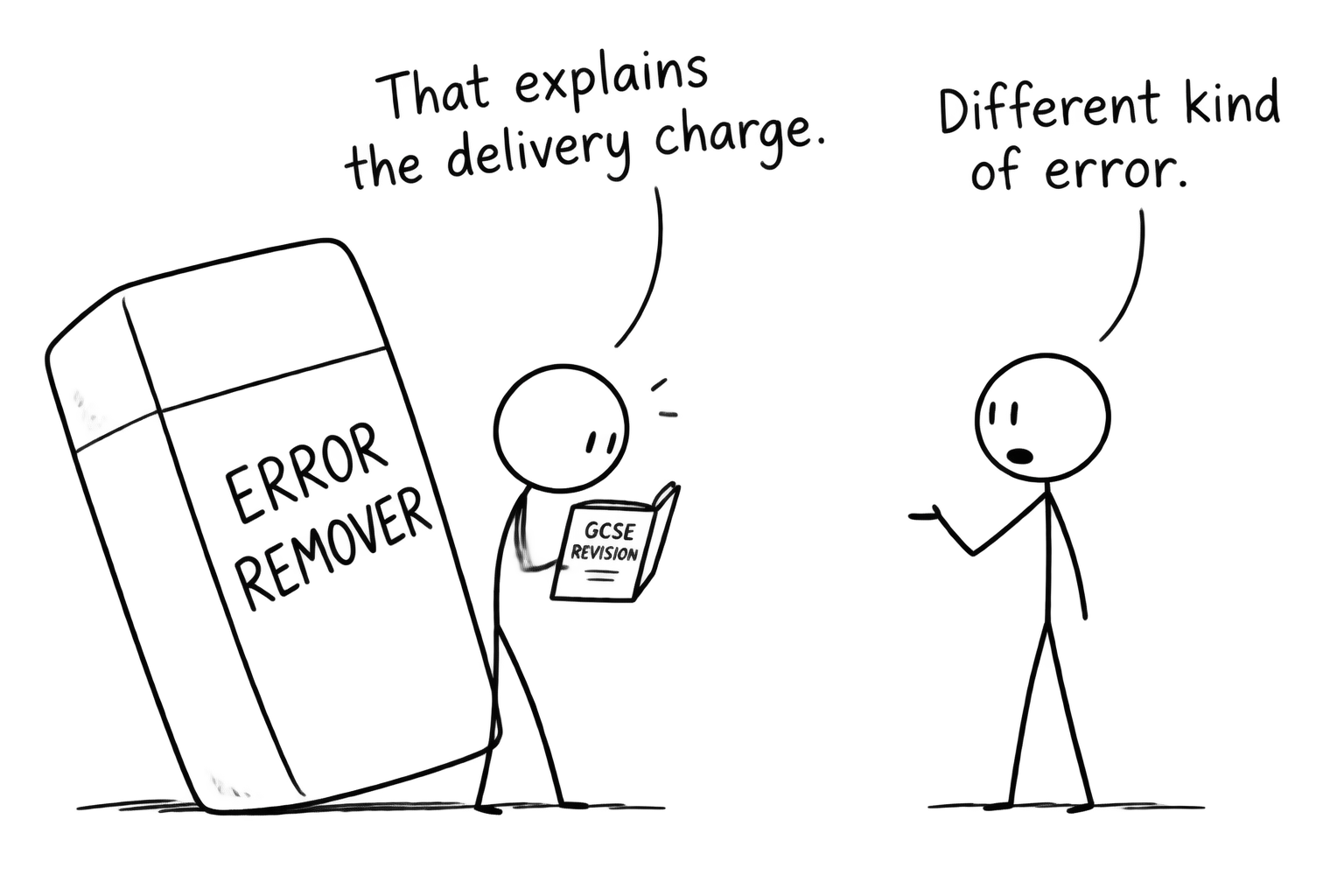 Stick-figure student discovers that an enormous eraser cannot solve this kind of maths error
A positive value that has been truncated
A positive length is truncated to one decimal place, giving 4.7 cm4.7\text{ cm}4.7 cm. Write an error interval for the actual length, l cml\text{ cm}l cm.
Truncation removes digits after the required position. It does not round to the nearest value.
The smallest possible length is 4.7 cm4.7\text{ cm}4.7 cm. Values below 4.8 cm4.8\text{ cm}4.8 cm can still truncate to 4.7 cm4.7\text{ cm}4.7 cm, but 4.8 cm4.8\text{ cm}4.8 cm cannot.
4.7≤l<4.84.7 \leq l < 4.84.7≤l<4.8There is no half-unit adjustment here. This method applies to the positive value in this question; negative truncated values need separate care with their endpoints.
Common mistakes and how to catch them
Using a whole rounding unit on each side. This makes the interval too wide. Write the unit and its half before calculating either bound.
Writing an inclusive upper endpoint. For the rounding examples above, the upper endpoint rounds to the next value. Test it rather than trusting memory.
Confusing decimal places with significant figures. Decimal places count positions after the decimal point. Significant figures start at the first non-zero digit. Locate the relevant digit before choosing the unit.
Treating truncation as rounding. Underline the word describing the process. For a positive truncated value, the interval starts at the stated value.
Reading the bound as an attainable maximum. In 6.35≤m<6.456.35 \leq m < 6.456.35≤m<6.45, the upper bound is 6.456.456.45, but the mass cannot equal it. It can approach that boundary from below.
Our hypothetical student's new habit is small: before moving on, they round each endpoint back. That check catches the mistake they used to repeat.
Error intervals questions to try
Write an error interval for each original value. These are practice questions in an exam-style format, rather than quotations from an exam paper.
- A length x cmx\text{ cm}x cm is 24 cm24\text{ cm}24 cm to the nearest centimetre.
- A mass m kgm\text{ kg}m kg is 0.82 kg0.82\text{ kg}0.82 kg to two decimal places.
- A distance d md\text{ m}d m is 5600 m5600\text{ m}5600 m to two significant figures.
- A positive time ttt seconds is truncated to one decimal place, giving 3.23.23.2 seconds.
Check your answers
For the length, half the rounding unit is 0.50.50.5:
23.5≤x<24.523.5 \leq x < 24.523.5≤x<24.5For the mass, half the rounding unit is 0.0050.0050.005:
0.815≤m<0.8250.815 \leq m < 0.8250.815≤m<0.825For the distance, the rounding unit is 100100100:
5550≤d<56505550 \leq d < 56505550≤d<5650For the positive truncated time:
3.2≤t<3.33.2 \leq t < 3.33.2≤t<3.3If you made a mistake, identify whether it came from the unit, the arithmetic or the endpoint signs. That tells you what to practise next.
Turn the method into a reliable habit
You want the interval and its signs to make sense even when an exam question changes the units or accuracy. Like our hypothetical student, you can move from recognising the method to applying it independently by attempting questions and checking why each endpoint belongs. Your turn: start with MathsGenie's Error Intervals lesson, then practise the topic in the Question Bank.















