Revision notes for Edexcel GCSE Maths Error Intervals. Open the guide for explanations and worked examples. Written against the Edexcel GCSE Maths (1MA1) specification, so the content matches what's examinable rather than general Maths background.
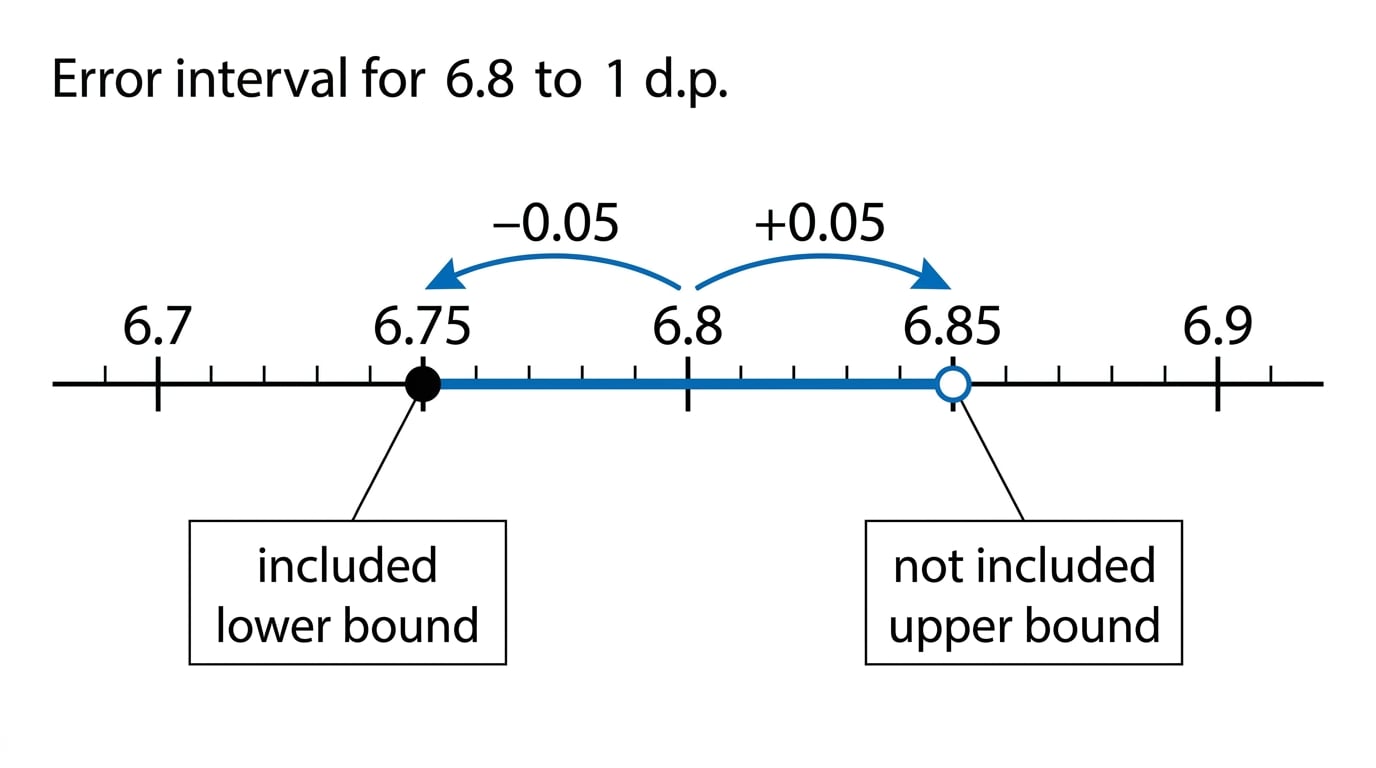
Rounding means changing a number to a nearby simpler value. For example, 6.83 rounded to 1 decimal place is 6.8.
But if you are only told the rounded answer is 6.8, the original number might have been 6.76, 6.82, 6.849, and so on. That is why we use an error interval.
Key words
A variable such as xxx or yyy is a letter that stands for an unknown number.
An error interval is the range of values that could have given the rounded or truncated result.
The lower bound is the smallest boundary value.
The upper bound is the largest boundary value.
For ordinary rounding, the lower bound is included, but the upper bound is not included. This is because the upper boundary would round up to the next answer.

Rounding uses halfway points
For ordinary rounding, go halfway down and halfway up from the rounded value. Write the interval as a≤x<ba \le x < ba≤x<b.
If a measurement is correct to the nearest kg, cm, or m, it has been rounded to the nearest whole unit.
The step size is the gap between one rounded answer and the next. For nearest kg, nearest cm, or nearest metre, the step size is 1 whole unit. Half of 1 is 0.5.
Measurement correct to the nearest kg
A sack has a mass of 18 kg, correct to the nearest kg. Find the lower and upper bounds.

The rounded value is 18 kg.
The step size is 1 kg, because the mass was rounded to the nearest kg.
Half of 1 kg is 0.5 kg.
Go 0.5 kg below and 0.5 kg above 18 kg.
The lower bound is 17.5 kg and the upper bound is 18.5 kg.
If mmm is the mass in kg, the error interval is 17.5≤m<18.517.5 \le m < 18.517.5≤m<18.5.
Least and greatest wording
If a question asks for the least and greatest boundary values, give the lower bound and upper bound. In a full error interval, the upper bound still uses <, not ≤.
A decimal place is a digit after the decimal point. For example, 4.7 has 1 decimal place, and 4.72 has 2 decimal places.
When rounding to decimal places, look at the value of the last rounded digit.
Useful half-steps
Rounded to 1 decimal place: step size 0.1, so half-step 0.05.
Rounded to 2 decimal places: step size 0.01, so half-step 0.005.
Rounded to 3 decimal places: step size 0.001, so half-step 0.0005.
Rounded to 1 decimal place
A number yyy is rounded to 1 decimal place. The result is 9.6. Write down the error interval for yyy.

Rounding to 1 decimal place means the step size is 0.1.
Half of 0.1 is 0.05.
Subtract 0.05 from 9.6 to get the lower bound: 9.6−0.05=9.559.6 - 0.05 = 9.559.6−0.05=9.55.
Add 0.05 to 9.6 to get the upper bound: 9.6+0.05=9.659.6 + 0.05 = 9.659.6+0.05=9.65.
The error interval is 9.55≤y<9.659.55 \le y < 9.659.55≤y<9.65.
Rounded to 2 decimal places
A number xxx is rounded to 2 decimal places. The result is 1.34. Write down the error interval for xxx.

Rounding to 2 decimal places means the step size is 0.01.
Half of 0.01 is 0.005.
The lower bound is 1.34−0.005=1.3351.34 - 0.005 = 1.3351.34−0.005=1.335.
The upper bound is 1.34+0.005=1.3451.34 + 0.005 = 1.3451.34+0.005=1.345.
The error interval is 1.335≤x<1.3451.335 \le x < 1.3451.335≤x<1.345.
Using ≤ on both sides
Do not write 1.335≤x≤1.3451.335 \le x \le 1.3451.335≤x≤1.345 for normal rounding. The upper boundary is not included, because 1.345 would round to 1.35, not 1.34.
A significant figure is an important digit in a number, counted from the first non-zero digit. Significant figures are often shortened to s.f.
For example, in 0.472, the significant figures are 4, 7, and 2. The zero before the decimal point does not count as significant.
To find an error interval for significant figures:
Do not confuse s.f. with d.p.
For significant figures, count from the first non-zero digit. For decimal places, count digits after the decimal point.
A small decimal rounded to 3 significant figures
A number xxx is rounded to 3 significant figures. The result is 0.472. Write down the error interval for xxx.

Count the significant figures: 4 is first, 7 is second, 2 is third.
The third significant figure is in the thousandths column.
The step size is 0.001, so the half-step is 0.0005.
The lower bound is 0.472−0.0005=0.47150.472 - 0.0005 = 0.47150.472−0.0005=0.4715.
The upper bound is 0.472+0.0005=0.47250.472 + 0.0005 = 0.47250.472+0.0005=0.4725.
The error interval is 0.4715≤x<0.47250.4715 \le x < 0.47250.4715≤x<0.4725.
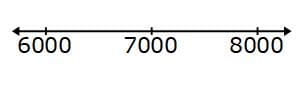
A large number rounded to 1 significant figure
A number xxx is rounded to 1 significant figure. The result is 7000. Write down the error interval for xxx.

The first significant figure is 7.
The 7 is in the thousands column.
The step size is 1000, so the half-step is 500.
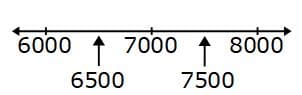
The lower bound is 7000 minus 500, which is 6500.
The upper bound is 7000 plus 500, which is 7500.
The error interval is 6500≤x<75006500 \le x < 75006500≤x<7500.
Truncation
Truncation means cutting off extra digits without rounding up.
This is different from rounding. If a positive number is truncated to 1 decimal place and the result is 6.2, the original number starts with 6.2 but is less than 6.3.

Truncated to 2 decimal places
A number xxx is truncated to 2 decimal places. The result is 4.73. Write down the error interval for xxx.

Truncating to 2 decimal places means the number has been cut off after the hundredths digit.
The smallest possible value is exactly 4.73.
The next 2-decimal-place value is 4.74.
So xxx must be less than 4.74.
The error interval is 4.73≤x<4.744.73 \le x < 4.744.73≤x<4.74.
Treating truncation like rounding
For truncation, do not go halfway down and halfway up. A number truncated to 4.73 starts at 4.73 and goes up to, but not including, 4.74.
In the exam
Underline whether the question says rounded, correct to the nearest, or truncated.
Find the step size: nearest whole unit, 1 decimal place, 2 decimal places, or the place value of the last significant figure.
For rounding, go half a step down and half a step up.
For truncation, start at the given value and go up to the next possible value.
Write the final interval with ≤ on the lower bound and < on the upper bound.
Check yourself
If a length is 23 cm correct to the nearest cm, what are the two boundary values?
A number rounds to 5.8 to 1 decimal place. What half-step should you use?
How is truncating to 2 decimal places different from rounding to 2 decimal places?
Test yourself with 5 quick questions on this guide. Answer them all correctly to complete it.
Test yourself on this topic, or move on to the next guide.
How was this guide?