Do Documentaries Help GCSE Spanish? Honest Guide
Documentaries help GCSE Spanish when viewing is active. Learn how subtitles, note-taking and exam practice can improve listening without wasting revision time.
The documentary ends. You understood the main story, recognised a few phrases and spent nearly an hour hearing authentic Spanish. It felt productive. But was it revision?
Yes, documentaries help GCSE Spanish, particularly with listening confidence, vocabulary recognition, pronunciation and cultural context. Research on second-language video suggests that captioned or subtitled viewing can support comprehension and vocabulary learning. But watching passively is unlikely to transform your grade by itself.
The distinction matters when Spanish is competing with maths, science and every other GCSE for your time. A documentary is useful when it becomes active language practice. Without that step, it is mostly enjoyable exposure. Enjoyable exposure still has value, but it should not replace specification vocabulary, grammar practice or exam questions.
The short answer: when documentaries are worth watching
Use this checklist before pressing play:
- Choose a documentary originally made in Spanish, rather than one dubbed into Spanish where possible.
- Pick a subject connected to GCSE themes such as lifestyle, popular culture, travel, technology or the environment.
- Watch a manageable section rather than automatically finishing the whole programme.
- Use Spanish captions if you can follow the central message.
- Use English subtitles temporarily if the Spanish is otherwise incomprehensible.
- Record a small number of useful words or phrases.
- Retrieve those words later without replaying the video.
- Keep doing direct exam practice alongside wider viewing.
The last point is the important one. Documentaries are a supplement, not the syllabus.
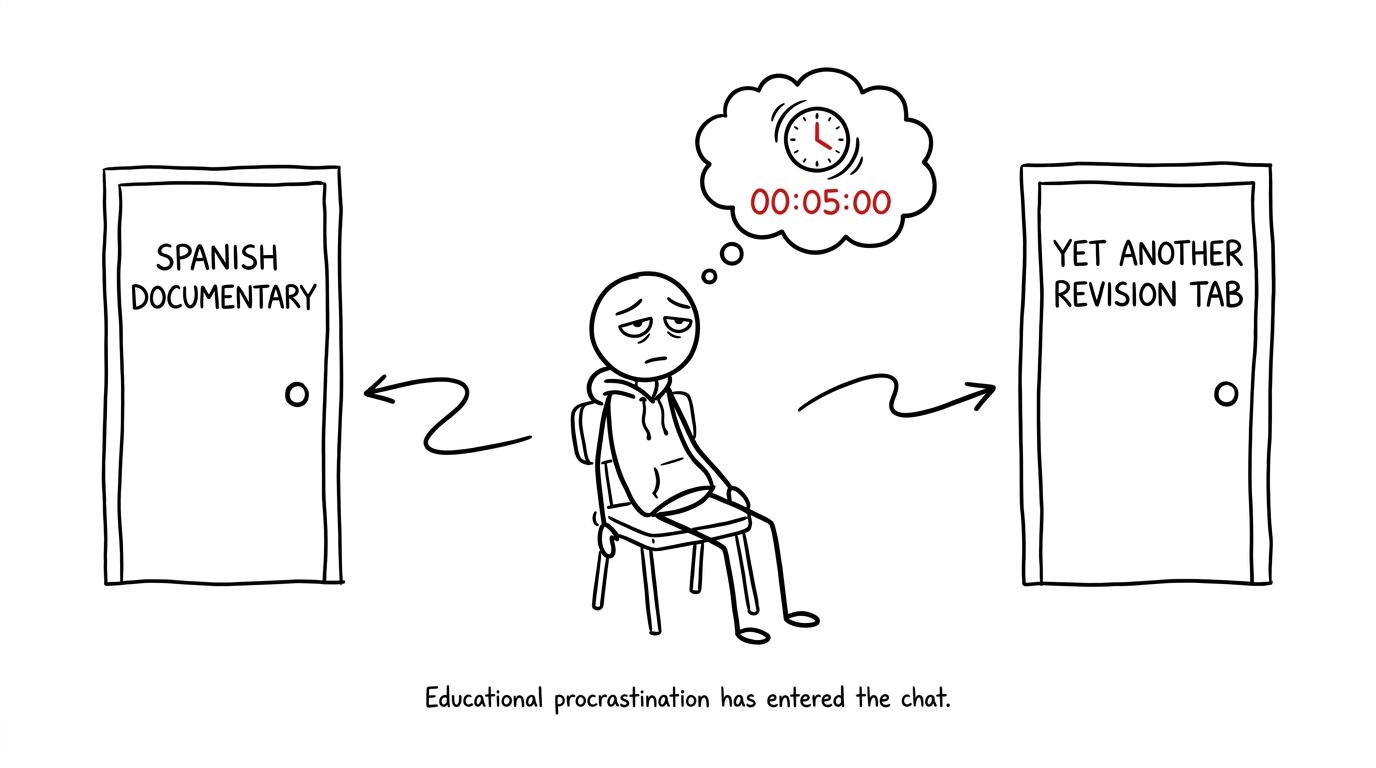 A student choosing between a Spanish documentary and another revision tab
How documentaries help GCSE Spanish skills
A documentary combines sound, images, context and written captions. That combination can make unfamiliar language easier to interpret than an audio recording heard in isolation.
Listening becomes less intimidating
GCSE listening can feel difficult because spoken language does not arrive as a tidy vocabulary list. Words join together, speakers vary their pace and familiar phrases can sound unfamiliar.
Regular exposure helps you become more comfortable with the rhythm of Spanish. Documentaries may introduce different voices and speech patterns, although students should remember that exam recordings are designed around the requirements of their specification rather than the full complexity of natural broadcasting.
The revised GCSE French, German and Spanish subject content, used for first examinations from summer 2026, requires students to understand spoken language and identify overall messages, details and opinions. Some specifications also include dictation. Documentary viewing supports the underlying listening habit, but board-specific sample assessments remain the best guide to the task you will actually face.
Vocabulary appears in context
A word encountered in a story has more connections than a word read once from a list. You may hear it beside an image, notice how it fits into a sentence and encounter it again later.
Research reviews of captioned and subtitled video generally find positive effects on second-language vocabulary learning. However, results vary according to the learner’s level, the subtitle format, repeated exposure and whether any retrieval activity follows the video. Much of this research concerns language learning broadly rather than GCSE Spanish specifically, so it supports a sensible method rather than guaranteeing extra marks.
Cultural knowledge becomes more concrete
Documentaries can show how people live across Spain and the wider Spanish-speaking world. They may add depth to themes such as festivals, environmental issues, tourism, identity and education.
That context can make speaking and writing ideas easier to remember. Yet cultural knowledge only earns credit when you answer the task using appropriate Spanish. Knowing a great deal about a subject will not compensate for inaccurate language or an unanswered bullet point.
Pronunciation starts to feel less abstract
Hearing Spanish while following Spanish captions can strengthen the connection between written forms and sounds. This is especially relevant where specifications include reading aloud or dictation tasks.
Listening alone will not correct your own pronunciation, however. Pause occasionally, repeat a short phrase and compare your version with the speaker. The purpose is not to imitate every regional feature. It is to produce clear, comprehensible Spanish.
Which subtitles should you use?
There is no single subtitle setting that is ideal for every student.
| Subtitle choice | Best use | Main limitation |
|---|---|---|
| English subtitles | Understanding a difficult topic or supporting an early-stage learner | Your attention may remain on English rather than Spanish |
| Spanish captions | Connecting spoken sounds with Spanish spelling and vocabulary | Fast, unfamiliar language may still feel overwhelming |
| No subtitles | Testing listening after you already know the section | Too difficult for many learners on a first viewing |
| English, then Spanish | Moving gradually from meaning to language form | Takes longer and should be used with short clips |
Research often finds that same-language captions are helpful for vocabulary form and sound recognition, while first-language subtitles can reduce the difficulty of understanding meaning. Findings are not identical across every study, age group or proficiency level.
A practical rule is simple: choose the least support that still allows you to follow the main idea. If English subtitles turn the session into English reading, switch to Spanish captions for a short replay. If Spanish captions leave you understanding almost nothing, use English briefly and return to the Spanish version.
A productive documentary revision routine
The best routine is deliberately small. A short section examined properly is more useful than an entire episode that disappears from memory by the following morning.
Before watching
Choose one purpose:
- listening for the main message;
- collecting language for a specification theme;
- noticing opinions and reasons;
- improving sound-spelling recognition; or
- learning about a Spanish-speaking community.
Read the programme description and predict a few words you might hear. This activates relevant vocabulary before the speech begins.
While watching
Watch the first time for meaning. Avoid pausing after every unknown word because this breaks the message into fragments.
On a second viewing, note only a handful of useful items. Prioritise language that is:
- relevant to your specification;
- reusable across several topics;
- understandable from context; or
- repeated by the speaker.
A rare technical term may be interesting without being useful for GCSE. Examination vocabulary is increasingly specification-defined. For example, AQA’s current specification identifies lexical content for foundation and higher tier, while Pearson Edexcel also publishes vocabulary and grammar content. Always follow the list and guidance for your own board.
After watching
Close the programme and do something that requires recall. You might:
- summarise the message aloud in simple Spanish;
- write several sentences using the new language;
- list the words you remember before checking your notes;
- record a short opinion and a reason; or
- return to the vocabulary after a few days.
This is the moment at which entertainment becomes revision. Recognition feels fluent because the answer is still on the screen. Retrieval shows whether the language is actually available to you.
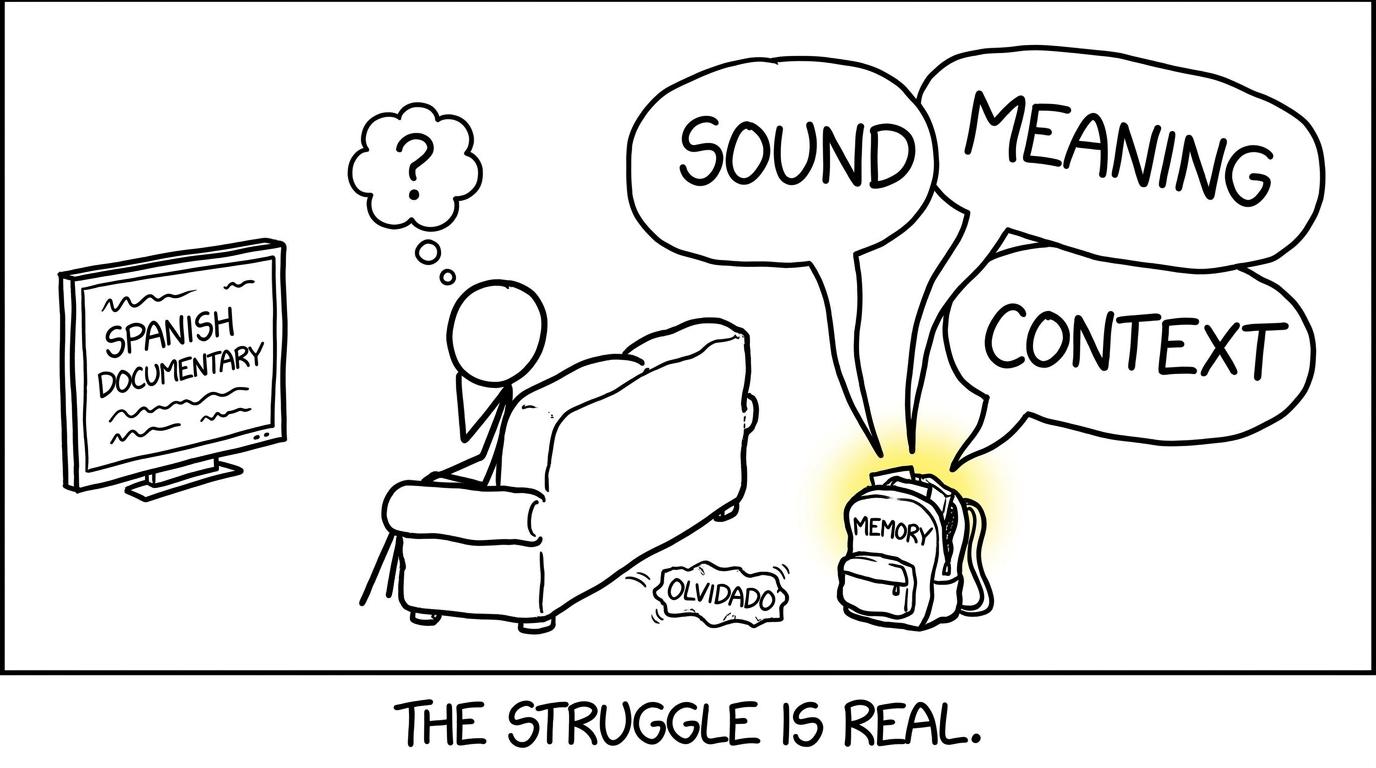 Sounds, meanings and context trying to fit inside a student's memory
Does reading around GCSE Spanish help too?
Yes, with the same qualification: wider reading helps most when you interact with the language.
Short news reports, interviews, museum descriptions and age-appropriate articles can develop reading stamina. They expose you to connectives, opinions and sentence structures in real contexts. They can also train you to infer meaning without translating every word, a skill reflected in current GCSE reading requirements.
But reading around a topic is not the same as preparing for a reading paper. Exam texts are selected or adapted according to a specification, and questions test precise comprehension. Wider reading builds capacity; exam practice teaches you how that capacity is assessed.
A balanced Spanish session might therefore combine a short authentic text or documentary clip with vocabulary retrieval and a board-specific question. The enjoyable part helps you remain curious. The exam task keeps the work aligned.
How to balance Spanish viewing with maths revision
The hidden cost of a documentary is not money. It is the revision session you could have completed instead.
That does not mean documentaries are wasteful. It means they need a place in your timetable. Use them as a lower-intensity language session after completing demanding practice, or schedule a short clip between active blocks.
For maths, passive watching has the same limitation: understanding a video is not proof that you can solve an unseen question. Start with the free GCSE Maths revision hub, where revision lessons lead into practice questions and exam resources.
If several subjects are competing for attention, the MathsGenie revision planner can help you make your maths commitments visible. A realistic GCSE maths revision timetable should include focused practice, feedback and rest rather than filling every available evening.
On a busy day, you might choose a short Spanish clip and one of the GCSE 45-minute maths tests. The important principle is that enjoyable revision does not quietly consume the time reserved for active question practice.
Common mistakes when using documentaries for revision
Treating hours watched as evidence of progress
Time is an input, not a result. Ask what you can now recognise, explain or use that you could not before.
Writing down every unknown word
This turns viewing into transcription and gives equal importance to useful language and obscure vocabulary. Select a small number of reusable phrases.
Depending permanently on English subtitles
English subtitles support comprehension, but they can absorb your attention. Rewatch a short section with Spanish captions so that you notice the language itself.
Choosing content that is far too difficult
Struggling through rapid specialist discussion may feel ambitious, but incomprehensible input gives you little to retrieve. Choose clearer material or shorter sections.
Replacing exam practice with cultural knowledge
A documentary cannot show you exactly how your board structures listening, reading, speaking and writing tasks. Use official sample materials and past assessments where appropriate.
The same warning applies to maths. Marked questions reveal weaknesses that watching cannot. Learn how to use GCSE past papers properly, then practise with resources such as Edexcel GCSE Maths past papers or the correct page for your exam board and tier.
The honest verdict
Documentaries and wider reading genuinely can help your GCSE Spanish. They build familiarity with spoken language, reinforce vocabulary in context and make the Spanish-speaking world feel less like a collection of textbook headings.
But they help indirectly. Grades are earned by performing the assessed skills: understanding precise details, speaking comprehensibly, reading carefully and writing accurate responses to the task. The most effective approach combines enjoyable exposure with vocabulary retrieval, grammar practice and exam questions.
Your revision across subjects should follow the same quiet logic: learn, practise, check and return. For maths, MathsGenie gives you that complete route through free revision lessons, practice questions, mini tests, past papers, predicted papers, mark schemes and video solutions. If exams are close, use the one-month GCSE maths revision plan to organise your next steps.
Watch the documentary because curiosity matters. Then close the screen, retrieve what you learnt and complete the practice that turns familiarity into marks.