Do Documentaries Help GCSE English Language?
Documentaries help GCSE English Language when watched actively, but cannot replace reading or exam practice. Learn how to use them without wasting time.
A documentary can feel like the perfect revision loophole. You press play, learn something interesting and avoid another hour staring at an extract. But do documentaries help GCSE English Language in a way that can actually improve your grade?
Yes, but only indirectly. Documentaries can strengthen your general knowledge, expose you to viewpoints and give you ideas for speeches, articles and discussions. However, GCSE English Language assesses how well you read unseen written texts and produce effective writing. Watching alone does not practise those skills.
The sensible approach is to use documentaries as a small, active part of revision, alongside reading, timed writing and exam questions. If you are also preparing for GCSE maths, this distinction matters: enjoyable enrichment should not quietly replace the practice that earns marks.
The short answer: useful, but not enough
Documentaries may help you:
- build background knowledge about social, scientific and historical issues;
- encounter unfamiliar vocabulary in context;
- notice how evidence, interviews and emotional stories shape an argument;
- hear contrasting viewpoints and different tones of voice;
- gather ideas for transactional writing and the Spoken Language endorsement;
- make reading about an unfamiliar topic feel less intimidating.
They do not directly train you to:
- analyse precise words and structural choices in a written extract;
- select short quotations efficiently;
- compare how two writers present their perspectives;
- plan and complete an answer under timed conditions;
- control paragraphing, punctuation and sentence structure;
- interpret older written language.
That difference is the heart of the answer. A documentary can supply knowledge and curiosity. It cannot supply exam technique.
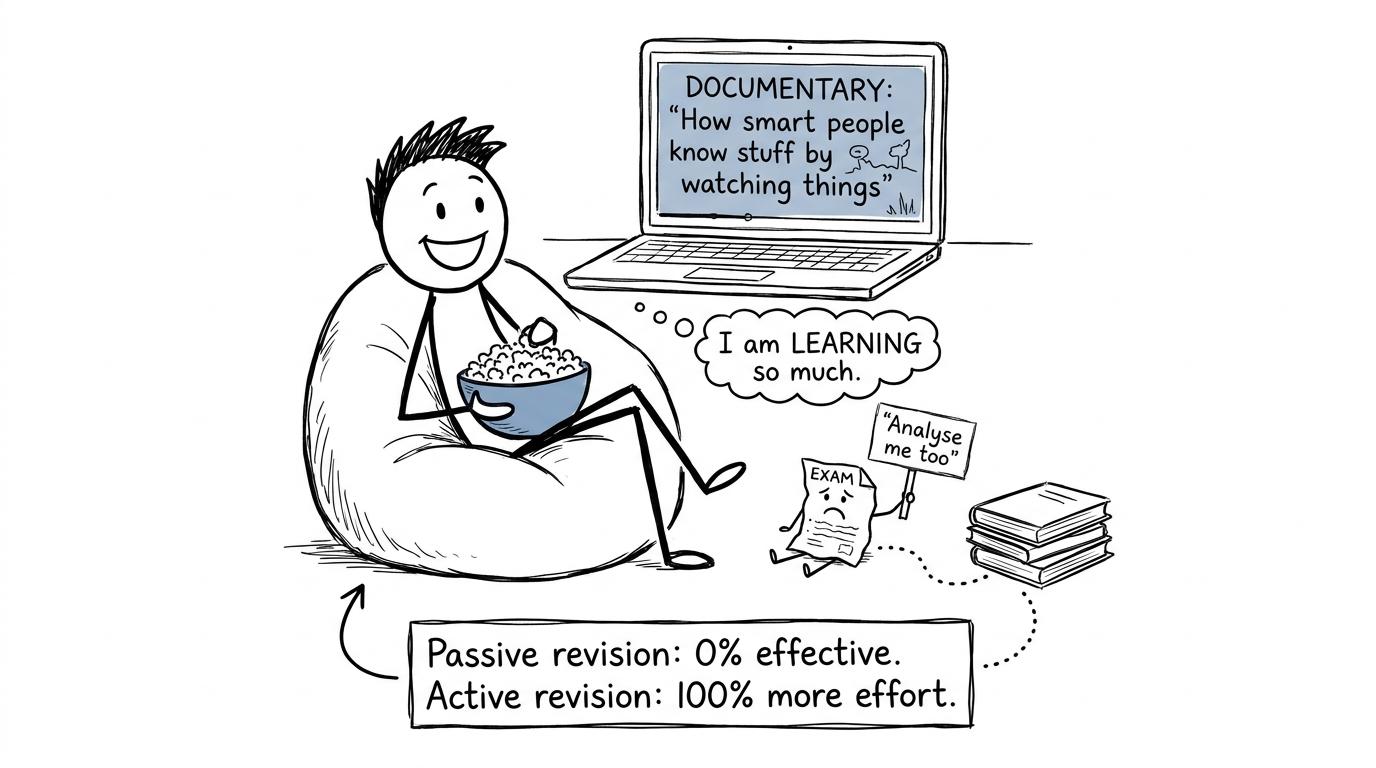 A student watching a documentary while an exam paper asks to be analysed
What GCSE English Language actually assesses
Across AQA, Edexcel, OCR and Eduqas, exact paper structures vary, so you should always follow your own specification and teacher’s guidance. The shared foundations, however, are clear: students must understand and analyse unseen texts, evaluate or compare ideas where required, and write accurately for particular audiences and purposes.
Official subject requirements include challenging texts from the nineteenth, twentieth and twenty-first centuries. These include fiction, literary non-fiction and other forms such as essays, journalism and reviews. The examinations use unseen material, which means broad reading experience genuinely matters.
Documentaries overlap with some of these demands. A film may communicate a clear viewpoint, arrange evidence deliberately and influence an audience. Yet an English Language examination asks you to explain how a writer creates meaning through written language and structure. Camera angles, editing and music may be interesting, but they are not substitutes for analysing words on a page.
A useful rule is:
If an activity gives you ideas, it is enrichment. If it makes you read, write, compare, analyse or evaluate under exam conditions, it is direct revision.
You need both, but direct revision deserves most of your available time.
How documentaries can support English Language skills
They can build useful background knowledge
Unseen sources can cover subjects you have never deliberately revised. You do not need expert knowledge to answer them, because the necessary evidence is in the extract. Nevertheless, familiarity with broad issues can make comprehension quicker and give you more ideas when writing.
A well-made documentary about technology, education, the environment, sport or inequality may introduce relevant concepts and competing positions. If a writing task later asks you to present a viewpoint on a related theme, you may have a wider pool of ideas.
Be careful, though. Background knowledge should help you engage with the source, not override it. Reading questions reward evidence from the text in front of you, not everything you remember from a programme.
They reveal how arguments are constructed
Documentaries are rarely neutral collections of facts. Choices are made about which speakers appear, what order information follows and when personal stories or statistics are introduced.
Noticing those choices can develop critical awareness. Ask:
- What viewpoint is being promoted?
- Which evidence appears most convincing, and why?
- Is an opposing view represented fairly?
- How does the opening capture attention?
- What does the conclusion want the audience to think or do?
These questions connect naturally to audience, purpose, tone, bias and persuasion. The transfer is not automatic, however. You still need to apply that thinking to written extracts and support your interpretation with precise textual references.
They may extend your vocabulary
Hearing unfamiliar words in a meaningful context can help you understand them. Subtitles can make the connection between spoken and written forms clearer, while pausing to record a word forces you to notice it properly.
But collecting impressive vocabulary is not the goal. A word becomes useful only when you understand its meaning, register and grammatical role. Five words you can use accurately are worth more than fifty copied into a notebook.
Reading remains especially valuable because it exposes you directly to written sentences, punctuation and paragraph structures. Research on reading for pleasure consistently finds positive associations with reading skill, comprehension and vocabulary, although an association does not prove that recreational reading alone causes higher attainment.
Reading around the subject versus watching
If your time is limited and your goal is a higher English Language grade, reading is usually the closer match to the examination.
Read a varied mixture of:
- quality journalism and long-form features;
- opinion columns from contrasting perspectives;
- memoirs, biographies and travel writing;
- essays, reviews, speeches and letters;
- nineteenth-century prose and non-fiction extracts;
- short stories and novel openings.
Reading around the subject is not simply enjoyable background activity. It can familiarise you with sentence patterns, tone, rhetorical choices and methods of organising an argument. Those are features you may analyse in Section A and control in your own Section B writing.
Still, reading can become passive too. Finishing an article without thinking about it is not automatically revision. After reading, summarise the central viewpoint, identify two deliberate language choices and explain how the ending affects the reader. That short response converts exposure into practice.
A practical way to watch actively
You do not need to turn every documentary into a school lesson. If you are watching purely to relax, let it be relaxation. When you choose to count it as revision, give the session a clear output.
Use this simple routine:
Before watching
Choose a documentary with a clear issue or argument. Write down what you expect its viewpoint to be. This gives you something to test rather than leaving you to absorb information passively.
While watching
Pause only occasionally. Record:
- the central viewpoint;
- two supporting claims;
- one contrasting perspective;
- three useful words or phrases;
- one moment designed to influence the audience.
Do not attempt to transcribe the entire programme. The purpose is selective attention.
After watching
Spend ten minutes producing something written. You could create a brief summary, plan a speech on the issue or write one analytical paragraph about how the argument was presented. Then read a written article on the same subject and compare how the two creators communicate their positions.
This final written step matters most. It turns an enjoyable programme into an activity connected to GCSE assessment.
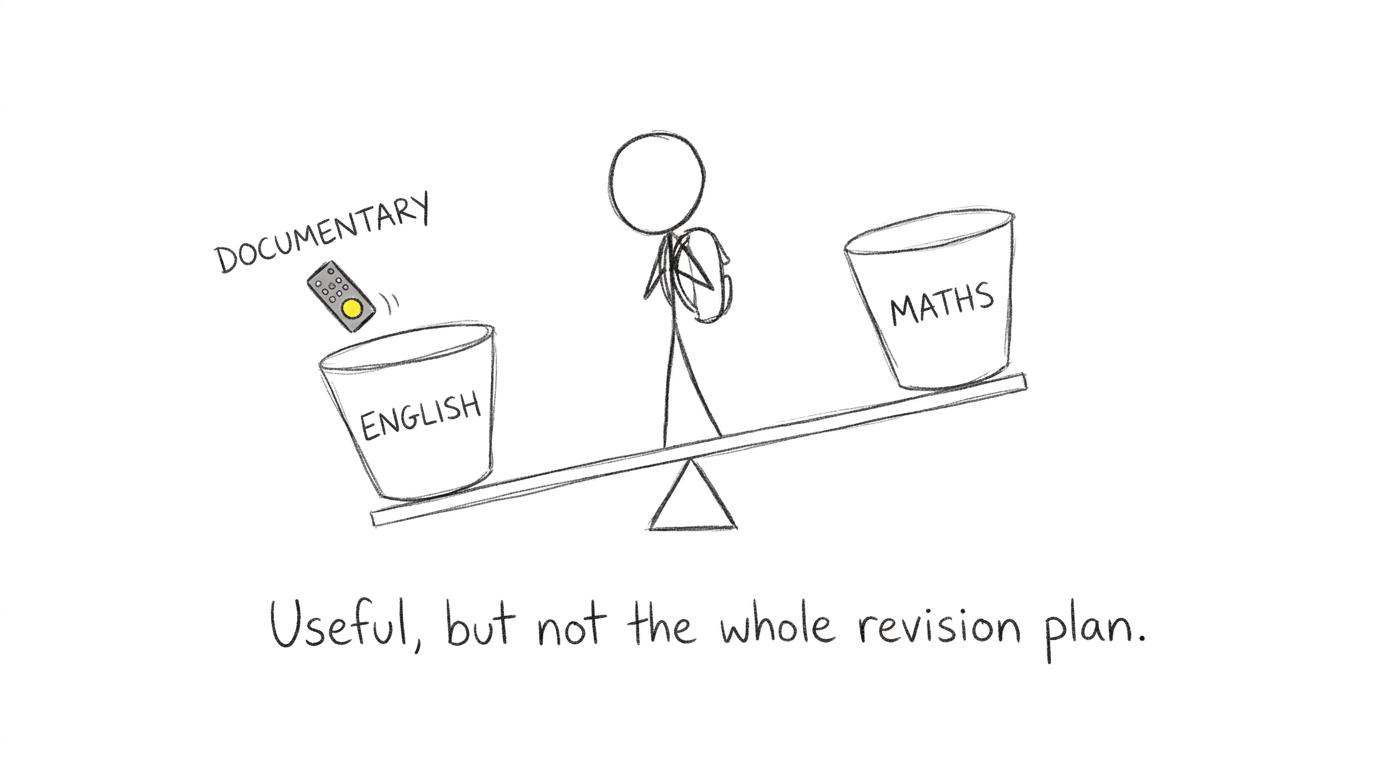 A student balancing English, maths and documentary time on a revision seesaw
How to fit documentaries around GCSE maths revision
For students preparing for maths exams, the danger is not documentaries themselves. It is displacement: forty minutes of planned algebra practice quietly becomes an evening of educational television.
Keep subjects separate in your timetable. The GCSE maths revision hub lets you choose resources for your exam board, while the GCSE maths revision timetable guide can help you protect time for foundation or higher tier practice.
A balanced week might include one documentary as optional English enrichment, but maths sessions should still contain active questions and feedback. If motivation is difficult, the revision guide for reluctant students offers a short learn, practise, mark and fix routine.
The same principle works in both subjects. Recognition feels comfortable, but retrieval and production reveal what you can actually do. In English, that means writing an analysis rather than merely agreeing with a documentary. In maths, it means solving a question rather than watching somebody else solve it.
Common mistakes when using documentaries for revision
Treating screen time as automatic progress
Educational content can still be passive. If you cannot summarise the viewpoint or produce a written response afterwards, the programme has probably been enrichment rather than focused revision.
Analysing film techniques instead of written language
Music, editing and camera work shape documentaries, but GCSE English Language reading answers must address the written source provided. Practise transferring your awareness of persuasion to vocabulary, imagery, tone, sentence choices and structure.
Assuming topic knowledge earns reading marks
Your knowledge may support understanding, but marks come from answering the question and using the source accurately. Do not replace textual evidence with remembered facts.
Watching instead of reading
The exam requires sustained reading of unfamiliar written material. Documentaries cannot prepare you fully for complex syntax, nineteenth-century vocabulary or close quotation analysis.
Letting enrichment replace exam practice
Near the exams, direct practice becomes more important. Use a realistic plan such as the one-month GCSE maths revision plan, and apply the same principle to English: diagnose weaknesses, complete timed tasks, mark them and revisit mistakes.
The best revision has a visible result
A useful session leaves evidence behind: an answered question, a writing plan, an improved paragraph or a corrected mistake. Entertainment leaves a memory. Both can be worthwhile, but they are not the same investment.
So, documentaries can help GCSE English Language by widening your knowledge, vocabulary and awareness of viewpoints. Reading around the subject is even more directly relevant. Neither should replace unseen-text analysis, transactional writing or timed exam practice.
Protect the same active habits in maths. Start with MathsGenie’s guide to learning GCSE maths topics in a sensible order, then move from revision lessons to practice questions, mini tests and mark schemes. Use past papers properly, and if you take Edexcel, practise with the Edexcel GCSE maths past papers and available video solutions.
Watch documentaries because they make you curious. Read because language is learned through language. Then practise because, in English and maths alike, marks come from what you can produce when the paper is in front of you.