

Depreciation GCSE Maths: A Step-by-Step Guide
Depreciation GCSE maths explained with multipliers, clear worked examples, common mistakes and exam-style questions for confident revision.
A student can understand percentages perfectly well and still get depreciation wrong. Imagine Sam facing the same problem for the third time: a car loses 15%15\%15% of its value each year. Sam calculates 15%15\%15% of the original price, subtracts that amount every year and wonders why the mark scheme disagrees.
The key to depreciation GCSE maths questions is simple: the percentage is taken from the new value each time, not repeatedly from the original value. The quickest reliable method is to convert the percentage decrease into a multiplier, then raise that multiplier to the number of years.
The depreciation checklist
Before calculating anything, identify four pieces of information:
- the original value
- the annual percentage decrease
- the depreciation multiplier
- the number of times the decrease happens
For an original value PPP, depreciation rate r%r\%r% and nnn years, use:
Final value=P(1−r100)n\text{Final value}=P\left(1-\frac{r}{100}\right)^nFinal value=P(1−100r)nThat formula may look formal, but it describes one repeated action: keep the percentage that remains, then repeat.
What depreciation means in GCSE maths
Depreciation is a decrease in value over time. It is commonly used in questions about cars, machinery and electronic equipment. Mathematically, it is a repeated percentage decrease.
Suppose an item depreciates by 20%20\%20% each year. After the decrease, it keeps:
100%−20%=80%100\%-20\%=80\%100%−20%=80%Convert 80%80\%80% to a decimal:
80%÷100=0.880\%\div 100=0.880%÷100=0.8The depreciation multiplier is therefore 0.80.80.8. Multiplying by 0.80.80.8 means keeping 80%80\%80% of the current value.
This was the point Sam had missed. The phrase “loses 20%20\%20% each year” does not mean subtract the same cash amount each year. It means multiply each new value by 0.80.80.8.
| Percentage decrease | Percentage remaining | Multiplier |
|---|---|---|
| 5%5\%5% | 95%95\%95% | 0.950.950.95 |
| 12%12\%12% | 88%88\%88% | 0.880.880.88 |
| 20%20\%20% | 80%80\%80% | 0.80.80.8 |
| 35%35\%35% | 65%65\%65% | 0.650.650.65 |
You can explore the same method through the Compound Interest and Depreciation lesson, which brings together explanations, questions and revision resources.
Depreciation worked examples
Finding a value after several years
A car is worth £18,000\pounds 18{,}000£18,000. Its value depreciates by 12%12\%12% each year. Calculate its value after 333 years.
First, find the percentage remaining:
100%−12%=88%100\%-12\%=88\%100%−12%=88%Convert this to a multiplier:
88%÷100=0.8888\%\div 100=0.8888%÷100=0.88There are 333 annual decreases, so use a power of 333:
Value after 3 years=18,000×0.883\text{Value after 3 years}=18{,}000\times 0.88^3Value after 3 years=18,000×0.883 =18,000×0.681472=18{,}000\times 0.681472=18,000×0.681472 =12,266.496=12{,}266.496=12,266.496Money should be given to the nearest penny unless the question says otherwise:
£12,266.50\boxed{\pounds 12{,}266.50}£12,266.50Sam’s earlier approach had been to find 12%12\%12% of £18,000\pounds 18{,}000£18,000 and subtract that amount three times. That would model a fixed decrease, not depreciation at a fixed percentage rate.
The compact method is:
18,000×(1−0.12)318{,}000\times (1-0.12)^318,000×(1−0.12)3Both versions are equivalent, but writing the multiplier explicitly can reduce mistakes.
You now have the full method; use the Maths Genie GCSE Maths lessons and topic Question Bank when you want to practise applying it without setting up every question yourself.
Finding the total depreciation
A machine costs £25,000\pounds 25{,}000£25,000 and depreciates by 18%18\%18% each year. Find how much value it loses after 444 years.
The multiplier is:
1−0.18=0.821-0.18=0.821−0.18=0.82Find the value after 444 years:
25,000×0.824=11,802.402525{,}000\times 0.82^4=11{,}802.402525,000×0.824=11,802.4025The question asks how much value the machine loses, not its remaining value. Subtract the final value from the original value:
25,000−11,802.4025=13,197.597525{,}000-11{,}802.4025=13{,}197.597525,000−11,802.4025=13,197.5975Therefore, the total depreciation is:
£13,197.60\boxed{\pounds 13{,}197.60}£13,197.60This distinction matters. A correct calculation can still earn an incomplete answer if you report the remaining value when the question asks for the loss.
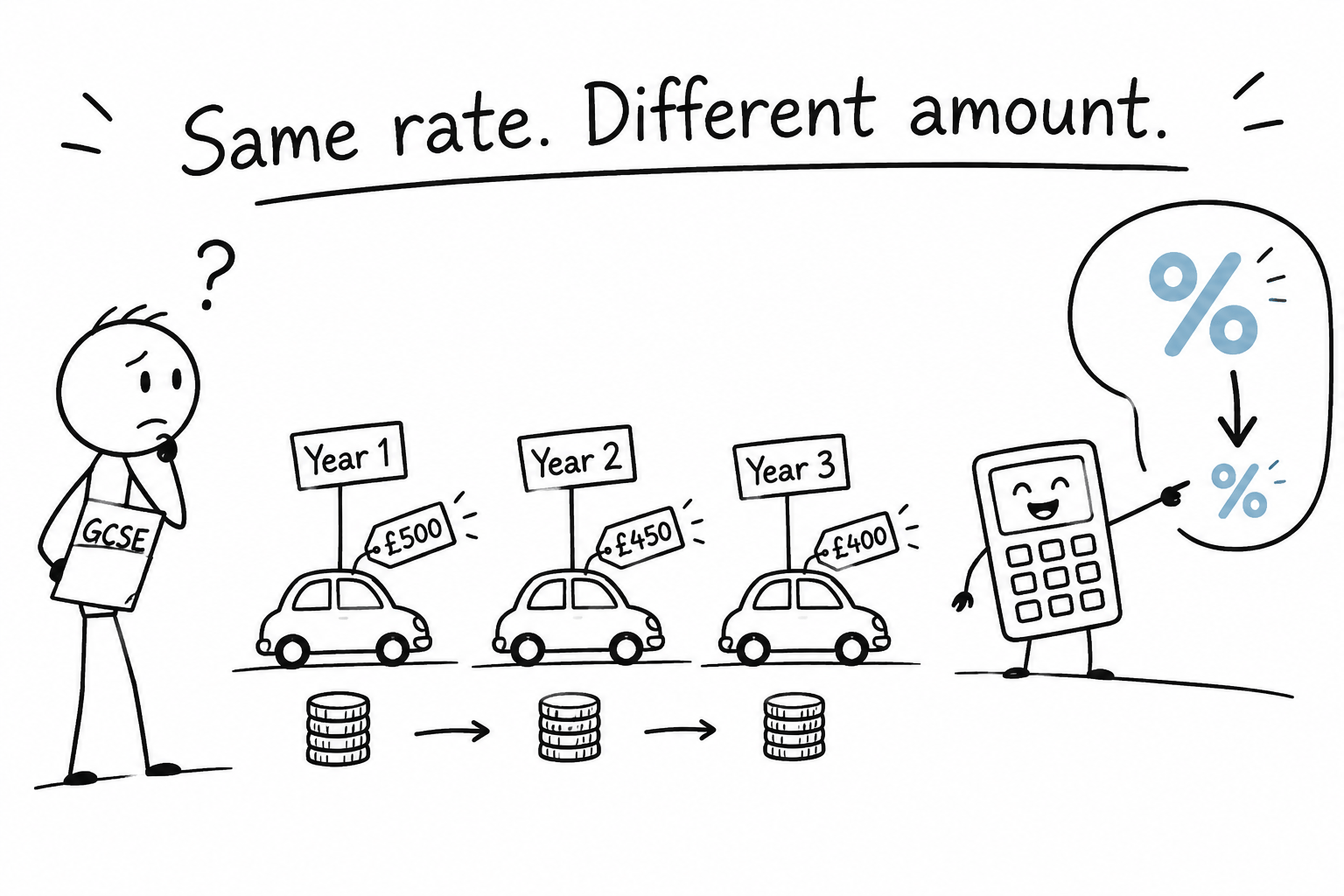 A student learns that the same depreciation rate produces a different cash decrease each year
Finding the original value
A laptop depreciates by 25%25\%25% each year. After 222 years, it is worth £675\pounds 675£675. Find its original value.
The multiplier is:
1−0.25=0.751-0.25=0.751−0.25=0.75If the original value is PPP, then:
P×0.752=675P\times 0.75^2=675P×0.752=675To reverse the depreciation, divide by the complete multiplier:
P=6750.752P=\frac{675}{0.75^2}P=0.752675 P=1,200P=1{,}200P=1,200The original value was:
£1,200\boxed{\pounds 1{,}200}£1,200Notice that reversing a 25%25\%25% decrease does not mean adding 25%25\%25%. The decrease was calculated from the larger original amount. Division reverses the multiplication accurately.
For more questions arranged around this topic, use the Compound Interest and Depreciation exam booklet or browse the wider collection of GCSE Maths exam booklets.
Why powers make the method quicker
You could calculate one year at a time. For 10%10\%10% annual depreciation over 333 years, that would be:
P×0.9×0.9×0.9P\times 0.9\times 0.9\times 0.9P×0.9×0.9×0.9A power records repeated multiplication more efficiently:
P×0.93P\times 0.9^3P×0.93The exponent must match the number of decreases. After 333 complete years, the multiplier has been applied 333 times.
This is closely related to compound interest. Compound interest repeatedly increases an amount using a multiplier greater than 111, while depreciation repeatedly decreases it using a multiplier between 000 and 111. The GCSE compound interest guide can help you compare the two processes.
Common depreciation mistakes
Using the percentage lost as the multiplier
For a 15%15\%15% decrease, the multiplier is not 0.150.150.15. That represents the part being lost. The amount keeps 85%85\%85%, so the correct multiplier is:
1−0.15=0.851-0.15=0.851−0.15=0.85Subtracting the same amount every year
Depreciation is normally a repeated percentage change. The cash decrease becomes smaller because it is calculated from a smaller value each time.
Multiplying the rate by the number of years
A decrease of 8%8\%8% for 555 years is not generally a total decrease of 40%40\%40%. Use:
P×0.925P\times 0.92^5P×0.925Rounding during the calculation
Keep the full calculator display until the final step. Early rounding can alter the final answer, particularly over many years.
Answering the wrong question
Underline whether you need the final value, the amount lost, the original value or the number of years. The same context can lead to several different calculations.
Exam-style depreciation questions
Try these before checking the answers.
Question one
A van is worth £32,000\pounds 32{,}000£32,000 and depreciates by 14%14\%14% each year. Find its value after 333 years.
32,000×0.863=20,354.43232{,}000\times 0.86^3=20{,}354.43232,000×0.863=20,354.432Answer:
£20,354.43\boxed{\pounds 20{,}354.43}£20,354.43Question two
A piece of equipment costs £8,500\pounds 8{,}500£8,500 and depreciates by 9%9\%9% each year. Calculate how much value it loses after 222 years.
8,500×0.912=7,038.858{,}500\times 0.91^2=7{,}038.858,500×0.912=7,038.85 8,500−7,038.85=1,461.158{,}500-7{,}038.85=1{,}461.158,500−7,038.85=1,461.15Answer:
£1,461.15\boxed{\pounds 1{,}461.15}£1,461.15Once the multiplier clicked, Sam no longer needed to guess whether to add or subtract repeatedly. Each question became a short decision: find what remains, form the multiplier and count the decreases.
Turn the method into marks
Knowing the formula is the first step; recognising which calculation an exam question requires comes from focused practice. Continue Sam’s approach by moving from guided lessons to depreciation questions, checking each attempt against the worked support rather than merely reading the answer. Start the Compound Interest and Depreciation Lessons and Question Bank.















