

Cramming vs Learning GCSE English Language | Signs
Cramming vs learning GCSE English Language: spot false confidence, build transferable exam skills and revise so your knowledge survives unseen questions.
The uncomfortable thing about revision is that effort and learning can look identical from the outside. You can sit at a desk for three hours, fill pages with notes and still discover in the exam that nothing is available when you need it.
That is the heart of cramming vs learning GCSE English Language. Cramming makes material feel familiar for a short time. Learning builds skills you can use independently, under time pressure and on an unseen text. The quickest test is simple: close your notes, attempt a fresh question and explain why your response would earn marks. If you cannot do that yet, you have revised the material without fully learning it.
This distinction matters to maths students too. Both subjects reward something deeper than recognition: you must select a method, apply it to unfamiliar information and communicate your reasoning clearly.
A quick cramming or learning checklist
You are probably cramming if you:
- reread notes without testing yourself;
- memorise a model paragraph word for word;
- recognise techniques but cannot explain their effects;
- practise only questions you have already seen;
- avoid timing, marking and difficult feedback;
- feel confident with notes open but stuck when they are closed.
You are more likely to be learning if you:
- retrieve ideas without prompts;
- apply the same reading skill to different unseen extracts;
- adapt writing to a new form, audience and purpose;
- use mark schemes to identify specific weaknesses;
- revisit a skill across several days;
- improve a response after feedback and later reproduce that improvement independently.
The dividing line is not how many hours you spend. It is what your mind has to do during those hours.
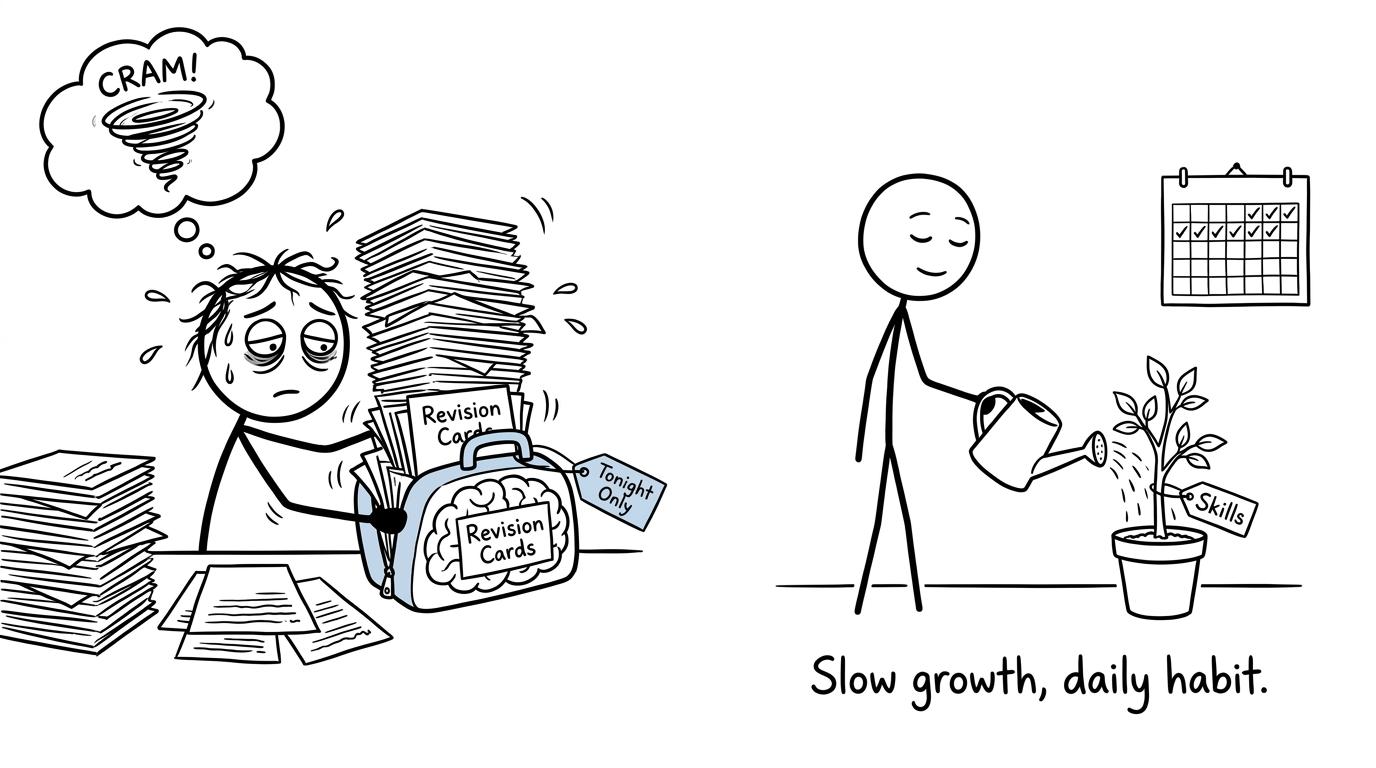 A student cramming notes into a tiny suitcase while another grows a tree of durable skills
Why cramming feels as though it is working
Cramming is persuasive because recognition feels like knowledge. When a revision guide is open, phrases such as “structural shift”, “semantic field” or “direct address” look obvious. That ease can create confidence. Yet the exam does not ask whether a term looks familiar. It asks whether you can notice a meaningful choice in an unseen text, interpret it and develop a relevant response.
Rereading is not useless. It can refresh forgotten material and help you begin a topic. The problem comes when refreshing becomes the whole revision strategy.
Research into learning consistently supports two ideas: retrieving knowledge is generally more durable than merely seeing it again, and practice spread across time is more effective for long-term retention than the same practice crowded into one sitting. For English Language, retrieval should not mean memorising hundreds of definitions. It means recalling a useful analytical process, planning without a template in front of you and producing ideas from a fresh source.
Maths students encounter the same illusion. Watching someone solve an equation can feel easy because every step makes sense when it appears. The real test is whether you can solve a different question alone. The MathsGenie GCSE maths revision hub is organised around this movement from explanation to independent practice.
What genuinely learning GCSE English Language looks like
GCSE English Language is principally a skills-based qualification. Although paper structures and question wording differ across AQA, Edexcel, OCR and Eduqas, the regulated assessment objectives share a common foundation.
Reading accounts for 50%50\%50% of the qualification and writing accounts for 50%50\%50%. Across those areas, students need to identify and interpret information, analyse language and structure, compare perspectives, evaluate texts, communicate effectively and write accurately. Technical accuracy under AO6 must account for 20%20\%20% of the qualification overall. Spoken Language is reported separately and does not contribute to the final examination mark.
That tells you something important: knowing a list of devices is not the same as mastering the subject. The marks come from using reading and writing skills purposefully.
You can transfer the skill to a new text
A memorised paragraph may work beautifully for the extract on which it was built. Change the extract and it may collapse.
Learning produces transfer. If you understand how to analyse a writer’s choice, you can use that thinking on fiction, literary non-fiction or an unfamiliar article. Your terminology supports the interpretation rather than replacing it.
Ask yourself:
- Can I identify an interesting choice without being told where it is?
- Can I explain its effect in this particular context?
- Can I select evidence because it supports my idea, not because I memorised it?
- Can I develop more than one reasonable interpretation where appropriate?
A strong response is not a suitcase of sentences carried into the examination hall. It is a set of tools you know how to use.
You understand the assessment objective
Cramming often focuses on surface instructions: include quotations, name techniques, write several paragraphs. Learning focuses on what the question is assessing.
For example, analysis is not improved simply by inserting more terminology. Evaluation is not the same as giving an unsupported opinion. Comparison is not two separate summaries placed beside each other. Effective writing is not a collection of ambitious words detached from audience and purpose.
Check the specification and materials supplied by your own exam board because paper formats differ. Then translate each assessment objective into an action you can practise. This is similar to using a maths mark scheme to see whether marks reward a method, an accurate result or both.
Your performance survives closed-book conditions
Remove the support gradually. First review the skill. Then plan with a brief checklist. Finally, attempt a fresh question without notes.
If performance drops sharply, that is not failure. It is useful evidence about the gap between recognition and recall. MathsGenie’s guide to finding your weakest GCSE topics uses the same principle: test first, locate the precise weakness and revise what the evidence reveals.
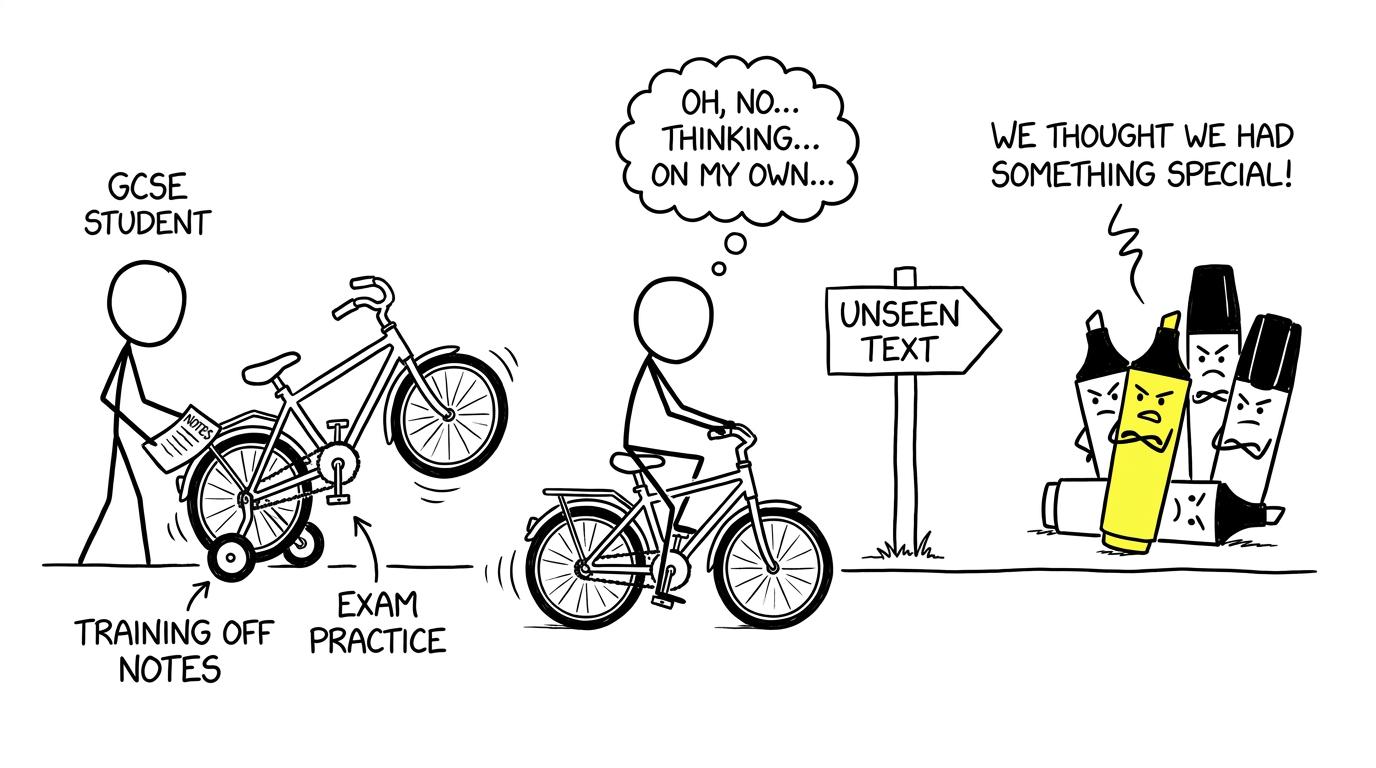 A student removing note stabilisers before riding towards an unseen text
A revision loop that turns cramming into learning
You do not need an elaborate system. You need a repeatable one.
Choose one precise skill
“Revise English” is too broad. Choose something observable, such as selecting evidence, analysing structure, comparing perspectives, planning descriptive writing or proofreading punctuation.
The same rule improves maths revision. “Do algebra” creates uncertainty; “practise rearranging formulae” creates an action. If planning is difficult, use the free MathsGenie revision planner to organise short, specific sessions across your exam subjects.
Attempt before reviewing everything
Start with a question, a short plan or a paragraph under closed-book conditions. This gives you a genuine baseline. You may discover that the problem is not analytical understanding but evidence selection, timing or paragraph development.
Only then return to notes or teacher feedback. Revision becomes targeted rather than decorative.
Mark for one improvement
Use the relevant exam-board mark scheme and any teacher feedback. Do not merely assign yourself a total. Record one precise change:
- make the interpretation more specific;
- connect the quotation to the writer’s purpose;
- compare methods as well as viewpoints;
- control paragraph sequencing;
- reserve time to check spelling and punctuation.
MathsGenie recommends the same feedback loop for using GCSE past papers properly: attempt, mark, diagnose, repair and retest. A paper becomes learning only when its mistakes influence what you do next.
Revisit the skill later
Try a different source or prompt after a gap. The wording should change because the examination will not reproduce your practice task.
A practical rhythm is an initial attempt, a short correction session on another day and a fresh retest later in the week. Exact intervals matter less than avoiding one uninterrupted marathon. The MathsGenie twenty-minute revision routine shows how recall, practice and feedback can fit into an ordinary school day.
Add timing only after building control
Untimed work helps you develop quality. Timed work checks whether that quality survives pressure. You need both.
Begin with individual questions or plans, then progress to sections and complete papers. In maths, Edexcel GCSE mini tests provide the same useful bridge between isolated topic practice and full papers.
How to tell whether today’s revision worked
At the end of a session, do not ask, “How much did I cover?” Ask:
- What can I now produce without looking?
- Which assessment skill became more reliable?
- What mistake did feedback expose?
- When will I test this again?
- Can I use the skill on unfamiliar material?
A page of colourful notes may be useful, but it is evidence of activity rather than proof of learning. A fresh response completed independently gives stronger evidence.
This is why GCSE past papers and mark schemes are so valuable in maths. They replace the vague feeling of being prepared with observable performance. English revision should aim for the same honesty.
Common mistakes when moving beyond cramming
Memorising complete responses
Memorised material can become irrelevant when the source, task, purpose or audience changes. Memorise flexible processes and a small number of useful principles instead of entire answers.
Treating terminology as analysis
Identifying a metaphor, short sentence or rhetorical question is only the beginning. The response must explain what the choice suggests, how it shapes meaning and why it matters in the passage.
Practising without feedback
Repeated writing can reinforce the same weakness. Use mark schemes, teacher comments and model materials to decide what needs to change before the next attempt.
Correcting work but never retesting it
Reading an improved response produces recognition. Recreating the improvement later produces stronger evidence of learning. Always schedule another attempt.
Replacing sleep with one more revision block
Late cramming often produces tired, low-quality practice. Set a stopping time, prepare what you need for the morning and protect your ability to read carefully. A calm, focused final session is more useful than collecting another stack of half-processed notes.
Using predicted papers as predictions rather than practice
Predicted papers cannot tell you exactly what will appear. Their value is in providing fresh, exam-style material. MathsGenie’s free GCSE predicted papers are designed to be attempted, marked and reviewed, not treated as a list of guaranteed questions.
Learning is what remains when the notes disappear
The practical difference between cramming and learning is independence. Cramming helps while the material is still in front of you. Learning remains available when the source is unseen, the clock is running and the wording is unfamiliar.
So make your next session small but honest. Choose one skill. Attempt it without help. Check it against the assessment objective and mark scheme. Correct one weakness. Then return later and prove that the improvement survived.
That habit crosses subject boundaries. Use MathsGenie as your free maths revision base: learn through clear revision lessons and video solutions, practise with topic questions and mini tests, then test your understanding using past papers, predicted papers and mark schemes. Do not merely recognise the method. Make sure you can produce it when it counts.










