Cramming vs Learning GCSE Astronomy: A Clear Test
Cramming vs learning GCSE Astronomy: spot the difference, test real understanding and build maths skills that still work under pressure on exam day.
The night before an assessment, astronomy can look like a wall of names, diagrams and facts: stellar evolution, lunar phases, redshift, telescopes, planetary motion. Reading everything again feels productive because everything looks familiar.
But familiarity is not the same as recall. And recall is not always the same as understanding.
The practical difference between cramming vs learning GCSE Astronomy is simple: cramming helps information feel recognisable for a short time, while learning helps you retrieve, connect and apply it without prompts. On exam day, genuine learning is more dependable because questions rarely copy your notes exactly. They ask you to use knowledge in a new context, interpret data or choose the right mathematics.
This distinction matters particularly for students also preparing for GCSE maths. Astronomy requires standard form, ratios, units, graphs, algebra and numerical reasoning. If those skills only work when an example is open beside you, they are not yet exam-ready.
A quick cramming or learning checklist
You are probably cramming if you:
- repeatedly read or highlight the same pages;
- recognise an answer but cannot produce it independently;
- complete questions while looking at notes or solutions;
- revise one topic intensely and never return to it;
- judge progress by time spent rather than questions answered;
- avoid mixed questions because they feel uncomfortable.
You are more likely to be learning if you:
- close your notes and retrieve ideas from memory;
- explain why a process happens, not merely what happens;
- apply knowledge to unfamiliar diagrams, observations and data;
- mark your answers and correct the cause of each mistake;
- revisit topics after a delay;
- connect astronomy calculations to your GCSE maths skills.
The difference is not whether revision feels difficult. In fact, effective learning often feels less fluent because your brain is doing more work.
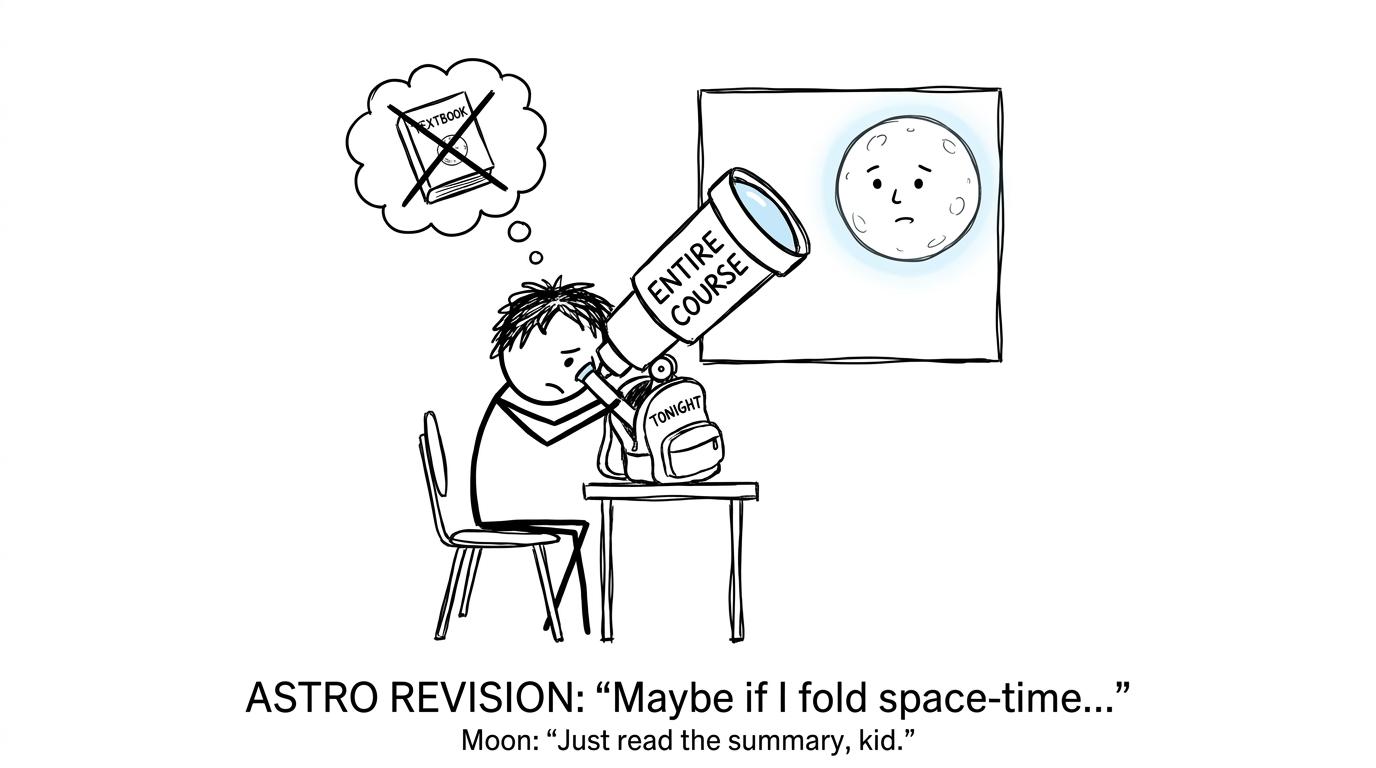 A student trying to cram an entire astronomy course into a tiny backpack
Why cramming can feel more effective than it is
Cramming creates quick familiarity. After reading a page several times, the sentences become easy to follow. That ease can be mistaken for mastery.
Remove the page, however, and the support disappears.
A useful test is to close your materials and write down everything you know about a topic. Then explain the relationships between the ideas. For stellar evolution, for instance, listing several stages is recall; explaining how a star's initial mass affects its path shows a deeper connection.
Educational research supports the use of retrieval practice, but with an important qualification: retrieval is most useful when students make a genuine attempt from memory, receive feedback and repeat the process after a delay. Quizzing alone is not magic, particularly for complex material. You must also practise application and reasoning.
That is why simply memorising the names of equations is not enough. In the current Pearson Edexcel GCSE Astronomy specification, equations and key data are supplied in the examination. Students are not required to recall the equations themselves. They must still select them, interpret their variables, substitute accurately and understand what the result means.
What genuine GCSE Astronomy learning looks like
The current Pearson Edexcel qualification contains two externally examined papers: Naked-eye Astronomy and Telescopic Astronomy. Each includes multiple-choice, short-answer, calculation, graphical and extended open-response questions.
Ofqual's assessment framework also explains why surface-level revision is fragile. Across the qualification, 40%40\%40% of assessment rewards knowledge and understanding, 40%40\%40% rewards application, and 20%20\%20% rewards analysis, evaluation and conclusions. At least 20%20\%20% of the total marks must reward mathematical skills, while observational work is also assessed through the written examinations.
In other words, knowing isolated facts covers only part of what the papers demand.
You can retrieve knowledge without cues
Start a session with a blank page rather than an open textbook. Recall definitions, processes, observational methods and links between topics. Only check your materials after making the attempt.
This exposes gaps that rereading conceals. A pause is not failure. It is useful information about what needs attention.
You can apply ideas in unfamiliar settings
A learner can recognise that the same principle may appear through a new diagram, data set or observational scenario. Instead of searching memory for an identical question, they identify what the question is testing.
This is central to AO2 and AO3. You may need to evaluate an observing method, interpret a light curve, compare evidence or justify an improvement. Those tasks depend on connected understanding rather than a memorised paragraph.
You can use the mathematics independently
Astronomy's scale makes mathematics unavoidable. The specification includes standard form, ratios, percentages, inverse-square relationships, logarithms, significant figures, unit conversion, algebra, graphs, angular measure and trigonometry.
For example, standard form is written as
a×10n,1≤a<10,a \times 10^n, \qquad 1 \leq a < 10,a×10n,1≤a<10,where nnn is an integer. You need to understand this structure well enough to use it with astronomical distances and other physical quantities. If powers of ten are uncertain, rebuild the skill with MathsGenie's free standard form revision guide.
You may also need to select or rearrange a supplied relationship. Astronomy formulae include relationships such as Hubble's law,
v=H0d,v = H_0d,v=H0d,and the distance modulus,
M=m+5−5log10(d).M = m + 5 - 5\log_{10}(d).M=m+5−5log10(d).Learning does not mean memorising these lines when the formula sheet supplies them. It means recognising each quantity, handling units, using the calculator correctly and rearranging when required. MathsGenie's changing the subject of a formula resources can strengthen that transferable algebra.
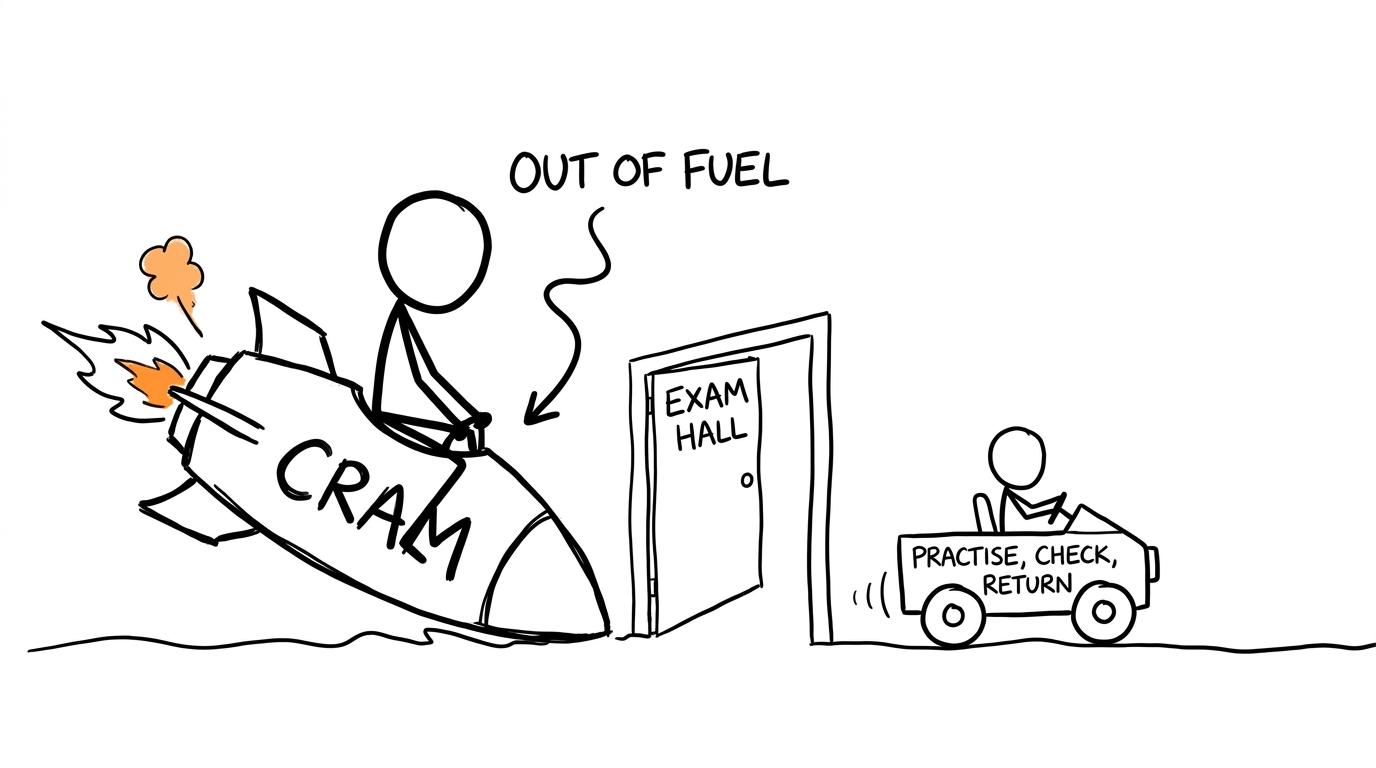 A cramming rocket running out of fuel while steady practice reaches the exam
Three tests that reveal whether learning will last
The closed-book test
Choose a narrow topic. Put every resource away and answer questions or produce a short explanation from memory. Do not look up a missing word immediately. The attempt to retrieve is part of the learning process.
Then compare your response with trusted notes or a mark scheme. Correct omissions in a different colour and record the exact gap.
The delayed test
Return to the topic after a gap. Research on spacing indicates that distributing learning across separate sessions generally supports longer-lasting retention better than massing the same practice together.
There is no single perfect spacing timetable for every student and topic. A practical pattern is to revisit material after a short delay, then again several days later. If retrieval remains secure, increase the interval. If it has collapsed, shorten it and repair the gap.
The test is not whether you understood something yesterday. It is whether you can still use it later.
The transfer test
Mix recall with calculations, graphs and observational reasoning. Can you decide which information matters without a heading telling you the topic? Can you connect an astronomy question to ratio, units or algebra?
MathsGenie's guide to finding your weakest GCSE topics offers a useful model: diagnose with questions, classify lost marks, repair a precise weakness and retest it. The context may differ, but the learning loop is the same.
A revision routine that replaces cramming
Use a compact cycle for each astronomy topic:
- Retrieve: spend a few minutes recalling the topic with no notes.
- Check: compare your response with the specification, lesson materials or mark scheme.
- Practise: answer questions that require recall, application and mathematical reasoning.
- Diagnose: label each error as knowledge, application, mathematics, units, interpretation or exam technique.
- Repair: revise the smallest skill that caused the lost mark.
- Return: attempt a different question after a delay.
For the maths element, begin with the GCSE maths topics by board and tier and identify the skills that overlap with astronomy. Use revision lessons to rebuild understanding, followed by practice questions and video solutions.
Short checks are useful because they make weaknesses visible without consuming an entire evening. MathsGenie's Edexcel GCSE maths mini tests can test transferable skills such as algebra, graphs and number work. When you need broader exam practice, move to Edexcel GCSE maths past papers and mark every attempt carefully.
Do not confuse a high score completed with notes with a secure skill. Reduce support over time until you can perform independently.
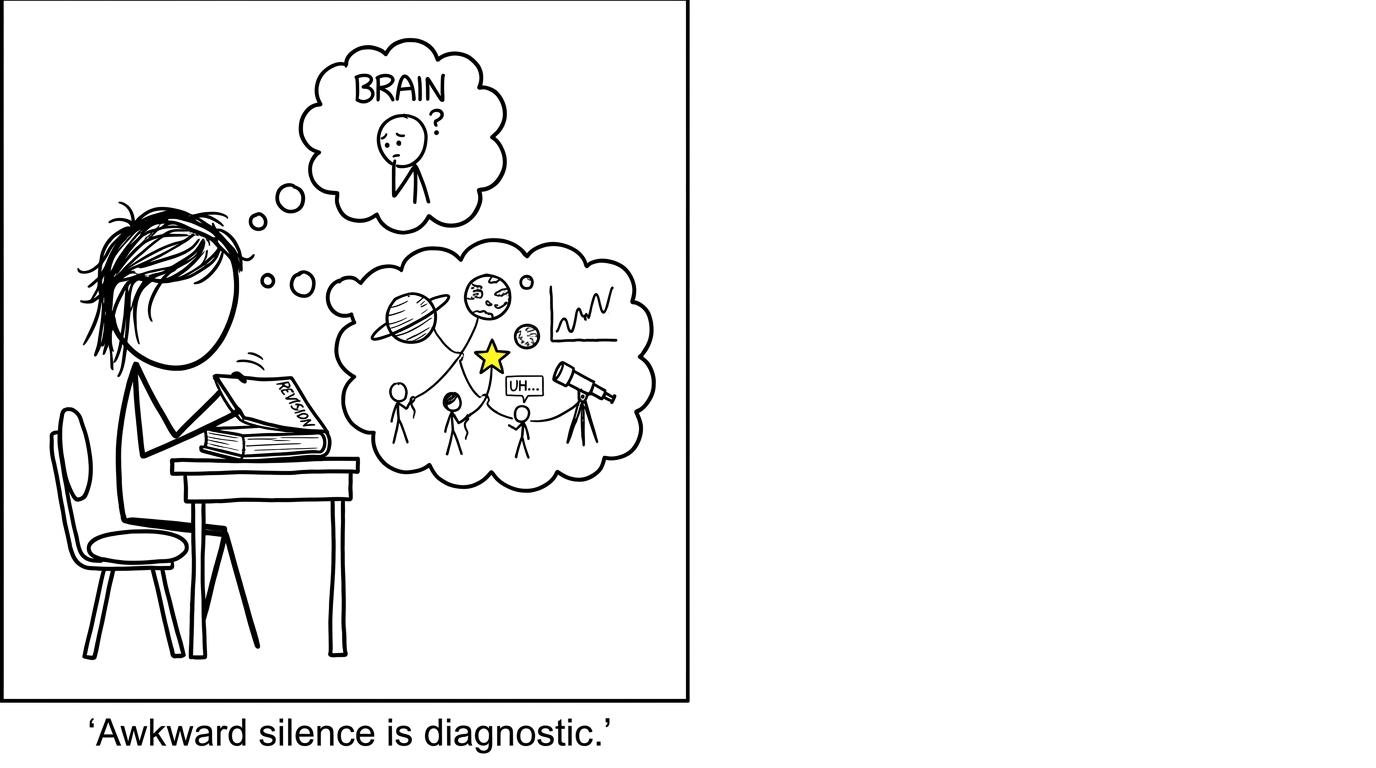 A student's brain connecting astronomy concepts during active recall
Common mistakes when moving beyond cramming
Turning retrieval into another reading task
Writing questions on one side of a card is not retrieval if you immediately turn it over. Pause, commit to an answer and then check. The effortful attempt matters.
Memorising model answers word for word
A model answer can show the precision and detail expected, but copying it repeatedly trains copying. Break it into claims, evidence and reasoning, then reconstruct the explanation for a differently worded question.
Revising astronomy while avoiding the maths
Students sometimes separate scientific knowledge from calculations. The examination does not. At least 20%20\%20% of the qualification's marks reward mathematics in an astronomy context, so standard form, graphs, units and formula use deserve regular practice.
Repeating questions without analysing errors
A completed question only becomes useful feedback when you identify why marks were lost. Compare your method with the mark scheme and write a specific correction. MathsGenie's guide to using GCSE maths past papers properly explains how to turn mistakes into targeted next actions.
Leaving mixed practice until the final week
Blocked practice feels reassuring because every question uses the same method. Real papers mix topics and question styles. Introduce mixed practice gradually so that choosing the method becomes part of the task.
Make your revision survive exam day
Cramming asks, “How much can I cover tonight?” Learning asks a better question: “What can I still retrieve and apply when the wording changes?”
You do not need to abandon notes, videos or revision guides. Use them to build understanding, then remove them and test what remains. Return after a delay. Mark honestly. Repair exact weaknesses. Repeat.
For the mathematical skills that support GCSE Astronomy, make MathsGenie your free revision base. Use revision lessons and practice questions to secure individual methods, mini tests to check retention, and past papers with mark schemes and video solutions to develop exam readiness. Nearer your GCSE maths exams, predicted papers can provide fresh, unseen practice.
Start with one topic today. Close the notes, retrieve what you know and let the gaps choose your next step. That is not as dramatic as cramming. It is much more likely to hold up when the paper opens.