

Conditional Probability GCSE Maths: Mock Revision
Conditional probability GCSE maths revision for December mocks: learn the method, tackle two exam-style questions and build a targeted practice paper now.
December mocks can make a familiar topic feel unexpectedly slippery. You can multiply fractions, draw branches and read tables, yet the words “given that” still make you hesitate. For conditional probability GCSE maths questions, the key is to identify what information has changed, then calculate using only the outcomes that remain possible.
Imagine a Year 11 student opening a probability question during revision. Their first instinct is to reach for a formula. A better first move is to underline the condition. That small pause often determines whether the denominator, the tree diagram and the final answer make sense.
This guide explains the method, works through two exam-style questions and shows how to turn mistakes into useful practice before your mock.
Your conditional probability revision checklist
Before attempting a timed set, check that you can:
- Identify the condition, including phrases such as “given that” and “without replacement”.
- Choose the correct group or update the remaining objects.
- Multiply probabilities along a tree diagram path.
- Add probabilities for separate successful paths.
- Explain why you chose your denominator.
Use the MathsGenie conditional probability revision page to revisit the topic before attempting questions independently. Select resources that match your exam board and your teacher’s mock revision list.
What conditional probability actually means
Conditional probability is the probability of an event when you know that another event has happened.
That information changes the group of possible outcomes. If a question tells you that a chosen student walks to school, you only consider students who walk. If a counter has been removed from a bag, you calculate the next probability using the counters still inside.
The notation is:
P(A∣B)=P(A∩B)P(B)P(A\mid B)=\frac{P(A\cap B)}{P(B)}P(A∣B)=P(B)P(A∩B)Here, P(A∣B)P(A\mid B)P(A∣B) means the probability of AAA given BBB, and A∩BA\cap BA∩B means both events occur. This formula applies when P(B)>0P(B)>0P(B)>0.
For GCSE questions involving equally likely selections, the same idea often becomes:
Conditional probability=number satisfying both conditionsnumber satisfying the given condition\text{Conditional probability}=\frac{\text{number satisfying both conditions}}{\text{number satisfying the given condition}}Conditional probability=number satisfying the given conditionnumber satisfying both conditionsThe denominator is your anchor. Before calculating, ask: “Which outcomes am I allowed to consider now?”
A method for conditional probability exam questions
Read the condition before doing arithmetic
Underline the information that restricts the possible outcomes. “Given that the student walks” restricts you to walkers. “Without replacement” means the first object stays out, so the second selection takes place from a smaller collection.
Also check exactly what the question asks. “Both red”, “different colours” and “at least one red” require different paths, even when the starting tree is identical.
Choose a useful representation
A two-way table helps when information sorts people or objects into categories. A tree diagram helps when events happen in sequence.
On a tree, probabilities leaving the same branch point should total 111. Multiply along a path to find the probability of that complete sequence. Add separate paths when either sequence satisfies the question and the paths cannot happen together.
If your revision materials use unfamiliar topic labels, the GCSE maths topics by exam board and tier guide can help you organise what to practise alongside your school checklist.
Worked question: counters without replacement
A bag contains 555 red counters and 333 blue counters. Two counters are selected at random without replacement. Find the probability that they are different colours.
Update the second selection
There are initially 888 counters. After the first selection, 777 remain.
If the first counter is red, the bag contains 444 red and 333 blue counters. Therefore:
P(blue second∣red first)=37P(\text{blue second}\mid\text{red first})=\frac{3}{7}P(blue second∣red first)=73If the first counter is blue, the bag contains 555 red and 222 blue counters. Therefore:
P(red second∣blue first)=57P(\text{red second}\mid\text{blue first})=\frac{5}{7}P(red second∣blue first)=75The second probability depends on what happened first. That is the conditional part.
Include both successful orders
Different colours can occur as red then blue, or blue then red:
P(red then blue)=58×37=1556P(\text{red then blue})=\frac{5}{8}\times\frac{3}{7}=\frac{15}{56}P(red then blue)=85×73=5615 P(blue then red)=38×57=1556P(\text{blue then red})=\frac{3}{8}\times\frac{5}{7}=\frac{15}{56}P(blue then red)=83×75=5615These are separate successful paths, so add them:
P(different colours)=1556+1556=1528P(\text{different colours})=\frac{15}{56}+\frac{15}{56}=\boxed{\frac{15}{28}}P(different colours)=5615+5615=2815The key decisions were reducing the second denominator and including both orders. Practise those decisions deliberately before trying to increase your speed.
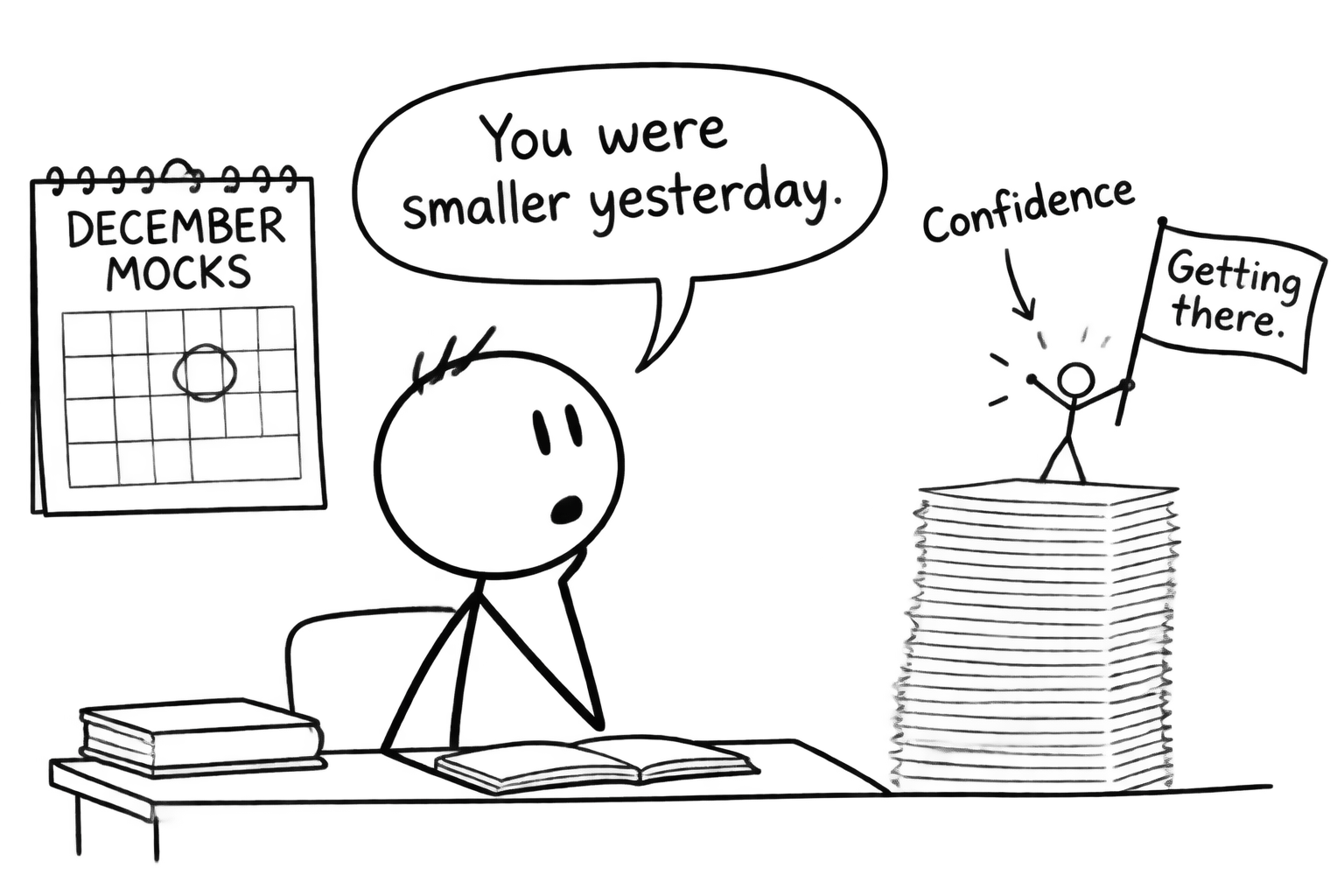 Stick-figure student preparing for December mocks as a tiny figure representing confidence climbs a stack of practice papers.
Worked question: “given that” in a two-way table
A group of students is asked whether they walk to school.
| Year group | Walk | Do not walk | Total |
|---|---|---|---|
| Year 10 | 888 | 121212 | 202020 |
| Year 11 | 121212 | 181818 | 303030 |
| Total | 202020 | 303030 | 505050 |
One student is selected at random. Given that the student walks to school, find the probability that they are in Year 11.
Restrict the group first
The condition tells us that the selected student walks. Only the 202020 students in the “Walk” column are now relevant.
Of those students, 121212 are in Year 11:
P(Year 11∣walks)=1220=35P(\text{Year 11}\mid\text{walks})=\frac{12}{20}=\boxed{\frac{3}{5}}P(Year 11∣walks)=2012=53Using 505050 as the denominator would answer a different question: the probability that a student selected from the entire group is both in Year 11 and walks.
Reversing the condition also changes the calculation. The probability that a student walks, given that they are in Year 11, would use the Year 11 total:
P(walks∣Year 11)=1230=25P(\text{walks}\mid\text{Year 11})=\frac{12}{30}=\frac{2}{5}P(walks∣Year 11)=3012=52Read the sentence in its original order before choosing a denominator.
Common mistakes to check before your mock
These slips are worth looking for when marking conditional probability exam questions:
- Keeping the original denominator. Without replacement, the total decreases after each selection.
- Changing only the denominator. The number of objects of the colour selected also decreases.
- Including only one order. “Different colours” can mean either red then blue or blue then red.
- Adding along a tree path. A complete sequence requires multiplication of the relevant branch probabilities.
- Using the whole table total. “Given that” usually restricts you to a particular row or column.
- Reversing the condition. P(A∣B)P(A\mid B)P(A∣B) and P(B∣A)P(B\mid A)P(B∣A) generally differ.
- Writing an unexplained answer. Show your fractions and operations so your method is visible.
When checking solutions, label the cause of each error: reading, representation or arithmetic. “Wrong denominator because I ignored the condition” gives you a clearer next step than “bad at probability”.
Make conditional probability mock revision targeted
Start with a short set from the GCSE maths question bank, choosing your own board where appropriate. Include both sequential selections and questions involving tables.
Attempt each question before checking its solution. Then close the solution and redo any missed question from a blank page. This reveals whether you can make the decisions independently.
In your next session, mix conditional probability with other topics. Recognising which method to use is part of mock preparation too. Keep a brief error log and revisit the specific slips that recur.
Build your next practice paper
The aim before December mocks is to make one habit reliable: identify the condition before calculating. Each carefully reviewed question gives that habit another chance to stick.
Use MathsGenie’s Mock Exam Builder to build a targeted practice paper. Choose your subject and exam board, include conditional probability questions, and work through the paper independently. Review your errors, then make your next revision session answer the problems your own work has revealed.















