

Compound Interest GCSE Maths: A Clear Guide
Compound interest GCSE maths explained with multipliers, clear worked examples, common mistakes and exam-style questions to build exam confidence calmly.
Compound interest can feel strangely unfair. A student follows the percentage method they already know, repeats it for several years, and still gets the wrong answer. Usually, the problem is not the arithmetic. It is one small misunderstanding about what changes each year.
For compound interest GCSE maths, the central idea is simple: interest is calculated on the new balance, not always on the original amount. The balance grows, so the amount of interest can grow too. Once you turn the percentage into a multiplier, the whole topic becomes much more manageable.
Imagine a student called Sam. At first, Sam calculates one year's interest and multiplies that interest by the number of years. That works for simple interest, but not compound interest. The moment Sam notices that each year begins with a different balance, the method clicks.
The compound interest checklist
For most GCSE compound interest questions, use this process:
- Identify the starting amount.
- Identify the annual percentage rate.
- Convert the percentage increase into a multiplier.
- Raise the multiplier to the number of years.
- Multiply by the starting amount.
- Keep the full calculator value until the end.
- Check whether the question asks for the final balance or the interest earned.
The formula is:
A=P(1+r100)nA=P\left(1+\frac{r}{100}\right)^nA=P(1+100r)nHere, AAA is the final amount, PPP is the starting amount, rrr is the annual percentage rate and nnn is the number of years.
You can explore the same method through the Maths Genie compound interest and depreciation lesson.
Why compound interest grows differently
Suppose money earns 5%5\%5% interest each year. After the first year, the account contains the original money and the first year's interest. During the second year, interest is calculated on that larger total.
That is why adding 5%5\%5% of the original amount each year is not compound interest. It ignores the interest that has already been added.
The multiplier for a 5%5\%5% increase is:
1+5100=1.051+\frac{5}{100}=1.051+1005=1.05Each year means another multiplication by 1.051.051.05:
P×1.05×1.05×1.05P\times1.05\times1.05\times1.05P×1.05×1.05×1.05For three years, this can be written more efficiently as:
P×1.053P\times1.05^3P×1.053This is repeated percentage change. The Maths Genie repeated percentage change lesson develops the same idea for growth and decay problems.
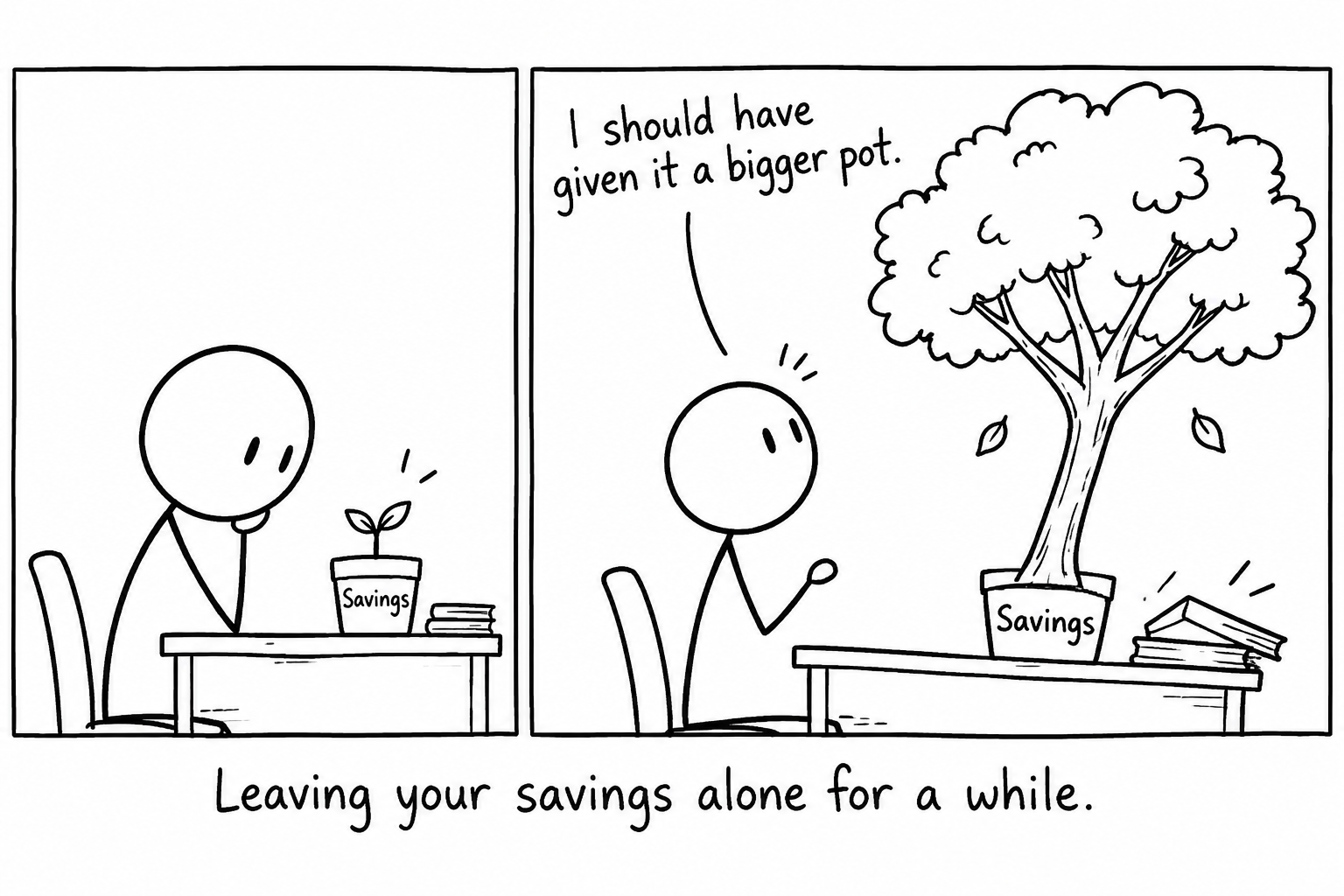 A stick-figure student discovers that savings can outgrow their pot
Compound interest worked examples
Finding the final balance
A savings account contains £800\pounds800£800 and earns 4%4\%4% compound interest each year. Find its value after three years.
The multiplier for a 4%4\%4% increase is:
1+4100=1.041+\frac{4}{100}=1.041+1004=1.04There are three annual increases, so:
800×1.043800\times1.04^3800×1.043Enter the complete calculation into a calculator:
800×1.043=899.8912800\times1.04^3=899.8912800×1.043=899.8912Money is given to the nearest penny:
£899.89\boxed{\pounds899.89}£899.89This is where Sam's earlier method went wrong. Calculating 4%4\%4% of £800\pounds800£800 and adding it three times would treat every year as if the balance were still £800\pounds800£800.
Finding the interest earned
A different account starts with £2500\pounds2500£2500 and earns 3.5%3.5\%3.5% compound interest for five years. Find the total interest earned.
First calculate the final balance:
2500×1.0355=2969.214…2500\times1.035^5=2969.214\ldots2500×1.0355=2969.214…The question asks for the interest, not the final balance. Subtract the original investment:
2969.214…−2500=469.214…2969.214\ldots-2500=469.214\ldots2969.214…−2500=469.214…Therefore, the interest earned is:
£469.21\boxed{\pounds469.21}£469.21A correct calculation can still lose marks if it answers the wrong part of the question. Sam starts underlining phrases such as “total amount” and “interest earned” before touching the calculator.
Use the Maths Genie Lessons and GCSE Maths Question Bank when you are ready to repeat this multiplier method with fresh questions.
Compound depreciation
The same structure applies when a value decreases. A car worth £12000\pounds12000£12000 loses 15%15\%15% of its value each year. Find its value after three years.
For a decrease, subtract the percentage from 100%100\%100%:
100%−15%=85%100\%-15\%=85\%100%−15%=85%Convert 85%85\%85% into a multiplier:
85100=0.85\frac{85}{100}=0.8510085=0.85Now apply the multiplier three times:
12000×0.853=7369.512000\times0.85^3=7369.512000×0.853=7369.5Therefore, the car is worth:
£7369.50\boxed{\pounds7369.50}£7369.50The multiplier must be below 111 for depreciation. A multiplier above 111 would increase the value. More worked guidance is available in the compound interest and depreciation revision guide.
How to handle different rates
The standard formula assumes the same rate applies every year. If the rate changes, use a separate multiplier for each change.
Suppose £1200\pounds1200£1200 increases by 5%5\%5% in the first year and 3%3\%3% in the second year:
1200×1.05×1.03=1297.81200\times1.05\times1.03=1297.81200×1.05×1.03=1297.8The final amount is:
£1297.80\boxed{\pounds1297.80}£1297.80Do not use a power here because the multiplier is not repeated. This distinction matters whenever an exam question gives different rates for different periods.
Common mistakes with compound interest questions
Adding the percentage rate to the money
A rate such as 4%4\%4% is not an amount of money. It must first be converted into a multiplier or used to find a percentage of the current balance.
Using the percentage as the multiplier
For a 6%6\%6% increase, the multiplier is 1.061.061.06, not 0.060.060.06. The multiplier must include the original 100%100\%100% as well as the extra 6%6\%6%.
Multiplying the rate by the number of years
A 5%5\%5% increase for four years is not generally a single 20%20\%20% increase. Compound growth changes the balance after every year.
Using the wrong power
The power represents the number of repeated changes. Three years of annual interest requires a power of 333, not 222 or 444.
Rounding during the calculation
Keep the full calculator display until the final step. Early rounding changes the balance used for later years and may produce an inaccurate answer.
Reporting the balance instead of the interest
If the question asks for interest earned, calculate the final balance and subtract the starting amount. If it asks for the value of the investment, do not subtract.
Exam-style practice
Try these without looking back at the examples:
- An account contains £650\pounds650£650 and earns 2.8%2.8\%2.8% compound interest annually. Find its value after four years.
- A phone costs £900\pounds900£900 and depreciates by 18%18\%18% each year. Find its value after two years.
- An investment of £1600\pounds1600£1600 earns 3.2%3.2\%3.2% compound interest for three years. Find the interest earned.
- Account A pays 2.5%2.5\%2.5% compound interest for four years. Account B adds £52\pounds52£52 each year. Both begin with £2000\pounds2000£2000. Which account has more after four years?
Answers
- 650×1.0284=£725.92650\times1.028^4=\boxed{\pounds725.92}650×1.0284=£725.92
- 900×0.822=£605.16900\times0.82^2=\boxed{\pounds605.16}900×0.822=£605.16
- 1600×1.0323−1600=£158.571600\times1.032^3-1600=\boxed{\pounds158.57}1600×1.0323−1600=£158.57
- Account A has 2000×1.0254=£2207.632000\times1.025^4=\pounds2207.632000×1.0254=£2207.63. Account B has 2000+4×52=£22082000+4\times52=\pounds22082000+4×52=£2208. Account B has £0.37\boxed{\pounds0.37}£0.37 more.
For marked practice, use the compound interest exam booklet, which lets you compare your work with the answers and mark scheme.
Make the method stick
Sam did not improve by memorising a longer formula. The change came from asking three questions: is the value increasing or decreasing, what is the multiplier, and how many times is it applied? Knowing those questions is the first step. Following them consistently under exam pressure takes practice.
Start the Maths Genie compound interest lesson, then use the GCSE Maths Question Bank to turn the multiplier method into a reliable exam habit.















