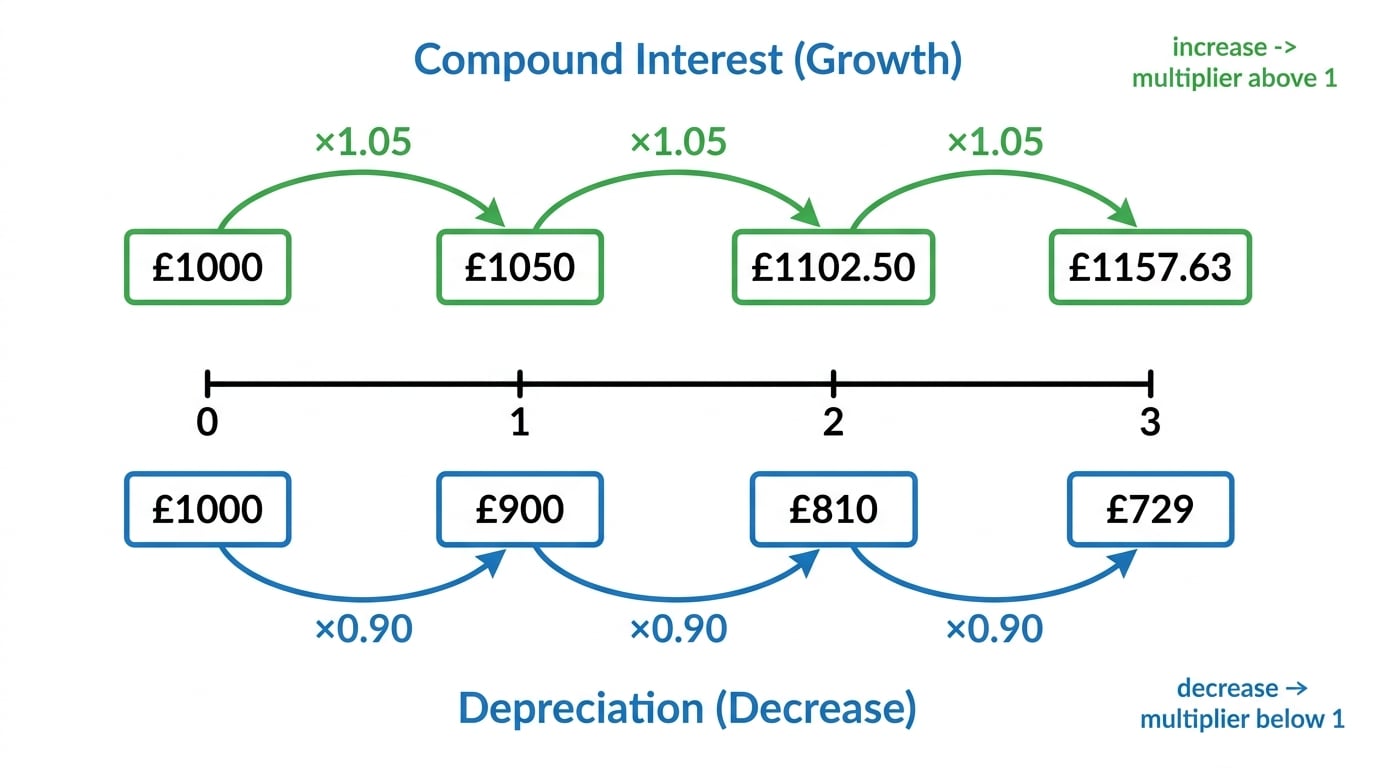
- Turn percentage increases and decreases into decimal multipliers.
- Use compound interest to find a final amount or total interest.
- Use depreciation for values that go down over time.
- Compare different saving options fairly.
Before compound interest, you need to be confident with percentage multipliers.
The original amount is 100% of itself. So:
- for an increase, the multiplier is bigger than 1
- for a decrease, the multiplier is smaller than 1
Multiplier
A multiplier is the decimal you multiply by for a percentage change. An increase of 6% uses 1.06; a decrease of 6% uses 0.94.
One percentage increase
A tablet costs £450. Its price increases by 8%. Find the new price.

-
An increase of 8% means the multiplier is 1.08.
-
Multiply the starting price by the multiplier: 450×1.08=486450 \times 1.08 = 486450×1.08=486.
-
The new price is £486.
Interest is extra money earned on savings or an investment.
Compound interest
Compound interest means each year's interest is added on, then the next year's interest is calculated on the new larger amount. “Per annum” means each year.
If the starting amount is PPP, the annual percentage rate is rrr, and the number of years is nnn, then the final amount AAA is:
A=P(1+r100)nA = P\left(1 + \frac{r}{100}\right)^nA=P(1+100r)n
The power tells you how many times the multiplier is used.
Repeated increases
For compound interest, do not add the interest rate each year. Multiply by the yearly multiplier once for each year.
Finding the final amount
Ravi invests £3600 for 4 years at 2.5% compound interest per annum. Find how much is in the account at the end.

-
A 2.5% increase means the multiplier is 1.025.
-
There are 4 years, so calculate 3600×1.02543600 \times 1.025^43600×1.0254.
-
This gives 3973.726..., so round to the nearest penny.
-
Ravi has £3973.73 at the end of 4 years.
Sometimes the question asks for the total interest, not the final amount.
Total interest
Total interest is the extra money earned. It is the final amount minus the starting amount.
Using a given formula
The value VVV of an investment after nnn years is given by V=6000×1.018nV = 6000 \times 1.018^nV=6000×1.018n.
Find the annual interest rate and the total interest after 3 years.

-
The multiplier is 1.018, so the increase above 1 is 0.018.
-
This means the annual interest rate is 1.8%.
-
Substitute n=3n = 3n=3: V=6000×1.0183V = 6000 \times 1.018^3V=6000×1.0183.
-
This gives £6329.87 to the nearest penny.
-
Subtract the original investment: £6329.87 minus £6000 is £329.87.
Interest vs final amount
If a question asks for total interest, do not stop when you have found the final amount. You must subtract the original investment.
Depreciation
Depreciation means a value goes down over time, often because an item gets older or is worth less.
For a depreciation of 20%, the item keeps 80% of its value, so the multiplier is 0.80.
If the same depreciation rate happens every year, use:
A=P(1−r100)nA = P\left(1 - \frac{r}{100}\right)^nA=P(1−100r)n
Depreciation over several years
A new scooter costs £1800. It loses 25% of its value in the first year, then 10% in each of the next two years. Find its value after 3 years.

-
Losing 25% means keeping 75%, so the first multiplier is 0.75.
-
Losing 10% means keeping 90%, so the next two multipliers are both 0.90.
-
Calculate 1800×0.75×0.902=1093.501800 \times 0.75 \times 0.90^2 = 1093.501800×0.75×0.902=1093.50.
-
The scooter is worth £1093.50 after 3 years.
Not every year has to have the same percentage change. Use a separate multiplier for each year.
A rise uses a multiplier above 1. A fall uses a multiplier below 1.
Increase, increase, then decrease
A house is bought for £300,000. Its value rises by 2% in the first year, rises by 5% in the second year, then falls by 4% in the third year. Find the value after 3 years.

-
The three multipliers are 1.02, 1.05 and 0.96.
-
Multiply by each one once: 300000×1.02×1.05×0.96=308448300000 \times 1.02 \times 1.05 \times 0.96 = 308448300000×1.02×1.05×0.96=308448.
-
The house is worth £308,448 after 3 years.
Adding the percentages
Do not just combine the percentage changes in your head. Each percentage is taken from the new value, not always from the original value.
Sometimes you are given the final amount and asked to find nnn, the number of years.
At Grade 4, a reliable method is to try whole-number powers on your calculator until the value matches or passes the target.
Finding n from a final amount
A savings account starts with £3000 and grows by 2% compound interest per year. After nnn years, the account has £3378.49. Find nnn.

-
The multiplier is 1.02.
-
Try 5 years: 3000×1.025=3312.243000 \times 1.02^5 = 3312.243000×1.025=3312.24.
-
Try 6 years: 3000×1.026=3378.493000 \times 1.02^6 = 3378.493000×1.026=3378.49.
-
So n=6n = 6n=6. The money has been invested for 6 years.
When something halves in value
A machine depreciates by 15% each year. Find how many years it takes to be worth less than half its original value.

-
Use 1 as the original value. Half of this is 0.5.
-
A 15% decrease means the multiplier is 0.85.
-
Try powers: 0.854=0.522...0.85^4 = 0.522...0.854=0.522..., which is still above half.
-
Try the next year: 0.855=0.443...0.85^5 = 0.443...0.855=0.443..., which is below half.
-
It first becomes worth less than half after 5 years.
Calculator accuracy
Use the full calculator value until the final answer, then round money to 2 decimal places. Rounding too early can change the final penny.
Simple interest
Simple interest is calculated only on the original amount each year. Compound interest is calculated on the growing amount.
When comparing options, work out the final amount for each one using the correct method, then choose the larger amount.
Compound interest or simple interest
Leah invests £7000 for 5 years. Option A gives 2.4% compound interest per annum. Option B gives 2.5% simple interest per annum. Which option should she choose?

-
For Option A, use the compound multiplier 1.024: 7000×1.0245=7881.307000 \times 1.024^5 = 7881.307000×1.0245=7881.30.
-
So Option A gives a final amount of £7881.30.
-
For Option B, 2.5% of £7000 is £175 each year.
-
Over 5 years, the simple interest is £875, so the final amount is £7875.
-
Option A is better because £7881.30 is more than £7875.
Comparing banks with changing rates
Noah invests £5000 for 3 years. Bank A pays 1.4% compound interest each year. Bank B pays 2.5% in the first year, then 1% for each extra year. Which bank gives more interest?
-
Bank A: 5000×1.0143=5212.955000 \times 1.014^3 = 5212.955000×1.0143=5212.95, so the interest is £212.95.
-
Bank B: 5000×1.025×1.012=5228.015000 \times 1.025 \times 1.01^2 = 5228.015000×1.025×1.012=5228.01, so the interest is £228.01.
-
Bank B gives more interest by £15.06.
In the exam
-
Underline whether the question wants the final amount, total interest, difference, or number of years.
-
Write the multiplier before you calculate: increases are above 1, decreases are below 1.
-
For comparisons, calculate each option separately and make a clear final statement.
-
Round money to 2 decimal places, but only at the end.
Check yourself
-
What multiplier would you use for a 7% decrease?
-
If an investment grows by 3% for 4 years, why is using 12% as one increase not the compound method?
-
After finding a final amount, how do you find the total interest?