

Compound Interest Exam Questions: GCSE Guide
Compound interest exam questions explained through three GCSE examples, with multiplier methods, clear working, method marks and practice advice.
Compound interest can feel unfair at first. The percentage stays the same, yet the amount added changes each year. That is precisely the point: each new percentage is calculated from a balance that has already grown.
To answer compound interest exam questions, convert the percentage rate into a multiplier, raise that multiplier to the number of time periods, and multiply by the starting amount:
final amount=starting amount×(1+r100)n\text{final amount}=\text{starting amount}\times\left(1+\frac{r}{100}\right)^nfinal amount=starting amount×(1+100r)nHere, rrr is the percentage rate and nnn is the number of equal growth periods. You should keep the full calculator value until the end, then round as the question requires.
In this guide, we will follow a GCSE student through three exam-style questions of rising difficulty. The questions are original, but they reflect the methods commonly tested in a compound interest GCSE exam.
Your compound interest checklist
Before doing any calculation, identify these four details:
- the starting amount
- the percentage rate per period
- whether the amount is increasing or decreasing
- the number of periods
For compound interest growth, use:
1+r1001+\frac{r}{100}1+100rFor depreciation or compound decay, use:
1−r1001-\frac{r}{100}1−100rA complete written method normally shows the multiplier, the power and the unrounded calculation. Exact mark allocations depend on the particular paper and mark scheme, so think of the method-mark comments below as guidance rather than a promise about every exam question.
Question one: finding the final balance
A student named Sam begins with a question that gives every value directly.
Exam-style question: Aisha invests £800£800£800 in an account paying 3%3\%3% compound interest per year. Calculate the value of the investment after 444 years. Give your answer to the nearest penny.
Step one: find the multiplier
An increase of 3%3\%3% means keeping the original 100%100\%100% and adding 3%3\%3%:
100%+3%=103%100\%+3\%=103\%100%+3%=103%Convert this to a decimal multiplier:
103%=1.03103\% = 1.03103%=1.03Step two: identify the number of periods
The interest is applied once per year for 444 years, so the power is 444.
Step three: calculate
800×1.034=900.407048800\times 1.03^4=900.407048800×1.034=900.407048Money is rounded to the nearest penny:
£900.41£900.41£900.41Answer: £900.41£900.41£900.41
A typical multi-mark question may reward choosing or using the correct multiplier, applying it for the correct number of years, and reaching the accurate final amount. Writing only £900.41£900.41£900.41 hides the method that could earn credit if a later calculator entry goes wrong.
Sam writes the calculation in one line. That is efficient, but it still shows the examiner what happened.
For a fuller explanation of multipliers, use the Compound Interest and Depreciation lesson, where the lesson, videos and related resources are collected together.
Once this multiplier method makes sense, use the Maths Genie Lessons and Question Bank to practise recognising it without having to invent suitable questions yourself.
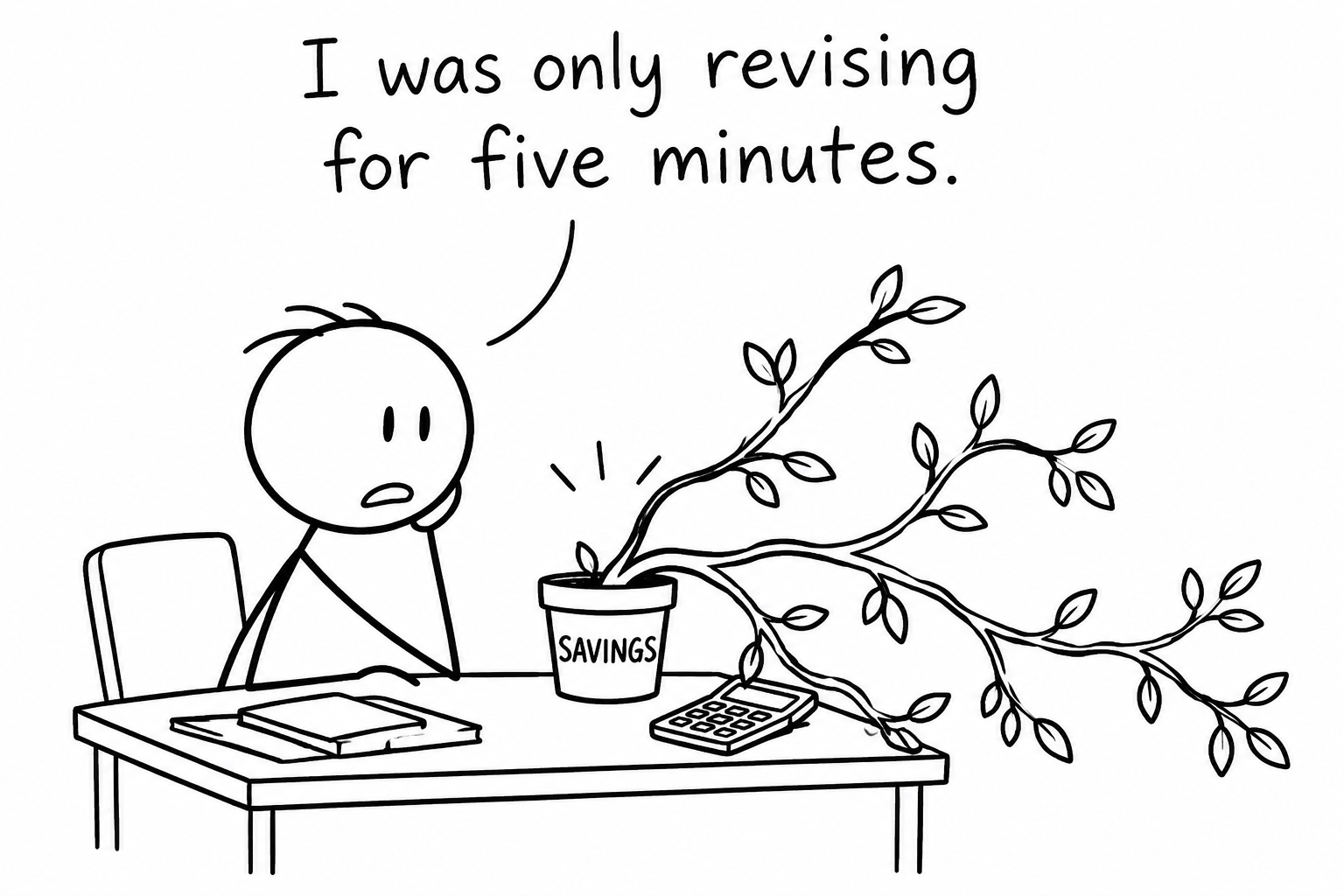 A student discovers that a small savings plant has grown over the calculator
Question two: finding the interest earned
The next question looks similar, but its final instruction changes what Sam must report.
Exam-style question: Callum invests £2,500£2,500£2,500 for 555 years at 2.4%2.4\%2.4% compound interest per year. Work out the total interest earned. Give your answer to the nearest penny.
Step one: form the multiplier
1+2.4100=1.0241+\frac{2.4}{100}=1.0241+1002.4=1.024Step two: find the final balance
2500×1.0245=2814.74853314562500\times 1.024^5=2814.74853314562500×1.0245=2814.7485331456Step three: subtract the original investment
The question asks for the interest, not the final balance:
2814.7485331456−2500=314.74853314562814.7485331456-2500=314.74853314562814.7485331456−2500=314.7485331456Round only now:
£314.75£314.75£314.75Answer: £314.75£314.75£314.75
The important line is the subtraction. Without it, £2,814.75£2,814.75£2,814.75 answers a different question. In exam language, “value of the investment” means the final total, while “interest earned” means the increase alone.
Sam also avoids rounding the balance before subtracting. It would not alter this answer, but early rounding can cause a final value to be a penny out in other questions.
You can reinforce this distinction with the Compound Interest and Depreciation exam booklet, then compare your working with the available answers. The printable GCSE compound interest questions provide further focused practice.
Question three: finding the original investment
The hardest question reverses the usual process. Sam knows the final amount but not the beginning.
Exam-style question: An investment grows by 4.5%4.5\%4.5% per year. After 666 years, it is worth £3,904.32£3,904.32£3,904.32. Work out the original investment. Give your answer to the nearest pound.
Step one: write the forward relationship
The growth multiplier is:
1+4.5100=1.0451+\frac{4.5}{100}=1.0451+1004.5=1.045If the original investment is PPP, then:
P×1.0456=3904.32P\times 1.045^6=3904.32P×1.0456=3904.32Step two: reverse the compound growth
To undo multiplication by 1.04561.045^61.0456, divide by it:
P=3904.321.0456P=\frac{3904.32}{1.045^6}P=1.04563904.32Step three: calculate and round
P=2999.999776…P=2999.999776\ldotsP=2999.999776…To the nearest pound:
P=£3,000P=£3,000P=£3,000Answer: £3,000£3,000£3,000
The likely source of method credit is the correct reverse operation. Subtracting 4.5%4.5\%4.5% six times does not undo compound growth because each increase was based on a different balance. Dividing by the complete growth factor reverses the process in one accurate step.
This is also why reverse percentage questions feel harder: the given final amount represents more than 100%100\%100% of the original. The Compound Interest and Depreciation revision guide can help you revisit that reasoning before attempting mixed questions.
How to approach compound interest past paper questions
The numbers change, but the decisions are usually familiar. When you meet compound interest past paper questions, annotate the information before reaching for the calculator:
- underline what the question wants
- circle the percentage rate
- check whether the rate is yearly, monthly or attached to another period
- match the exponent to the number of times the change occurs
- write the full calculation before entering it
- retain the calculator value until the final line
- include pounds, pence or other required units
If a question involves a comparison between two accounts, calculate both amounts over the same period and compare the final balances. Do not assume the account with the larger headline rate is always better if fees, different time periods or different compounding information are included.
After topic practice, try identifying the method in less familiar contexts. Maths Genie also provides GCSE past papers, which help you practise selecting a technique without being told the topic in advance.
Common mistakes in compound interest exam questions
Adding the same interest every year
Calculating 3%3\%3% of the original amount and adding it four times is simple interest. Compound interest recalculates the percentage from the changing balance. Use 1.0341.03^41.034, not repeated addition of one fixed amount.
Using the percentage as the multiplier
For a 3%3\%3% increase, the multiplier is 1.031.031.03, not 0.030.030.03. The number 0.030.030.03 represents only the increase, while 1.031.031.03 represents the whole balance after growth.
Multiplying the rate by the number of years
A 4%4\%4% yearly increase over 555 years is not generally a 20%20\%20% compound increase. The correct factor is:
1.0451.04^51.045Giving the balance instead of the interest
Read the final instruction again after calculating. If the question asks for interest earned, subtract the starting amount from the final balance.
Rounding during the calculation
Keep the full value on your calculator. Round once, at the end, to the accuracy requested.
Reversing growth by subtracting
To recover an original amount, divide by the compound multiplier raised to the required power:
original amount=final amount(1+r100)n\text{original amount}=\frac{\text{final amount}}{\left(1+\frac{r}{100}\right)^n}original amount=(1+100r)nfinal amountTurn the method into reliable exam marks
Sam’s progress is modest but important: first identify the multiplier, then show the power, calculate without early rounding, and answer the exact question asked. Knowing those steps is useful; applying them quickly across unfamiliar wording requires deliberate practice.
Your turn. Build that confidence by opening the Maths Genie Compound Interest and Depreciation Lessons and Question Bank and work through the questions from direct growth to reverse compound interest.















