

Composite and Inverse Functions GCSE Maths Guide
Composite and inverse functions GCSE maths revision for Year 11: learn each method, avoid mock slips and practise two exam-style questions.
December mocks have an awkward habit of making familiar notation look unfamiliar. You may understand substitution, then freeze when you see fg(x)fg(x)fg(x) or f−1(x)f^{-1}(x)f−1(x) on the page.
The reassuring truth is that composite and inverse functions GCSE maths questions are built from algebra you already know. A composite function applies two rules in the correct order. An inverse function reverses a rule. For your mock, the priorities are simple: read notation carefully, show each algebraic stage and check your answer.
This is generally Higher tier content. For example, the AQA GCSE Maths specification places inverse and composite functions within its Higher content. Exact presentation varies between exam boards, so use the resources for your own specification.
Your mock revision checklist
Before tackling a full paper, make sure you can:
- substitute a number or expression into a function;
- identify which function acts first in fg(x)fg(x)fg(x);
- simplify expressions after substitution;
- find an inverse by writing y=f(x)y=f(x)y=f(x) and rearranging;
- distinguish f−1(x)f^{-1}(x)f−1(x) from a reciprocal;
- verify an inverse using composition;
- show enough working for a mark scheme to follow.
Start with the Inverse and Composite Functions revision lesson if you take Edexcel. OCR students can use the corresponding OCR inverse and composite functions resources. Both bring the lesson, practice questions and worked support together.
Composite functions: order comes first
Suppose fff and ggg are two functions. The composite function fg(x)fg(x)fg(x) means:
f(g(x))f(g(x))f(g(x))The function next to the input acts first, so apply ggg before fff. It helps to read fg(x)fg(x)fg(x) aloud as “fff of ggg of xxx”.
This is not multiplication. You are feeding the output of one function into the other. In general,
fg(x)≠gf(x)fg(x) \ne gf(x)fg(x)=gf(x)because changing the order usually changes the result.
A reliable method is:
- write fg(x)=f(g(x))fg(x)=f(g(x))fg(x)=f(g(x));
- find the inside function first;
- substitute that complete expression into the outside function;
- use brackets before simplifying.
Exam-style question: finding a composite function
Let
f(x)=3x−4andg(x)=x2+2.f(x)=3x-4 \qquad \text{and} \qquad g(x)=x^2+2.f(x)=3x−4andg(x)=x2+2.Find fg(x)fg(x)fg(x) and then find fg(2)fg(2)fg(2).
Begin by expanding the notation:
fg(x)=f(g(x)).fg(x)=f(g(x)).fg(x)=f(g(x)).The output of ggg is x2+2x^2+2x2+2. Substitute this whole expression wherever xxx appears in f(x)=3x−4f(x)=3x-4f(x)=3x−4:
f(g(x))=3(x2+2)−4.f(g(x))=3(x^2+2)-4.f(g(x))=3(x2+2)−4.Now simplify:
fg(x)=3x2+6−4=3x2+2.fg(x)=3x^2+6-4=3x^2+2.fg(x)=3x2+6−4=3x2+2.Substitute x=2x=2x=2:
fg(2)=3(22)+2=12+2=14.fg(2)=3(2^2)+2=12+2=14.fg(2)=3(22)+2=12+2=14.You could instead calculate g(2)g(2)g(2) first and then apply fff:
g(2)=22+2=6,g(2)=2^2+2=6,g(2)=22+2=6, f(6)=3(6)−4=14.f(6)=3(6)-4=14.f(6)=3(6)−4=14.Both routes agree. That agreement is a useful check rather than a coincidence.
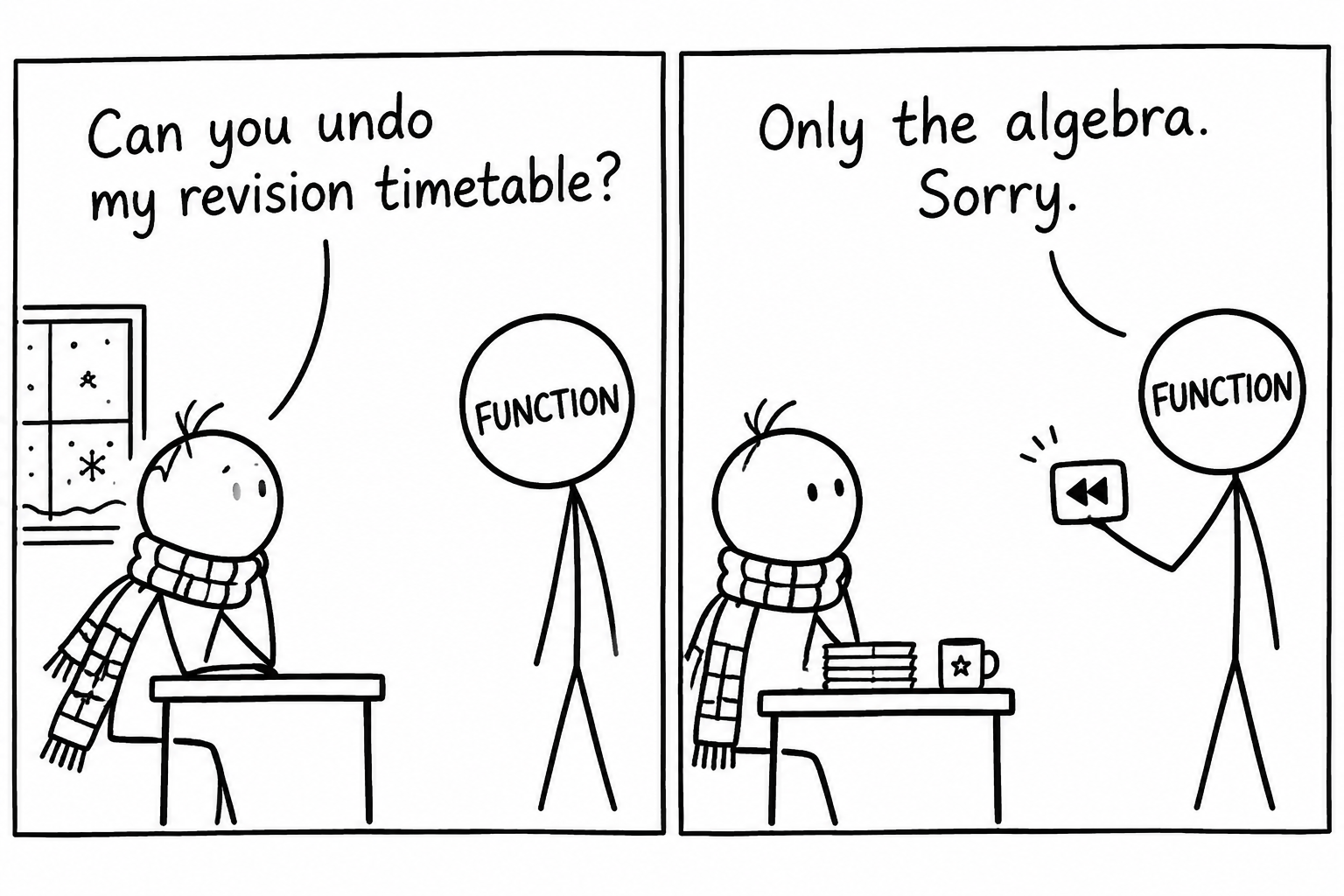 A student asks a function to reverse a revision timetable
Inverse functions: undo the original rule
An inverse function reverses what the original function does. If
f(x)=4x+7,f(x)=4x+7,f(x)=4x+7,then fff multiplies by 444 and adds 777. Its inverse must subtract 777 and divide by 444, in that order.
The notation is f−1(x)f^{-1}(x)f−1(x). It does not mean
1f(x).\frac{1}{f(x)}.f(x)1.That distinction is one of the most important facts in composite and inverse functions mock revision.
For straightforward GCSE functions, use this dependable algebraic method:
- write y=f(x)y=f(x)y=f(x);
- swap xxx and yyy;
- rearrange to make yyy the subject;
- replace yyy with f−1(x)f^{-1}(x)f−1(x).
Swapping the variables captures the idea that inputs and outputs exchange roles. Rearranging then gives a usable rule for the inverse.
Exam-style question: finding and using an inverse
The function hhh is defined by
h(x)=5x−8.h(x)=5x-8.h(x)=5x−8.Find h−1(x)h^{-1}(x)h−1(x) and use it to solve h(x)=27h(x)=27h(x)=27.
First write:
y=5x−8.y=5x-8.y=5x−8.Swap xxx and yyy:
x=5y−8.x=5y-8.x=5y−8.Rearrange. Add 888 to both sides:
x+8=5y.x+8=5y.x+8=5y.Then divide by 555:
y=x+85.y=\frac{x+8}{5}.y=5x+8.Therefore,
h−1(x)=x+85.h^{-1}(x)=\frac{x+8}{5}.h−1(x)=5x+8.To solve h(x)=27h(x)=27h(x)=27, apply the inverse to 272727:
x=h−1(27)=27+85=355=7.x=h^{-1}(27)=\frac{27+8}{5}=\frac{35}{5}=7.x=h−1(27)=527+8=535=7.Check by using the original function:
h(7)=5(7)−8=35−8=27.h(7)=5(7)-8=35-8=27.h(7)=5(7)−8=35−8=27.The check takes seconds and catches sign or operation errors before they cost marks.
How composite functions check an inverse
A function followed by its inverse returns the original input. Therefore,
f−1f(x)=xf^{-1}f(x)=xf−1f(x)=xand, where both compositions are valid,
ff−1(x)=x.ff^{-1}(x)=x.ff−1(x)=x.For the previous example,
h−1(h(x))=(5x−8)+85=5x5=x.h^{-1}(h(x))=\frac{(5x-8)+8}{5}=\frac{5x}{5}=x.h−1(h(x))=5(5x−8)+8=55x=x.This gives you a powerful revision habit. Do not merely look at an inverse and hope it is right. Compose it with the original function. If the result does not simplify to xxx, revisit your rearranging.
If substitution itself feels uncertain, return briefly to the Edexcel GCSE Maths revision page, where topics are organised by grade and skill. Fixing that foundation is often quicker than repeatedly attempting harder function questions.
The slips to watch in your mock
Examiner feedback on inverse-function questions has highlighted the value of inverse operations and clear rearranging. In practice, these are the recurring slips that lose marks:
- Applying functions in the wrong order. In fg(x)fg(x)fg(x), calculate g(x)g(x)g(x) first, not f(x)f(x)f(x).
- Multiplying f(x)f(x)f(x) and g(x)g(x)g(x). Composition means substitution, not a product.
- Dropping brackets. If f(x)=2x+1f(x)=2x+1f(x)=2x+1 and you substitute x−3x-3x−3, write 2(x−3)+12(x-3)+12(x−3)+1.
- Treating f−1(x)f^{-1}(x)f−1(x) as a reciprocal. The inverse reverses a process; it is not 1f(x)\frac{1}{f(x)}f(x)1.
- Undoing operations in the original order. Reverse both the operations and their order.
- Swapping xxx and yyy but not rearranging. The final answer must normally be written as f−1(x)f^{-1}(x)f−1(x).
- Giving only a calculator answer. A correct result with no visible algebra may not demonstrate the required method.
- Skipping the check. Substituting back into the original function can expose an incorrect sign immediately.
A focused plan before December mocks
Do not spend an evening passively rereading notes. Use short cycles with a clear purpose.
First, watch the topic lesson and write the two core methods from memory. Next, answer several untimed questions, marking each one as soon as you finish. Sort mistakes into three categories: notation, substitution or rearranging. Then retry only the questions you got wrong, without looking at the solution.
After that, add time pressure. A 20-minute GCSE maths revision routine can make this manageable on busy school days. Once the skill is secure in isolation, use GCSE Maths past papers to practise recognising function questions among unrelated topics.
The final step is targeted exam practice. Open the GCSE Mock Exam Builder, choose your subject and exam board, and build a paper around the areas that need attention. Sit it without notes, mark it honestly, then use MathsGenie’s revision lessons, mark schemes and video solutions to repair each gap.
A mock is not asking whether you felt confident while revising. It is asking whether you can recognise the process and carry it out accurately. Learn the order, show the algebra and check the result. Composite and inverse functions then become less of a notation puzzle and more of what they really are: careful substitution and reversible steps.















