Comparing GCSE Arabic Progress With Friends: Is It Bad?
Comparing GCSE Arabic progress with friends can distort your view. Learn how to measure your own improvement and keep GCSE maths revision on track.
A friend finishes a translation quickly. Another seems completely relaxed before a speaking task. You start wondering whether everyone is improving except you.
If you are comparing GCSE Arabic progress with friends, the short answer is this: comparison is not automatically bad, but using somebody else's performance as the main measure of your ability usually gives you poor information. Your classmates may have different starting points, language exposure, strengths and revision routines. A fairer question is not, "Am I ahead of them?" but, "What can I do now that I could not do reliably a month ago?"
That distinction matters beyond Arabic. Comparison anxiety can follow you into GCSE maths, where one classmate's quick answer can make your own steady progress feel invisible. The healthier approach is to compare evidence from your own work: marks, recurring errors, independence and performance under timed conditions.
A quick progress checklist
Use these questions before deciding that you are "behind":
- Can you complete more of an Arabic listening task without guessing?
- Are your spoken answers becoming longer, clearer or more accurate?
- Can you understand a wider range of vocabulary in context?
- Are you making fewer repeated errors in writing and translation?
- In maths, are you losing fewer marks on the same topics?
- Can you begin questions without immediately checking notes?
- Have your recent results become more consistent under similar conditions?
Progress is a trend, not a single classroom moment.
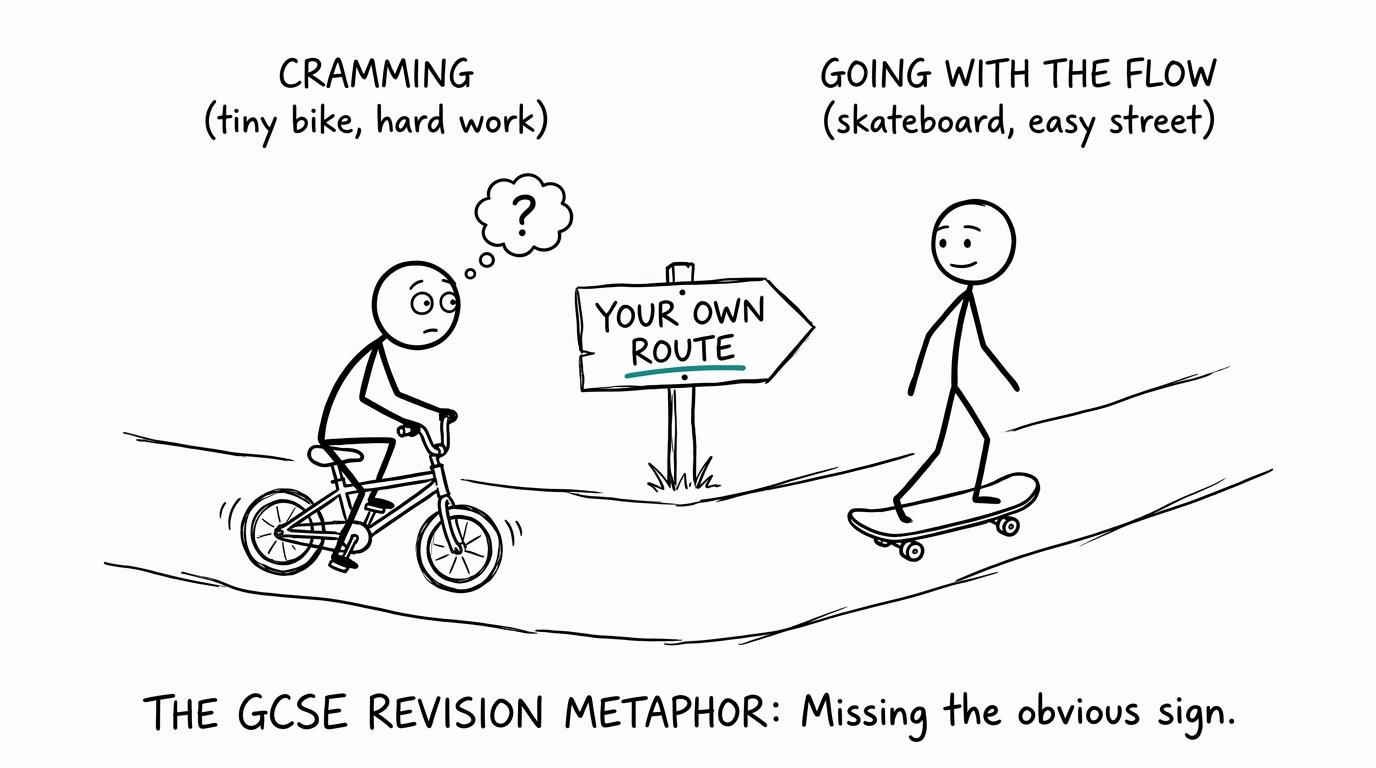 Two students accidentally ignore their own revision routes while comparing speed
Why comparing GCSE Arabic progress with friends is misleading
Comparison feels precise because it gives you an immediate answer: they remembered the word and you did not. Yet the conclusion you draw from that moment may be far larger than the evidence supports.
You may have different starting points
A student may hear or speak Arabic regularly outside school. Another may have strong reading skills but less confidence speaking spontaneously. Someone else may be learning almost entirely through lessons.
Those students can sit in the same classroom while facing very different learning tasks. Comparing their speed without considering their starting points is like comparing two runners who began at different places on the track.
This is particularly important because GCSE Arabic is not one general test of being "good at Arabic". The current Pearson Edexcel GCSE assesses listening, speaking, reading and writing separately, with each skill contributing 25%25\%25% of the qualification. A confident speaker may still need substantial work on reading or written accuracy. A quieter classmate may be excellent at translation.
One visible strength does not reveal the whole picture.
You notice performance, not preparation
You can see a friend's answer in class. You cannot see every earlier conversation, vocabulary review, correction or unsuccessful attempt that helped produce it.
This creates an unfair comparison: their finished performance against your private uncertainty. The same thing happens in maths when somebody answers a question immediately. You see the answer, not the practice that made the method familiar.
Different skills improve at different speeds
Language development is uneven. Vocabulary may expand before speaking confidence catches up. Reading comprehension may improve while writing still feels slow. Maths behaves similarly: algebra can strengthen while geometry remains fragile.
A single overall label such as "behind" hides useful detail. Replace it with a diagnosis:
- Which skill is improving?
- Which skill is currently limiting my marks?
- What evidence would show that it has improved?
That turns worry into a revision decision.
When comparison can be useful
The goal is not to ignore everybody else. Classmates can provide ideas, encouragement and useful feedback. Comparison becomes constructive when you compare strategies, not identities.
You might notice that a friend:
- records and listens back to spoken answers;
- revisits vocabulary across several days;
- keeps a short list of repeated grammar errors;
- practises under timed conditions;
- asks the teacher for precise feedback.
The useful question is, "Could that method help me?" The unhelpful version is, "Why am I not naturally as good as them?"
This principle transfers directly to maths. A classmate's colour-coded folder matters less than whether their routine includes active question practice, marking and reattempting mistakes. If the strategy is effective, borrow it. You do not need to borrow the judgement attached to it.
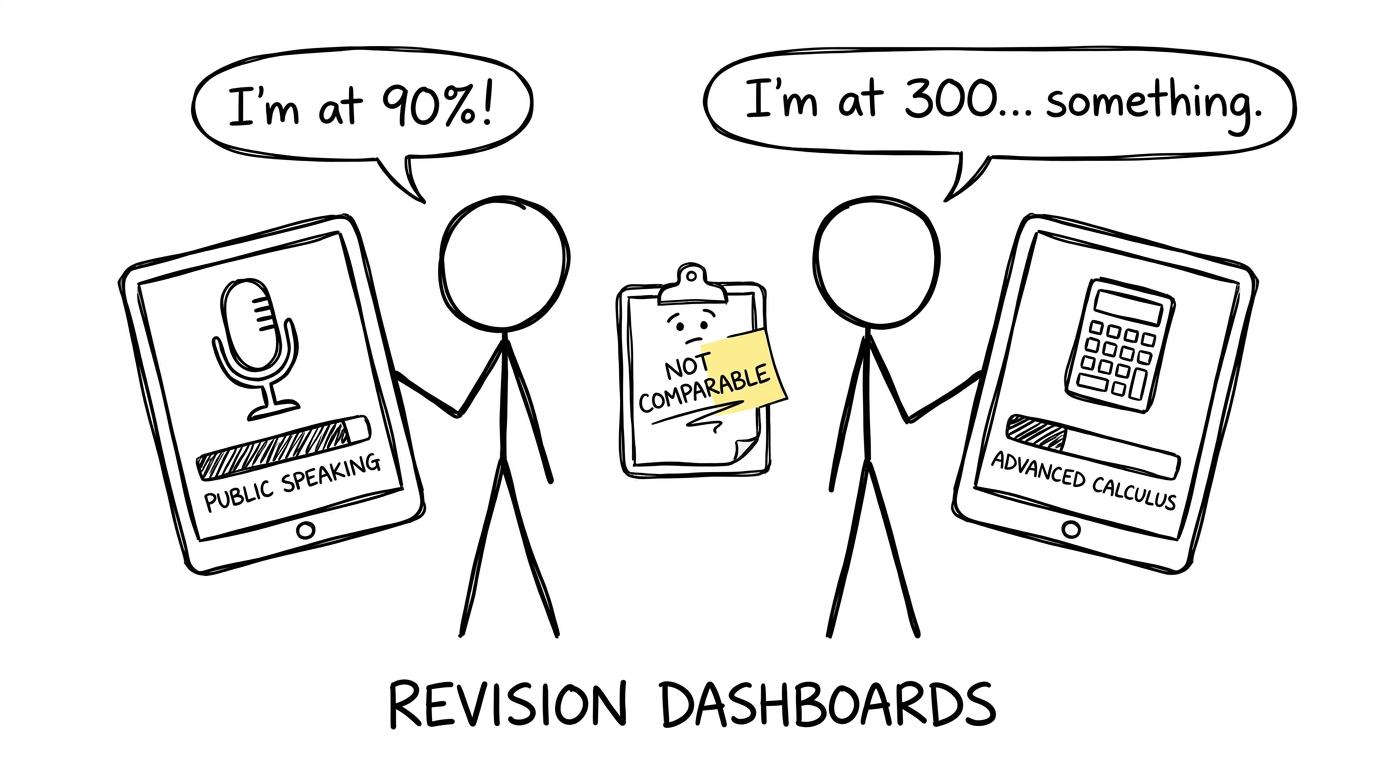 A revision clipboard discovers that different skills are not directly comparable
What to measure instead of class rank
Reliable progress measures should be personal, repeatable and connected to the assessment.
Track performance by skill
For Arabic, keep separate records for listening, speaking, reading and writing. Avoid combining everything into one vague confidence score. After a task, record:
- the mark or teacher feedback;
- the type of error;
- whether you completed it independently;
- one action for the next session.
For maths, divide lost marks into topic gaps, method errors, accuracy slips, misreading and timing. The GCSE maths revision hub lets you choose your exam board and move between revision lessons, questions and papers.
Compare like with like
A mark only becomes useful evidence when the conditions are reasonably similar. Do not compare a short familiar exercise completed with notes against an unseen timed assessment.
Instead, use repeated tasks of similar difficulty and ask whether accuracy, independence or timing is improving. In maths, Edexcel GCSE mini tests can provide short, consistent checks without requiring a full paper every time.
Measure the quality of your mistakes
A lower mark does not always mean no progress. Suppose you once could not start a question, but now choose the correct method and make one arithmetic slip. The final answer may still be wrong, yet the underlying gap has narrowed.
Mark schemes help reveal this distinction. The guide to using GCSE mark schemes explains how to turn a lost mark into a specific correction rather than a judgement about ability.
Use a personal feedback loop
A strong revision cycle is simple:
- choose one weak skill;
- attempt a relevant task without help;
- check it carefully;
- identify the exact error;
- practise that error pattern;
- retest it after a gap.
This reflects the plan, monitor and evaluate approach used in self-regulated learning. The Education Endowment Foundation's current evidence review describes metacognition and self-regulation as helping pupils plan, monitor and evaluate their learning. The practical lesson is straightforward: progress becomes easier to manage when you examine your own process rather than merely watching somebody else's result.
MathsGenie's GCSE maths revision timetable guide can help you place this loop inside a realistic weekly plan.
Protecting your GCSE maths revision from comparison
You may have arrived here because Arabic comparison is bothering you, but your immediate priority could be maths. The same remedy works.
First, confirm your own course details: exam board, foundation or higher tier, and the topics that repeatedly cost you marks. Edexcel, AQA, OCR and Eduqas organise their papers differently, so compare results only when the paper, tier and conditions are genuinely comparable. The GCSE maths topics by board and tier guide can help you check what belongs in your revision route.
Next, build a private scoreboard. It might include:
- topics you can now complete without notes;
- marks recovered after correcting earlier mistakes;
- questions completed within the time available;
- recurring errors that have disappeared;
- paper sections completed calmly and independently.
Then use the right resource for the stage you are at. Revision lessons and practice questions repair individual skills. Past papers test selection, stamina and timing. Edexcel GCSE maths past papers include mark schemes and worked support where available, while the wider revision hub covers other boards.
Nearer the exams, GCSE predicted papers can provide fresh practice. They are not promises about what will appear. Their value is that they reveal remaining gaps when you attempt them properly, mark them and return to targeted revision.
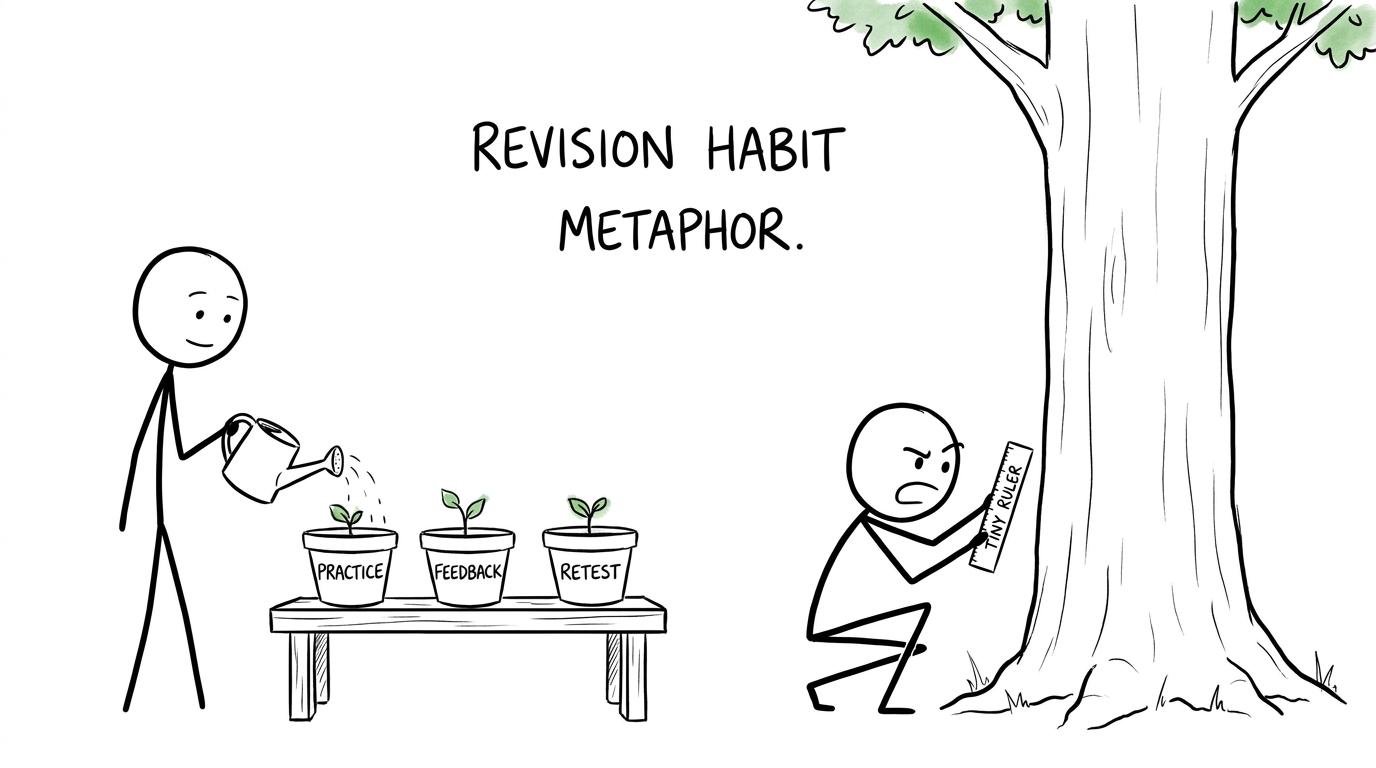 One student tends useful revision habits while another measures somebody else's tree
Common mistakes when judging your progress
Treating speed as proof of ability
Fast answers are visible, but accuracy, reasoning and long-term recall matter more. A quick response may reflect familiarity with that exact task rather than stronger understanding overall.
Comparing one strength with your weakest skill
You may compare your hesitant speaking with a friend's strongest spoken performance, then ignore your own reading or writing progress. Compare the same skill under similar conditions.
Turning a result into an identity
"I lost marks on this translation" is useful information. "I am bad at languages" is too broad to guide revision. In maths, replace "I cannot do algebra" with the exact issue, such as rearranging formulae or expanding brackets.
Copying a routine without testing it
A friend's revision method may suit their gaps, schedule and prior knowledge. Test any borrowed strategy against your own results. Keep it only if it improves recall, accuracy or independence.
Checking progress too frequently
Learning fluctuates from day to day. Constantly testing whether you have caught up can make ordinary variation feel like failure. Use planned checkpoints, then give your method enough time to work.
Ignoring feedback after counting marks
A score tells you where you finished. Feedback tells you what to change. After a maths paper, follow the paper, mark, repair and retest cycle described in MathsGenie's guide to using GCSE past papers properly.
Your progress needs a better reference point
Your friends can be companions, practice partners and sources of useful ideas. They should not become the ruler used to measure your worth or predict your GCSE result.
Track the four Arabic skills separately. Compare similar tasks over time. Use teacher feedback, recognise smaller improvements and judge revision methods by what they help you do independently. Then apply the same discipline to maths: diagnose your gaps, practise actively, mark honestly and retest.
MathsGenie is your free base for that process. Start with the GCSE maths revision hub, use revision lessons and practice questions to strengthen specific topics, then move into mini tests, past papers, mark schemes, video solutions and predicted papers. Build your plan around your evidence. The most useful person to outperform is not the student beside you; it is the earlier version of you who could not yet do what you can do now.