

Common A-Level Maths Mock Mistakes and How to Fix Them
Common A-Level maths mock mistakes explained, with worked fixes for algebra, calculus, statistics, timing and smarter targeted revision practice today.
Mock season has a peculiar rhythm. One week, the exam feels comfortably distant. The next, a sixth-form student is staring at a paper full of familiar topics and wondering why familiar does not feel easy.
The most common A-Level maths mock mistakes are rarely caused by knowing nothing. They usually come from incomplete working, weak algebra, calculator settings, misreading commands, poor timing or failing to connect a method to the question in front of you. The solution is not simply to revise for longer. It is to identify exactly where marks disappear, then practise that weakness deliberately.
A quick mock-season checklist
Before the next paper, check that you can:
- distinguish between exact and decimal answers
- show enough working to earn method marks
- use radians when the question requires them
- handle signs, brackets, indices and logarithms accurately
- include constants of integration where needed
- state statistical conclusions in context
- move on when one question begins consuming too much time
- review errors using the mark scheme rather than only recording a score
The MathsGenie A-Level Maths question bank is useful here because it lets you practise the topic behind a lost mark, not merely attempt another random paper.
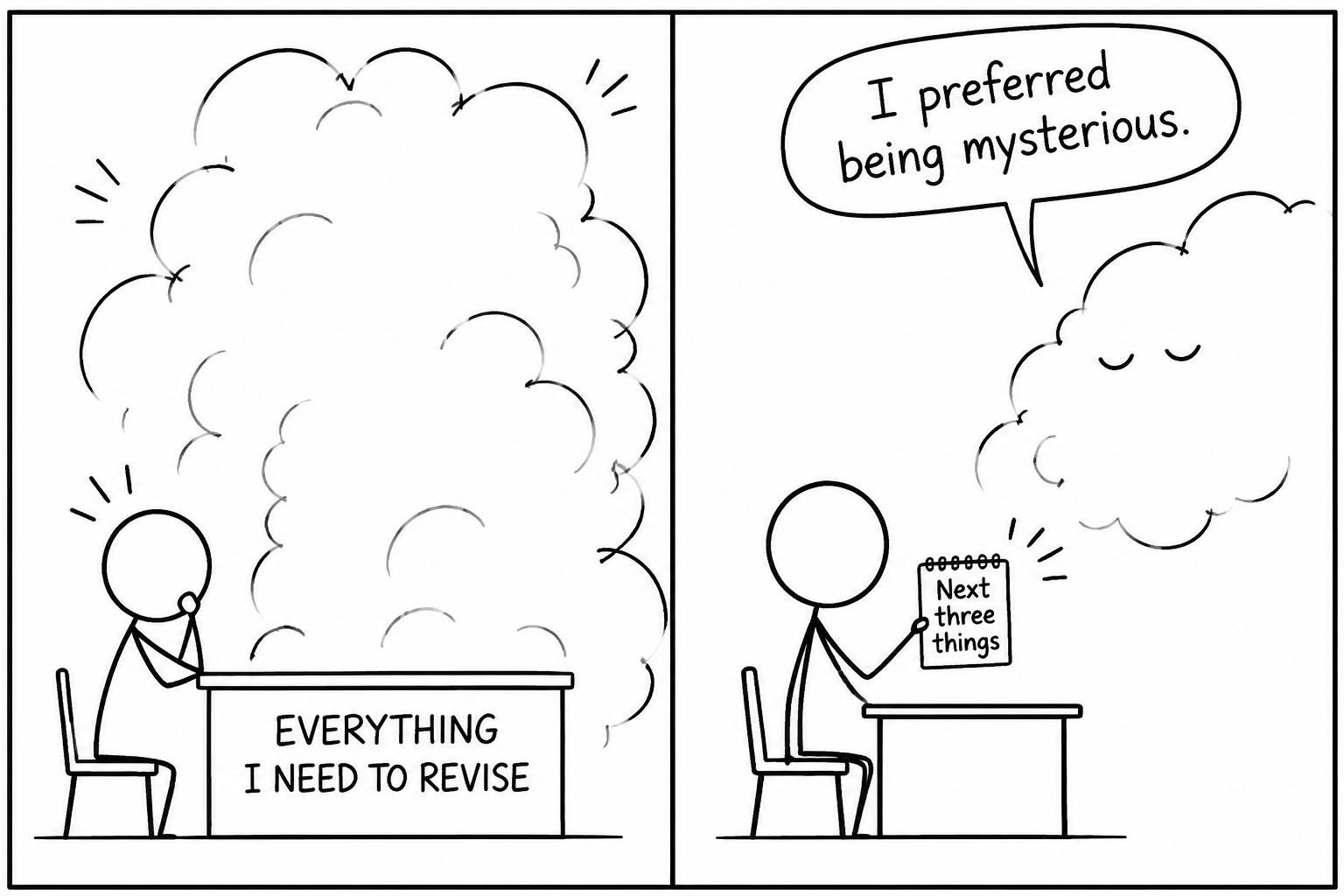 A sixth-form student turns a mysterious revision fog into three manageable tasks
Mistaking recognition for understanding
Imagine a student, Sam, opening an A-Level maths mock and seeing a logarithm question. Sam recognises the chapter, remembers completing the exercise and assumes the method will return automatically.
It does not.
Recognition is comfortable because the page looks familiar. An exam requires recall: selecting and applying a method without prompts. This distinction explains why rereading notes can feel productive while producing little improvement under timed conditions.
Suppose Sam must solve:
2e3x=7.2e^{3x}=7.2e3x=7.First isolate the exponential term:
e3x=72.e^{3x}=\frac{7}{2}.e3x=27.Then take natural logarithms:
3x=ln(72).3x=\ln\left(\frac{7}{2}\right).3x=ln(27).Therefore,
x=13ln(72).x=\frac{1}{3}\ln\left(\frac{7}{2}\right).x=31ln(27).Typical errors include taking logarithms before isolating the exponential, losing the factor of 333, or converting to a rounded decimal when an exact answer is expected. Students who need to rebuild this skill can revisit working with natural logarithms before attempting closed-book questions.
Losing marks through fragile algebra
A-Level Maths often tests an advanced idea through ordinary algebra. Differentiation, integration and mechanics can all collapse because of one incorrect expansion or sign.
Sam understands the product rule but differentiates
y=x2exy=x^2e^xy=x2exas though only one factor changes. The correct rule is
ddx(uv)=udvdx+vdudx.\frac{\mathrm{d}}{\mathrm{d}x}(uv)=u\frac{\mathrm{d}v}{\mathrm{d}x}+v\frac{\mathrm{d}u}{\mathrm{d}x}.dxd(uv)=udxdv+vdxdu.Taking u=x2u=x^2u=x2 and v=exv=e^xv=ex gives
dydx=x2ex+2xex.\frac{\mathrm{d}y}{\mathrm{d}x}=x^2e^x+2xe^x.dxdy=x2ex+2xex.This may be factorised as
dydx=ex(x2+2x).\frac{\mathrm{d}y}{\mathrm{d}x}=e^x(x^2+2x).dxdy=ex(x2+2x).Writing the rule before substituting reduces the chance of omitting a term. The MathsGenie product rule revision lesson provides further exam-style practice and step-by-step support.
When reviewing A-Level maths mocks, label an algebra error honestly. Do not write “silly mistake” and move on. Record whether it involved a negative sign, a fraction, an index, factorisation or rearrangement. A named weakness can be practised. A “silly mistake” cannot.
Showing too little working
Strong students sometimes compress several lines into one because the steps feel obvious. That may save seconds, but it can also hide the method that earns marks.
For example, integrating
6x2−4x6x^2-4x6x2−4xshould produce
∫(6x2−4x) dx=2x3−2x2+C.\int(6x^2-4x)\,\mathrm{d}x=2x^3-2x^2+C.∫(6x2−4x)dx=2x3−2x2+C.The constant CCC is necessary for an indefinite integral. If the final expression is wrong but the integration method is visible, the working may still matter under the relevant mark scheme. A calculator output without supporting reasoning is often far less useful.
Good working is not about filling the page. It means showing the mathematical decisions that connect the question to the answer.
Treating the calculator as an oracle
By the middle of mock season, Sam has learnt that a calculator can confirm an answer. The more dangerous belief is that it can decide the method.
Calculator-related mistakes include:
- using degree mode for a radians question
- entering a negative power without brackets
- copying a decimal incorrectly
- rounding during an intermediate step
- reporting a calculator result without interpreting it
For arc length, for example, the relationship
s=rθs=r\thetas=rθrequires θ\thetaθ in radians. If r=4r=4r=4 and θ=1.2\theta=1.2θ=1.2, then
s=4×1.2=4.8.s=4\times1.2=4.8.s=4×1.2=4.8.The calculator performs the multiplication. It does not notice that the wrong angle mode or formula has been used.
A useful habit is to estimate first. If the displayed answer has an impossible sign or scale, pause before copying it down.
Writing incomplete statistics conclusions
Statistics questions often require more than a probability. They require a decision connected to the original context.
Suppose a hypothesis test gives a probability of
0.00590.00590.0059at the 5%5\%5% significance level. Since
0.0059<0.05,0.0059<0.05,0.0059<0.05,the result is significant, so the null hypothesis should be rejected. The final sentence must then explain what the evidence suggests in the context of the question.
Writing only “reject H0H_0H0” may not complete the interpretation. Equally, saying that the alternative hypothesis has been “proved” is too strong. A significance test provides evidence; it does not establish absolute certainty.
This is where mark schemes become part of revision rather than something checked after it. On the Edexcel A-Level Maths revision page, students can combine topic revision with exam questions, past papers and mark schemes. Students following AQA, OCR or another specification should use the resources and wording appropriate to their own exam board.
Common mistakes in the exam room
Some errors are about knowledge. Others are about managing the paper.
Spending too long on one question
A difficult part can become a trap. Sam spends twelve minutes trying to rescue two marks, then rushes a later question that was entirely accessible.
If progress stops, write down any relevant formula or first step, leave space and move on. Returning later with a calmer mind is often more productive.
Ignoring command words
“Show that” requires a convincing chain of reasoning. “Hence” signals that an earlier result should be used. “State” usually needs less development than “explain”. Circle the command word before beginning a longer response.
Rounding too early
Keep exact values or full calculator precision during intermediate stages. Round only at the end and follow any accuracy instruction given in the question.
Revising only comfortable topics
Completing another differentiation question may feel reassuring. If mechanics or hypothesis testing caused the lost marks, comfort is not the goal. Targeting the weakest area is.
Turn each mistake into targeted practice
After the mock, Sam creates three columns: topic, cause and next action. “Integration” is too broad. “Forgot CCC in an indefinite integral” is useful. So is “used degrees instead of radians” or “did not write the conclusion in context”.
The next action should be equally specific:
- review one revision lesson
- complete a short set of practice questions
- mark the work carefully
- retry incorrect questions without notes
- test the skill later in a timed mixed paper
MathsGenie brings together revision lessons, practice questions, video solutions, worksheets and past papers so that this cycle can happen in one place. If the transition into sixth form still feels unsettled, the GCSE to A-Level Maths guide also explains how the demands change.
Make the next mock more useful
A mock is not a verdict. It is a detailed map of what happened under pressure. By the end of mock season, Sam has not eliminated every error. Instead, each error has become smaller and more specific. That is real progress because specific problems have specific solutions.
Start with the questions that exposed your weakest methods, then use the MathsGenie Mock Exam Builder to build a targeted practice paper. Sit it under timed conditions, mark it honestly and compare the new mistakes with the old ones. Your score matters, but the changing pattern of your mistakes tells you even more.















