

Combining Ratios GCSE Maths: Worked Examples
Combining ratios GCSE maths explained with a matching-parts method, clear worked examples, common mistakes and exam-style practice for better revision.
A student can understand ratios perfectly well and still freeze when two of them have to be joined. Imagine Sam facing A:B=2:3A:B=2:3A:B=2:3 and B:C=4:5B:C=4:5B:C=4:5. He writes A:B:C=2:3:5A:B:C=2:3:5A:B:C=2:3:5, checks the answer, and finds that it is wrong again.
The problem is not ratio itself. It is the shared quantity. In combining ratios GCSE maths, the two versions of that shared quantity must represent the same amount before the ratios can be connected. Here, BBB cannot be both 333 parts and 444 parts at once. Make those parts equal, then combine.
That single idea is the whole method.
The combining ratios checklist
When two ratios share one quantity:
- identify the letter or quantity appearing in both ratios;
- find a common multiple of its two values;
- multiply every part of each ratio by the required scale factor;
- join the equivalent ratios;
- simplify only after all three quantities have been combined;
- check that both original ratios can be recovered.
This topic relies on equivalent ratios, so revisit the GCSE ratio lesson if scaling a ratio still feels uncertain. AQA students can use the corresponding AQA ratio revision resources.
Why the shared part must match
Return to Sam's question:
A:B=2:3 A:B=2:3 A:B=2:3 B:C=4:5 B:C=4:5 B:C=4:5The first statement says that for every 222 parts of AAA, there are 333 parts of BBB. The second says that for every 444 parts of BBB, there are 555 parts of CCC.
The least common multiple of 333 and 444 is 121212. Scale the first ratio by 444:
A:B=8:12 A:B=8:12 A:B=8:12Scale the second ratio by 333:
B:C=12:15 B:C=12:15 B:C=12:15Now both ratios describe BBB using 121212 equal parts, so they can be joined:
A:B:C=8:12:15 A:B:C=8:12:15 A:B:C=8:12:15This is when the method clicks for Sam. Combining ratios is not about attaching two strings of numbers. It is about rewriting two comparisons so that they agree about the quantity connecting them.
Use Maths Genie's Lessons and Question Bank for combining ratios when you want to practise this matching-parts method without setting up every question yourself.
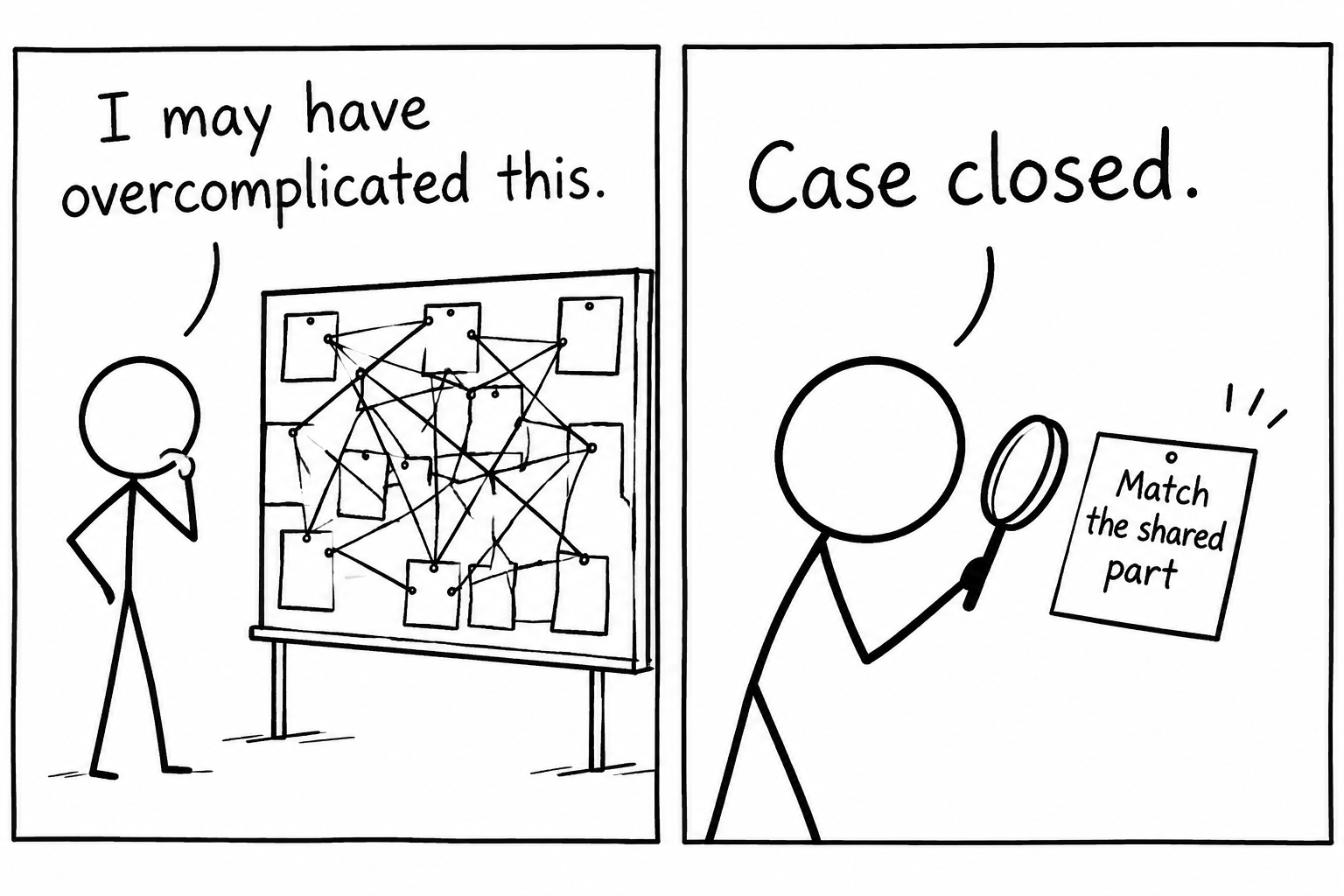 A student detective discovers that matching the shared part solves the ratio mystery
Combining ratios worked examples
Example with a shared middle quantity
Given
P:Q=3:7 P:Q=3:7 P:Q=3:7and
Q:R=5:2, Q:R=5:2, Q:R=5:2,find P:Q:RP:Q:RP:Q:R.
The shared quantity is QQQ. Its values are 777 and 555, whose least common multiple is 353535.
Multiply the first ratio by 555:
P:Q=15:35 P:Q=15:35 P:Q=15:35Multiply the second ratio by 777:
Q:R=35:14 Q:R=35:14 Q:R=35:14Combine the ratios:
P:Q:R=15:35:14 P:Q:R=15:35:14 P:Q:R=15:35:14There is no common factor greater than 111 across all three terms, so this is the simplest form.
A reliable check is to recover the originals:
15:35=3:7 15:35=3:7 15:35=3:7and
35:14=5:2. 35:14=5:2. 35:14=5:2.Both work, so the combined ratio is correct.
Example where the shared quantity changes position
Given
X:Y=4:9 X:Y=4:9 X:Y=4:9and
Z:X=5:6, Z:X=5:6, Z:X=5:6,find X:Y:ZX:Y:ZX:Y:Z.
The shared quantity is XXX, but it is not in the same position in both statements. Its values are 444 and 666. Their least common multiple is 121212.
Multiply X:Y=4:9X:Y=4:9X:Y=4:9 by 333:
X:Y=12:27 X:Y=12:27 X:Y=12:27Multiply Z:X=5:6Z:X=5:6Z:X=5:6 by 222:
Z:X=10:12 Z:X=10:12 Z:X=10:12Keep the requested order, X:Y:ZX:Y:ZX:Y:Z. Therefore:
X:Y:Z=12:27:10 X:Y:Z=12:27:10 X:Y:Z=12:27:10Sam's earlier habit was to copy numbers in the order they appeared. This example shows why labels matter more than position. Track the letters first, then write the final ratio in the requested order.
For more structured notes, use the ratio as a fraction or linear function revision guide.
Example involving an actual amount
The ratio of red to blue counters is
R:B=3:8. R:B=3:8. R:B=3:8.The ratio of blue to green counters is
B:G=4:7. B:G=4:7. B:G=4:7.There are 515151 counters altogether. Find the number of green counters.
Match BBB. The values are 888 and 444, so multiply the second ratio by 222:
B:G=8:14 B:G=8:14 B:G=8:14Now combine:
R:B:G=3:8:14 R:B:G=3:8:14 R:B:G=3:8:14The total number of parts is
3+8+14=25. 3+8+14=25. 3+8+14=25.However, 515151 is not divisible by 252525. That tells us the information is inconsistent if all counters must be whole objects. This is an important exam habit: do not force a calculation when the quantities cannot fit the ratio.
If the total were 757575 instead, one part would be
75÷25=3, 75\div25=3, 75÷25=3,so the number of green counters would be
14×3=42. 14\times3=42. 14×3=42.Checks like this often catch an error before it costs another mark.
Common mistakes when combining ratios
Joining ratios without matching
From A:B=2:3A:B=2:3A:B=2:3 and B:C=4:5B:C=4:5B:C=4:5, writing A:B:C=2:3:5A:B:C=2:3:5A:B:C=2:3:5 ignores the fact that BBB has two different values. Match 333 and 444 first.
Scaling only the shared term
Changing A:B=2:3A:B=2:3A:B=2:3 into A:B=2:12A:B=2:12A:B=2:12 changes the ratio. If one term is multiplied by 444, every term must be multiplied by 444:
2:3=8:12. 2:3=8:12. 2:3=8:12.Reversing a ratio accidentally
If C:B=5:4C:B=5:4C:B=5:4, then B:C=4:5B:C=4:5B:C=4:5. The labels carry meaning. Write them above or beside your working instead of trying to remember the order mentally.
Using the product every time
Multiplying the shared values always produces a common multiple, but it may create unnecessarily large numbers. For 666 and 999, use the least common multiple, 181818, rather than 545454.
Simplifying too early
Equivalent ratios may be scaled during the matching process. Wait until the complete three-part ratio has been formed before checking whether all terms share a common factor.
The Maths Genie exam booklet is useful for practising clear working, while the linked answers help you distinguish a method error from an arithmetic slip.
Exam-style combining ratios questions
Try these without looking back at the examples.
Question one
A:B=5:6 A:B=5:6 A:B=5:6 B:C=9:4 B:C=9:4 B:C=9:4Find A:B:CA:B:CA:B:C in its simplest form.
Question two
M:N=7:3 M:N=7:3 M:N=7:3 P:M=5:14 P:M=5:14 P:M=5:14Find M:N:PM:N:PM:N:P in its simplest form.
Question three
The ratio of adults to children at an event is 2:72:72:7. The ratio of children to teachers is 14:314:314:3. There are 929292 people altogether. Find the number of teachers.
Answers
For question one, match BBB using 181818:
A:B:C=15:18:8. A:B:C=15:18:8. A:B:C=15:18:8.For question two, match MMM using 141414:
M:N:P=14:6:5. M:N:P=14:6:5. M:N:P=14:6:5.For question three:
A:C=2:7=4:14, A:C=2:7=4:14, A:C=2:7=4:14,so
A:C:T=4:14:3. A:C:T=4:14:3. A:C:T=4:14:3.There are 212121 parts altogether, but 929292 is not divisible by 212121. Therefore the stated total is inconsistent with whole people. Recognising that is part of checking the model, not a failure to finish the arithmetic.
Continue with an exam-style ratio question and worked solution once these feel secure. If a question moves from ratios into scaling quantities, the GCSE proportion lesson provides the next step.
Turn the method into exam confidence
Sam did not improve by memorising more rules. He improved when every question began with one instruction: match the shared part. Knowing that method is the first step, but following it under exam pressure comes from deliberate practice with feedback.
Start the Maths Genie Lessons and Question Bank and practise matching the shared part until combining ratios feels routine.















