Writing a Ratio as a Fraction or Linear Function
x

Revision notes for Edexcel GCSE Maths Writing a Ratio as a Fraction or Linear Function. Open the guide for explanations and worked examples. Written against the Edexcel GCSE Maths (1MA1) specification, so the content matches what's examinable rather than general Maths background.

Writing a Ratio as a Fraction or Linear Function

What you'll learn

  • How to turn a ratio into fractions or algebraic expressions.
  • How to combine two ratios by matching a shared letter or quantity.
  • How to use a common multiplier to solve sharing and difference problems.
  • How to handle ratios involving “not red”, “not won”, or line segments.

1. Ratios, parts, and fractions

A ratio compares quantities by splitting them into parts. For example, if Sam and Tia share money in the ratio 3:2, then Sam gets 3 parts and Tia gets 2 parts.

Definition

Ratio parts

In a ratio like 3:2, the total number of parts is 3 + 2 = 5. The first person gets 35\frac{3}{5}53​ of the total, and the second person gets 25\frac{2}{5}52​ of the total.

Example

Using a ratio as fractions

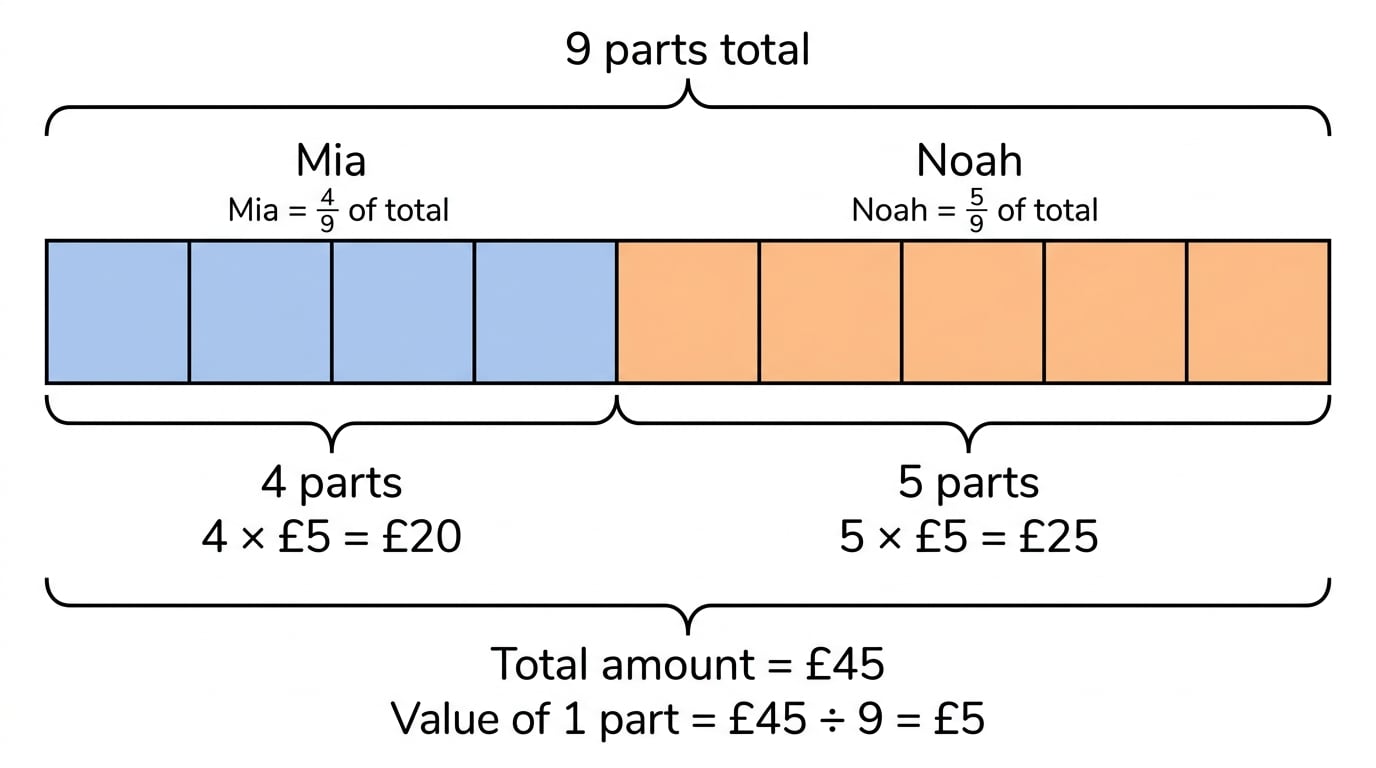
Mia and Noah share £45 in the ratio 4:5. How much does Mia get?

A bar model shows the £45 split into 9 equal parts, with 4 parts for Mia and 5 parts for Noah.

  1. Add the parts in the ratio.

    Mia has 4 parts and Noah has 5 parts, so there are 9 parts altogether.

  2. Write Mia’s share as a fraction of the total.

    Mia’s fraction=49\text{Mia's fraction}=\frac{4}{9}Mia’s fraction=94​
  3. Multiply the total by that fraction.

    49×45=20\frac{4}{9}\times 45=2094​×45=20
  4. Mia gets £20.

Key Idea

Ratio to fraction

To turn a part of a ratio into a fraction, put that part over the total number of parts.

2. Writing a ratio as a linear relationship

Sometimes you are given a ratio using letters, such as A:B=5:2A:B=5:2A:B=5:2.

This means AAA and BBB are linked by a fixed multiplier.

Definition

Linear relationship

A linear relationship between two quantities means one can be written as a constant multiple of the other, such as A=52BA=\frac{5}{2}BA=25​B.

If A:B=5:2A:B=5:2A:B=5:2, then:

  • AAA is 5 parts.
  • BBB is 2 parts.
  • So A=52BA=\frac{5}{2}BA=25​B.
  • Also B=25AB=\frac{2}{5}AB=52​A.
Example

Writing one variable in terms of another

Given p:q=7:3p:q=7:3p:q=7:3, write ppp in terms of qqq.

A paired bar model compares p as 7 equal parts with q as 3 equal parts.

  1. Interpret the ratio.

    ppp has 7 parts and qqq has 3 parts.

  2. Compare ppp to qqq.

    pq=73\frac{p}{q}=\frac{7}{3}qp​=37​
  3. Multiply both sides by qqq.

    p=73qp=\frac{7}{3}qp=37​q
Common Mistake

Reversing the fraction

If p:q=7:3p:q=7:3p:q=7:3, then p=73qp=\frac{7}{3}qp=37​q, not p=37qp=\frac{3}{7}qp=73​q. The order of the ratio matters.

3. Combining ratios with a shared quantity

A common GCSE question gives two ratios that share one letter. Your job is to make the shared letter have the same number of parts in both ratios.

For example, if a:b=2:5a:b=2:5a:b=2:5 and b:c=3:4b:c=3:4b:c=3:4, the shared letter is bbb. In the first ratio, bbb is 5 parts. In the second ratio, bbb is 3 parts. We need to make both into 15 parts.

Example

Finding a three-part ratio

Given a:b=2:5a:b=2:5a:b=2:5 and b:c=3:4b:c=3:4b:c=3:4, find a:b:ca:b:ca:b:c.

The shared quantity b is scaled to 15 parts so the two ratios can be combined.

  1. Identify the shared quantity.

    The shared quantity is bbb.

  2. Make the bbb parts match.

    In a:b=2:5a:b=2:5a:b=2:5, bbb is 5 parts.
    In b:c=3:4b:c=3:4b:c=3:4, bbb is 3 parts.
    The lowest common multiple of 5 and 3 is 15.

  3. Scale the first ratio so b=15b=15b=15.

    a:b=2:5=6:15a:b=2:5=6:15a:b=2:5=6:15
  4. Scale the second ratio so b=15b=15b=15.

    b:c=3:4=15:20b:c=3:4=15:20b:c=3:4=15:20
  5. Combine the matching parts.

    a:b:c=6:15:20a:b:c=6:15:20a:b:c=6:15:20
Tip

Match the middle

When two ratios share a letter, focus on matching that shared letter first. The other values then fall into place.

4. Using a multiplier to solve amount problems

When actual amounts are involved, it is often easiest to write each amount as a multiple of one letter, usually kkk.

Definition

Common multiplier

A common multiplier is a letter, often kkk, used to turn ratio parts into real amounts. For example, a 4:3 ratio could mean 4k4k4k and 3k3k3k.

Example

Using a difference to find the multiplier

Dylan, Eva, and Finn share some counters. Dylan to Eva is in the ratio 5:2. Dylan to Finn is in the ratio 3:4. Finn gets 14 more counters than Dylan. How many counters does Eva get?

A combined ratio bar shows Dylan, Eva, and Finn as 15, 6, and 20 parts, with Finn 5 parts more than Dylan.

  1. Write the two ratios.

    D:E=5:2D:E=5:2D:E=5:2 D:F=3:4D:F=3:4D:F=3:4
  2. Match the shared quantity, DDD.

    In the first ratio, DDD is 5 parts.
    In the second ratio, DDD is 3 parts.
    The lowest common multiple of 5 and 3 is 15.

  3. Scale both ratios.

    D:E=15:6D:E=15:6D:E=15:6 D:F=15:20D:F=15:20D:F=15:20
  4. Combine the ratio.

    D:E:F=15:6:20D:E:F=15:6:20D:E:F=15:6:20
  5. Use the difference between Finn and Dylan.

    Finn has 20 parts and Dylan has 15 parts, so the difference is 5 parts.
    This equals 14 counters.

  6. Find one part.

    5 parts=145\text{ parts}=145 parts=14 1 part=1451\text{ part}=\frac{14}{5}1 part=514​
  7. Find Eva’s amount.

    6×145=845=16.86\times \frac{14}{5}=\frac{84}{5}=16.86×514​=584​=16.8
Common Mistake

Check for whole-number answers

If a question is about sweets, counters, or people, the final answer should usually be a whole number. If it is not, re-check the ratio or the difference.

5. Ratios involving “not” groups

A phrase like “red to not red” means:

  • red is one group
  • everything else is the other group

So if red to not red is 2:3, then red is 2 parts and the whole total is 5 parts.

Example

Using two 'not' ratios

In a bag there are red, blue, and green sweets. Red to not red is 3:7. Green to not green is 2:3. Find the ratio red:blue:green.

A 10-part total model shows red as 3 parts, green as 4 parts, and the remaining blue as 3 parts.

  1. Turn each statement into a fraction of the total.

    Red to not red is 3:7, so red is 3 parts out of 10.

    R=310 of the totalR=\frac{3}{10}\text{ of the total}R=103​ of the total
  2. Do the same for green.

    Green to not green is 2:3, so green is 2 parts out of 5.

    G=25 of the totalG=\frac{2}{5}\text{ of the total}G=52​ of the total
  3. Use a total that works for both fractions.

    The denominators are 10 and 5, so use 10 total parts.

  4. Find red and green parts.

    R=310×10=3R=\frac{3}{10}\times 10=3R=103​×10=3 G=25×10=4G=\frac{2}{5}\times 10=4G=52​×10=4
  5. Find blue parts by subtracting from the total.

    B=10−3−4=3B=10-3-4=3B=10−3−4=3
  6. Write the final ratio.

    R:B:G=3:3:4R:B:G=3:3:4R:B:G=3:3:4
Common Mistake

Forgetting the total

In “red:not red = 3:7”, the total is 10 parts, not 7 parts. The “not red” group is everything except red.

The ‘not red’ group is the complement of red, so the total contains both groups.

6. Line segment ratios

If points are in order on a straight line, a longer section may be made from smaller sections.

For points AAA, BBB, CCC, and DDD in order:

A straight-line diagram shows how AC and BD are made from adjacent smaller sections.

  • AC=AB+BCAC=AB+BCAC=AB+BC
  • BD=BC+CDBD=BC+CDBD=BC+CD
Example

Finding a ratio on a straight line

Points AAA, BBB, CCC, and DDD lie in order on a straight line. Given AB:BD=1:4AB:BD=1:4AB:BD=1:4 and AC:CD=3:5AC:CD=3:5AC:CD=3:5, find AB:BC:CDAB:BC:CDAB:BC:CD.

The line segment setup identifies the unknown sections x, y, and z and the two longer sections used in the ratios.

  1. Let the three small sections be AB=xAB=xAB=x, BC=yBC=yBC=y, and CD=zCD=zCD=z.

  2. Use AB:BD=1:4AB:BD=1:4AB:BD=1:4.

    Since BD=BC+CDBD=BC+CDBD=BC+CD, this means:

    x:(y+z)=1:4x:(y+z)=1:4x:(y+z)=1:4
  3. Use AC:CD=3:5AC:CD=3:5AC:CD=3:5.

    Since AC=AB+BCAC=AB+BCAC=AB+BC, this means:

    (x+y):z=3:5(x+y):z=3:5(x+y):z=3:5
  4. Choose a helpful value for xxx from the first ratio.

    If x=1x=1x=1, then y+z=4y+z=4y+z=4.

  5. Use the second ratio.

    x+yx+yx+y must be 3 parts while zzz is 5 parts, so scale until the equations fit.
    From x=1x=1x=1 and y+z=4y+z=4y+z=4, try multiplying the second ratio so z=5z=5z=5 is too large, so scale both relationships instead.

  6. A cleaner algebra method is to convert the ratios into equations.

    y+z=4xy+z=4xy+z=4x 5(x+y)=3z5(x+y)=3z5(x+y)=3z
  7. Substitute z=4x−yz=4x-yz=4x−y into the second equation.

    5(x+y)=3(4x−y)5(x+y)=3(4x-y)5(x+y)=3(4x−y) 5x+5y=12x−3y5x+5y=12x-3y5x+5y=12x−3y 8y=7x8y=7x8y=7x
  8. Choose values that make whole-number parts.

    Let x=8x=8x=8, so y=7y=7y=7.
    Then z=4x−y=32−7=25z=4x-y=32-7=25z=4x−y=32−7=25.

  9. Write the ratio.

    AB:BC:CD=8:7:25AB:BC:CD=8:7:25AB:BC:CD=8:7:25
Exam technique

In the exam

  1. Underline the shared quantity or the phrase “not”.
  2. If two ratios share a letter, make that letter have the same number of parts.
  3. If there is a total or a difference, use it only after you have found the combined ratio.
Self review

Check yourself

  • If a:b=3:4a:b=3:4a:b=3:4 and b:c=2:5b:c=2:5b:c=2:5, what number should you make the bbb parts equal to?
  • In “won to not won = 5:3”, what fraction of the games were won?
  • If A:B=4:7A:B=4:7A:B=4:7, can you write AAA in terms of BBB?

Recap questions

Test yourself with 5 quick questions on this guide. Answer them all correctly to complete it.

You've reached the end

Test yourself on this topic, or move on to the next guide.

Practice questionsTake a quick quiz on this topicFlashcardsSelf-test with active recall
Direct and Inverse ProportionUp next

How was this guide?

Writing a Ratio as a Fraction or Linear Function Revision Guide

  1. GCSE
  2. /Maths
  3. /Writing a Ratio as a Fraction or Linear Function