Are Mocks Harder Than the Real GCSE?
Are mocks harder than the real GCSE? Learn why difficulty varies, what mock grades mean and how to turn GCSE maths mocks into focused revision.
Are mocks harder than the real GCSE? Sometimes they feel harder, but there is no general rule that mock papers are more difficult than final exams. A school may use a demanding past paper, set cautious grade boundaries or test topics before students have finished the course.
After a difficult November mock, the resulting grade can feel like a prediction. The useful answer is not that your final GCSE will definitely be easier. It is that a mock shows what to practise while there is still time to improve. Your next step is to understand where the marks went.
The short answer about GCSE maths mocks
Keep these points in mind when reading a mock result:
- Difficulty varies between schools and papers.
- Mocks may use genuine past papers or questions assembled by teachers.
- You may not have completed every topic in the specification.
- School grade boundaries may differ from live GCSE boundaries.
- Individual topic scores often tell you more than the headline grade.
Explore the expected content through GCSE Maths revision resources, then compare your paper with the topics you have covered.
Why mocks can feel harder than the real GCSE
You may not have completed the course
A Year 11 class can sit mocks while some specification content is still being taught. Unfamiliar material will naturally feel demanding. Even familiar topics may not yet have been revisited in revision lessons.
Maths knowledge also accumulates. Difficulty rearranging equations can affect algebra, graphs and geometry. The problem may be an earlier skill underneath the question.
Full papers demand unfamiliar skills
Completing questions in class differs from working under timed conditions. You must choose methods, manage time and recover after difficult questions without immediate help.
You are learning how to take the exam as well as demonstrating maths. By the final GCSE, the timing and paper structure may feel more familiar.
Schools interpret mock marks differently
There is no universal set of mock grade boundaries. Schools may use boundaries from a past paper or apply internal assessment policies.
For live GCSEs, exam boards set boundaries after considering evidence from the completed exam series. This accounts for differences in paper difficulty. An earlier boundary cannot tell you exactly what your final series will require.
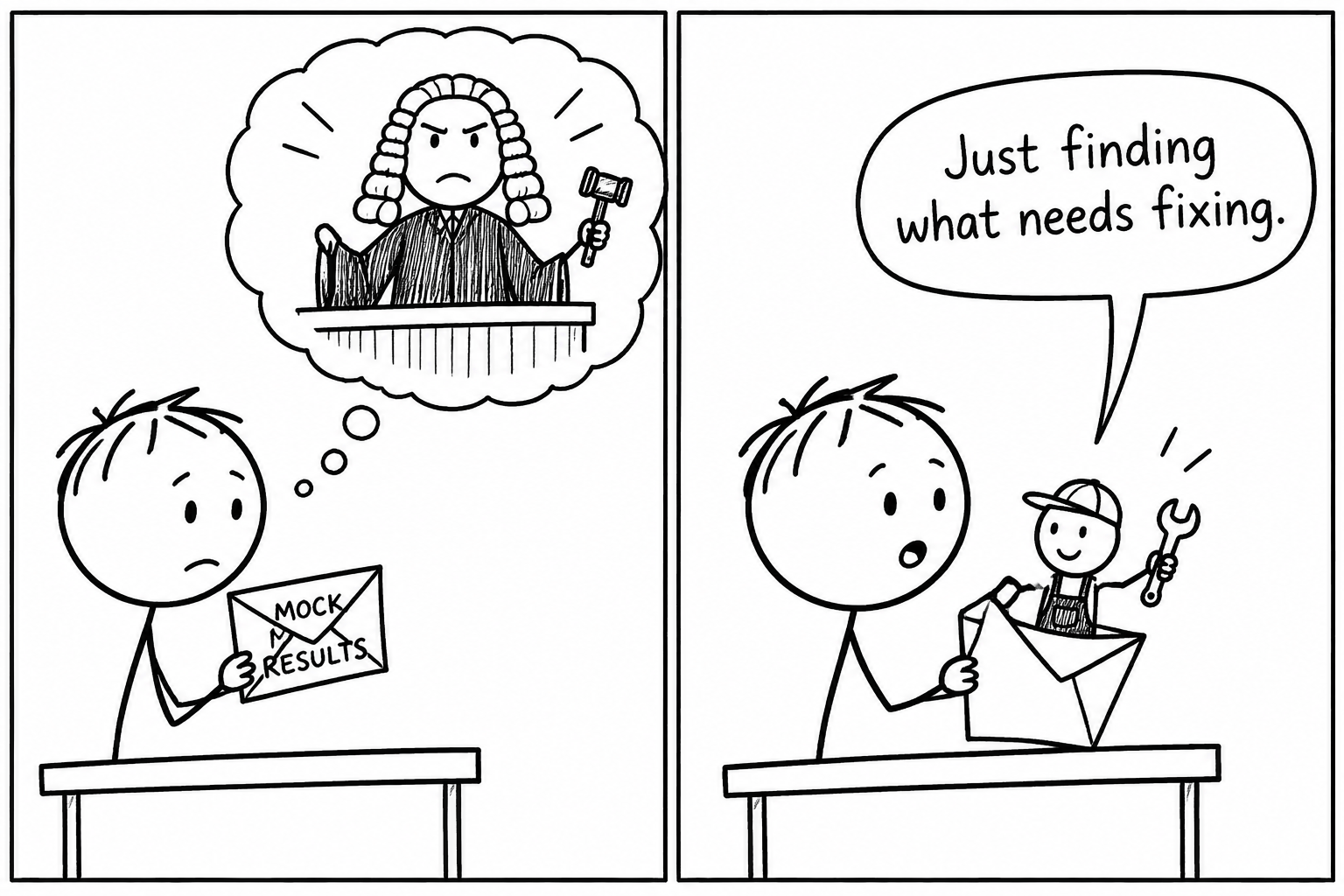 A student discovers that mock results are a mechanic finding what needs fixing, not a judge delivering a verdict
What does a mock grade actually mean?
A mock grade records one performance on one selection of questions at one stage of your course. It may inform discussions about tier entry, predicted grades and support, but mock marks do not contribute to your final externally assessed GCSE maths papers.
Separate lost marks into four categories:
- Knowledge gaps: you did not know the fact, formula or method.
- Method errors: you chose or applied the wrong process.
- Accuracy errors: arithmetic, signs, rounding or calculator entry caused mistakes.
- Exam technique: you misread questions, omitted working or ran out of time.
Each category needs a different response. Knowledge gaps need teaching and practice; timing problems need controlled paper practice. Use the GCSE papers collection, including Edexcel GCSE Maths past papers, or visit the AQA GCSE Maths revision area for relevant resources.
Mock exam tips for turning results into progress
Review before revising everything
Begin with questions you nearly completed correctly. These often offer marks you can recover quickly. Then address repeated weaknesses. Fractions causing difficulty across several questions deserve more attention than one unusual final-page problem.
Write down the topic and reason for each error. Choose three precise priorities that you can realistically tackle this week.
Relearn, practise and retest
Use a simple cycle:
- Relearn the method through a clear explanation or video solution.
- Complete practice questions independently.
- Mark your work and correct errors.
- Retest the topic several days later.
- Apply it again in a mixed paper.
MathsGenie's free maths revision resources include topic videos, practice questions, past papers and mark schemes. Moving from focused practice to mixed questions matters because an exam requires you to identify the method yourself.
Practise under realistic conditions
Once you have addressed the main gaps, sit a paper using the correct time allowance, equipment and calculator rules. Avoid pausing for hints. Afterwards, apply the mark scheme carefully instead of awarding marks because an answer seems close.
Full papers reveal timing problems, but they should sit alongside targeted topic practice.
Give your priorities a place in the week
Use the GCSE Mock Exam Builder for targeted practice. If ratio, equations and probability caused problems, focus your next practice on those areas before returning to mixed content.
A MathsGenie revision planner can help organise manageable sessions. Leave time for corrections and retesting, not just completing fresh questions.
Common mistakes after a difficult mock
Assuming the final exam will be easier. Better preparation may make it feel easier, but a kinder paper is never guaranteed.
Treating the grade as a ceiling. It describes current performance, not everything you could achieve after further practice.
Reading solutions without attempting questions. Recognising a method is different from producing it independently.
Completing endless papers without reviewing mistakes. Repeated practice only helps when you act on what it reveals.
Ignoring working marks. Relevant correct methods can earn marks even when the final answer is wrong. Clear working also helps you check your reasoning.
From the mock to the real GCSE
A mock can initially look like a judgement. Once each lost mark has a reason beside it, the paper becomes a practical revision guide.
The final GCSE is not guaranteed to be easier. You can, however, become better prepared through stronger topic knowledge, familiar exam routines and rehearsed time management.
Start with two or three priorities from your paper. Use MathsGenie's free revision lessons and practice questions, check your corrections, then return to timed practice. Let the mock tell you what to work on next.