

Apprenticeship GCSE Psychology Requirement Guide
Apprenticeship GCSE psychology requirement explained: learn which routes may ask for it, what employers want and what to do if your grade falls short.
A list of entry requirements can make one grade feel as though it controls your entire future. Usually, it does not. The short answer to the apprenticeship GCSE psychology requirement question is that UK apprenticeship standards do not normally specify a minimum GCSE Psychology grade. Even apprenticeships connected with mental health or psychological services tend to prioritise English, maths, relevant higher-level qualifications, experience and personal suitability.
A particular employer or training provider can still set its own criteria. That means the vacancy itself matters more than a general list found elsewhere. If GCSE Psychology appears as an essential requirement, check the exact wording and ask whether an equivalent subject or evidence of relevant experience will be considered.
The quick answer and application checklist
Before worrying about one subject, work through this checklist:
- Read the live vacancy rather than relying on the apprenticeship title.
- Separate essential criteria from desirable criteria.
- Check whether it asks for GCSE Psychology, a psychology qualification at a higher level, or simply an interest in the subject.
- Confirm the required English and maths grades.
- Check the apprenticeship level and whether it is designed for school leavers or graduates.
- Ask the employer or training provider about equivalent qualifications before ruling yourself out.
- Keep revising the qualifications that appear most often, especially GCSE maths and English.
This last point matters. GCSE Psychology may help demonstrate interest, but maths and English are much more commonly named in apprenticeship adverts. You can build a focused plan through the free GCSE Maths Revision Hub, organised by exam board, tier and topic.
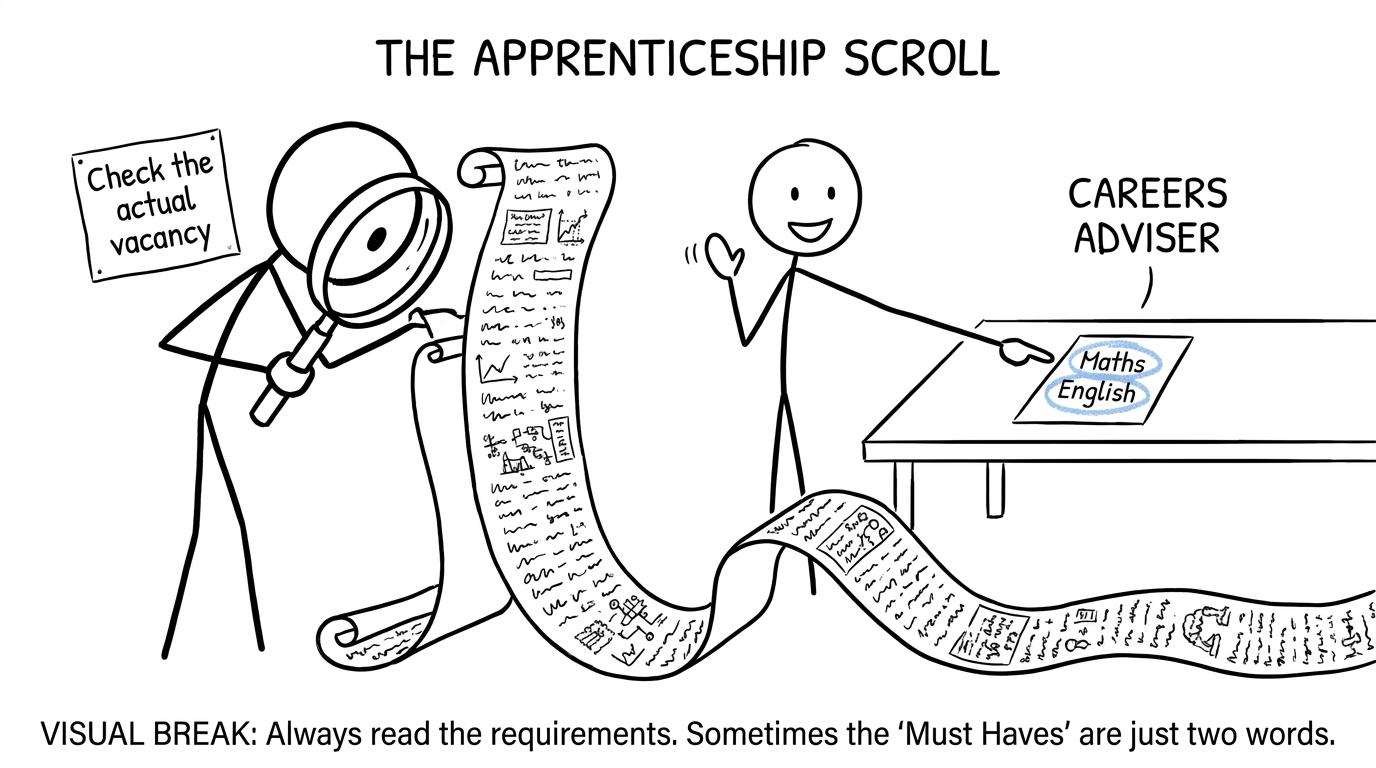 A student checks a long apprenticeship requirements list while a careers adviser points towards the important details
Do any apprenticeships require a particular GCSE Psychology grade?
There is no widely applied national apprenticeship route that currently sets a standard minimum GCSE Psychology grade for every applicant. Where such a grade is requested, it is normally a local recruitment decision made by an employer or training provider.
This distinction is easy to miss. An apprenticeship standard describes the occupation and the knowledge, skills and behaviours developed during training. A vacancy advert describes who one employer wants to recruit. The employer may add entry criteria beyond the apprenticeship standard.
Therefore, a vacancy could theoretically ask for GCSE Psychology at grade 444, grade 555 or another threshold. That would not make the same grade compulsory for every apprenticeship with a similar job title.
Psychology is also not offered as a GCSE in every school. Employers recruiting nationally would exclude many otherwise suitable candidates if they treated it as a universal requirement. Related evidence, such as health and social care, sociology, science, volunteering or experience supporting people, may therefore be more practical, although each advert must be checked individually.
Which psychology-related apprenticeship routes ask for instead
The phrase “psychology apprenticeship” can describe very different career stages. Some opportunities are suitable after GCSEs. Others are postgraduate professional training routes requiring a degree.
| Route or vacancy type | What is usually more important than GCSE Psychology |
|---|---|
| Mental health support or care roles | English, maths, communication, safeguarding awareness and suitability for the role |
| Healthcare support apprenticeships | Employer criteria, relevant experience and the ability to complete the programme |
| Psychological wellbeing roles | English and maths, prior education or experience, plus provider-specific selection criteria |
| Clinical psychology-related training | A recognised psychology degree or conversion course, professional eligibility and relevant clinical experience |
| Business, HR or people-focused apprenticeships | English, maths, communication and analytical skills rather than GCSE Psychology |
Clinical Associate in Psychology
Clinical Associate in Psychology training has historically been a Level 777 degree apprenticeship route in England. Official career information has required applicants to hold a psychology degree recognised for the relevant British Psychological Society graduate eligibility, or an accredited postgraduate conversion qualification. Relevant health, mental health or psychological service experience has also been important.
That is a university-level psychology requirement, not a GCSE Psychology requirement. Historic vacancies commonly asked for Level 222 English and maths, often expressed as GCSE grade 444 or above or an accepted equivalent.
The former national apprenticeship standard was retired for new starts in February 2025. Students researching this career should therefore check current NHS vacancies, professional guidance and apprenticeship listings rather than assuming an old advert describes an available route today.
Psychological Wellbeing Practitioner
The former Psychological Wellbeing Practitioner apprenticeship standard also focused on professional training, English and maths, relevant prior learning and the employer’s selection process. It did not establish a universal minimum GCSE Psychology grade.
That standard has been retired too, although the job title and other education or employment pathways may still appear. Old vacancy pages can remain visible in search results long after applications have closed, so always check the status and closing date.
School-leaver mental health and care routes
A school-leaver vacancy in mental health support, adult care, youth work or healthcare may value GCSE Psychology. However, adverts are more likely to describe it as relevant or desirable than to make one particular grade a national condition.
The practical rule is simple: if the advert says “GCSE Psychology desirable”, a lower grade or no qualification does not automatically make you ineligible. If it says “essential”, contact the named recruiter before applying if you do not meet it.
Why GCSE maths is more likely to affect your application
Psychological and care-based work may appear to be entirely about conversation, but numbers sit quietly underneath it. Staff may need to understand outcome measures, interpret tables, monitor change, work accurately with records or discuss evidence.
In England, current apprenticeship funding rules distinguish between apprentices aged 161616 to 181818 and those aged 191919 or over at the start of training. For younger apprentices who do not already hold suitable English and maths qualifications, these subjects remain a mandatory part of the programme. The requirements also depend on the apprenticeship level.
For apprentices aged 191919 or over, standalone English and maths qualifications can be optional where the employer agrees. However, this funding-rule flexibility does not stop an employer or university from setting English and maths grades as entry requirements for a particular vacancy.
In other words, do not read “optional during training” as “irrelevant when applying”. A vacancy can still require GCSE maths at grade 444 or above.
If maths is currently your vulnerable grade, begin with your own board and tier on the MathsGenie GCSE maths revision page. Students taking Edexcel can then use Edexcel GCSE Maths past papers with official mark schemes and worked solutions where available.
What to do if you are short of the stated Psychology grade
Being below a requirement is a problem to investigate, not a reason to disappear from the process.
Check whether the grade is genuinely essential
Recruitment language matters:
- Essential normally means the employer expects applicants to meet the condition.
- Desirable means it may strengthen an application but is not necessarily compulsory.
- Relevant subject may allow alternatives such as sociology, biology, health and social care or another social science.
- Or equivalent means you should ask which qualifications the provider accepts.
Do not claim a qualification you do not hold. Instead, make a brief, precise enquiry before the deadline. State your actual grade, mention any related qualification or experience, and ask whether the application can still be considered.
Show stronger evidence elsewhere
If the requirement is flexible, relevant evidence can make your application more convincing. Depending on the role, this might include:
- experience in a care, education or community setting;
- safeguarding training;
- a related GCSE, A Level or vocational qualification;
- evidence of communication, reliability and confidentiality;
- thoughtful understanding of the occupation;
- improvement in English or maths.
Experience does not automatically replace an essential qualification. Its value depends on the employer’s rules. But it can help where GCSE Psychology is only desirable or where equivalent evidence is accepted.
Consider a resit or an alternative route
If several suitable vacancies repeatedly ask for a grade you do not hold, a resit may be sensible. Ask your school, college or local examination centre what is available and check the relevant exam board specification, Edexcel, AQA, OCR or Eduqas, before preparing.
An alternative apprenticeship can also provide experience before you apply for a more specialised position. A support role in health, care or education may develop occupational knowledge without pretending to be the same as professional psychology training.
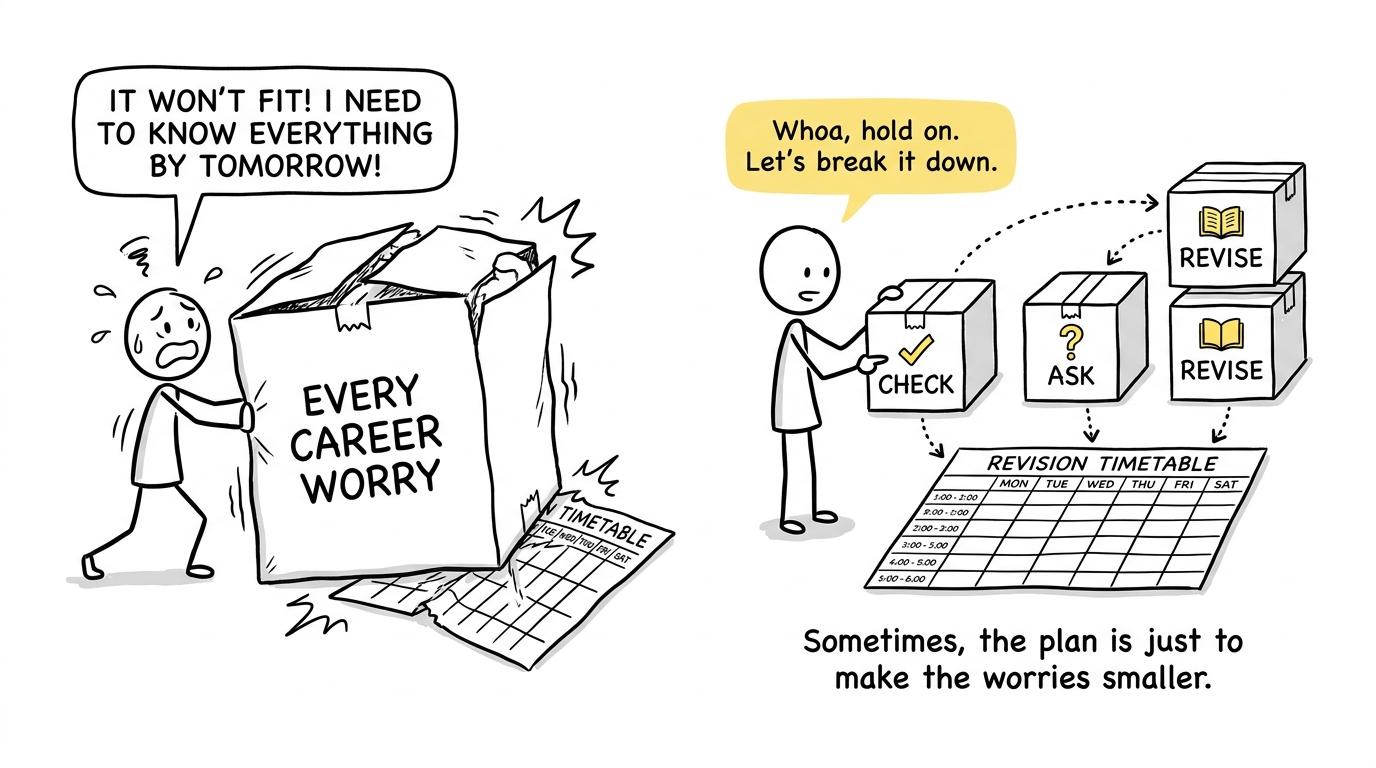 A student turns one giant box of career worries into three manageable boxes labelled Check, Ask and Revise
Turn uncertainty into a GCSE maths revision plan
Career research can create urgency. Use that energy carefully. If an apprenticeship asks for GCSE maths at grade 444 and your current performance is below that level, your next step should be specific rather than dramatic.
Start with a timed paper or mini test. Mark it, identify the topics costing you marks, revise those topics and test them again. The GCSE maths revision timetable guide explains how to build this into a realistic week.
If a full paper feels too large, use the 20-minute GCSE maths revision routine. Short practice is useful when it contains genuine retrieval, exam-style questions and immediate correction.
Past papers should become more prominent as your topic knowledge improves. The guide to using GCSE past papers properly shows how to turn each lost mark into a clear next action. Predicted papers can then provide fresh practice, but they should supplement official past papers rather than replace them.
Common mistakes when checking apprenticeship requirements
Assuming every psychology-related role is for school leavers
Some psychology-labelled apprenticeships are advanced professional routes. If an advert requires a psychology degree, improving a GCSE Psychology grade alone will not make you eligible.
Confusing GCSE Psychology with GCSE maths
An advert may ask for a psychology degree alongside GCSE maths and English. Read each line separately. The subject, qualification level and minimum grade all matter.
Treating desirable criteria as compulsory
Desirable criteria strengthen an application, but they are not the same as essential criteria. Apply honestly and explain the relevant evidence you do have.
Using an old vacancy as current guidance
Closed adverts can be useful examples, but standards, funding rules and provider requirements change. Confirm the date and find a live vacancy before planning around it.
Giving up without contacting the recruiter
A short question can establish whether an equivalent qualification is accepted. It cannot guarantee an exception, but it replaces guessing with reliable information.
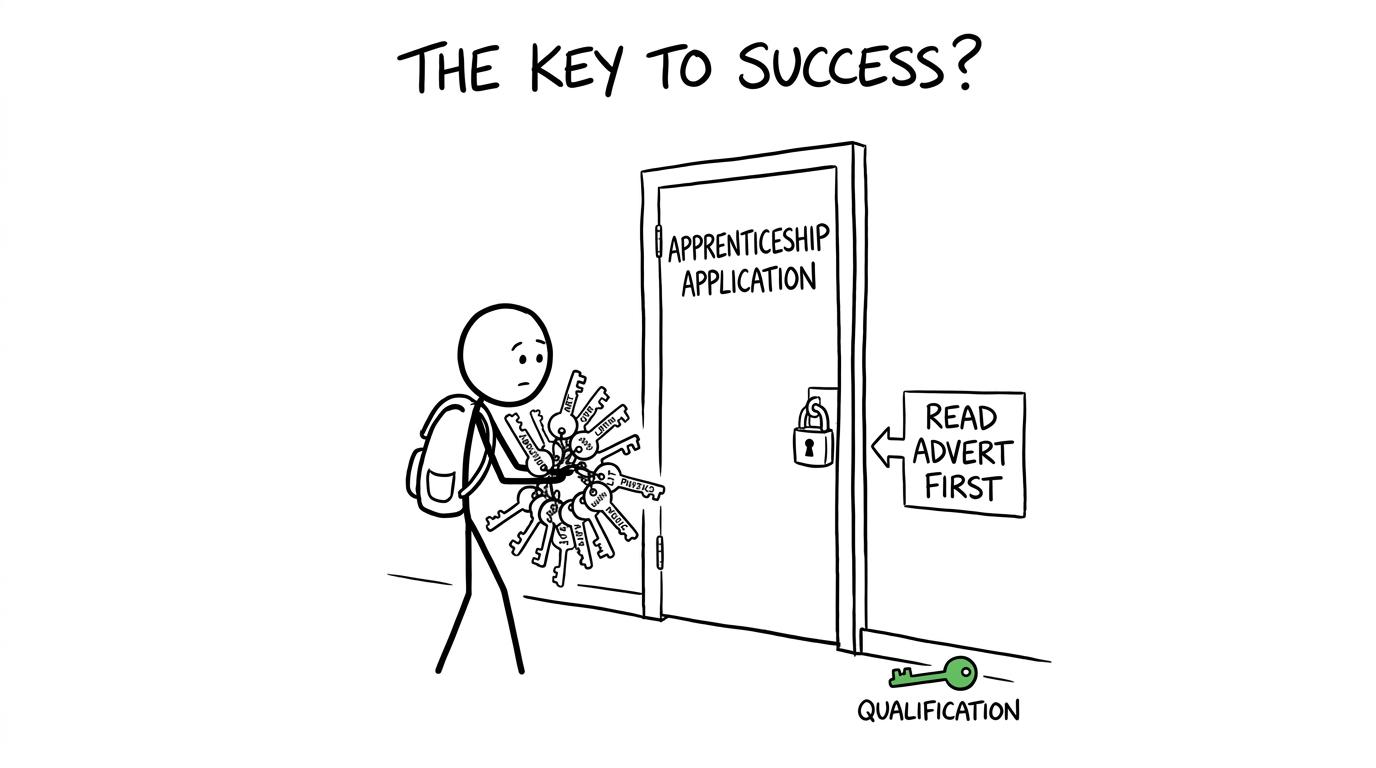 A student holds dozens of subject keys beside an apprenticeship door while a sign advises them to read the advert first
Your next step
A specific GCSE Psychology grade is rarely the universal gatekeeper students fear. Psychology-related apprenticeships are more likely to focus on maths, English, relevant higher-level study, experience and suitability. When GCSE Psychology is mentioned, the decisive source is the current vacancy and its essential criteria.
Check the advert. Ask a precise question if necessary. Then put your effort into the qualifications you can still improve.
MathsGenie gives you a free place to do that: revision lessons for understanding, practice questions for fluency, mini tests for quick diagnosis, and past papers, predicted papers, mark schemes and video solutions for exam preparation. If time is short, follow the one-month GCSE maths revision plan and turn an uncertain entry requirement into a clear revision target today.










