Apprenticeship GCSE Further Maths Requirement Guide
Apprenticeship GCSE Further Maths requirement explained: learn which routes may ask for it, how adverts differ, and what to do if your grade falls short.
You open an apprenticeship advert that looks ideal. The work sounds interesting, the location is manageable and you can imagine yourself doing the job. Then comes the qualifications section. Maths is listed. Perhaps Further Maths appears somewhere too. Suddenly, the whole application seems to depend on one line.
Here is the reassuring answer: there is no universal apprenticeship GCSE Further Maths requirement across UK apprenticeship routes. Employers commonly specify a grade in ordinary GCSE Maths, particularly for engineering, finance, digital and degree apprenticeships. A particular employer could request GCSE Further Maths, but current standards and vacancy evidence do not show a mainstream route that universally requires a specific grade in it.
The individual vacancy is what matters. Read its essential criteria, distinguish GCSE Maths from Further Maths, and ask the employer or training provider if the wording is unclear.
The short checklist
Before deciding whether you are eligible, check:
- Does the advert say GCSE Maths or GCSE Further Maths?
- Is the qualification essential, desirable or simply relevant?
- Does it name a minimum grade?
- Are equivalent qualifications accepted?
- Does a university or training provider impose separate requirements?
- Are Level 333 qualifications, such as A Level Maths, being requested instead?
- Can you contact the recruiter before the deadline?
For a wider explanation of entry criteria, read what GCSE grades apprenticeships may require.
 Student using a magnifying glass to find the essential requirement in an apprenticeship advert
Is GCSE Further Maths normally required for an apprenticeship?
Usually, no.
In England, apprenticeship levels have broad educational equivalents. Level 222 is associated with GCSE-level learning, Level 333 with A Level standard, Levels 444 and 555 with higher education, and Levels 666 and 777 with degree-level study. These comparisons describe the level of training. They do not create one national admissions rule for every vacancy.
Employers set their own recruitment criteria. Current Skills England standards repeatedly state that individual employers determine selection requirements, while live vacancies demonstrate how much these requirements vary. Some technical roles ask for GCSE Maths at grade 444 or 555. More selective engineering, economics or finance opportunities may ask for grade 666 or 777. Others make Maths desirable rather than essential.
The important pattern is that these requirements normally concern standard GCSE Maths, not GCSE Further Maths.
Rules also differ across England, Scotland, Wales and Northern Ireland. This article primarily reflects current arrangements in England, where the official vacancy and training provider should always be treated as the final authority.
What GCSE Further Maths actually means
The name can create confusion. The AQA Level 222 Certificate in Further Mathematics, commonly called GCSE Further Maths, is an additional Level 222 qualification. It sits alongside ordinary GCSE Maths rather than automatically replacing it.
AQA describes the qualification as suitable for learners expected to achieve grades 777, 888 or 999 in GCSE Maths and who may progress to A Level Maths or Further Maths. It extends familiar algebra and geometry while introducing content such as calculus and matrices.
That makes a strong result useful evidence of mathematical confidence. It does not, however, mean every mathematically demanding apprenticeship requires it. You can explore the qualification through the free AQA GCSE Further Maths revision hub, which includes lessons, questions, past papers and mark schemes.
Which apprenticeship routes actually set a minimum grade?
The careful answer is: no broad apprenticeship route identified in current national standards sets one universal minimum GCSE Further Maths grade.
A route name such as engineering, actuarial, digital or economics is not enough to determine the entry requirement. The employer, training provider and, for some degree apprenticeships, university partner decide what applicants need.
| Apprenticeship area | What vacancies more commonly request | Role of GCSE Further Maths |
|---|---|---|
| Engineering and manufacturing | GCSE Maths, English and sometimes science at specified grades | Helpful evidence, but not normally a route-wide requirement |
| Finance and accounting | GCSE Maths and English, sometimes with a higher Maths grade | Usually optional unless the advert explicitly names it |
| Actuarial and data roles | GCSE Maths plus Level 333 qualifications, often A Level Maths | Prior Further Maths may strengthen an application but is not automatically essential |
| Digital and software | GCSE Maths and English, with requirements varying widely | Relevant but rarely specified as a universal condition |
| Quantity surveying and construction | GCSE Maths and English, sometimes science or a technical subject | Generally not required unless named by the employer |
| Degree engineering | GCSE Maths and English plus A Levels, a T Level or relevant BTEC | Level 333 Maths or a Further Maths unit may matter more than GCSE Further Maths |
This distinction matters. Some degree engineering programmes accept a BTEC only if it contains a particular Level 333 Further Maths unit. That is not the same as requiring a particular GCSE Further Maths grade. Likewise, an actuarial vacancy may require A Level Maths at grade BBB while asking only for grade 444 in GCSE Maths.
Requirements are attached to the actual vacancy, not permanently to the occupation label. An advert opening next year may use different criteria from one advertised today.
Essential, desirable and alternative qualifications
Three words can change the meaning of an advert.
Essential
An essential requirement is intended as a minimum screening condition. If the vacancy explicitly says “GCSE Further Maths at grade 666 or above: essential”, assume the employer means it. Contacting the recruiter is still sensible if you hold a related qualification, but do not quietly substitute something else.
Desirable
A desirable qualification can strengthen an application without necessarily determining eligibility. If Further Maths is desirable and you did not take it, demonstrate mathematical interest through your standard GCSE Maths result, relevant projects, competitions, coding, technical subjects or other evidence requested by the employer.
Equivalent accepted
Do not decide for yourself that two qualifications are equivalent. Current apprenticeship guidance recognises specified qualifications for English and maths purposes, but an employer may impose a separate recruitment requirement. A Level Maths, Functional Skills Maths, Additional Maths and a Level 222 Further Mathematics certificate are not interchangeable in every admissions process.
Ask the employer or provider to confirm your qualification in writing. Keep certificates or official statements of results available, because providers may need evidence rather than a school-generated summary.
What to do if you are short of the stated grade
A disappointing result feels final because it is printed as a single number. Your response does not need to be final.
Check exactly which subject is below the threshold
A grade 555 in Further Maths does not mean you missed a grade 666 requirement in GCSE Maths. They are separate qualifications. Compare the exact certificate title with the advert.
Contact the recruiter before ruling yourself out
Ask a precise question: is the stated grade an absolute entry condition, and will the employer consider your achieved qualification or predicted result? Mention relevant alternatives without claiming equivalence.
If the criterion is desirable, applying may still be reasonable. If it is essential and the employer confirms there is no flexibility, focus your time on vacancies whose criteria you meet.
Search for the same occupation with other employers
One company’s threshold is not an industry-wide law. Search the same apprenticeship standard across several employers and levels. A Level 222 or Level 333 route may also create progression towards a higher apprenticeship later.
Improve standard GCSE Maths first
For most students, ordinary GCSE Maths has wider importance than the additional Further Maths qualification. Current rules in England also give English and maths a formal place within apprenticeship completion arrangements, particularly for apprentices aged 161616 to 181818 when they start.
If your standard Maths grade is the obstacle, begin with the GCSE Maths revision hub. Choose Edexcel, AQA, OCR or Eduqas resources that match your specification and tier. A student targeting grade 777 can also use the guide to what a grade 7 means and what comes next.
Build a revision loop around evidence
Start with a short diagnostic rather than revising everything. Use GCSE Maths mini tests to identify gaps, then repair them with revision lessons and practice questions.
After that, complete papers under timed conditions. The Edexcel GCSE Maths past papers, for example, include official mark schemes and worked solutions where available. Students following another board should select the matching papers from the main GCSE hub.
A realistic GCSE Maths revision timetable can turn this into a weekly process: learn, practise, mark, correct and retest.
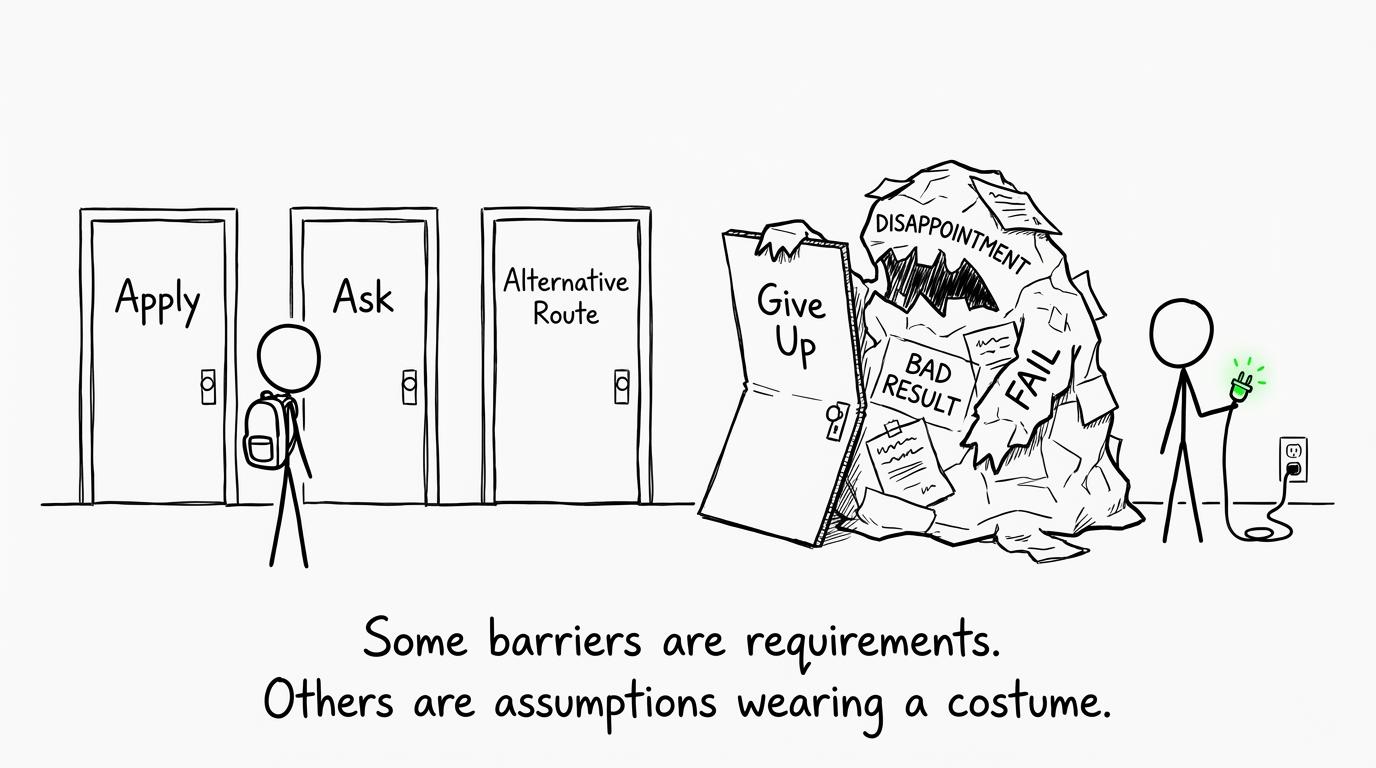 Student choosing between applying, asking and finding an alternative route
Common mistakes when checking apprenticeship requirements
Treating GCSE Maths and Further Maths as the same subject
They may both contain “Maths” in the title, but they are distinct qualifications. Quote the complete qualification title when asking about eligibility.
Assuming a high Maths requirement means Further Maths is required
An employer asking for grade 777 in GCSE Maths has not automatically asked for GCSE Further Maths. Do not add conditions that the advert does not contain.
Confusing GCSE Further Maths with A Level Further Maths
A degree apprenticeship may mention Further Maths among acceptable A Level subjects. That statement concerns Level 333 entry qualifications, not the additional Level 222 certificate.
Looking only at the apprenticeship level
A Level 666 apprenticeship does not have one fixed set of GCSE requirements. Two employers recruiting for similar degree apprenticeships can use different grades and subject combinations.
Giving up without checking whether a requirement is desirable
Read the wording carefully and ask. A desirable criterion is not automatically a rejection rule.
Neglecting ordinary GCSE Maths revision
Further Maths can be impressive, but standard GCSE Maths remains the qualification most frequently named in vacancies. Strengthen the result with the greatest reach first, then use Further Maths to extend your profile.
Your next step
The search for an apprenticeship can make one grade feel larger than it is. The better approach is quieter: read the precise requirement, confirm anything ambiguous and separate one employer’s decision from an entire career.
No mainstream apprenticeship route currently imposes a universal minimum GCSE Further Maths grade. Individual vacancies can set one, so the advert always wins. If you fall short, ask about flexibility, compare other employers, consider a progression route and improve the qualification that is genuinely blocking you.
Then turn uncertainty into preparation. Use MathsGenie’s free revision lessons, practice questions and mini tests to rebuild weak topics. Move on to past papers, video solutions and mark schemes, then use predicted topics and papers sensibly as exams approach. A requirement is useful information. Once you know exactly what it says, you can make a plan.