How to Use AI Tools to Revise GCSE Sociology
Use AI tools to revise GCSE Sociology safely with practical prompts, fact-checking steps, exam practice advice and warnings about unreliable answers.
Revision often becomes hardest at the moment it should become simplest. You have a specification, a stack of notes and limited time but you are not sure what to do next. That uncertainty explains why so many students want to know whether AI tools can help revise GCSE Sociology.
The short answer is yes. ChatGPT and similar tools can generate questions, clarify difficult language, organise revision and provide feedback prompts. But they can also invent studies, misrepresent sociologists and produce answers that sound convincing without meeting your exam board's requirements.
The safest principle is straightforward: use AI as a revision assistant, not as your source of truth or a substitute for thinking. Your specification, teacher guidance, textbooks, past papers and official mark schemes remain more reliable.
A quick AI revision checklist
Before using an AI-generated resource, ask:
- Does it match my exact GCSE Sociology specification?
- Can I verify every sociologist, study, concept and date?
- Am I retrieving knowledge, or merely reading another summary?
- Does the task help me practise an assessed skill?
- Have I removed personal or confidential information?
- Could I complete the same task without AI in the examination?
That final question matters. Revision should gradually make you less dependent on support, not more dependent on it.
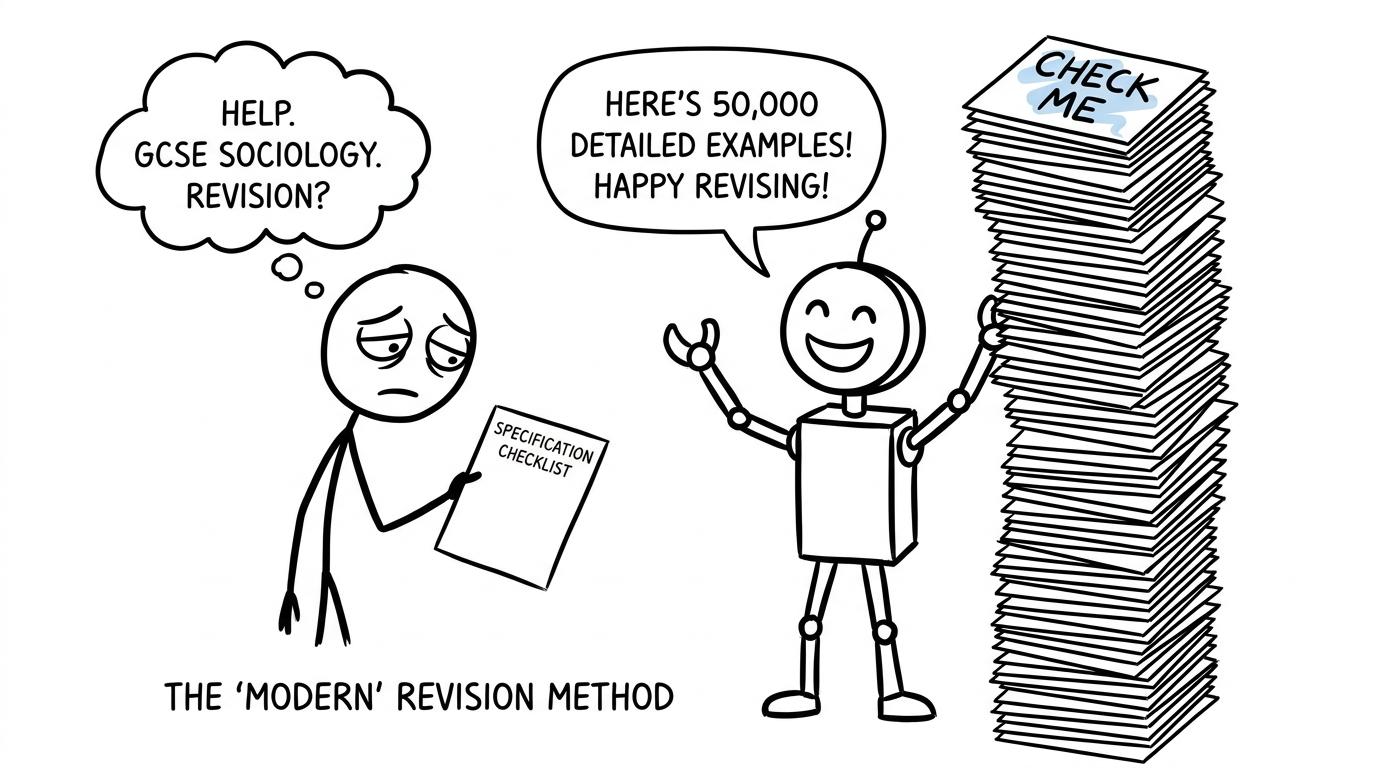 A student choosing a specification checklist over an enormous pile of AI-generated flashcards
Where AI tools genuinely help GCSE Sociology revision
Turning the specification into manageable questions
A specification can look like a list of content. In practice, it is the boundary of what you may be assessed on. AI can turn a small section into short-answer questions, flashcard prompts or a revision checklist.
Give the tool the precise topic wording and ask it to create questions without supplying the answers immediately. For example, you might request questions that test definitions, applications, comparisons and evaluation separately.
Keep the section small. Asking for an entire course in one prompt encourages broad, shallow material and makes errors harder to notice.
This approach transfers well across subjects. On MathsGenie, the GCSE maths revision resources similarly divide a large course into focused topics, videos and practice questions. Progress is easier when the next task is visible.
Explaining unfamiliar sociological language
Terms such as socialisation, stratification, validity, representativeness and cultural capital can become barriers if their meanings remain vague. AI can provide a first explanation in simpler language, then contrast related concepts or ask you to use a term in context.
A useful prompt should request:
- a concise definition;
- a distinction from a commonly confused term;
- a question requiring you to apply the concept;
- no invented studies or quotations.
However, simplicity has a cost. An explanation can become so compressed that it loses the qualification or nuance needed for a strong answer. Compare it with your course materials before adding it to your notes.
Creating retrieval practice
Reading feels comfortable because recognition is easier than recall. Examinations demand recall: the question appears, and you must produce relevant knowledge without seeing the answer first.
AI can act as a patient quiz partner. Ask for one question at a time, answer from memory, and then request a checklist of ideas you should compare against your verified notes. You can also ask it to revisit missed questions later in the session.
Do not let the tool reveal the answer too quickly. The pause in which you struggle to remember is not wasted time. It is the practice.
Planning answers without writing them for you
GCSE Sociology rewards more than remembered definitions. Depending on the question and specification, you may need to apply material, develop arguments, interpret evidence or evaluate a view.
AI can help you sort verified ideas into a plan. Give it the question, the command word and the relevant assessment guidance, then ask for planning questions rather than a finished response. Useful questions might include:
- What is the central claim?
- Which evidence would support it?
- What alternative explanation could challenge it?
- Have I connected each paragraph to the question?
- Is my conclusion based on the argument I developed?
You still choose the evidence and write the answer. That preserves the skill the examination is designed to assess.
Supporting quantitative and research-methods revision
Sociology may require you to interpret tables, graphs, percentages or research evidence. AI can generate verbal questions about patterns, reliability, validity, sampling and research design. Yet any generated dataset needs checking, especially if the tool claims it comes from real research.
If your confidence with numerical information is holding you back, use MathsGenie's free GCSE maths revision lessons to strengthen the underlying skills. Maths revision can make data interpretation in sociology feel less intimidating.
Where AI tends to lead students astray
Invented studies, quotations and evidence
Generative AI predicts plausible language. It is not a guaranteed database of verified facts. It may combine a real sociologist with the wrong finding, invent a publication or produce a quotation that nobody said.
This is particularly dangerous because fabricated details can look polished. Never put an AI-generated study, statistic or quotation into your revision notes until you have verified it against a trusted source supplied or approved for your course.
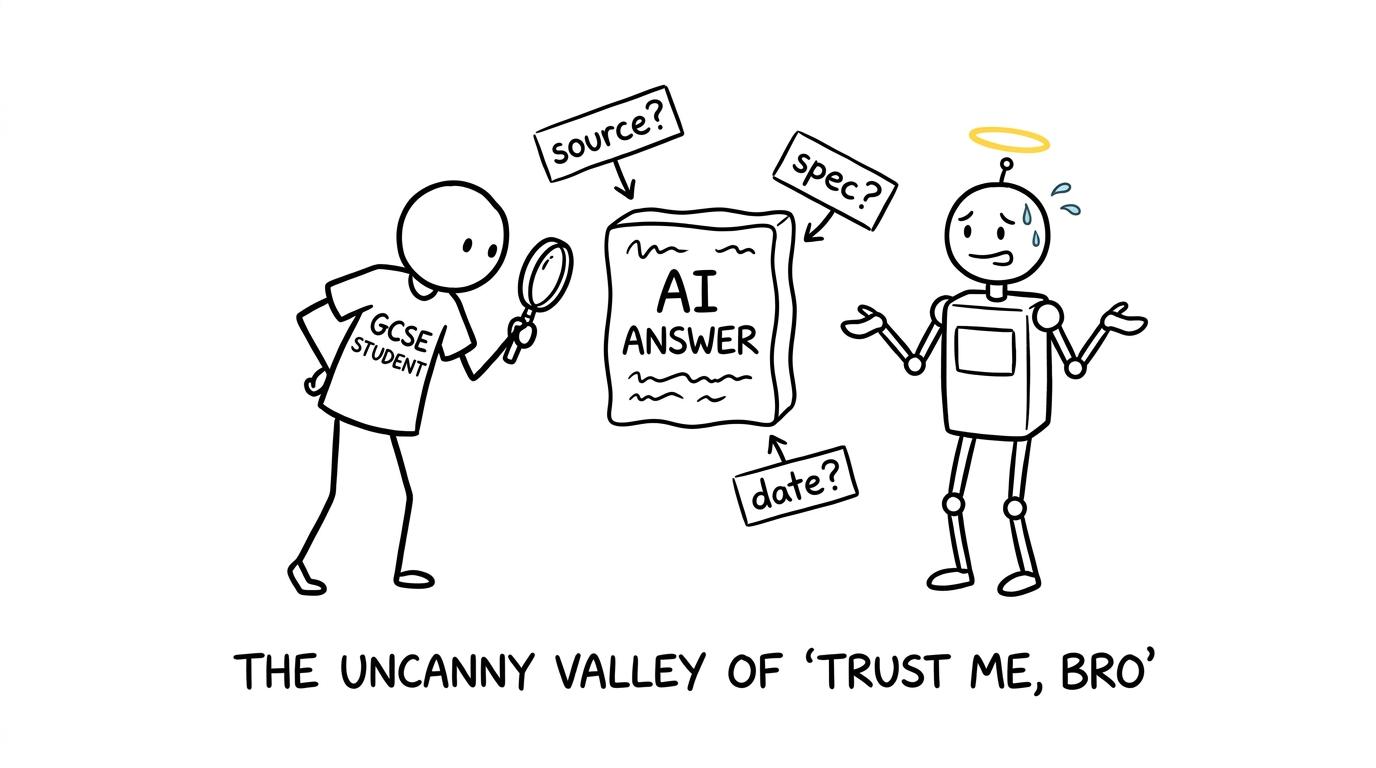 A student investigates an AI answer using clues labelled source, specification and date
Generic answers that ignore the specification
GCSE Sociology content is not identical across every awarding organisation. A response described as suitable for GCSE may still omit your required material, use unfamiliar terminology or reflect a different qualification.
Tell the tool your exam board and topic, but do not assume that this guarantees accuracy. Compare its output with the current specification and your teacher's guidance. If the two disagree, trust the official course material rather than the chatbot.
The same discipline matters in maths. Students should select resources for their qualification and practise using appropriate GCSE maths past papers, rather than relying on questions that merely look exam-like.
Feedback that sounds more authoritative than it is
AI feedback can spot repetition, unclear sentences and missing counterarguments. It cannot reliably award marks unless it has the correct question, level descriptors, indicative content and exam-board conventions and even then, its judgement may differ from an examiner's.
Ask for diagnostic feedback rather than a definitive grade. A better request is: “Identify where my argument becomes unclear and show me which claims need evidence.” Treat any estimated mark as provisional, then compare your answer with the official mark scheme or discuss it with your teacher.
Passive revision disguised as productivity
A perfectly formatted AI summary can feel like progress. Sometimes it is simply more material to read.
The useful test is whether you had to retrieve, decide, compare or write. If the tool completes every cognitive step, the session may produce attractive notes without improving examination performance.
A stronger sequence is:
- attempt a question independently;
- identify the gap;
- use AI for a targeted explanation or prompt;
- verify the information;
- close the tool and attempt another question.
That is also the logic behind MathsGenie's GCSE past-paper practice: an attempt reveals more about your needs than another hour of passive reading.
A safe workflow for revising with ChatGPT
Start with trusted course material
Choose one specification section, lesson handout or verified page of notes. Do not begin with the vague instruction “teach me GCSE Sociology”. A narrow source gives the conversation boundaries.
Give AI a limited role
Decide what you want it to do: quiz you, simplify a definition, question your reasoning or organise a checklist. Avoid asking it to become the examiner, textbook and answer writer at once.
Verify before saving
Check names, concepts, studies, dates and claims. If you cannot verify an impressive detail, leave it out. A shorter bank of accurate knowledge is more valuable than a large bank of uncertain material.
Finish without AI
Write a response, reconstruct a topic map or answer questions with the chatbot closed. This is the point at which support becomes learning.
Maths students can apply the same cycle through MathsGenie's topic-by-topic GCSE revision, followed by predicted maths papers and official past-paper practice. Predicted papers are useful practice, but they are not claims about exactly what will appear in an examination.
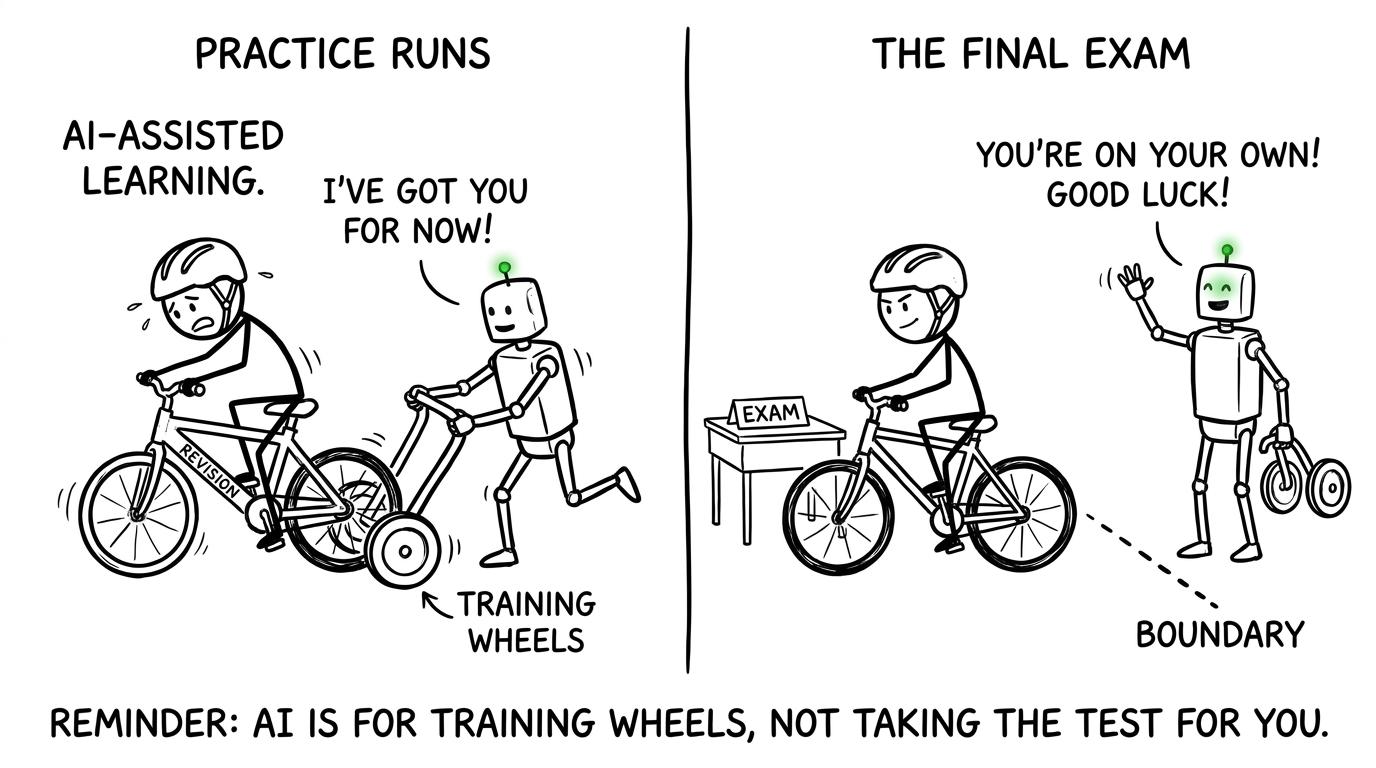 A robot removes revision training wheels as a student cycles independently towards an exam desk
Protect your work and personal information
Do not paste personal information, confidential school material or another student's work into a public AI service. Check the platform's age requirements and privacy terms, and follow your school's rules.
There is also an important distinction between revision and assessed work. Using AI privately to generate practice questions is different from submitting AI-generated writing as your own. For any non-exam assessment or school assignment, follow current teacher, school and awarding-body instructions. If AI use is prohibited or must be acknowledged, those requirements apply regardless of how small the contribution seems.
Common mistakes when using AI for sociology revision
Asking prompts that are too broad
“Revise sociology with me” gives the tool too much freedom. Name the specification area, task and output you need.
Copying answers before attempting questions
Seeing an answer creates familiarity, not necessarily recall. Attempt first, even when the first attempt is incomplete.
Trusting citations because they look academic
A plausible title is not proof that a source exists. Verify every reference independently.
Letting AI replace timed writing
Conversation can help you prepare, but examinations require sustained independent answers. Regularly practise under realistic time limits.
Ignoring command words and mark schemes
A knowledgeable response can still underperform if it does not answer the question being asked. Use official past questions and marking guidance to understand the required depth.
Using one revision method for every weakness
AI quizzes may help recall, but weak timing needs timed papers, weak structure needs answer planning, and weak knowledge needs accurate course materials. Diagnose the problem before choosing the tool.
Build revision that survives the examination
AI is most useful at the edges of revision: turning content into questions, exposing gaps and helping you see an idea from another angle. It becomes risky when it moves to the centre and starts supplying the facts, judgement and writing that you need to control yourself.
The goal is not to become brilliant at prompting. It is to walk into the examination able to think without the prompt box.
Use that principle across your subjects. For maths, begin with MathsGenie's free revision lessons and practice questions, test yourself with past papers and mark schemes, and use predicted papers as additional practice. Students continuing beyond GCSE can also explore the A Level maths revision resources.
Let AI help you decide what to practise next. Then close it, pick up the pen and do the thinking that earns the marks.