AI Tools to Revise GCSE Arabic: A Safe Guide
AI tools revise GCSE Arabic more effectively when used with care. Learn where ChatGPT helps, where it misleads, and how to check its feedback safely.
Revision becomes uncomfortable when you can produce an answer but cannot tell whether it is right. That problem is especially sharp in Arabic: a sentence may look polished while hiding an unnatural phrase, the wrong register or a grammatical error.
If you are searching for how AI tools revise GCSE Arabic, the short answer is that ChatGPT and similar tools can be useful for generating questions, rehearsing conversations, organising vocabulary and explaining corrections. They should not replace your teacher, specification, textbook, official past papers or mark schemes. AI can produce convincing mistakes, and the confidence of its wording is not evidence of accuracy.
The best role for AI is therefore not to do your revision. It is to create opportunities for you to retrieve, speak, write and evaluate Arabic.
A quick AI revision checklist
Before using an AI tool, keep these rules beside you:
- Check that every activity matches your exam board, tier and current specification.
- Ask for Modern Standard Arabic unless your course requires something different.
- Attempt each task before requesting feedback or a model response.
- Verify vocabulary, grammar and cultural claims with trusted course materials or your teacher.
- Never upload personal information, confidential school material or secure assessment content.
- Do not submit AI-generated work as your own.
- Use official past papers for the final test of exam readiness.
That last point matters. AI can imitate an examination question, but only official materials show exactly how your board has previously assessed the course.
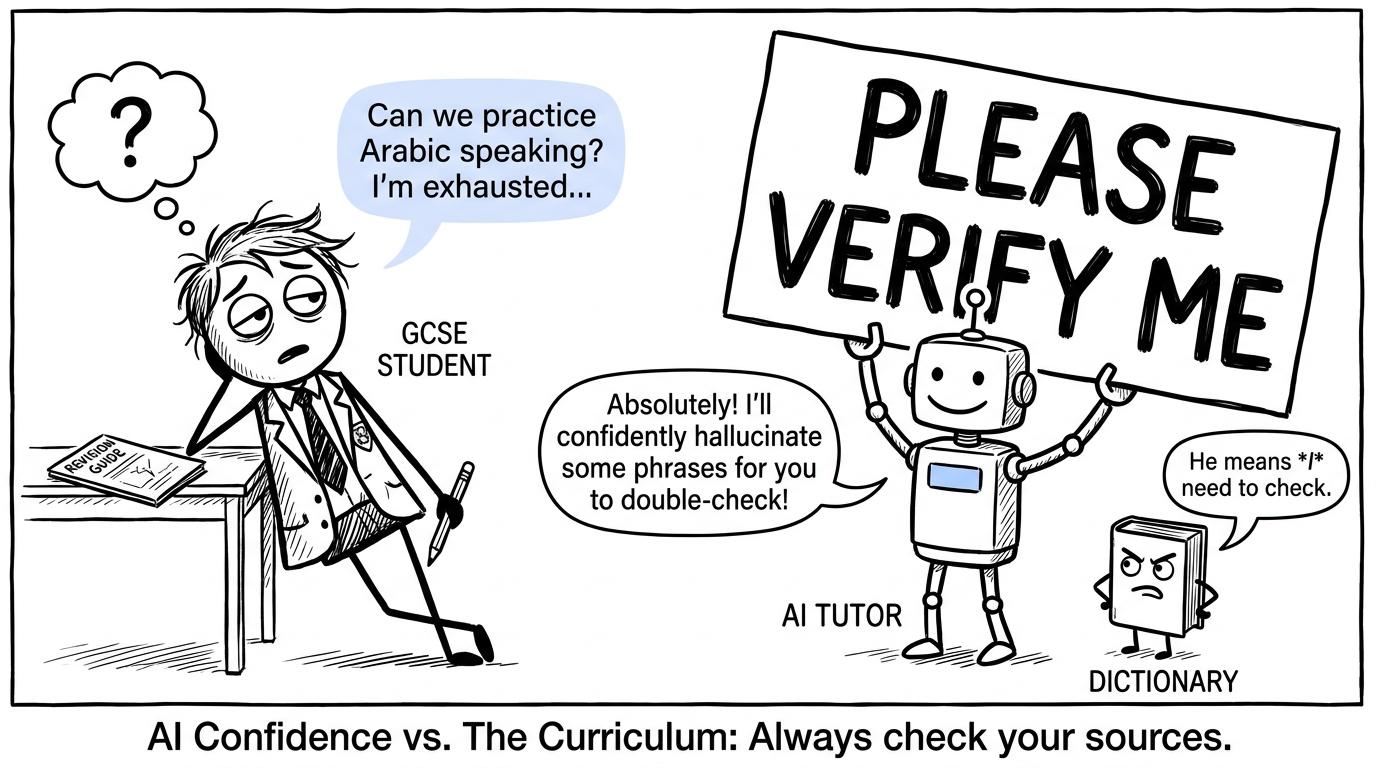 A robot tutor confidently asks to be verified during a revision session
Start with the GCSE Arabic assessment, not the tool
A useful revision resource begins with the assessment you will actually sit. For the current Pearson Edexcel GCSE Arabic qualification, listening, speaking, reading and writing each contribute 25%25\%25% of the qualification. Students take either foundation or higher tier and must enter the same tier across all four papers. Dictionaries are not permitted in the assessments.
The practical lesson is simple: an AI chatbot should not quietly turn your revision into endless vocabulary translation. You need balanced practice across all four skills, under conditions that gradually become closer to the real examination.
Specifications can differ between qualifications, particularly if your school offers an international GCSE rather than the Pearson Edexcel GCSE. Confirm your qualification code, tier, themes and paper structure with your teacher before asking AI to build a plan. Do not rely on the chatbot to identify them correctly.
This is the same principle that protects maths revision. An AQA paper is not interchangeable with an Edexcel paper merely because both contain algebra. MathsGenie's AQA GCSE Maths revision hub keeps board-specific materials together, while its Edexcel predicted papers reflect the relevant maths format. Your Arabic resources need the same specification-first discipline.
Where ChatGPT and AI tools can help
Generating retrieval questions
AI is good at producing volume. Give it a theme from your specification, a difficulty level and a narrow instruction, then ask it to quiz you one item at a time. This can make vocabulary recall more active than rereading a list.
Useful prompt instructions include:
- test meaning in both directions;
- mix nouns, verbs, adjectives and time phrases;
- return missed items later in the session;
- avoid showing the answer before you respond;
- keep a list of uncertain answers for human verification.
The crucial word is retrieval. If the tool immediately supplies the word, you have read something. If you must recall it first, you have practised something.
Rehearsing speaking interactions
A chatbot can act as a patient conversation partner. Ask it to take the role of an examiner, present one question at a time and wait for your answer. You can practise extending responses, giving opinions, justifying them and moving between past, present and future time frames.
Voice-enabled tools may also make speaking practice easier to begin. However, automated speech recognition and pronunciation feedback can mishear words or accept weak pronunciation. Treat the transcript as a rough signal, not an examiner's judgement. A teacher or proficient Arabic speaker is the safer source for detailed feedback on pronunciation, register and natural expression.
Creating short reading practice
AI can generate a short passage around a specified GCSE theme and ask questions about its main message, details and opinions. You can also request distractors so that the correct answer is not always obvious.
This works best as low-stakes practice between lessons. Check unfamiliar language before learning it, because generated passages may contain vocabulary outside your course or phrasing that is technically possible but unnatural.
Giving a first review of writing
After writing independently, you can ask AI to identify possible issues with agreement, verb forms, word order, spelling and range of language. Ask it to label suggestions as certain or uncertain and to explain each proposed change rather than silently rewriting the response.
Then make the final judgement yourself, supported by your teacher and course resources. If AI replaces the entire paragraph, the finished language may improve while your ability does not. In an examination, only the second of those matters.
Building a realistic revision plan
AI can turn your available time and topic list into a timetable. Give it fixed commitments, your weakest skill and the date of your next classroom assessment. Ask for short sessions containing retrieval, independent production and review.
A plan is only useful if it survives an ordinary Tuesday. Maths students can adapt the structure in MathsGenie's one-month GCSE revision plan: diagnose weaknesses, practise actively, mark carefully and revisit mistakes. The subjects differ, but the revision logic travels well.
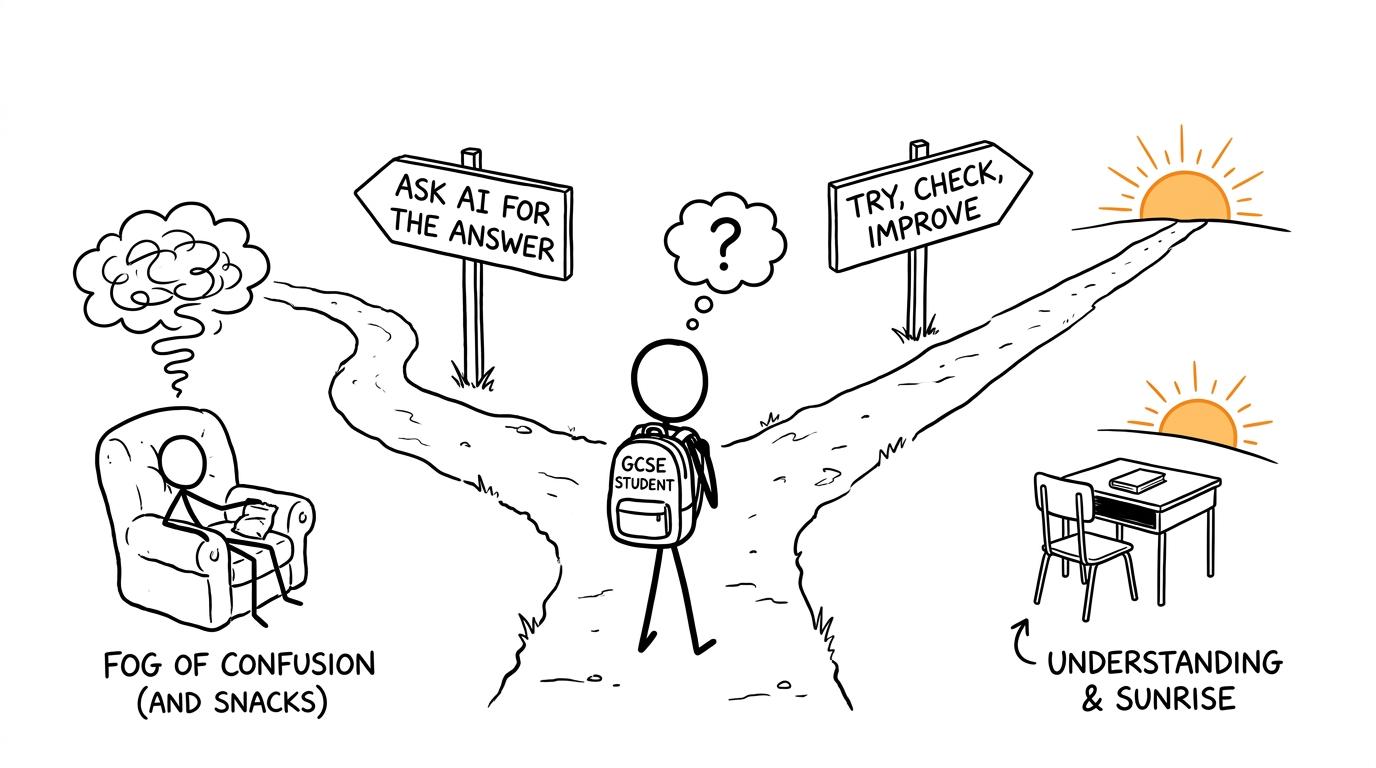 A student chooses between instant AI answers and active revision
Where AI tends to lead GCSE Arabic students astray
Confident but inaccurate Arabic
Generative AI predicts plausible language. It does not consult your mark scheme like an examiner before every answer. It may invent a rule, mistranslate an expression, mishandle agreement or give inconsistent corrections across two conversations.
Arabic adds further complexity because dialects, Modern Standard Arabic and different regional usage can become mixed. A response that sounds natural in one setting may not suit the language expected by your specification.
Feedback that does not match the mark scheme
A chatbot may praise sophistication while overlooking whether the response fulfils the task. It may also invent a mark or grade boundary. Unless the complete, current assessment criteria have been supplied and applied correctly, an AI-generated score is at best an informal estimate.
Use official mark schemes and teacher feedback to judge performance. This mirrors good maths practice: MathsGenie's guide to using GCSE past papers properly centres on marking, diagnosing and retesting rather than trusting a vague impression that the paper went well.
Revision that feels active but is passive
Prompting can become a sophisticated form of procrastination. You ask for a model answer, request a shorter version, turn it into flashcards and colour-code the vocabulary. Twenty minutes pass, but you have recalled and produced almost nothing yourself.
A better sequence is:
- attempt;
- check;
- explain the mistake;
- improve;
- repeat later without help.
AI belongs mainly in the middle of that loop, not at the beginning or end.
Privacy and assessment problems
Do not enter names, contact details, school login information or identifiable information about other people. Follow the age requirements, privacy terms and AI policy set by your school and the tool provider.
JCQ guidance is also clear that work submitted for assessment must be the student's own. AI-generated material must not be passed off as independent work, and AI tools must not be accessible during formal examinations or controlled assessments. If you are unsure whether a particular use is allowed, ask your teacher or exams officer before using it.
A safer workflow for AI-assisted Arabic revision
Use three layers of evidence.
The specification sets the destination
Write down the themes, grammar, vocabulary expectations, paper formats and assessment objectives for your exact qualification. This prevents a chatbot from steering you towards impressive but irrelevant material.
AI supplies extra practice
Use the tool for fresh questions, conversation turns, retrieval prompts and tentative explanations. Keep prompts narrow. Asking it to test one tense or one theme is safer and more useful than asking it to teach the whole course.
Authoritative materials make the final judgement
Finish with official past papers, mark schemes and teacher feedback. Record repeated errors and retest them without AI assistance. This reveals whether the learning is yours.
The method resembles MathsGenie's recommended order for learning GCSE maths topics: establish the underlying knowledge, use focused practice, then move into exam technique. You can reinforce that cycle in maths with GCSE predicted papers, but predicted material remains practice rather than a promise about the real paper.
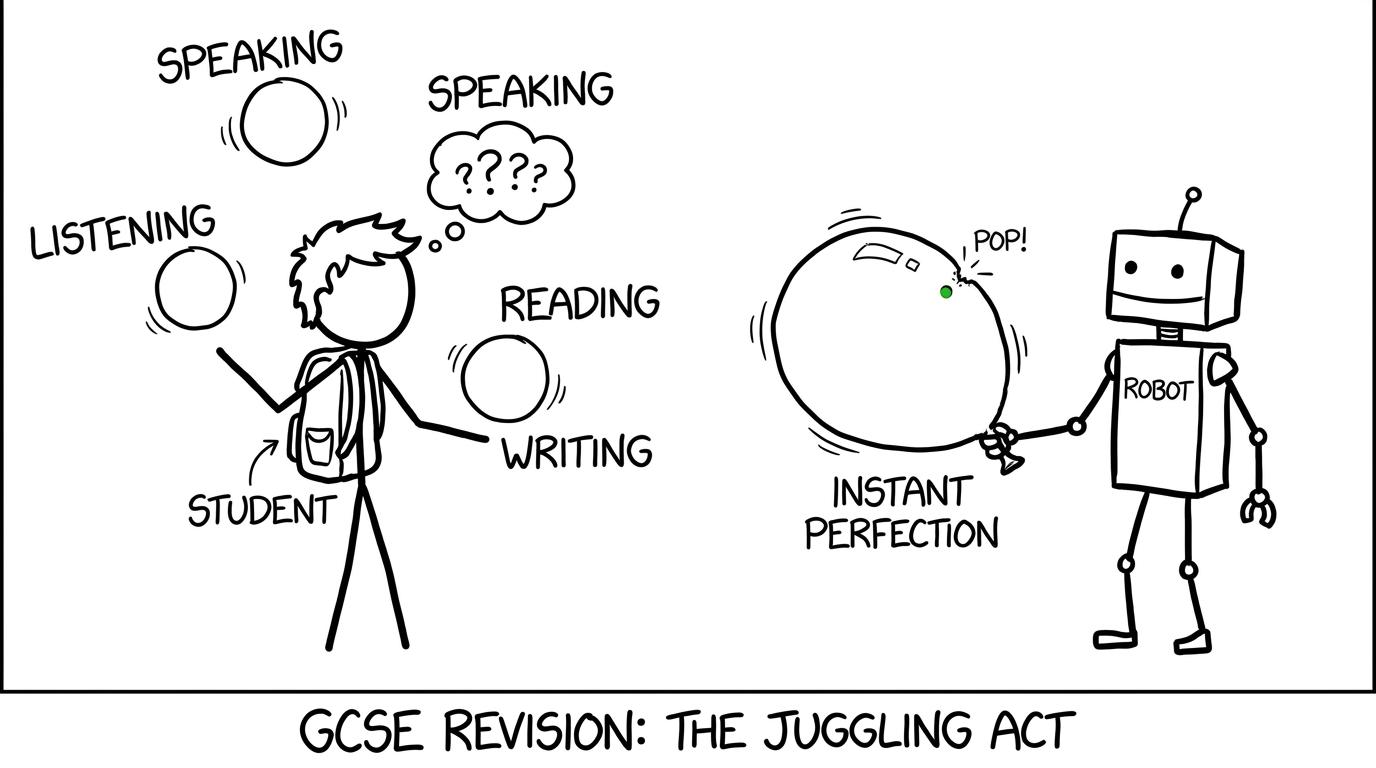 A student juggles the four language skills while a robot offers instant perfection
Common mistakes when using AI for GCSE Arabic
Requesting answers before attempting the task. This removes the productive struggle that makes retrieval stronger. Always answer first.
Trusting fluent wording automatically. Readability and accuracy are different qualities. Verify new vocabulary and every correction you plan to learn.
Forgetting the required form of Arabic. Tell the tool which register your course expects, then check that it has followed the instruction consistently.
Using only written chat. GCSE Arabic assesses listening and speaking as well as reading and writing. A balanced plan must not hide inside the easiest format.
Asking AI to predict a grade. A chatbot cannot replace official marking or professional judgement. Use it to identify possible issues, not to certify performance.
Keeping no error record. Save the type of mistake, the verified correction and a date for retesting. In maths, the same habit turns lost marks into specific action; the wider MathsGenie revision library provides lessons, questions and solutions for doing exactly that.
Use AI as a practice partner, not an answer machine
ChatGPT can make GCSE Arabic revision more responsive. It can ask another question when a textbook page is finished, simulate a conversation when no partner is available and help organise a week that otherwise feels shapeless. Those are meaningful advantages.
But the tool should increase the amount of thinking you do, not conceal how little you have done. Keep the specification in charge, verify unfamiliar language, practise all four skills and finish with official materials under realistic conditions.
Then apply the same honest loop to your maths preparation. Start with MathsGenie's free revision lessons, build fluency through practice questions and mini tests, and test yourself with past papers, mark schemes, video solutions and predicted papers. AI may help organise the journey. MathsGenie gives you the structured maths practice needed to turn that journey into marks.