

AI Quiz GCSE Art and Design: Use It Safely
AI quiz GCSE Art and Design tips for testing knowledge safely, checking weak answers and avoiding false claims while making your revision more productive.
Revision becomes difficult when two subjects ask you to think in completely different ways. Maths rewards precise methods and checkable answers. Art and Design asks you to investigate, experiment, record and create something personal. It can therefore be hard to know how to test yourself.
An AI quiz GCSE Art and Design tool can help with recall, terminology, artist research and assessment objectives. But it should be treated as a quiz partner, not an examiner or a source you automatically trust. AI tools can produce convincing but inaccurate information, and work submitted for assessment must remain your own.
The productive approach is simple: give the tool reliable source material, ask focused questions, answer without help, verify its feedback and keep AI-generated content away from your final portfolio unless your teacher has explicitly permitted and explained its use.
Your quick AI quiz checklist
Before opening an AI tool, remember these rules:
- Base questions on your exam board specification, class notes or teacher-approved resources.
- Tell the tool your exam board and subject title.
- Ask for one question at a time so you cannot glance at later answers.
- Answer from memory before requesting feedback.
- Make the tool separate facts from subjective interpretation.
- Check names, dates, artworks, processes and assessment rules independently.
- Do not submit AI-generated writing, images or ideas as your own work.
- Ask your teacher before using AI anywhere near assessed portfolio work.
The same principle improves maths revision. A quiz is useful for retrieval, but actual performance must eventually be tested through questions carrying marks. MathsGenie's GCSE Maths revision hub brings together revision lessons, questions and exam resources for that next stage.
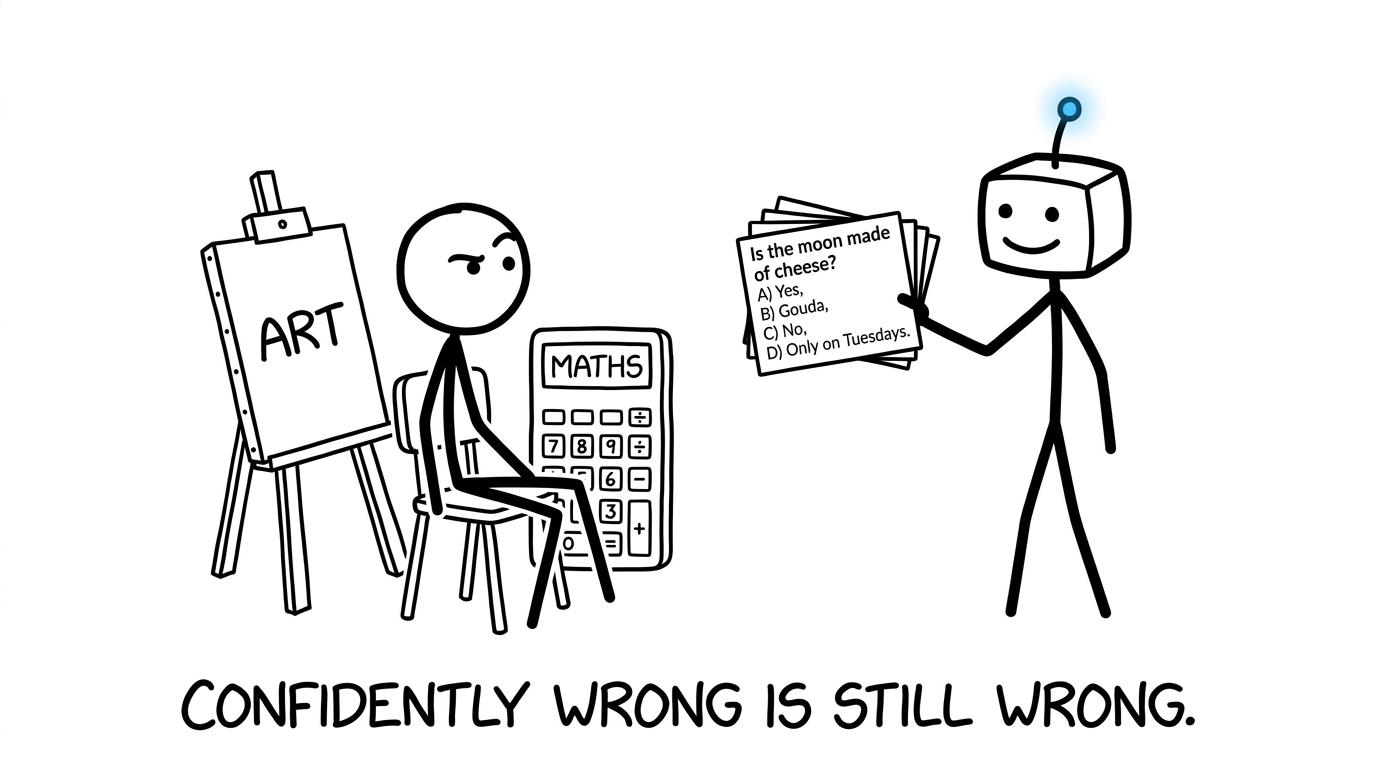 A sceptical student checks an overconfident robot quizmaster
What an AI Art and Design quiz can test well
GCSE Art and Design is not mainly a memory examination. Nevertheless, there is knowledge behind every thoughtful creative decision. AI is most helpful when it tests that supporting knowledge in small, focused pieces.
Assessment objectives
Across GCSE Art and Design specifications in England, the four assessment objectives concern developing ideas through investigations, refining work, recording ideas and observations, and presenting a personal and meaningful response. They are commonly described as AO1, AO2, AO3 and AO4.
Each objective accounts for 25%25\%25% of the overall assessment. An AI tool can test whether you can distinguish them, identify what evidence might support each one and explain why a particular activity belongs in one category rather than another.
It cannot reliably decide what mark your sketchbook deserves. Assessment depends on the quality, relevance and development visible across your work. Your teacher understands your specification, your project and the context in which the work was produced. A chatbot does not.
Vocabulary and processes
An AI quiz can be useful for checking terms such as composition, tone, texture, scale, negative space, primary research, contextual source and refinement. You can also ask it to test your understanding of processes you have genuinely used, such as printmaking, photography, painting, ceramics or digital editing.
Ask for questions that require explanation rather than simple recognition. Choosing a definition from four options can create familiarity without understanding. Explaining how a process affected your intentions demands more thought.
Artists, designers and contextual sources
AI can ask you about an artist's materials, subject matter, visual language and possible influence on your own investigation. This is valuable when the underlying facts come from reliable notes.
It becomes less dependable when asked to generate artist research from nothing. AI tools may confuse artists, invent artwork titles, give inaccurate dates or offer generic interpretations as though they were established facts. If the quiz introduces information you did not provide, treat it as an unverified lead rather than revision material.
How to set up an AI quiz productively
The quality of the quiz is largely determined before the first question appears. A vague request produces a broad, shallow test. A clear instruction creates something closer to deliberate practice.
Build a trusted source pack
Start with a small collection of material you already trust:
- your exam board's current specification;
- your teacher's assessment guidance;
- your own class notes;
- an approved vocabulary list;
- accurate notes about the artists and designers you studied;
- the processes and materials you actually explored.
Paste only the relevant section into the tool, if your school's rules and the platform's privacy arrangements allow it. Never upload personal data, teacher comments, unpublished assessed work or identifiable photographs without permission.
Tell the AI to use only the supplied material. This does not guarantee accuracy, but it narrows the space in which the tool can improvise.
Give the tool a precise instruction
A productive prompt should state:
- the qualification and exam board;
- the topic being tested;
- the number and style of questions;
- whether questions should arrive individually;
- when feedback should be shown;
- what the tool should do when the source pack does not contain an answer.
For example, you could instruct it to quiz you one question at a time on AO1 to AO4, use only your supplied notes, wait for your response and label anything uncertain. That is not a request for completed coursework. It is a request for retrieval practice.
Answer before seeing any help
The moment between reading a question and producing an answer is where retrieval happens. Do not ask for hints immediately. Write or say what you remember, then compare it with the source material.
Use a simple confidence label after each response:
- secure;
- partly secure;
- guessed;
- incorrect.
Revisit guessed answers as well as wrong ones. A lucky answer is not yet dependable knowledge. Maths students can apply the same habit after an Edexcel GCSE Maths mini test: confidence and correctness are different pieces of evidence.
Make the AI show its limits
Ask the tool to state which part of your source material supports its feedback. If it cannot point to that material, check the claim yourself. You can also ask it to say, "The source does not contain enough information," rather than fill a gap.
This turns scepticism into part of the revision exercise. You are not merely remembering content. You are judging evidence, specificity and relevance, useful habits in both Art and Design and maths.
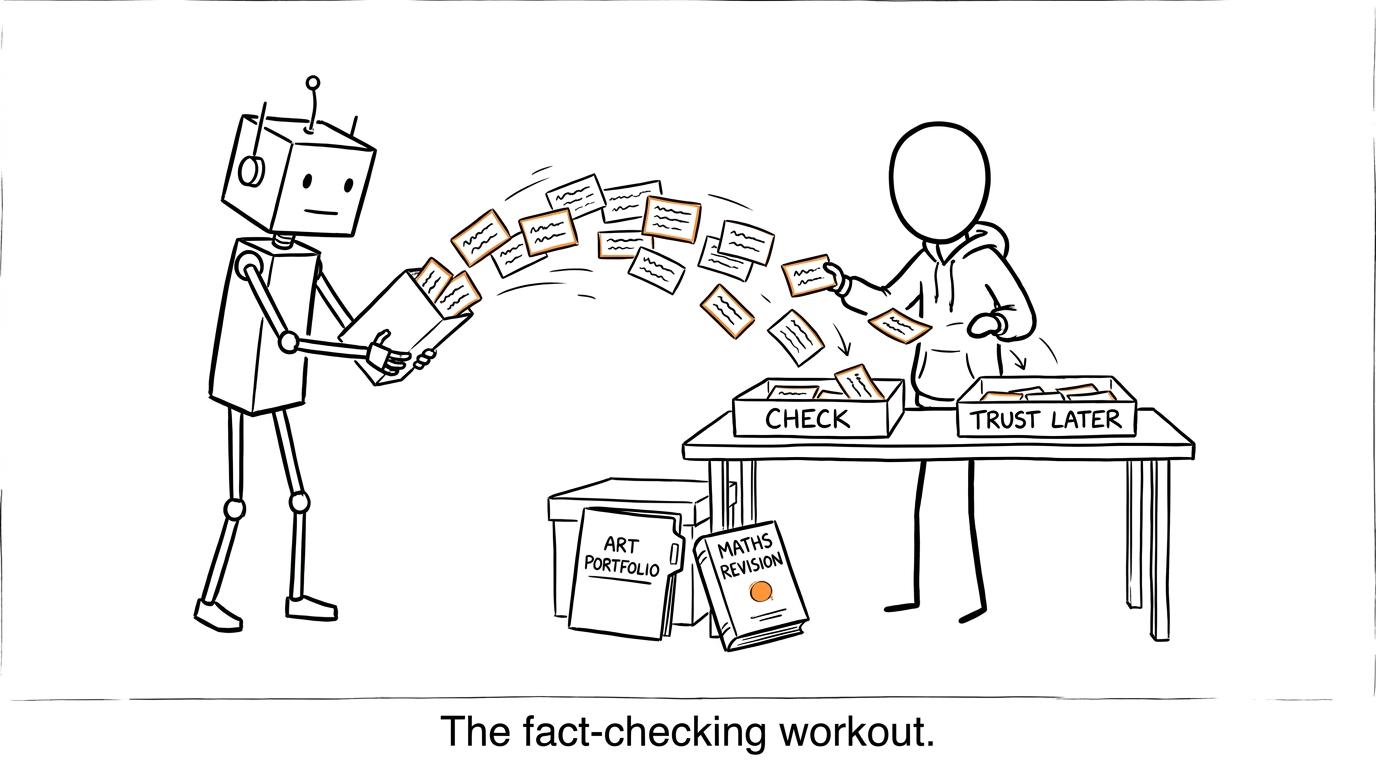 A student sorts robot quiz cards into checking trays
Where AI tends to give bad information
The most dangerous AI answer is not obviously ridiculous. It is smooth, specific and slightly wrong.
Invented artistic facts
An AI tool may create plausible artwork titles, exhibitions, quotations, dates or techniques. Never add one of these claims to your notes merely because the wording sounds authoritative. Check it against a museum, gallery, artist archive, published book or teacher-approved source.
Generic portfolio advice
Advice such as "experiment more" or "make the final piece personal" may sound sensible but is too broad to guide a real project. Useful feedback must connect to your intentions, materials, development and assessment evidence.
AI has not watched your project evolve. It may overvalue polished final work while overlooking investigation, recording and refinement. Your teacher remains the right person for assessment feedback.
Confusion between specifications
A tool may mix GCSE with A Level, use guidance from a different exam board or confuse an Art and Design title with another endorsed route. AQA, Edexcel, OCR and Eduqas specifications share nationally defined assessment objectives, but their documents, terminology and administrative details should still be checked directly.
Always name your board and qualification. If the tool gives precise rules about submissions, supervised sessions or deadlines, verify them with your teacher and current specification.
Overconfident marking
Do not ask AI to predict a grade from a photograph of one page. GCSE Art and Design assessment considers a body of evidence, and image quality can conceal texture, scale, process and physical detail. A numerical-looking judgement is not automatically an objective one.
This is where art revision differs from marking a maths paper. In maths, an official mark scheme can show how marks are awarded. MathsGenie's GCSE past paper collection lets students practise with real papers and then compare their work with official schemes.
AI rules for assessed Art and Design work
Private self-quizzing is different from using AI to create submitted content. Current JCQ guidance states that work submitted for qualification assessment must be the student's own. Unacknowledged AI-generated material, or work heavily derived from it, can amount to malpractice.
Where AI use is permitted, JCQ guidance requires appropriate acknowledgement. Students may need to retain the questions and generated responses, identify the tool and date, and explain how the content was used. Subject-specific or school rules may be stricter, so speak to your teacher before using AI for research, annotation, idea generation or image production.
Even acknowledged AI content does not demonstrate your independent skills merely because it has been referenced. In Art and Design, your marks come from evidence of your own investigation, decisions, recording, experimentation and personal response.
A safe distinction is:
- Revision quiz: AI asks questions about trusted notes for private practice.
- Assessed work: your own authenticated creative development, following teacher and exam-board rules.
Keep that boundary clear.
Common mistakes when using an AI quiz
Letting the tool teach before it tests
If the AI explains everything first, the quiz measures recognition rather than recall. Ask for the question, answer independently and request feedback afterwards.
Accepting every correction
An AI correction can itself be wrong. Check unfamiliar facts and challenge feedback that contradicts your source pack.
Revising only definitions
Knowing vocabulary matters, but Art and Design also requires you to connect sources, intentions, experiments and decisions. Include questions beginning with "why", "how" and "which evidence".
Uploading assessed material carelessly
Do not upload sketchbook pages, student information or teacher feedback without permission. Consider privacy, school policy and assessment rules before sharing anything.
Using quizzes instead of making work
No quiz can replace observing, drawing, photographing, testing materials, refining ideas and producing your response. The tool should support thinking, not perform the assessed process.
The same trap appears in maths when students watch solutions without attempting questions. Move from recall to genuine practice through MathsGenie's free GCSE maths resources, then use Edexcel past papers with mark schemes to test whether the method survives under exam conditions.
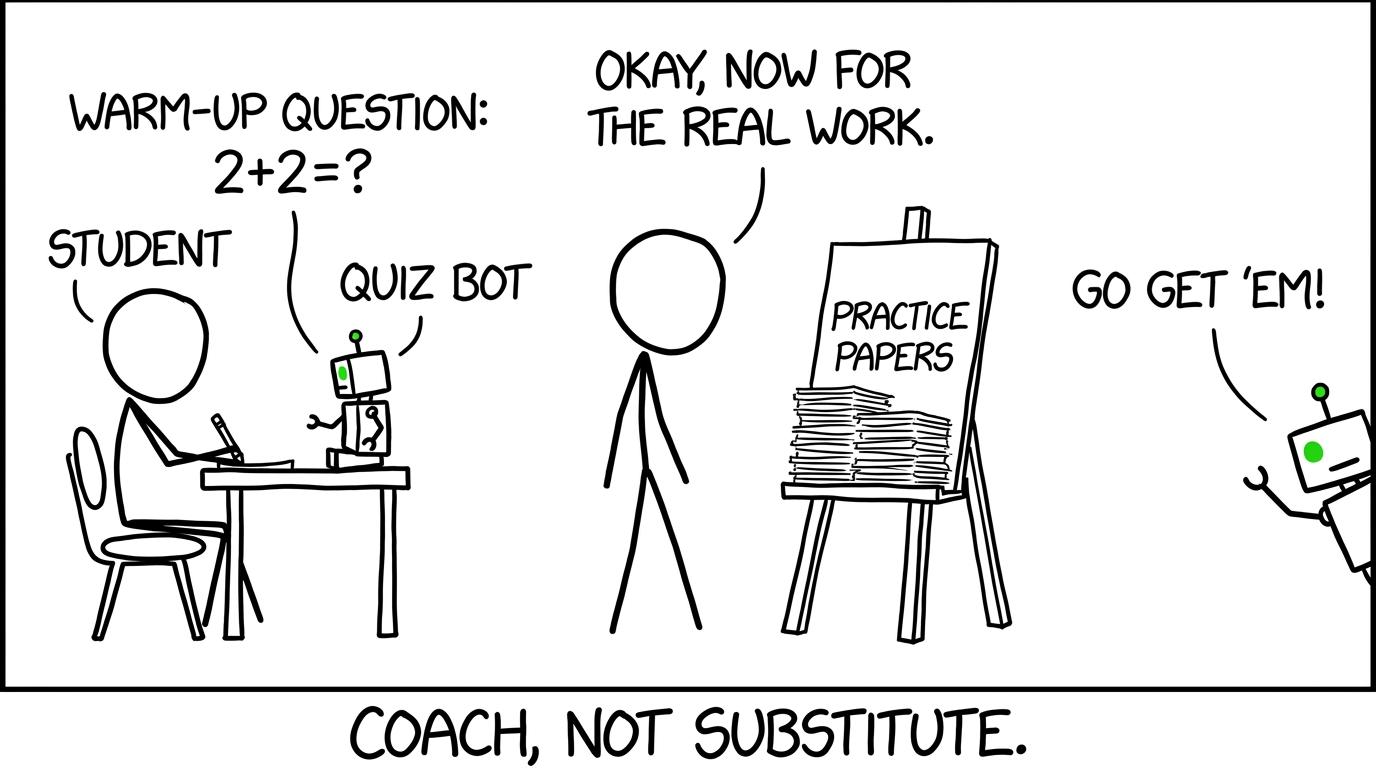 A small quiz robot acts as coach while the student does the real work
Fit Art quizzes around maths revision
Students preparing for several GCSEs need a system that changes with the subject. A short Art and Design recall quiz can work as a warm-up or lower-intensity session. Maths needs written calculation, method and timed problem-solving.
A balanced revision cycle could contain:
- a short AI quiz based on verified Art and Design notes;
- practical or analytical Art and Design work completed independently;
- one focused maths revision lesson;
- exam-style maths questions marked immediately;
- a later retest of whatever went wrong.
For maths, use the twenty-minute GCSE revision routine when time is limited. As exams approach, add Edexcel predicted papers for fresh exam-style practice, while remembering that predicted papers complement rather than replace real past papers.
Use AI as a coach, not an authority
Yes, you can get an AI tool to quiz you on GCSE Art and Design. It works best for structured recall based on material you already trust. It works badly when asked to invent research, judge an entire portfolio, predict a grade or replace your independent creative decisions.
Keep the useful part: quick questions, immediate retrieval and a record of weak areas. Reject the dangerous part: false certainty and work that is no longer demonstrably yours.
Then give each subject the practice it needs. For maths, start with MathsGenie's free revision lessons and practice questions, identify gaps with mini tests, and build exam confidence through past papers, predicted papers, mark schemes and video solutions. The purpose of any tool is not to do the thinking for you. It is to make your next piece of thinking more focused.










