Can Adults Retake GCSE English Language and Literature?
Adults retake GCSE English Language and Literature with this clear guide to courses, private entry, exam dates, funding, fees and revision.
The envelope containing an old GCSE result can feel heavier than paper should. Perhaps English is blocking a university application, an apprenticeship or a change of career. Perhaps you passed Language years ago but now want Literature for personal satisfaction.
The short answer is yes: adults retake GCSE English Language and Literature throughout the UK. You can enrol at a college or adult learning provider, take an online course, or prepare independently and enter through an exam centre as a private candidate. English Language and English Literature are separate GCSEs, however, so you must decide whether you need one or both before booking anything.
The route is manageable once you separate it into decisions: which qualification, which exam board, where to learn and where to sit the examinations.
Adult GCSE English retake checklist
Before paying for a course or examination entry, check the following:
- Confirm whether you need English Language, English Literature or both.
- Ask the organisation requesting the GCSE which grade it requires. Grade 444 is broadly regarded as a standard pass, while grade 555 is a strong pass.
- Find out whether a local college or adult education provider offers funded tuition.
- Check the exam board and specification before buying resources.
- Confirm which examination series is available.
- Ask a private centre about entry fees, administration charges and access arrangements.
- Check how the English Language spoken language endorsement will be handled.
- Build a revision timetable that also protects time for maths or other GCSEs.
These questions matter because taking a GCSE is not simply a matter of arriving at a school on exam day. Someone must enter you with an exam board, verify your identity, manage the required assessments and issue your result.
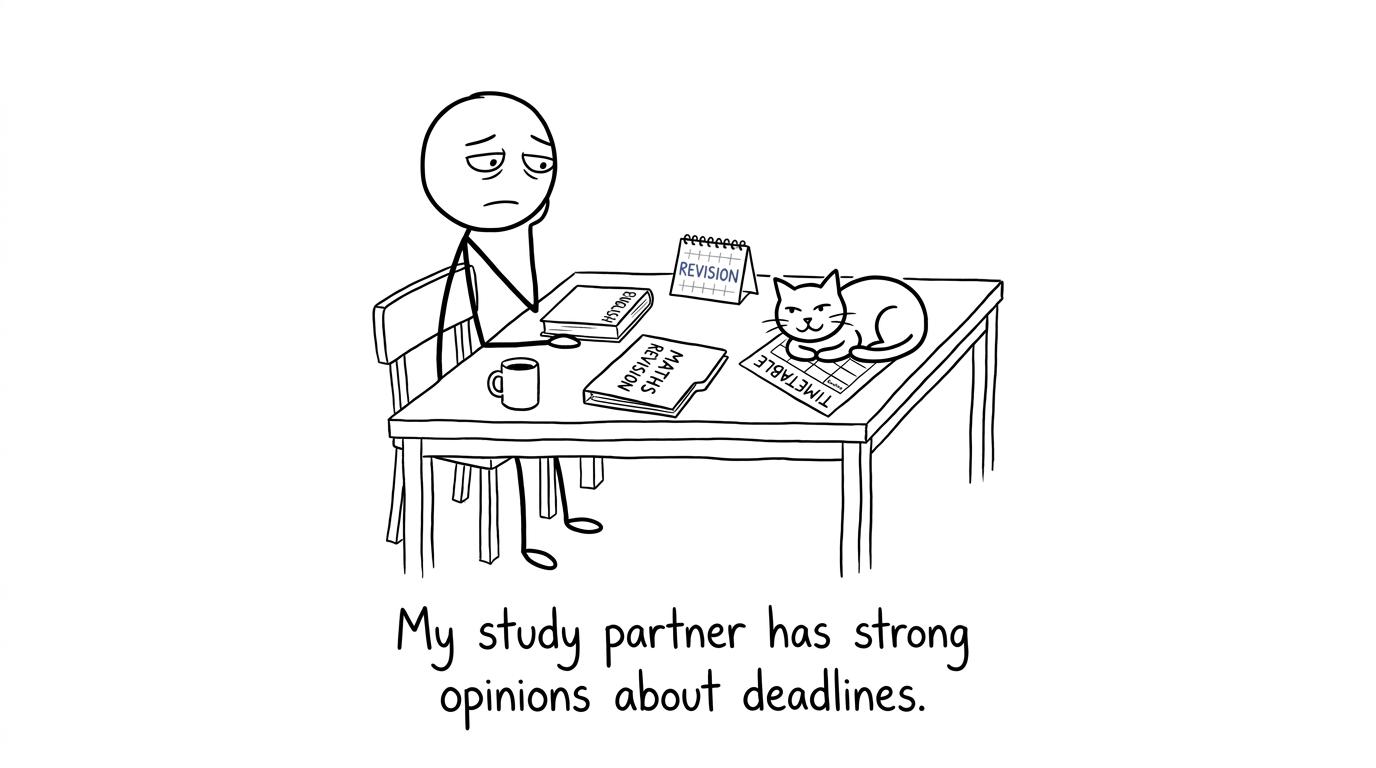 An adult learner revises while a cat takes control of the timetable
English Language and Literature are different GCSEs
The names sit beside each other, but the qualifications assess different skills.
GCSE English Language focuses on reading unfamiliar fiction and non-fiction, analysing how writers communicate, comparing texts, and producing accurate, effective writing. It also includes a spoken language endorsement, which is reported separately from the grade 999-111 result.
GCSE English Literature concerns set texts. Depending on the exam board specification, these may include a Shakespeare play, a nineteenth-century novel, poetry and modern prose or drama. You need detailed knowledge of the texts as well as the ability to construct an analytical argument.
Neither qualification is divided into foundation and higher tier. That differs from GCSE Maths, where your tier determines the range of available grades and questions. Adult learners preparing for both subjects can review the tier structure through the GCSE Maths revision resources.
For many employment, college and university requirements, English Language is the qualification being requested. English Literature is valuable, but it is not automatically a substitute. Ask the employer or admissions team directly rather than assuming that any English GCSE will meet the condition.
How adults retake GCSE English Language and Literature
Enrol at a further education college
A local further education college is often the simplest starting point. Colleges may offer daytime or evening classes, with teaching, examination entry and feedback organised together.
This route suits learners who want deadlines and regular contact with a teacher. It can be particularly helpful for Literature because a tutor can guide you through the correct set texts and help you refine analytical essays over time.
In England, eligible adults who do not already hold GCSE English Language at grade 444 or above, or an equivalent qualification, may be able to access fully funded provision. Funding rules, residency requirements and course availability can change, while arrangements differ in Scotland, Wales and Northern Ireland. English Literature is not normally covered by the same English legal entitlement. Always confirm eligibility with the provider before enrolling.
Use an adult learning provider
Councils, community learning services and specialist training providers may also run GCSE English courses. Their timetables can be more flexible than conventional school hours, although not every area offers both Language and Literature.
Ask whether the quoted course includes examination entry. A low tuition price can become less attractive if you must later locate and pay a separate exam centre.
Take an online or distance-learning course
Online courses can work well around employment, caring responsibilities or travel. The important distinction is between learning and entry: an online provider may teach the specification without providing a physical place to sit the examinations.
Before enrolling, ask:
- Which exam board and specification does the course follow?
- Does it include marked assignments and individual feedback?
- Are the Literature set texts included?
- Is examination entry part of the price?
- How is the spoken language endorsement arranged?
- What happens if you need access arrangements?
Recorded lessons offer flexibility, but feedback is what reveals whether an answer is becoming more precise. Look beyond the size of the video library.
Prepare independently as a private candidate
You do not have to attend a course. An independent learner can study the specification, contact an approved centre that accepts private candidates, pay the required fees and sit the papers there.
The centre might be a school, college or dedicated examination venue. Not every centre accepts private candidates, and a centre accepting one exam board may not offer every subject or specification. Contact centres early and obtain written confirmation of what is included.
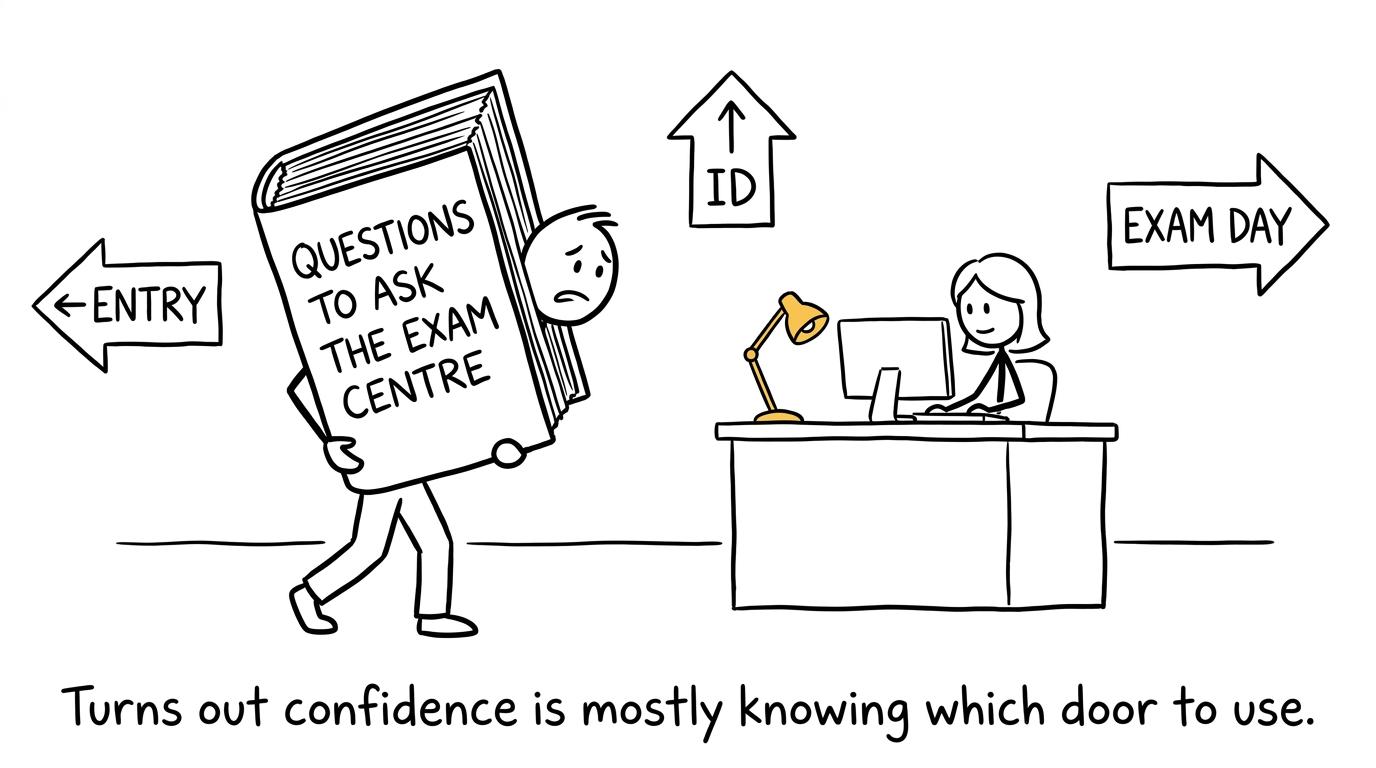 A private candidate arrives prepared with questions for the exam centre
Choosing an exam board and examination series
AQA, Pearson Edexcel, OCR and Eduqas offer GCSE English qualifications, but you cannot mix papers from different specifications. Your exam centre's available board will usually determine which course materials, set texts and past papers you need.
GCSE English Language is generally available in the summer series. In England, a November opportunity is also available for eligible post-161616 candidates, but exact entry conditions and centre availability must be checked for the relevant year. English Literature is generally taken in the summer rather than November.
Do not assume that every centre offers a November sitting simply because the exam board has one. Centres decide which entries they can administer, and private-candidate deadlines may be earlier than the exam board's final deadline.
The English Language spoken language endorsement needs particular attention. Ask whether a previous result can be carried forward under the board's rules or whether the centre can assess a new presentation. It does not contribute to the numerical GCSE grade, but it is separately reported as Pass, Merit, Distinction or Not Classified.
What will an adult GCSE retake cost?
There is no single private-candidate price. The total can include:
- tuition or online course fees;
- the exam board entry fee;
- the centre's administration charge;
- a charge for the spoken language assessment;
- late-entry fees;
- textbooks and Literature set texts;
- fees connected with approved access arrangements.
Request an itemised quotation before committing. Ask whether a resit, transfer or withdrawal would create further charges. If you may qualify for funded English Language tuition, speak to a college or adult education service before paying a commercial provider.
Planning English alongside GCSE Maths
Adults often return to English because a course or employer also asks for maths. Two qualifications can feel like twice the pressure, but they do not need identical revision methods.
English improves through regular reading, planning, writing and feedback. Maths improves through understanding a method, applying it to questions and correcting errors. Both reward consistency more than occasional heroic revision sessions.
A practical weekly plan might contain short English reading sessions, one timed writing task and several focused maths sessions. For maths, use MathsGenie's free revision lessons to revisit weak topics, then move to GCSE past papers and mark schemes once individual skills are secure.
Past papers should not merely generate a score. They should generate a list of decisions: which topics need reteaching, which errors came from timing, and which marks disappeared because working was unclear. That principle applies equally to an English essay and a maths paper.
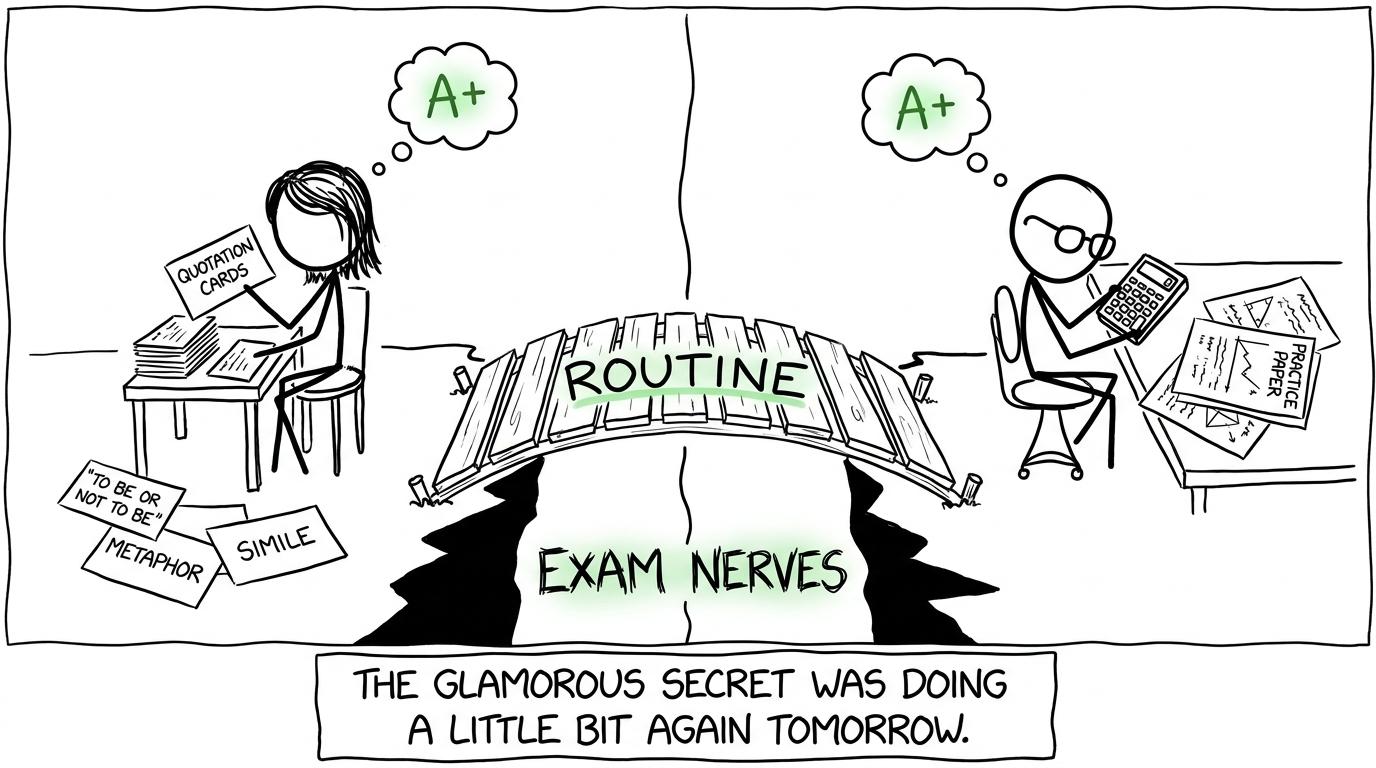 English and maths revision routines build a bridge over exam nerves
Learners progressing beyond GCSE can also explore A Level Maths revision and A Level Maths past papers. The qualification may be different, but the habit remains the same: learn, practise, review and return.
Access arrangements for adult candidates
Having access arrangements at school does not mean they transfer automatically years later. If you may require extra time, supervised rest breaks, a reader, a scribe or modified papers, tell the centre before entering.
The centre must follow the current assessment and evidence rules. Gathering evidence and completing an assessment can take time, so this is an early conversation rather than an exam-week request. Ask what documentation is needed, who will conduct any assessment and whether additional charges apply.
Common mistakes when arranging an adult retake
Booking Literature when Language is required
The two GCSEs are separate. Check the exact wording of the employment or course condition before entering.
Choosing resources before confirming the specification
Literature texts and paper structures differ between exam boards. Confirm the board, specification and set-text combination first.
Assuming an online course includes an exam place
Tuition and examination entry are often separate services. Ask for confirmation in writing.
Contacting private centres too late
Centres have capacity limits and internal deadlines. Starting early gives you more choice and reduces the risk of late fees.
Ignoring the spoken language endorsement
Private candidates should establish how this English Language component will be recorded or assessed before paying.
Revising by watching rather than doing
Videos and model answers can explain a method, but progress becomes visible when you produce your own response under realistic conditions. In maths, combine teaching with questions, predicted papers and mark schemes; in English, combine reading with timed writing and feedback.
Your next step
Retaking a GCSE as an adult is an administrative process before it becomes an academic one. First confirm the qualification you need. Then find the course or private centre, check the board and assessment requirements, understand the full cost, and build a routine you can sustain.
If maths is part of the same journey, make MathsGenie your free revision base. Use the revision lessons and practice questions to strengthen individual topics, then bring in past papers, predicted papers, video solutions, mini tests, mark schemes and a revision planner as the exam approaches. A better grade is rarely created by one dramatic weekend. It is built through clear next steps, repeated calmly.