

Adding Fractions GCSE Maths: A Clear Guide
Adding fractions GCSE maths made clear with simple steps, worked examples, common mistakes and exam-style questions for confident revision today.
A student can understand fractions perfectly well on Monday, then lose a mark on Tuesday by writing 13+14=27\frac{1}{3}+\frac{1}{4}=\frac{2}{7}31+41=72. The mistake feels small. The frustration does not.
Imagine a GCSE student called Maya who keeps doing exactly this. She knows the numerator is on top and the denominator is underneath, but she has not yet understood the rule beneath the method. Adding fractions GCSE maths questions become much easier once that rule clicks: fractions must describe equal-sized parts before their numerators can be added.
That is the whole idea. The steps below turn it into a dependable exam technique.
The adding fractions checklist
For any fraction addition:
- Check whether the denominators are the same.
- If they are different, find a common denominator.
- Rewrite each fraction as an equivalent fraction.
- Add the numerators and keep the denominator.
- Simplify the answer where possible.
- Convert an improper fraction into a mixed number if the question requires it.
You can review these skills through the complete GCSE Fractions lesson, which brings together fraction arithmetic and mixed numbers.
Why the denominators must match
The denominator tells you the size of each part. In 14\frac{1}{4}41, the whole has been divided into four equal parts. In 16\frac{1}{6}61, it has been divided into six equal parts.
Those parts are not the same size, so they cannot be counted together immediately. It is like trying to add one large slice of pizza to one small slice and claiming you have two identical slices. You have two pieces, but the pieces represent different fractions of the whole.
This was Maya's missing thought. She had memorised instructions without seeing their purpose. A common denominator simply redraws both fractions using pieces of the same size.
Adding fractions with the same denominator
When denominators already match, add the numerators and leave the denominator unchanged.
Worked example
Calculate:
38+28\frac{3}{8}+\frac{2}{8}83+82Both fractions count eighths, so add the numerators:
38+28=3+28=58\frac{3}{8}+\frac{2}{8}=\frac{3+2}{8}=\frac{5}{8}83+82=83+2=85The denominator remains 888 because the size of each part has not changed. We are counting more eighths, not creating a new type of fraction.
The same principle appears throughout the Maths Genie fractions revision guide.
Adding fractions with different denominators
This is where Maya used to add both the top and bottom numbers. Instead, she now asks one question: What denominator can both fractions use?
Worked example with one denominator as a multiple
Calculate:
13+16\frac{1}{3}+\frac{1}{6}31+61The lowest common multiple of 333 and 666 is 666. Rewrite 13\frac{1}{3}31 in sixths:
13=26\frac{1}{3}=\frac{2}{6}31=62Now add:
26+16=36\frac{2}{6}+\frac{1}{6}=\frac{3}{6}62+61=63Finally, simplify by dividing the numerator and denominator by 333:
36=12\frac{3}{6}=\frac{1}{2}63=21Therefore:
13+16=12\frac{1}{3}+\frac{1}{6}=\frac{1}{2}31+61=21Worked example requiring two conversions
Calculate:
25+34\frac{2}{5}+\frac{3}{4}52+43The lowest common multiple of 555 and 444 is 202020. Convert both fractions:
25=2×45×4=820\frac{2}{5}=\frac{2\times4}{5\times4}=\frac{8}{20}52=5×42×4=208 34=3×54×5=1520\frac{3}{4}=\frac{3\times5}{4\times5}=\frac{15}{20}43=4×53×5=2015Add the numerators:
820+1520=2320\frac{8}{20}+\frac{15}{20}=\frac{23}{20}208+2015=2023This is an improper fraction. As a mixed number:
2320=1320\frac{23}{20}=1\frac{3}{20}2023=1203Either form may be suitable unless the question specifies how to present the answer. The key is to show enough working for the conversion and addition to be clear.
Now that you have the method, use the fractions lesson and question booklet to practise choosing common denominators rather than merely rereading the steps.
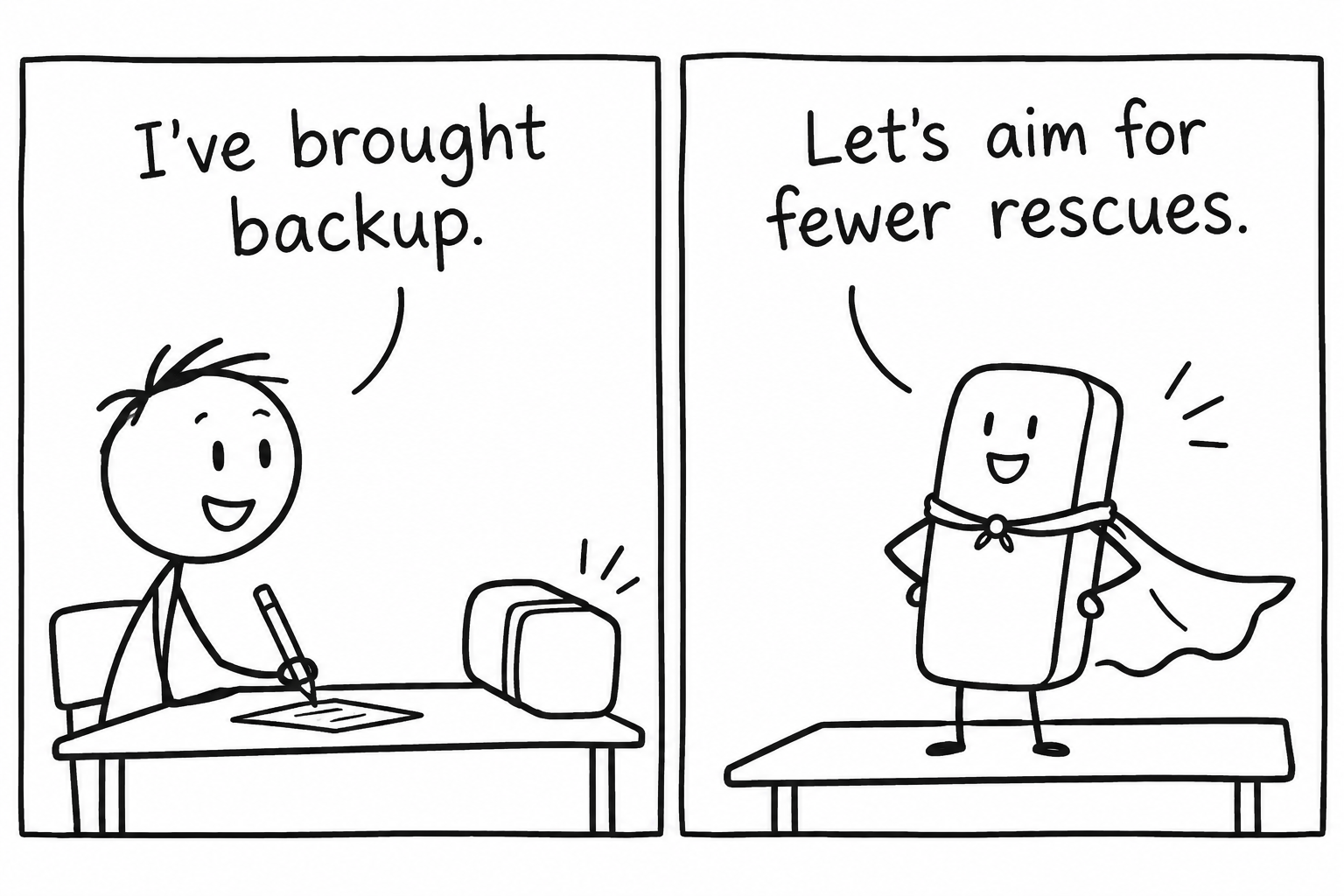 A GCSE pupil brings an oversized superhero eraser to fractions revision
Adding mixed numbers
Mixed numbers can be added in more than one way, but converting them to improper fractions gives you one consistent method.
Worked example
Calculate:
112+2231\frac{1}{2}+2\frac{2}{3}121+232Convert both mixed numbers:
112=321\frac{1}{2}=\frac{3}{2}121=23 223=832\frac{2}{3}=\frac{8}{3}232=38The lowest common multiple of 222 and 333 is 666:
32=96\frac{3}{2}=\frac{9}{6}23=69 83=166\frac{8}{3}=\frac{16}{6}38=616Add:
96+166=256\frac{9}{6}+\frac{16}{6}=\frac{25}{6}69+616=625Convert back to a mixed number:
256=416\frac{25}{6}=4\frac{1}{6}625=461Maya's improvement does not come from working faster. She slows down at the conversion stage, writes each equivalent fraction clearly, and then completes the easy addition.
If converting and simplifying still feel uncertain, revisit writing, simplifying and ordering fractions before attempting longer questions. You can also watch the fractions video lessons to see the process modelled line by line.
Common mistakes when adding fractions
Adding the denominators
A common incorrect answer is:
13+14=27\frac{1}{3}+\frac{1}{4}=\frac{2}{7}31+41=72This does not work because thirds and quarters are different-sized parts. The correct calculation uses twelfths:
13+14=412+312=712\frac{1}{3}+\frac{1}{4}=\frac{4}{12}+\frac{3}{12}=\frac{7}{12}31+41=124+123=127Changing only the denominator
If 23\frac{2}{3}32 is rewritten with denominator 121212, both parts must be multiplied by 444:
23=812\frac{2}{3}=\frac{8}{12}32=128Writing 212\frac{2}{12}122 changes the value of the fraction.
Forgetting to simplify
An answer such as 68\frac{6}{8}86 may contain correct arithmetic, but it should normally be simplified:
68=34\frac{6}{8}=\frac{3}{4}86=43Look for a number that divides both the numerator and denominator. The OCR fractions revision guide also reinforces simplifying and working with mixed numbers.
Using the product automatically
Multiplying the denominators always creates a common denominator, but it may create unnecessary simplification. For 16+18\frac{1}{6}+\frac{1}{8}61+81, using 484848 works, but 242424 is the lowest common denominator and keeps the numbers smaller.
Converting back too early
When adding mixed numbers, keep the fractions improper until the calculation is complete. Moving repeatedly between forms creates extra opportunities for errors.
Adding fractions questions for exam practice
Try these without looking back at the worked examples. Show each equivalent-fraction step.
- Calculate 27+37\frac{2}{7}+\frac{3}{7}72+73.
- Calculate 14+38\frac{1}{4}+\frac{3}{8}41+83.
- Calculate 23+512\frac{2}{3}+\frac{5}{12}32+125.
- Calculate 35+710\frac{3}{5}+\frac{7}{10}53+107. Give your answer as a mixed number.
- Calculate 134+2231\frac{3}{4}+2\frac{2}{3}143+232. Give your answer as a mixed number.
Answers
- 57\frac{5}{7}75
- 58\frac{5}{8}85
- 1312=1112\frac{13}{12}=1\frac{1}{12}1213=1121
- 1310=1310\frac{13}{10}=1\frac{3}{10}1013=1103
- 5312=4512\frac{53}{12}=4\frac{5}{12}1253=4125
Do not judge practice only by the final score. Check where an error happened: finding the common denominator, creating equivalent fractions, adding, or simplifying. That diagnosis tells you what to practise next. Students following the Eduqas specification can use the equivalent Eduqas GCSE fractions lesson.
Turn the method into reliable marks
Maya's turning point is not a clever shortcut. It is recognising that denominators describe the size of the parts. Once she checks that the parts match, the rest becomes a short sequence she can trust.
You now know the sequence, but reliability comes from using it on varied questions and checking each stage. Start the Maths Genie Fractions lesson, then complete its Question Bank booklet to turn the adding-fractions method into an exam habit.















