Active Recall GCSE Astronomy: Does It Work?
Active recall GCSE astronomy advice: learn key facts, observational skills and maths with a practical revision routine that works better than rereading.
A page about stellar evolution can feel perfectly clear while it is open. Close the book, however, and the neat sequence from nebula to main-sequence star may suddenly become foggy. That gap between recognising information and retrieving it is where revision succeeds or fails.
So, does active recall GCSE astronomy revision actually work? Usually, yes. Research consistently finds that trying to retrieve previously learned material supports longer-term retention better than simply rereading it. But recall is not a complete revision system by itself. GCSE Astronomy also demands mathematical application, interpretation, observational reasoning and extended responses. You need to recall knowledge, check it, correct it and then apply it.
The short answer: active recall works when it is used properly
Active recall means attempting to bring information to mind without looking at the answer first. That attempt might involve answering a question, labelling a diagram from memory, describing an observation method or explaining why an astronomical event occurs.
A useful GCSE Astronomy recall routine contains five parts:
- Choose a small, precise topic from the specification.
- Close your notes before answering questions.
- Retrieve explanations as well as isolated facts.
- Check every response against reliable notes or a mark scheme.
- Revisit mistakes after a gap and apply the knowledge to exam questions.
This is more demanding than rereading. That is part of its value. Rereading shows you what looks familiar; retrieval shows you what is available when the page is no longer there.
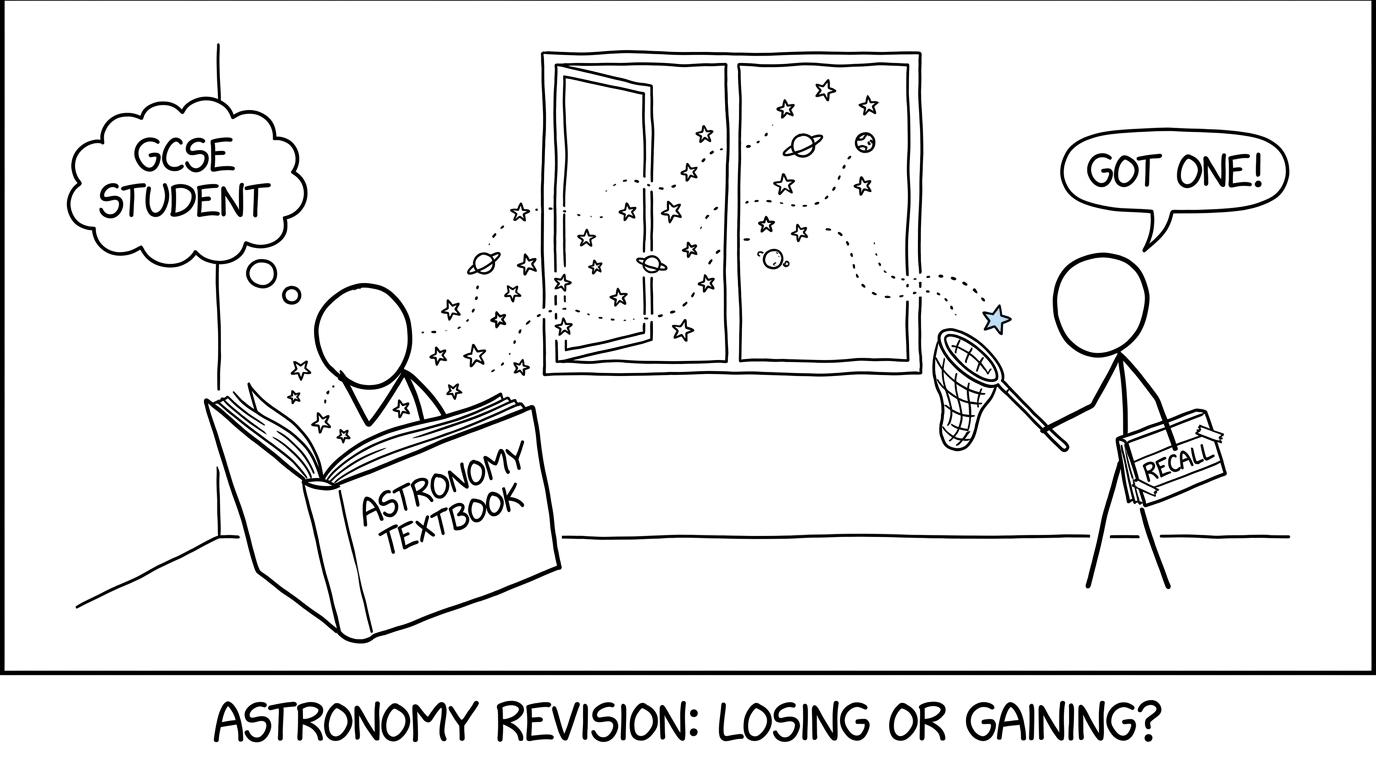 A student catches a recalled fact while reread facts escape through a window
Why active recall tends to beat rereading
Rereading is not useless. It can help you encounter an idea for the first time, untangle a difficult explanation or refresh knowledge before attempting questions. The problem is relying on it as the main event.
When the same wording appears repeatedly, it becomes familiar. Familiarity can feel like knowledge even when you could not produce the idea independently. In an examination, the textbook paragraph is absent and the wording may be unfamiliar. You must retrieve relevant knowledge and adapt it to the question.
Retrieval practice rehearses that process. Systematic reviews of classroom research have generally found positive effects across subjects and age groups, particularly when retrieval replaces passive restudy. Evidence also suggests that difficulty should be manageable and that students benefit from identifying and correcting gaps.
There is an important qualification. Research does not show that a flashcard alone teaches every complex skill, and evidence about retrieval for demanding mathematical problem-solving is less straightforward than evidence about factual retention. Nor is there a large body of research devoted specifically to GCSE Astronomy. The sensible conclusion is not that active recall is magic. It is that recall is a strong tool for making essential knowledge accessible, after which application practice must follow.
What GCSE Astronomy actually asks you to remember and do
GCSE Astronomy is currently offered by Pearson Edexcel rather than AQA, OCR or Eduqas. Its specification contains 161616 topics: Topics 111 to 888 are assessed in Paper 111, Naked-eye Astronomy, while Topics 999 to 161616 are assessed in Paper 222, Telescopic Astronomy.
The papers include multiple-choice, short-answer, calculation, graphical and extended open-response questions. Official requirements also mean mathematical skills account for at least 20%20\%20% of written examination marks, while observational skills account for at least 15%15\%15%.
That matters because successful recall must extend beyond definitions. Divide your prompts into four categories.
Recall essential astronomical knowledge
Test definitions, sequences, comparisons, causes and evidence. Suitable prompts include:
- What causes lunar phases?
- How do geocentric and heliocentric models differ?
- What evidence supports an expanding universe?
- How does stellar evolution depend on initial mass?
- How are transit and radial-velocity methods used to detect exoplanets?
Avoid making every card a single-word question. Astronomy questions often reward connected explanations, so some prompts should require a short chain of reasoning.
Recall diagrams and spatial relationships
Use blank paper to reconstruct labelled diagrams, celestial coordinate systems or sequences. Then compare your version with your notes. The drawing does not need to be artistic. Its purpose is to expose missing labels, reversed directions and misunderstood relationships.
You can also cover a completed diagram and explain it aloud. If you cannot describe why each component is present, recognition has probably been mistaken for understanding.
Recall observational decisions
Pearson requires students to undertake at least one unaided and one aided observation during the course. Written papers assess the knowledge and understanding developed through observational work.
Build prompts around the complete cycle:
- How would I design the observation?
- Which instrument or unaided technique is appropriate?
- What details must I record?
- How would I analyse the observations?
- What affects validity, reliability or accuracy?
- What improvement would address a particular limitation?
Recalling a generic phrase such as “repeat the observation” is rarely enough. Your answer should connect the improvement to a stated weakness.
Retrieve the maths method, then practise it
The specification includes standard form, ratios, inverse-square relationships, logarithmic scales, rearranging equations, gradients, angular measures and specialist units. Equations and key astronomical data are supplied on the examination Formula and Data Sheet, so spending hours memorising every equation is a poor use of recall.
Instead, retrieve the decisions surrounding the equation:
- Which relationship is relevant?
- What does each symbol represent?
- Which units are required?
- Does the equation need rearranging?
- What calculator operation is needed?
- Is the final scale and precision reasonable?
MathsGenie can help repair the underlying mathematical skills. Use its free lessons and questions on standard form, changing the subject of a formula, direct and inverse proportion and gradient of a line. Where angular geometry causes difficulty, revisit SOHCAHTOA and trigonometry.
How to apply active recall to GCSE Astronomy
The strongest routine moves from knowledge to application rather than stopping when a flashcard is answered correctly.
Start with the specification, not random cards
Turn each specification statement into one or more questions. This prevents revision from becoming a collection of interesting space facts that are not examinable. Keep Paper 111 and Paper 222 prompts separate at first, then mix them later to strengthen topic selection.
Use blank-page retrieval
Choose one narrow heading, close every resource and write everything you can remember for a few minutes. Organise the page into definitions, mechanisms, evidence, observations and mathematical links. Open your notes only when time is up.
Use another colour to add omissions and correct errors. The colour is not the learning strategy; the attempted retrieval and correction are.
Build better flashcards
A good card tests one clear idea but may require more than one word. Mix several prompt styles:
- definition prompts;
- “why” and “how” questions;
- comparisons;
- diagram labelling;
- ordering a process;
- selecting an observation method;
- choosing a mathematical relationship.
Say or write the full answer before turning the card over. Mentally saying “I knew that” does not provide reliable evidence.
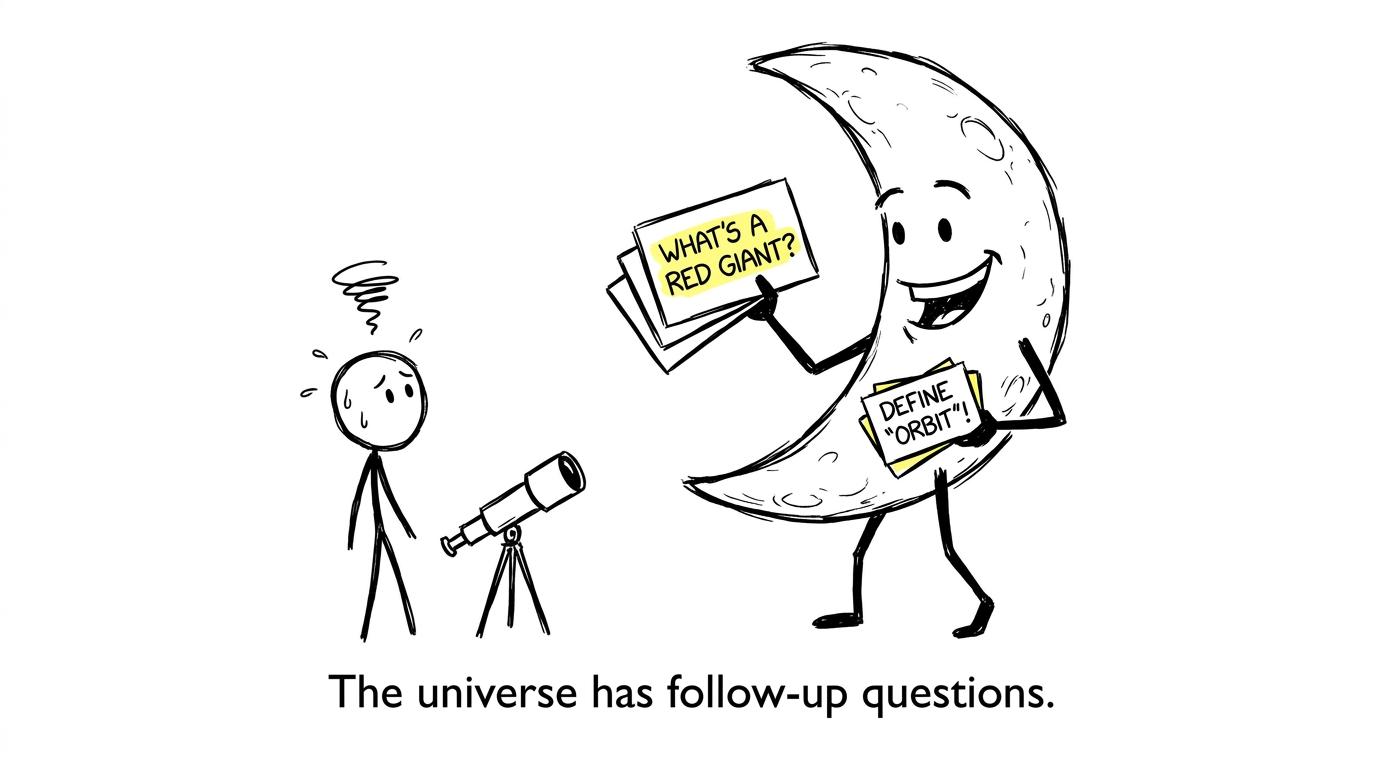 The Moon quizzes a student beside a telescope
Space and mix your retrieval
Do not discard a card after one successful answer. Revisit it after increasing gaps. If it is forgotten, shorten the interval and repair the underlying explanation.
Once individual topics are stable, mix questions from different areas. Astronomy papers require you to decide what knowledge is relevant, not merely repeat the method named at the top of a worksheet. This resembles the broader approach in MathsGenie’s one-month GCSE revision plan: retrieve, practise, mark and revisit.
Finish with exam-style application
After recalling a topic, answer questions without notes. Mark them carefully and record why each mark was lost. Useful categories include:
- knowledge missing;
- knowledge known but not applied;
- command word misread;
- mathematical error;
- weak observational reasoning;
- insufficient precision.
This turns the mark scheme into feedback rather than a final judgement. Maths students can use the GCSE maths revision hub for topic questions, mini tests and papers, while the guide to using past papers properly explains how to convert mistakes into the next round of practice.
A practical revision session
A focused session can follow this structure:
- Recall: answer old prompts without notes.
- Check: correct every omission or misconception.
- Repair: reread only the part you could not retrieve.
- Apply: complete a small set of exam-style questions.
- Review: record errors and schedule another attempt.
The exact timings matter less than the sequence. Recall must happen before checking, and checking must lead to correction. If every session begins with another full read of the chapter, the difficult but valuable act of retrieval keeps being postponed.
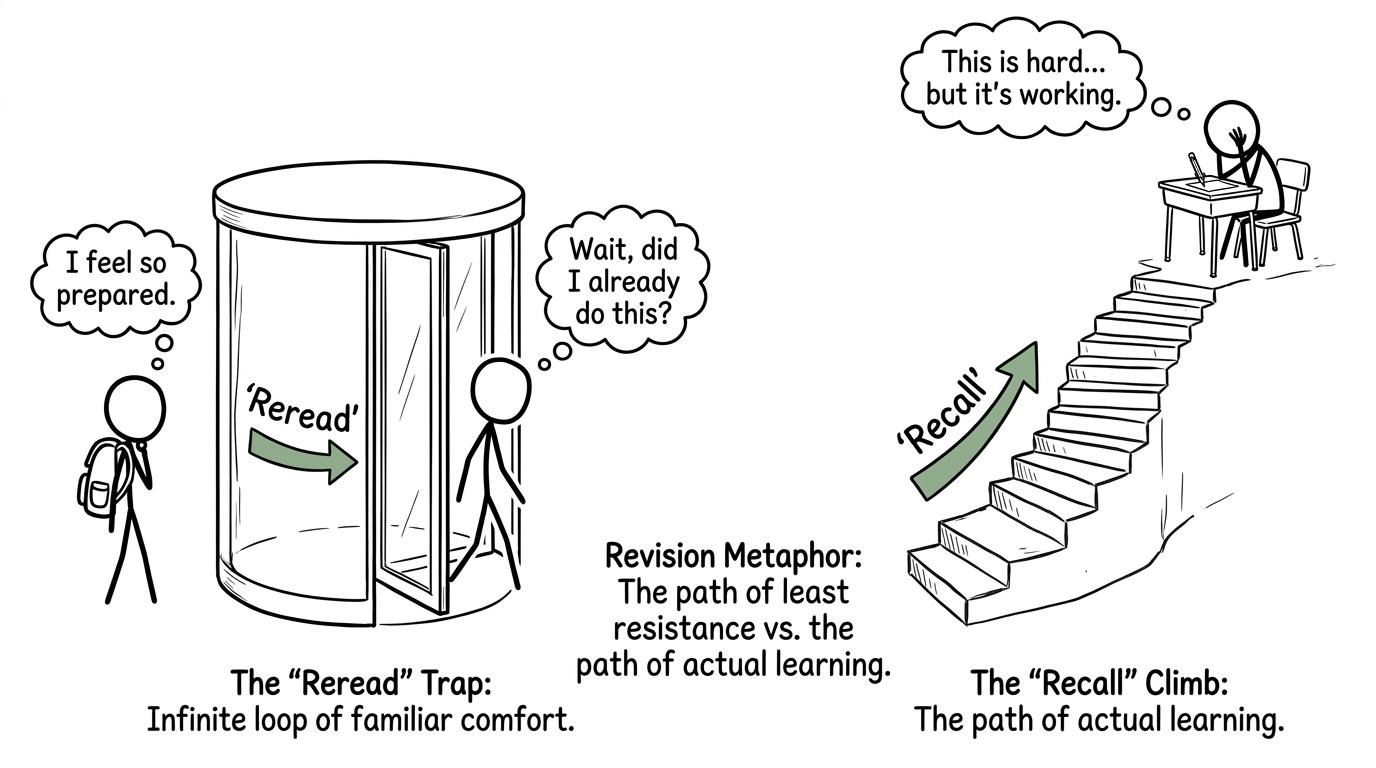 A comfortable rereading loop beside a recall staircase leading towards an exam
Common active recall mistakes
Making recall too easy
Looking at the first letter, keeping notes visible or using only multiple-choice cards can turn retrieval into recognition. Include short-answer and blank-page tasks where the answer must be generated.
Learning disconnected facts
Knowing that two ideas are associated is not the same as explaining the causal link. Include prompts asking for mechanisms, evidence, comparisons and limitations.
Ignoring incorrect answers
An unmarked quiz is diagnosis without treatment. Check promptly, write the correct answer and retrieve it again later.
Treating calculation cards as calculation practice
Recalling that an inverse-square relationship has the form
y∝1x2y \propto \frac{1}{x^2}y∝x21is useful, but it does not prove that you can interpret or apply it. Follow recall with unfamiliar numerical and graphical questions.
Revising only favourite topics
The comfortable topics return because they feel rewarding. Use the specification, an error log and timed papers to decide what needs attention. MathsGenie’s free revision lessons, practice questions, mark schemes, video solutions and mini tests make the same weakness-led approach practical for the mathematical side of Astronomy.
Make retrieval the beginning, not the whole plan
Active recall works because an examination asks you to produce knowledge, not admire it on a page. For GCSE Astronomy, its greatest value is making definitions, explanations, diagrams, observation choices and mathematical decisions easier to access under pressure.
But durable recall must meet real questions. Learn the content, retrieve it without help, correct the gaps and apply it in unfamiliar contexts. Then repeat the cycle.
Start by choosing one Astronomy topic and writing five closed-book questions. If the maths beneath it feels uncertain, open MathsGenie’s free GCSE revision resources, use a revision lesson to rebuild the skill, and test it with practice questions. As your exams approach, add mini tests, past papers, predicted papers, mark schemes and video solutions. The goal is not to make revision feel effortless. It is to make the right knowledge available when the paper asks for it.