

A-Level Remark Cost in 2026: Fees by Board
A-level remark cost in 2026 explained by exam board, including standard and priority fees, deadlines, refunds and what to check before applying.

Results day can turn a handful of marks into a large decision. In 2026, the A-level remark cost ranges from £51\pounds 51£51 to £67.75\pounds 67.75£67.75 per paper for a standard review, or from £60\pounds 60£60 to £83.50\pounds 83.50£83.50 for priority service, depending on the exam board.
The official term is a review of marking, not a re-mark. An examiner checks whether the original mark scheme was applied correctly; they do not mark the paper again from scratch. Requests must normally go through your school or college.
A-level remark cost: quick checklist
Before paying, confirm:
- which paper or component you want reviewed;
- how far you are from the relevant grade boundary;
- whether your university place depends on the result;
- your school's internal deadline, which may be earlier than the official deadline;
- whether the school adds an administration charge;
- that your mark and grade can rise, remain unchanged or fall.
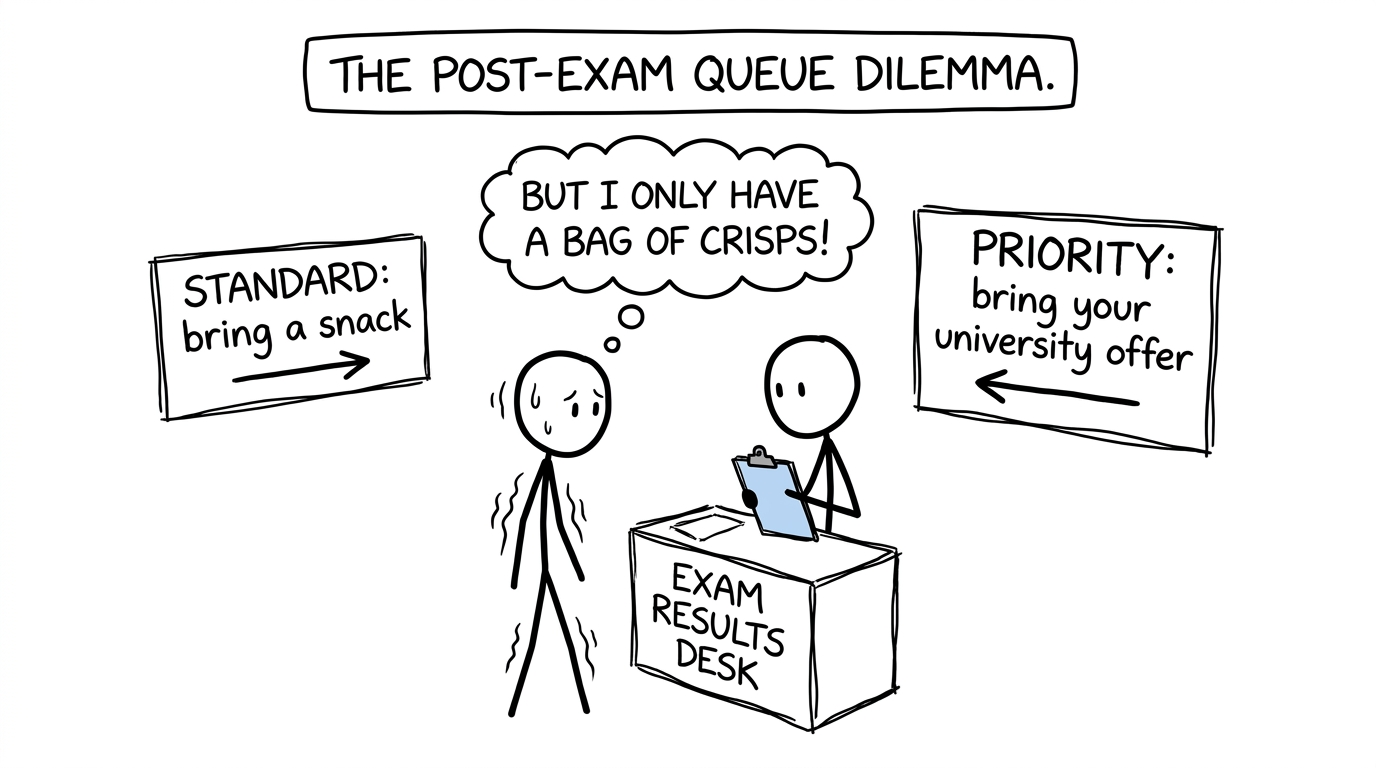 A student choosing between standard and priority review queues at an exam results desk
Cost of an A-level re-mark by exam board
The following published fees apply per candidate, per paper or component for the summer 2026 series. Always confirm the final amount with your exams officer before applying.
| Exam board | Standard review | Priority review |
|---|---|---|
| AQA | £51.95\pounds 51.95£51.95 | £61.70\pounds 61.70£61.70 |
| Pearson Edexcel | £57.00\pounds 57.00£57.00 | £68.00\pounds 68.00£68.00 |
| OCR | £67.75\pounds 67.75£67.75 | £83.50\pounds 83.50£83.50 |
| WJEC/Eduqas | £51.00\pounds 51.00£51.00 | £60.00\pounds 60.00£60.00 |
These are component fees, not whole-subject prices. If several papers are reviewed, the total can be several times the figure shown. Your centre will explain which component is most sensible to submit.
Students can compare their result with previous thresholds using MathsGenie's A-level grade boundaries, although boundaries vary between exam series and do not predict whether a review will succeed.
Standard or priority review?
A standard review is appropriate when there is no urgent university decision. Under the 2026 JCQ timetable, awarding bodies must receive standard requests by 24 September 2026 and normally complete them within 20 calendar days.
Priority Service 2 is designed mainly for A-level students whose university place is pending. The awarding-body deadline is 20 August 2026, seven days after A-level results day on 13 August 2026, and the service should be completed within 15 calendar days.
Schools usually set earlier internal deadlines so staff can collect consent, payment and component details. Speak to the exams officer immediately if a university offer is at risk.
Should you request a review?
Cost matters, but distance from the boundary matters more. Ask a teacher to inspect the script where possible and identify a credible marking issue. Access-to-script services are generally free for the boards covered here.
A review may be worth considering when:
- the mark is close to the next grade boundary;
- the result is significantly different from reliable evidence;
- a teacher can identify where the mark scheme may have been applied incorrectly;
- the higher grade affects a university offer.
Written consent is compulsory because there is no grade protection. The final mark can go down, and the original result cannot simply be restored because you preferred it.
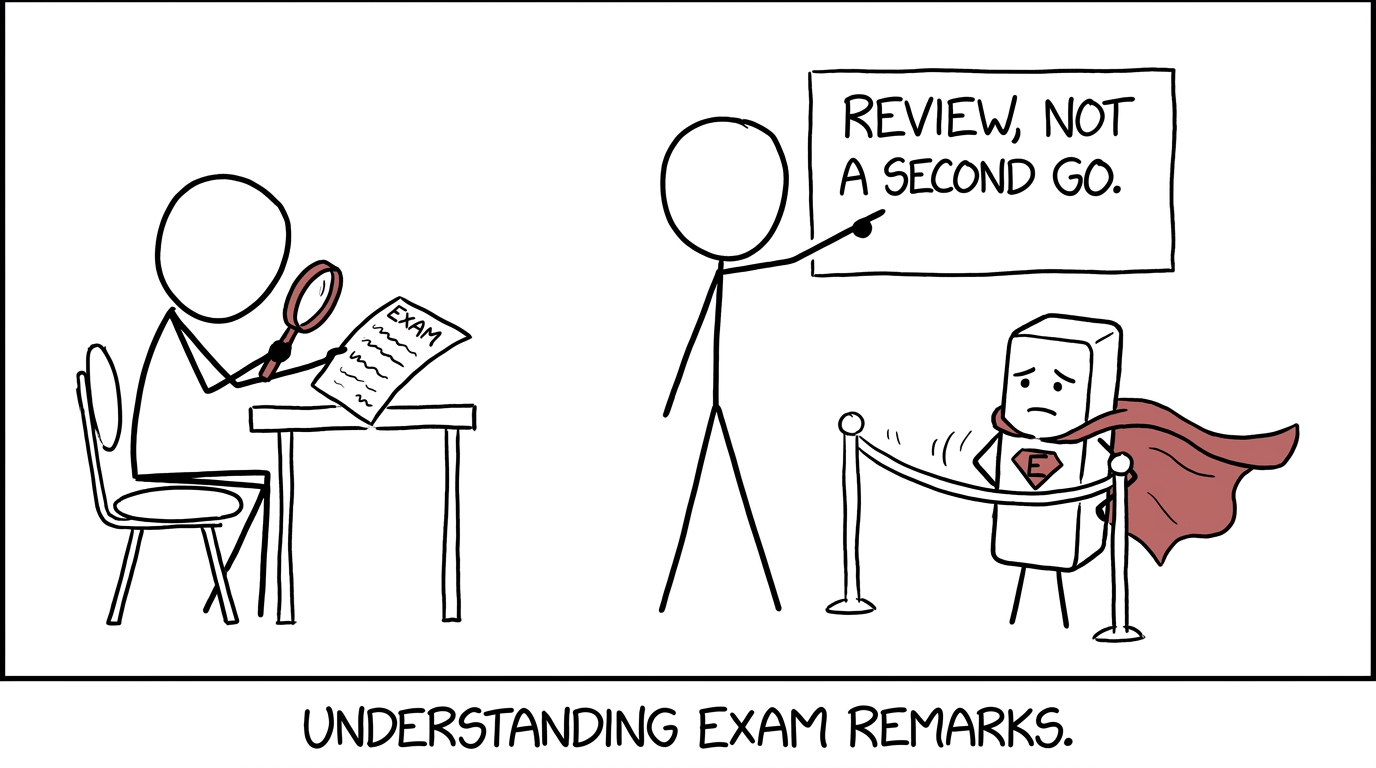 An examiner explaining that a marking review is not a completely new attempt
Will the fee be refunded?
Exam boards commonly waive the fee when a review changes the qualification grade, but the precise rule can differ by board and outcome. WJEC/Eduqas also waives the charge when a unit grade changes. Ask whether your school collects payment in advance and how any refund will be returned.
Common mistakes to avoid
- Calling it a complete re-mark: it is a check that the mark scheme was applied correctly.
- Missing the centre deadline: your school's deadline may precede the JCQ deadline.
- Reviewing every paper automatically: each component attracts a separate fee.
- Ignoring the downside: marks and grades can fall as well as rise.
- Choosing priority without urgency: it costs more and is intended for time-sensitive A-level decisions.
Plan beyond results day
A result is important, but it is also information. Future A-level students can build stronger evidence through AQA A-level maths revision, Edexcel A-level maths revision or OCR A-level maths revision. Use Edexcel A-level past papers and A-level predicted papers with mark schemes and video solutions to understand exactly where marks are earned.
If you are currently preparing for grades 999 to 111, begin with the GCSE maths revision hub. Revision lessons, practice questions, mini tests and past papers make the marking process less mysterious long before results arrive.
For results-day questions and your next practical step, visit the MathsGenie revision blog, then contact your exams officer before paying for any review.











