

A-Level Religious Studies Career Paths After Results
A-level religious studies career paths include law, teaching, policy, media and charity work. Explore realistic course routes and plan your next step.
Results day can make one letter feel like a verdict on your future. It is not. A-level religious studies career paths extend across law, teaching, policy, journalism, charities, community work and many other fields. Your grade may help you meet a course or apprenticeship offer, but it does not assign you a single occupation.
Religious Studies develops something employers repeatedly need: the ability to understand a complex position, test its evidence and explain a reasoned conclusion. AQA's current assessment objectives, for example, emphasise knowledge, analysis and evaluation. Other exam boards, including Edexcel, OCR and Eduqas, assess comparable critical skills through their own specifications.
The useful question after opening your result is therefore not simply, "What job does this grade give me?" It is, "Which route does my combination of grades, interests and skills make possible?"
Your results-day checklist
Before making a decision:
- compare your result with the conditions of your university, college or apprenticeship offer;
- check your full subject combination rather than judging Religious Studies alone;
- read the exact entry requirements for each course or vacancy;
- identify whether the route requires particular GCSEs, work experience or professional training;
- speak to your school, college, careers adviser or university before changing plans;
- remember that resits, Clearing, apprenticeships and alternative courses may provide further routes.
If you are still taking GCSEs, this matters now. Strong results across your subjects preserve choices. Some degree apprenticeships and professional routes specify passes in GCSE English and maths, so regular GCSE maths revision can support plans that appear, at first glance, to have little to do with numbers.
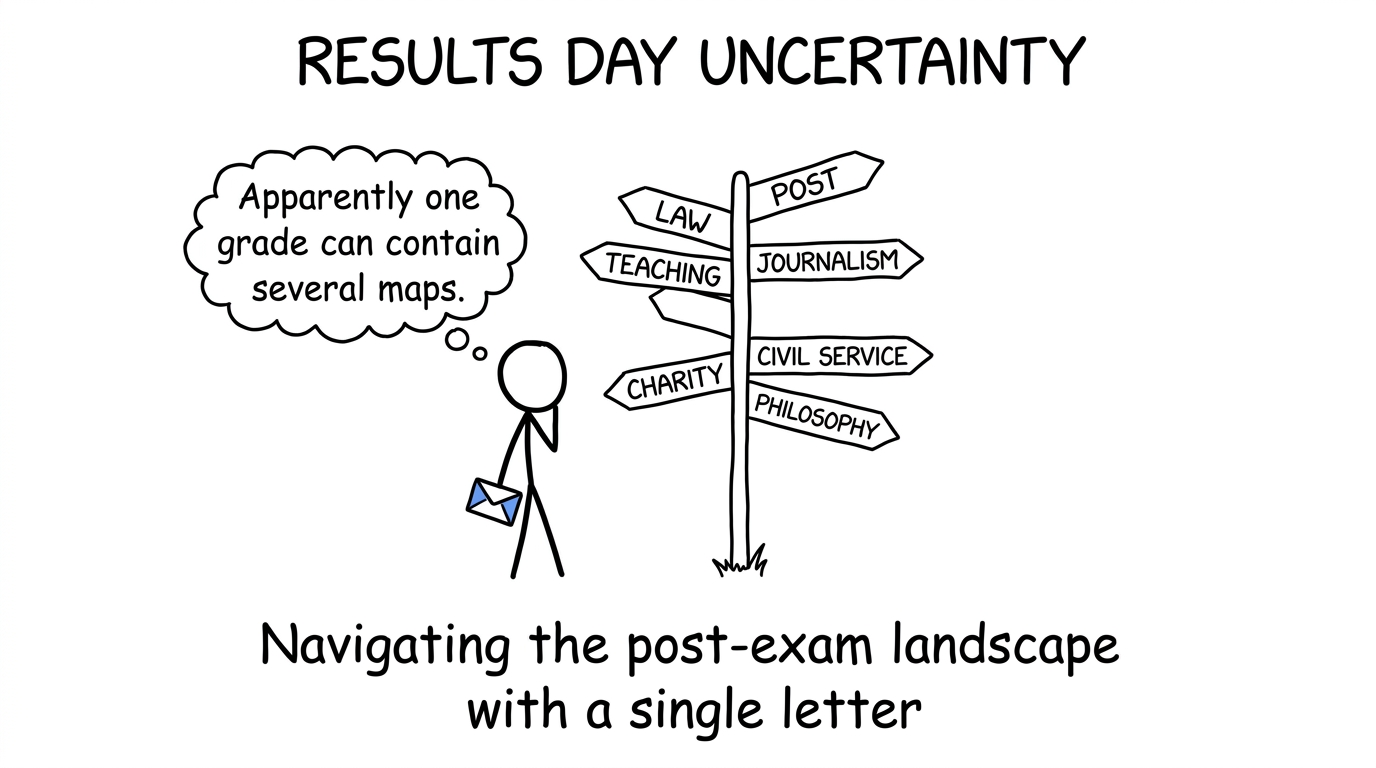 A student discovering several career routes at a results-day signpost
What does A-Level Religious Studies prepare you for?
Religious Studies is not vocational training for one profession. Its value is broader.
A typical course asks you to compare ethical theories, interpret sources, examine philosophical arguments and evaluate competing conclusions. You learn to distinguish assertion from evidence. You also practise presenting disagreement accurately before explaining your own judgement.
Those abilities transfer particularly well to work involving:
- research and written communication;
- ethical or policy decisions;
- cultural and religious understanding;
- structured argument;
- interpretation of detailed documents;
- communication with people holding different perspectives.
The Edexcel A-Level Religious Studies revision hub reflects this breadth through philosophy, ethics, New Testament studies and the study of religion. Resources on religious beliefs, values and teachings and religion and society also show why the subject is relevant beyond explicitly religious occupations.
Realistic career and course pairings
The following are possible routes, not automatic outcomes. Entry requirements differ between universities, employers and parts of the UK.
| Career direction | Relevant course or training route |
|---|---|
| Solicitor or legal work | Law degree, another degree followed by the Solicitors Qualifying Examination route, or a solicitor degree apprenticeship |
| Religious Education teacher | Religious Studies, theology or a related degree followed by an approved teacher-training route; requirements vary across the UK |
| Civil Service or policy work | A relevant degree, direct-entry vacancy, apprenticeship or graduate programme |
| Journalism, publishing or communications | Journalism, English, politics, philosophy or religion-related degrees, alongside a strong portfolio and experience |
| Charity or community work | Theology, Religious Studies, sociology, social policy or development courses, supported by relevant volunteering or employment |
| Chaplaincy | Theology or Religious Studies followed by the training, experience and endorsement required for the particular setting or faith tradition |
| Ethics and public affairs | Philosophy, ethics, politics, law or social-science courses, followed by sector-specific experience |
Law and public policy
Religious Studies has a natural connection with law because both involve interpreting language, weighing evidence and defending conclusions. It can therefore be a useful A Level for a law application, although universities assess the complete application and may set their own subject requirements.
In England and Wales, a future solicitor can take a degree in any subject before completing the required professional stages. Degree apprenticeships provide another route. Religious Studies is preparation for the reasoning involved, not a replacement for legal training.
Policy work offers similar variety. Civil Service careers include direct-entry jobs, apprenticeships and graduate programmes. Studying religion, ethics, politics or law may provide useful context, but the precise route depends on the role.
Teaching, charities and community work
A Religious Studies or theology degree can lead towards secondary teaching, but qualified teaching requires further approved training. The process differs across England, Scotland, Wales and Northern Ireland, so check the rules for where you intend to work.
Charities, youth organisations and community services also value clear communication and awareness of different beliefs. Relevant experience matters here. Volunteering responsibly can help you understand the work before committing to a course.
Journalism, publishing and communications
Essays train you to select evidence and organise an argument. That foundation is useful in journalism and communications, where clarity matters, but employers may also expect a portfolio, practical experience or specialist training.
Studying the social and historical context of the New Testament is a good illustration of the underlying skill: a text becomes more meaningful when you investigate its context rather than reading one sentence in isolation.
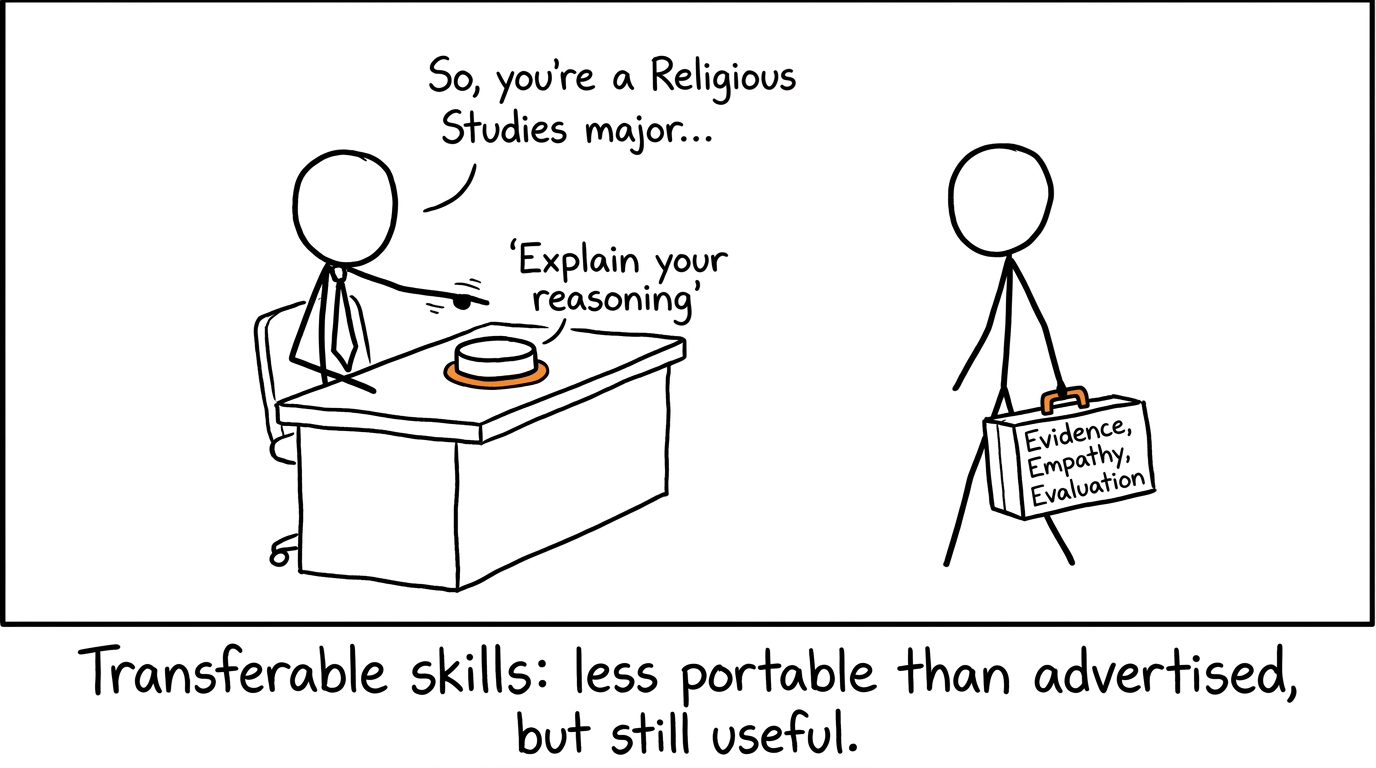 A Religious Studies student carrying a toolbox of transferable skills
How much does the grade matter?
The grade matters most when it forms part of a specific offer. A university may require a particular overall grade profile, while an apprenticeship may focus on several A Levels, GCSE English and maths, an application and an interview.
Grade boundaries are not fixed career thresholds. They can change between exam series, and different paper combinations may have different boundaries. Use the A-Level Religious Studies grade boundaries to understand an awarded result, not to decide what you are capable of doing next.
If your result is higher than expected, investigate courses with more demanding offers before making a rushed change. If it is lower, contact the relevant institution. A missed offer does not automatically mean the end of that career direction; it may mean choosing a different course, institution or route.
Why GCSE maths still belongs in the plan
A student interested in ethics can easily treat maths as unrelated. Careers rarely respect subject boundaries so neatly. Data appears in policy reports, charity budgets, journalism, research and public-sector decisions.
More immediately, some apprenticeships and courses specify a GCSE maths requirement. Build that result while you still have time. Use GCSE mini tests to identify weak areas, then return to targeted practice questions. If you later choose A-Level Maths alongside an essay subject, the Edexcel A-Level Maths revision hub and A-Level past papers provide structured practice with mark schemes.
Common mistakes when choosing a route
Assuming Religious Studies only leads to religious work
Clergy and chaplaincy are genuine possibilities, but they are only part of the picture. Law, education, government, communications and charities are realistic directions when followed by the appropriate course or training.
Treating a career list as a guarantee
An A Level develops useful skills; it does not qualify you as a solicitor, teacher or journalist. Research every professional stage.
Ignoring the rest of your qualifications
Universities and employers usually consider a combination of subjects and grades. Check GCSE requirements as carefully as the headline A-Level offer.
Choosing a degree only because its title sounds familiar
Compare modules, assessment methods, placements and entry requirements. Theology, philosophy, ethics and Religious Studies degrees can overlap, but they are not identical.
Turn one result into a practical next step
A result is information. Its value comes from what you do with it.
Start by checking your offer, then shortlist two or three realistic routes and identify the next requirement for each. If Religious Studies remains part of your plan, use MathsGenie's free A-Level Religious Studies resources for specification-matched revision lessons, guides, practice questions, past papers and mark schemes.
Keep your wider qualifications moving too. MathsGenie's revision planner, mini tests, video solutions, past papers and predicted papers can turn an uncertain ambition into a repeatable weekly routine. Career choices often feel enormous. Progress usually begins with something smaller: one requirement checked, one weak topic repaired and one honest next step taken.










