A-Level After GCSE Religious Studies: What Next?
A-level after GCSE Religious Studies: compare entry grades, course content and subject combinations before confirming your sixth-form choices with confidence.
Results day can make two years of work feel strangely small: an envelope, a screen and a row of grades. Then comes the larger question. If you are considering an A-level after GCSE Religious Studies, should you continue with Religious Studies, choose a related subject, or take a completely different route?
The short answer is this: choose A Level Religious Studies if you enjoyed building arguments, comparing viewpoints and examining ethical or philosophical questions. A GCSE grade of 666 or above usually indicates a useful foundation, but every sixth form sets its own entry requirements. Check the course content as carefully as the grade threshold.
Your results-day decision checklist
Before confirming your options, ask:
- Do I enjoy extended writing and critical discussion?
- Am I interested in philosophy, ethics and the study of religion?
- What GCSE grades does my chosen sixth form require?
- Which exam board and course options will I study?
- Does the subject fit well with my other A Levels?
- Am I choosing it for myself rather than following friends?
You can compare the transition from the GCSE Religious Studies revision overview with MathsGenie's A Level Religious Studies overview. The difference in depth quickly becomes visible.
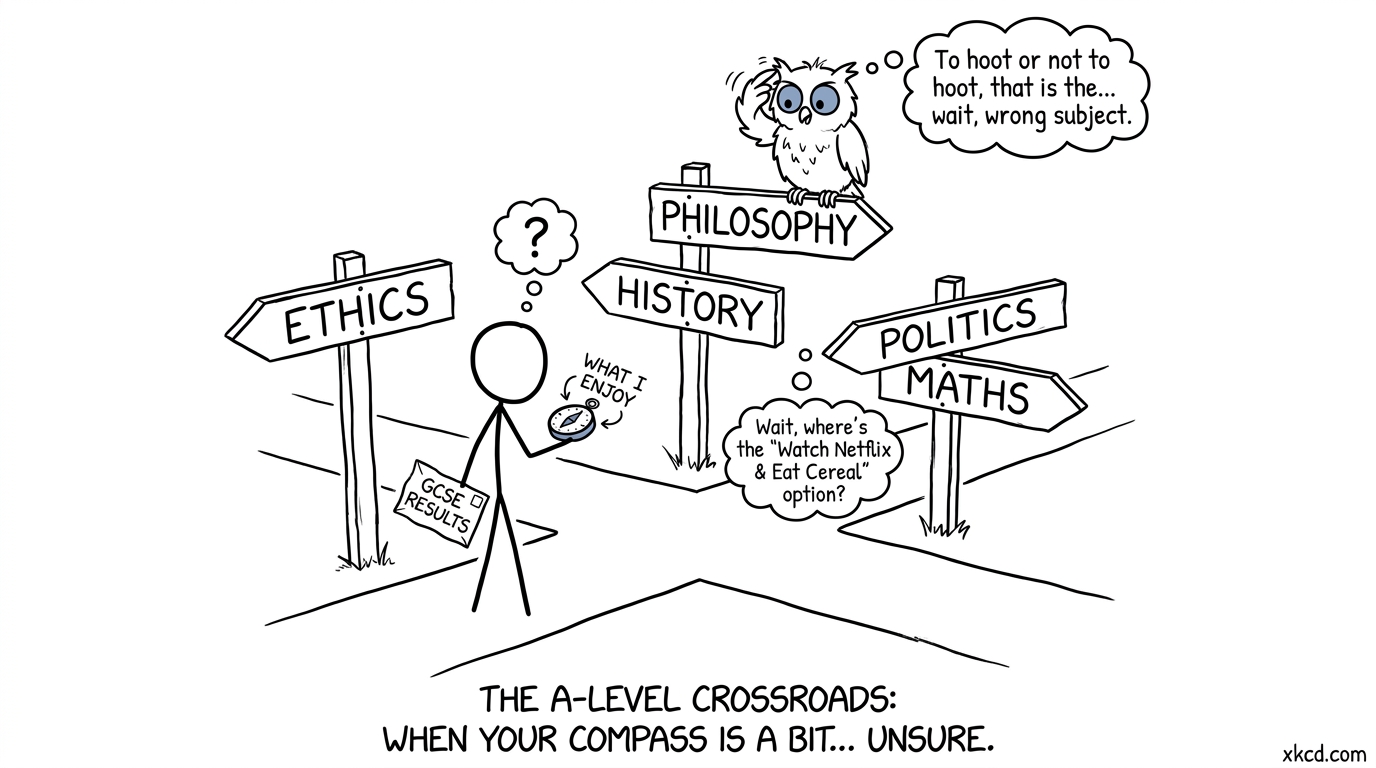 A student facing a humorous crossroads of A-level options
What grade do you need for A Level Religious Studies?
There is no universal national GCSE entry grade for A Level Religious Studies. Exam boards publish specifications, but schools and colleges decide who can join their courses. AQA states that previous learning requirements are not compulsory, although GCSE Religious Studies skills and knowledge are recommended.
Many providers ask for evidence of strength in Religious Studies or another essay-based subject. English Language or Literature may also matter because the A Level involves substantial reading and writing.
Use this table as decision guidance, not as an admissions guarantee:
| GCSE result | What it may suggest |
|---|---|
| Grades 777 to 999 | You probably have a strong foundation in knowledge, evaluation and extended responses. |
| Grade 666 | Often a sound starting point, provided that you are comfortable writing analytical essays. |
| Grade 555 | Progression may still be possible, depending on the sixth form and your English or humanities results. |
| Grade 444 or below | Speak to the subject leader. You may need to demonstrate stronger performance elsewhere or consider another route. |
Do not confuse entry thresholds with A Level grade boundaries. Entry requirements determine whether a provider will admit you; grade boundaries determine the final qualification grade after the examinations. Historical boundaries also change between exam series and options, as the Edexcel A Level Religious Studies grade boundaries demonstrate.
How different is GCSE Religious Studies from A Level?
Moving from GCSE Religious Studies to A Level is not simply a matter of learning more quotations. The intellectual centre of the subject shifts towards sustained analysis.
Across AQA, OCR, Pearson Edexcel and Eduqas specifications, the assessment objectives give approximately 40%40\%40% to knowledge and understanding and 60%60\%60% to analysis and evaluation. That means knowing the material is necessary, but it is not enough. You must test arguments, engage with scholars, make connections and reach justified conclusions.
Course structures differ by board. Typical areas include:
- philosophy of religion, including arguments about God, evil and religious experience;
- religion and ethics, including ethical theories, conscience and free will;
- detailed study of a religion or developments in religious thought;
- religious texts, scholars and debates about society.
For example, the Eduqas A Level Religious Studies course contains three equally weighted components covering a religion, philosophy and ethics. The Edexcel A Level Religious Studies course offers routes involving philosophy, ethics, New Testament studies and the study of religion.
The board matters. So do the options selected by your school. Ask to see the precise specification rather than relying on the subject name alone.
Is choosing A Level Religious Studies right for you?
The most reliable clue is not whether you found GCSE easy. It is whether you found its difficult parts interesting.
A Level Religious Studies may suit you if you like:
- questioning the assumptions behind an argument;
- considering interpretations you do not personally accept;
- reading carefully and selecting relevant evidence;
- planning extended answers under time pressure;
- refining a conclusion when the evidence is complicated.
You do not need to follow a religion. The qualification assesses academic knowledge, reasoning and evaluation, not personal belief.
You should think carefully if you strongly dislike extended writing, independent reading or arguments without a single indisputable answer. Interest helps, but the daily work still matters.
Which A Levels work well with Religious Studies?
There is no perfect combination. The best set balances enjoyment, likely attainment and any requirements for future courses.
English, History or Politics
These subjects complement Religious Studies through source analysis, argument and structured writing. They can create a strongly humanities-based programme.
Psychology or Sociology
These combinations allow you to examine belief, identity, behaviour and society from different academic perspectives. However, the methods and specifications are distinct, so do not assume the content will overlap completely.
Maths or a science
Religious Studies can also balance a numerical programme. Maths develops formal reasoning and precision; Religious Studies asks you to apply disciplined reasoning to philosophical and ethical claims. If A Level Maths is under consideration, inspect the A Level Maths revision overview before deciding. The jump from GCSE is substantial, and your school is likely to set a separate Maths entry grade.
Some university courses require particular A Levels, while many religion, theology and philosophy courses accept varied combinations. Requirements differ by institution and course, so check current admissions information before fixing options around a possible career.
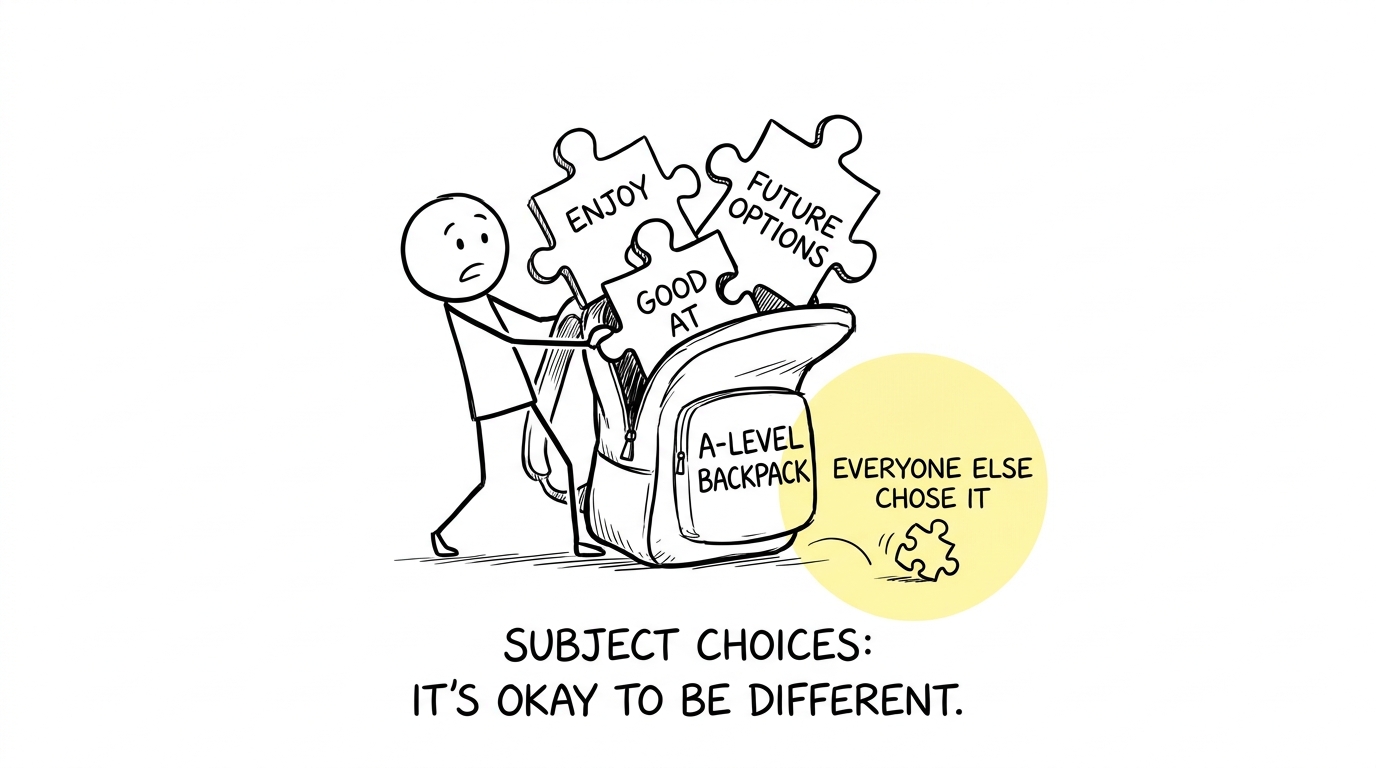 A student packing enjoyment, ability and future options into an A-level bag
What to do between results day and September
First, confirm your sixth form's subject-specific requirements. If you narrowly miss one, ask for a conversation rather than assuming the decision is final. Providers may consider your wider grade profile, but they are not required to make exceptions.
Next, identify your exam board and topics. Revisit one familiar GCSE area through the Edexcel A GCSE Religious Studies resources or the page for your own board. Then preview an A Level topic. You are testing your interest, not trying to complete the course early.
Finally, read and write regularly. Summarise an argument, identify an objection and decide which side is stronger. That small routine reflects the habits the A Level will reward.
Common mistakes when choosing your next A Level
Assuming a high grade guarantees enjoyment. A strong result shows attainment in the GCSE course, not certainty about two more years of study.
Ignoring the actual specification. Two schools can offer Religious Studies while teaching different religions, texts or components.
Choosing only by career label. A Level choices should keep relevant routes open, but you also need subjects in which you can remain motivated and perform well.
Following friends. Shared timetables change. Your reasons for taking the qualification need to survive independently.
Treating past grade boundaries as future targets. Boundaries vary. Use them for context, not prediction.
Make the next decision calmly
Choosing A Level Religious Studies is not a declaration about what you must do for the rest of your life. It is a decision to spend two years learning how beliefs, ethical theories and philosophical arguments can be understood and challenged.
Check the entry threshold, inspect the specification and be honest about whether you enjoy sustained evaluation. Then start with MathsGenie's free A Level Religious Studies overview, where you can find revision lessons, practice questions, revision guides, past papers and mark schemes. As the course develops, predicted papers and mini tests can help turn broad ideas into examination-ready arguments.