A-Level After GCSE Business: What Should You Choose?
A-level after GCSE Business: compare Business, Economics and Maths, check typical grade thresholds, and choose the right sixth-form route confidently.
Results day can make a familiar subject suddenly feel like a new decision. If you are considering an A-level after GCSE Business, the clearest next step is usually A Level Business, but it is not automatically the best choice for everyone. Economics, Maths, Psychology and vocational Business courses may suit you better, depending on your grades, interests and preferred way of learning.
The important question is not simply, “Did I pass GCSE Business?” It is, “Which course will I still want to work at when the content becomes more demanding?”
Your results-day decision checklist
Before confirming an option, check four things:
- Your sixth form's entry requirements, including GCSE English and Maths
- How much you enjoyed analysis, not just learning business terminology
- Whether you are comfortable with percentages, ratios, graphs and financial data
- How the subject fits alongside your other A Levels and future plans
Entry rules are set by individual schools and colleges. Recent published requirements vary considerably: some ask for around grade 555 in English and Maths, while others request grade 555 or 666 in GCSE Business or an essay-based subject. Treat any general threshold as guidance and check your own sixth form's current prospectus.
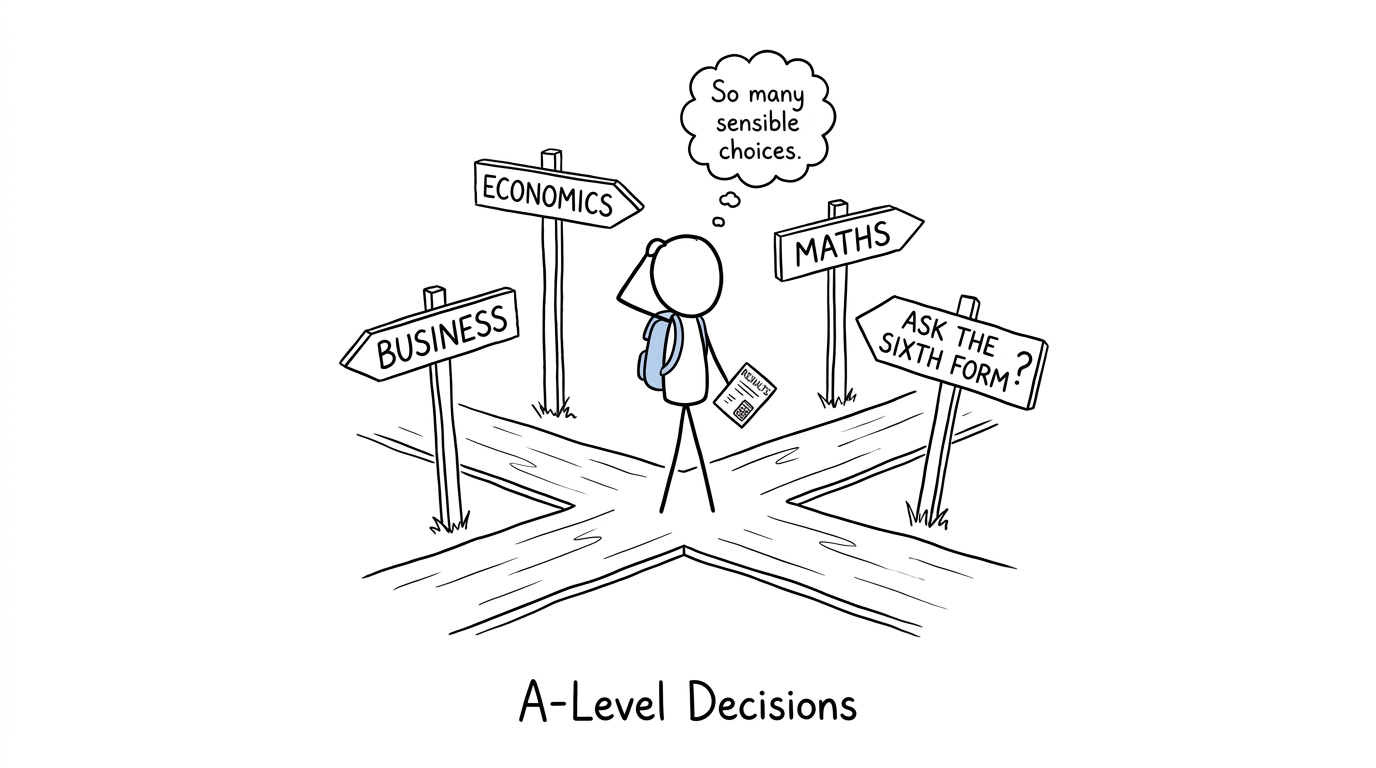 A student faces an unusually sensible set of A-Level signposts
Is A Level Business the natural next step?
For many students moving from GCSE Business to A Level, yes. The course develops familiar areas such as marketing, finance, operations, people and external influences. The difference is depth.
At GCSE, you may identify an advantage of a decision. At A Level, you are more likely to apply evidence from a case study, build a chain of consequences, consider quantitative information and reach a justified judgement. Knowing definitions matters, but knowing when an argument is convincing matters more.
Assessment depends on the specification used by your school. AQA, Edexcel, OCR and Eduqas courses all combine business knowledge with application, analysis and evaluation, although their content and paper structures differ. Students beginning an AQA course from September 202620262026 should check whether their school is teaching the new specification for first assessment in 202820282028.
Start by exploring the free A Level Business revision overview. You can then compare the AQA A Level Business course, Edexcel A Level Business resources, OCR A Level Business course and Eduqas A Level Business resources.
Grade thresholds: what is likely to be required?
There is no national GCSE grade threshold for choosing A Level Business. Your school or college decides its admissions policy.
| Your results | Sensible next action |
|---|---|
| GCSE Business grade 666 or above, with secure English and Maths | You are likely to meet many providers' subject expectations, but confirm the published rules. |
| GCSE Business grade 555 | A Level Business may remain available; check whether your provider also requires grade 555 in English or Maths. |
| GCSE Business grade 444 | Speak to the subject leader. Some providers may accept it, while others require grade 555 or 666. |
| You did not take GCSE Business | Many providers still allow entry, often using English, Maths or a humanities grade instead. |
| Maths or English below grade 444 | You will normally need to continue working towards GCSE grade 444 alongside post-161616 study. Ask how this affects your programme. |
These are decision prompts, not guaranteed entry rules. A strong overall GCSE profile does not override a provider's subject-specific requirement.
How much maths is in A Level Business?
A Level Business is not A Level Maths, but numerical confidence matters. You may interpret graphs and financial statements, compare data and use techniques involving:
- percentages and percentage change
- ratios and averages
- revenue, costs, profit and cash flow
- market share and productivity
- investment appraisal
- probabilities and decision trees
The calculations are usually accessible to a student with secure GCSE Maths foundations. The harder part is often interpretation: explaining what a result means for the organisation in the case study.
If your maths result is close to an entry threshold, use the GCSE Maths revision hub to strengthen weak topics. The AQA GCSE Maths revision guides cover percentages, ratio, graphs, probability and averages, while the Edexcel probability guide supports a skill later used in business decision-making.
Business, Economics or Maths?
Choose A Level Business if you enjoy examining how organisations make decisions across marketing, finance, operations and people. It suits students who can combine written reasoning with numerical evidence.
Consider Economics if you are more interested in markets, inflation, unemployment, government policy and how whole economies allocate resources. Economics can involve more abstract models and may have a higher GCSE Maths requirement at some sixth forms.
Consider A Level Maths if solving mathematical problems is one of your strongest interests and you meet the provider's entry grade, commonly higher than the threshold for Business. It is especially relevant to quantitative degrees, but it should be chosen because you are prepared for sustained algebraic work. Preview the demand through the A Level Maths revision hub.
A combination such as Business, Economics and Maths can be coherent, but coherence is not the same as suitability. Three demanding subjects chosen for appearance alone are less useful than three subjects in which you can work consistently and achieve strong grades.
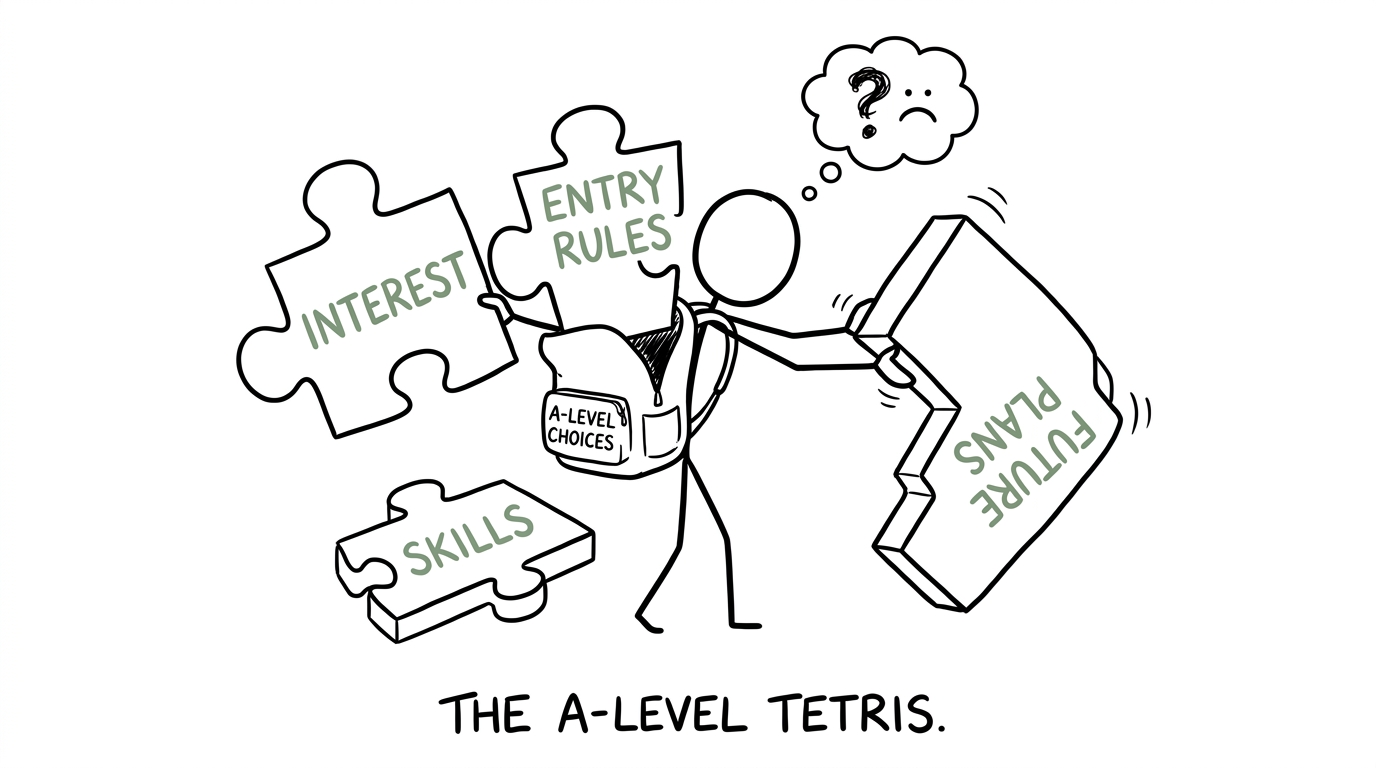 A student discovers that A-Level choices are awkwardly shaped puzzle pieces
What if you prefer practical assessment?
Choosing A Level Business is not the only business-related route. Some colleges offer Level 333 vocational Business qualifications with a mixture of examined and internally assessed work. The exact balance depends on the qualification.
Ask for the current specification, assessment structure and progression information. Do not assume that “vocational” means easy, or that “A Level” automatically means better. The stronger route is the one that matches your learning style and supports your intended next step.
Common mistakes when choosing an A Level
Assuming GCSE and A Level are the same
Familiar topics can hide a substantial increase in depth. Look at an A Level paper and mark scheme before enrolling.
Ignoring English and Maths requirements
A good Business grade may not be enough if your provider also sets minimum grades in English or Maths.
Choosing only for a future career
You do not need to take Business simply because you might want to run a company. Interest, attainment and course combinations all matter.
Confusing entry grades with grade boundaries
An entry requirement tells you whether a provider will admit you. An exam grade boundary converts marks into an A Level grade and changes between exam series.
Make the decision, then prepare well
The best A-level after GCSE Business is the course whose content, assessment and entry requirements fit you. Check the prospectus, compare specifications and ask the teacher what successful students do each week.
If Business is your choice, begin with MathsGenie's A Level Business overview. Use the revision lessons and practice questions to preview the course, then return for topic guides, flashcards, past papers, predicted papers, mini tests, mark schemes and video solutions as your knowledge grows. A good decision opens the door. Consistent practice carries you through it.