

A 12-Week IGCSE Maths Revision Plan
A 12-week IGCSE Maths revision plan for Edexcel or Cambridge, with weekly topics, past-paper practice, mistake reviews and a realistic timetable.
Twelve weeks can feel comfortably distant until you count the school days, homework deadlines and weekends that are already spoken for. Then the exam begins to look much closer.
A 12-week IGCSE Maths revision plan should move through three stages: rebuild topic knowledge, practise mixed questions, then complete timed papers. You do not need to revise everything every day. You need a timetable that identifies weak topics early, revisits them regularly and leaves enough time for exam practice.
Imagine an IGCSE student called Sam. Sam could be taking Pearson Edexcel International GCSE Mathematics A or Cambridge IGCSE Mathematics. The details of the papers differ, but the planning problem is the same: there is a large specification, limited time and no obvious place to begin.
This plan gives Sam, and you, a practical route from week twelve to exam day.
Your 12-week plan at a glance
Divide the twelve weeks into three phases:
- Weeks 1-4: diagnose gaps and rebuild essential skills.
- Weeks 5-8: tackle harder topics and mixed problem-solving.
- Weeks 9-12: complete timed papers, analyse mistakes and consolidate.
Before starting, confirm your exam board, specification, tier and examination dates with your school. Pearson Edexcel Mathematics A uses Foundation and Higher tiers, with two papers in the linear qualification. Cambridge Mathematics 0580 uses Core and Extended routes. For Cambridge examinations under the 2025-2027 syllabus, Papers 1 and 2 are non-calculator papers, while Papers 3 and 4 are calculator papers.
Those differences matter. Your IGCSE revision timetable should match the papers you will actually sit, not the papers a friend at another school is taking.
The complete weekly IGCSE revision timetable
Use three or four sessions each week. A realistic session might contain five minutes of recall, 25-35 minutes of focused practice and ten minutes of marking. The final weekly session should revisit errors rather than introduce another new topic.
| Week | Main focus | What to do |
|---|---|---|
| 1 | Diagnosis and number | Complete a short mixed assessment. Review fractions, percentages, ratio, bounds and standard form. Start an error log. |
| 2 | Algebra foundations | Practise simplifying expressions, indices, equations, inequalities and changing the subject of a formula. Reattempt errors after two days. |
| 3 | Graphs and sequences | Work on straight-line graphs, sequences, functions where required, and interpreting real-life graphs. Include unfamiliar questions. |
| 4 | Geometry and measures | Revise angles, polygons, constructions, similarity, area, volume and circle measures. Finish with a mixed mini test. |
| 5 | Trigonometry and Pythagoras | Practise choosing the correct method, drawing diagrams and checking whether answers are sensible. Add sine and cosine rules if they are on your course. |
| 6 | Statistics and probability | Review averages, data displays, cumulative frequency where required, probability diagrams and combined events. Mark every question carefully. |
| 7 | Higher-demand algebra | For the appropriate tier, cover quadratics, simultaneous equations, algebraic fractions, functions and proof. Foundation or Core students should deepen accuracy on their specified content instead. |
| 8 | Mixed problem-solving | Combine number, algebra, geometry and data questions. Practise deciding which method to use without a topic label. |
| 9 | First timed paper | Complete a paper under timed conditions. Mark it, classify every lost mark and revise the two weakest topics. |
| 10 | Second timed paper | Sit another paper in the correct format. Compare recurring errors with week 9 and complete targeted practice. |
| 11 | Full paper cycle | Complete the relevant set of papers across the week. Practise calculator or non-calculator skills according to your board. |
| 12 | Final consolidation | Reattempt error-log questions, review key facts and complete short mixed sets. Avoid cramming unfamiliar material immediately before the exam. |
You now have the structure; if arranging every session feels like another revision task, build your 12-week schedule in the MathsGenie Revision Planner instead of drawing it all by hand.
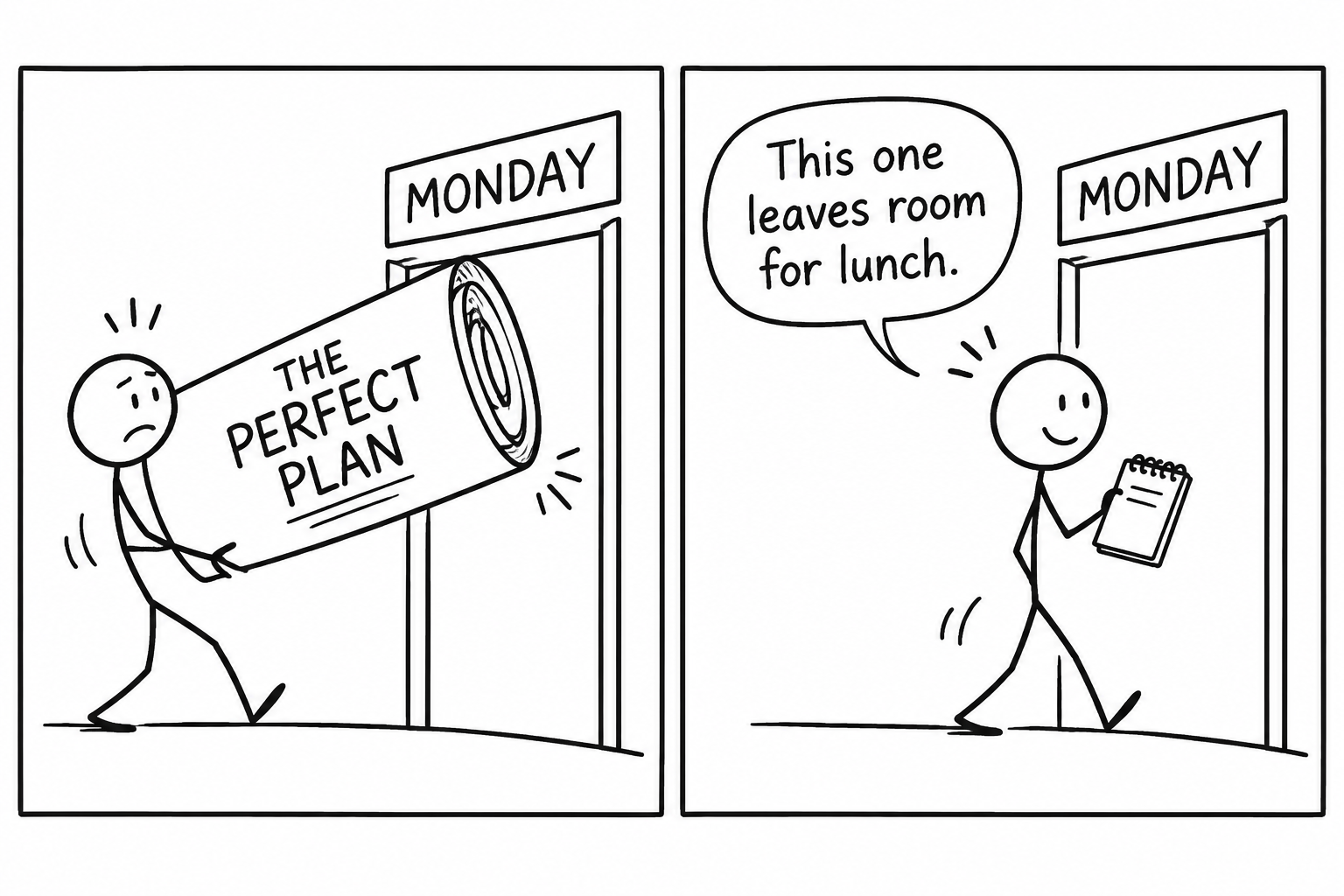 A student discovers that a realistic revision plan fits through Monday more easily than a perfect one
What each revision session should contain
A timetable can look impressive while producing very little learning. Sam discovers this after spending an evening colour-coding topics without answering a question. Planning matters, but only because it makes practice more likely.
Use a simple three-part routine.
Recall the method
Begin without notes. Write down what you remember about the topic, including formulae, steps and common question types. This quickly reveals the difference between recognising a method and recalling it independently.
If the method is unclear, use a MathsGenie revision lesson or video solution. The purpose is not to watch passively. Pause, attempt the next step and explain why it works.
Practise exam questions
Move from straightforward questions to unfamiliar applications. Topic practice develops the method; mixed practice develops the ability to recognise when that method is needed.
The GCSE Maths revision timetable guide provides a broader framework for balancing lessons, practice questions, past papers and mark schemes. Although your IGCSE specification must remain your checklist, much of the underlying mathematical practice is relevant.
Mark and revisit
Use the mark scheme after completing the questions, not while answering them. Record each mistake under one of four headings:
- knowledge gap;
- wrong method;
- arithmetic or algebra error;
- misread question.
Then write one corrective action. “Revise algebra” is too vague. “Practise five equations involving fractions on Thursday” can be scheduled and completed.
Adapt the plan for Edexcel or Cambridge
The weekly structure stays stable, but the final phase should reflect your board.
For Pearson Edexcel International GCSE Mathematics A, practise using your calculator efficiently because calculators are permitted in both linear papers. Learn how to enter brackets, powers, roots and trigonometric calculations accurately, while still showing enough working to communicate your method.
For Cambridge IGCSE Mathematics 0580 under the current 2025-2027 syllabus, include non-calculator practice from the beginning. Do not wait until week 11. Mental arithmetic, exact values, written calculation and algebraic manipulation become harder to rebuild under last-minute pressure.
Core, Extended, Foundation and Higher content also differs. A student should never spend valuable time learning a topic merely because it appeared in somebody else’s revision video. Treat your current specification and teacher guidance as the final checklist.
How to make the plan survive a difficult week
The best IGCSE Maths revision plan is not the one that assumes perfect motivation. It is the one that survives football practice, a science test and an unexpectedly exhausting Wednesday.
Set a minimum session of 20 minutes. If you have more energy, continue. If not, complete one focused task and keep the routine alive. Leave one catch-up slot each week, but do not fill it in advance.
If you begin later than planned, compress the topic phase rather than removing paper practice. The one-month GCSE Maths revision plan shows how a shorter schedule can retain topic review, mini tests and past-paper work. If the exam is extremely close, the one-week Maths revision plan offers a more concentrated structure.
You can also use the revision timetable you will actually stick to to turn ambitious weekly intentions into repeatable sessions.
Common revision mistakes
Revising favourite topics first
Comfort can resemble progress. Begin with diagnostic evidence instead. Weak topics usually offer more valuable improvement than another page of questions you can already answer.
Completing papers without reviewing them
A past paper is a diagnostic tool, not just a score. Spend substantial time marking, correcting and classifying errors. Reattempt missed questions later without looking at the solution.
Copying a generic timetable exactly
School commitments, tiers and specifications vary. Use this plan as a framework, then replace each broad topic with the precise areas you need.
Saving timed work until the final week
Timing is a skill. Begin with individual timed sections, then progress to complete papers during weeks 9-11.
Treating one bad paper as a verdict
A low mark is information about today’s gaps. Sam’s useful question is not “What grade am I?” but “Which three errors can I prevent next time?” That question leads somewhere.
Turn the structure into your schedule
You now know what each of the twelve weeks needs to accomplish. The remaining gap is consistency: turning a sound IGCSE Maths revision plan into specific sessions that happen before fixed exam dates arrive.
Your turn. Build your 12-week schedule in the Revision Planner.















