A cylindrical research buoy floats vertically in an experimental chemical solvent, as shown in the diagram.
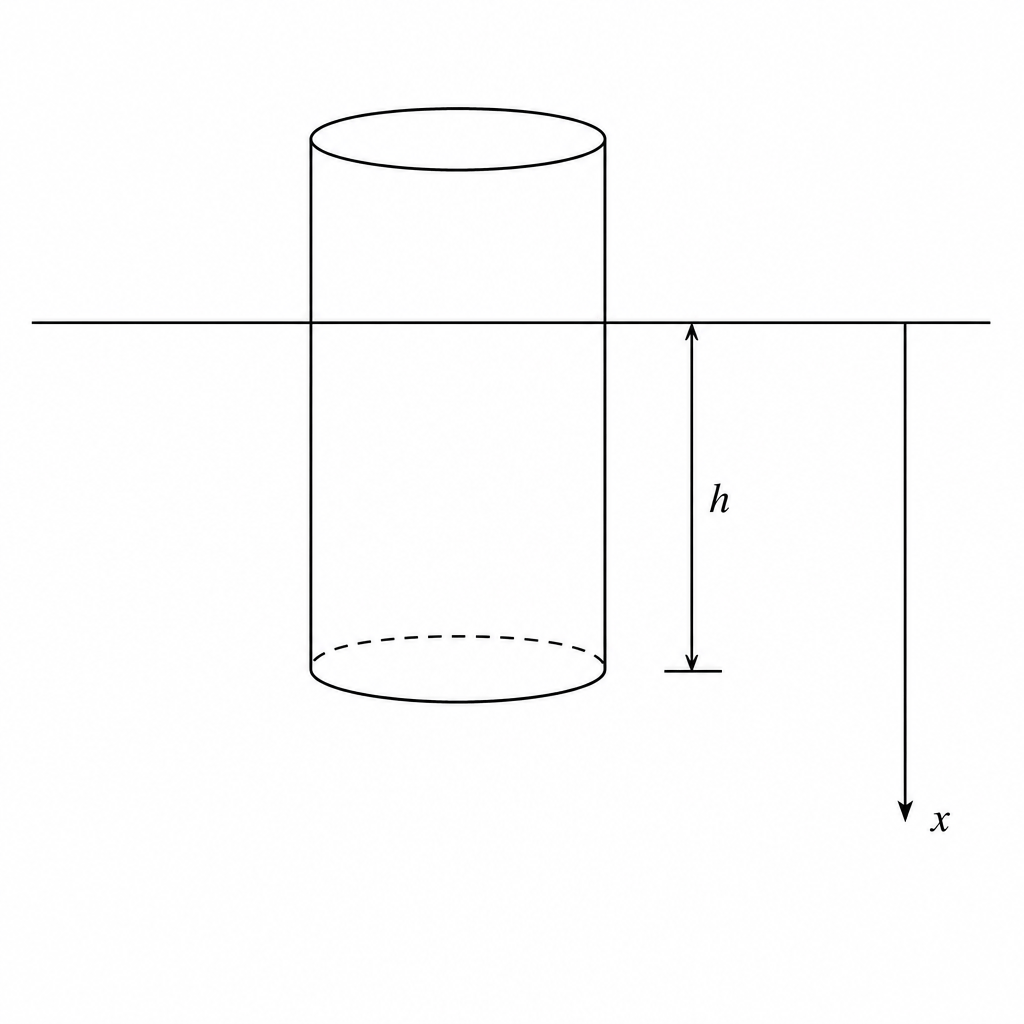
The equilibrium depth of the flat bottom of the cylinder below the liquid level is 16 cm16\text{ cm}16 cm.
The pressure exerted by the solvent alone on the bottom of the buoy is 1.9×10³ Pa1.9 \times 10^3\text{ Pa}1.9×10³ Pa. Calculate the density ρ\rhoρ of the solvent to 2 significant figures. (Use g=9.81 m s−2g = 9.81\text{ m s}^{-2}g=9.81 m s−2)
The buoy is depressed vertically down into the solvent and then released so that it oscillates freely with simple harmonic motion at a frequency of 1.5 Hz1.5\text{ Hz}1.5 Hz. At t=0 st = 0\text{ s} t=0 s, the buoy is released from its maximum displacement of 4.0 cm4.0\text{ cm}4.0 cm.
Calculate the displacement xxx (in cm\text{cm}cm) of the buoy at time t=0.30 st = 0.30\text{ s}t=0.30 s.
Calculate the maximum speed of the oscillating buoy (in m s−1\text{m s}^{-1}m s−1) to 2 significant figures.
State the effect of pushing the buoy down further before release on its (1) amplitude and (2) period.