For a simple harmonic oscillator, the kinetic energy EkE_kEk of an oscillating particle of mass mmm as a function of displacement xxx and amplitude x0x_0x0 is given by the equation: Ek=12mω2(x02−x2)E_k = \frac{1}{2} m \omega^2 (x_0^2 - x^2)Ek=21mω2(x02−x2) where ω\omegaω is the angular frequency. Show that this equation is homogeneous by reducing both sides to S.I. base units.
A vertical cylindrical hydrometer floats in a salt-water solution. The displacement of the hydrometer from its equilibrium floating position is xxx. The density ρ\rhoρ of the salt-water is 1030 kg m−31030\text{ kg m}^{-3}1030 kg m−3.
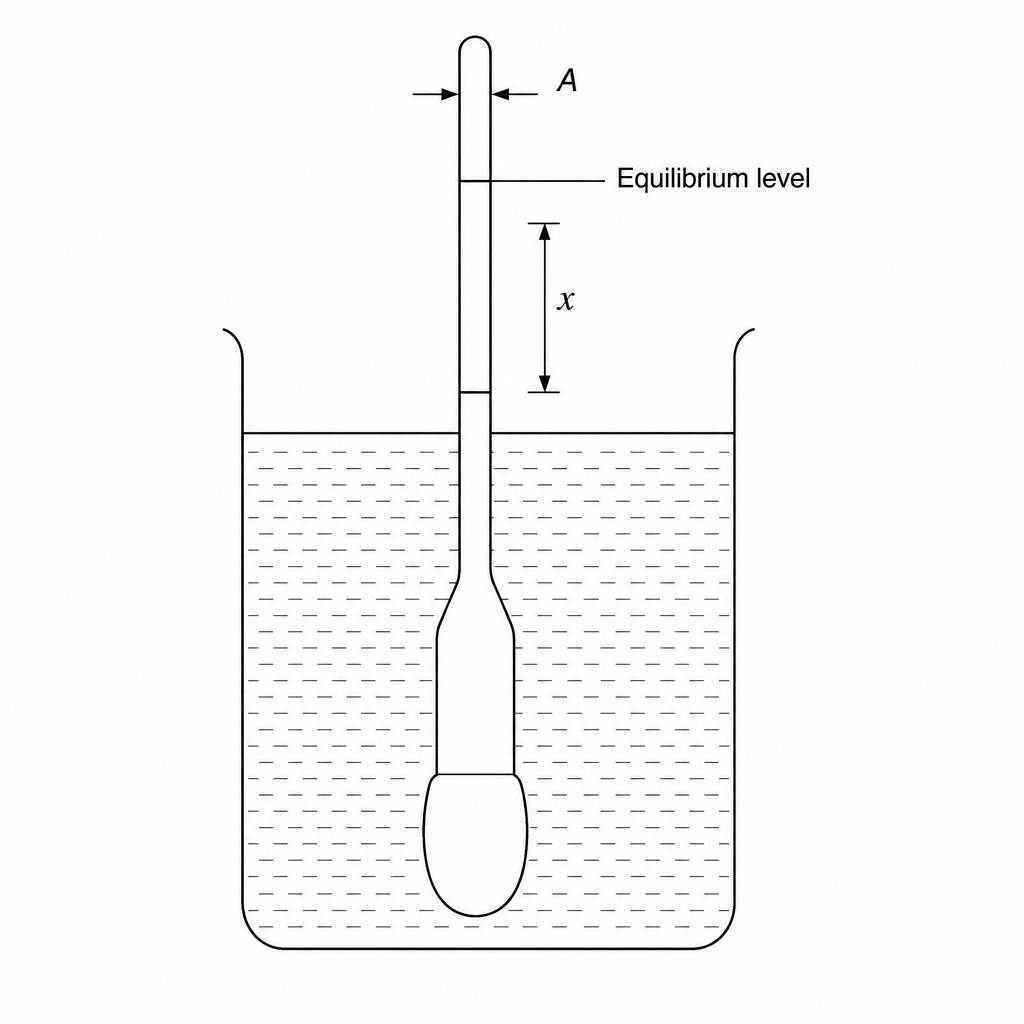
The hydrometer is held in equilibrium with an additional downward vertical force FFF which displaces it vertically downwards by x=4.5 cmx = 4.5\text{ cm}x=4.5 cm from its normal floating position. The cross-sectional area of the stem of the hydrometer is A=3.5×10⁻⁴ m2A = 3.5 \times 10^{-4}\text{ m}^2A=3.5×10⁻⁴ m2. Calculate the magnitude of the additional force FFF.
When the force FFF is suddenly removed, the hydrometer oscillates with simple harmonic motion. The acceleration aaa of the hydrometer is given by the equation: a=−ρgAmxa = -\frac{\rho g A}{m} xa=−mρgAx where mmm is the mass of the hydrometer, AAA is the cross-sectional area of its stem, ρ\rhoρ is the density of the solution, ggg is the acceleration of free fall (9.81 m s−29.81\text{ m s}^{-2}9.81 m s−2), and xxx is the displacement.
For this hydrometer, A=3.5×10⁻⁴ m2A = 3.5 \times 10^{-4}\text{ m}^2A=3.5×10⁻⁴ m2 and its mass is m=0.042 kgm = 0.042\text{ kg}m=0.042 kg. Show that the period TTT of the oscillations is approximately 0.68 s0.68\text{ s}0.68 s.